

14.5.1. Minimising Alteration of Aquatic Ecosystems (Plan)
The University of Economics Ho Chi Minh City (UEH) implements a plan to minimise physical, chemical and biological alterations to relevant aquatic ecosystems through its Green Campus Regulations and the annual implementation plan of the UEH Green Campus Project. In 2025, UEH focused on improving water management, reviewing wastewater treatment systems, controlling waste at source, and advancing research and partnerships for the conservation of estuarine and coastal ecosystems. This approach connects on-campus environmental management with off-campus research and conservation initiatives to prevent pollution, limit habitat degradation and maintain the quality of aquatic ecosystems.
1. UEH Plan to Minimise Impacts on Aquatic Ecosystems
1.1. Regulatory basis and action plan
UEH implements its plan to minimise alterations to aquatic ecosystems through two interconnected components:
First, the Green Campus Regulations, issued under Decision No. 2059/QD-DHKT-CSVC in 2022, establish the policy direction, environmental control measures and responsibilities of relevant units. Specifically, Article 21, Clauses 1–3, address water management, treatment, reuse and quality monitoring; Clause 5 provides for the development of wastewater discharge quality standards and guidelines, including physical, chemical and biological indicators, to maintain water quality and protect ecosystems. Provisions on waste sorting at source, hazardous waste management and the prioritisation of environmentally friendly cleaning products further help prevent pollution risks to receiving water bodies.
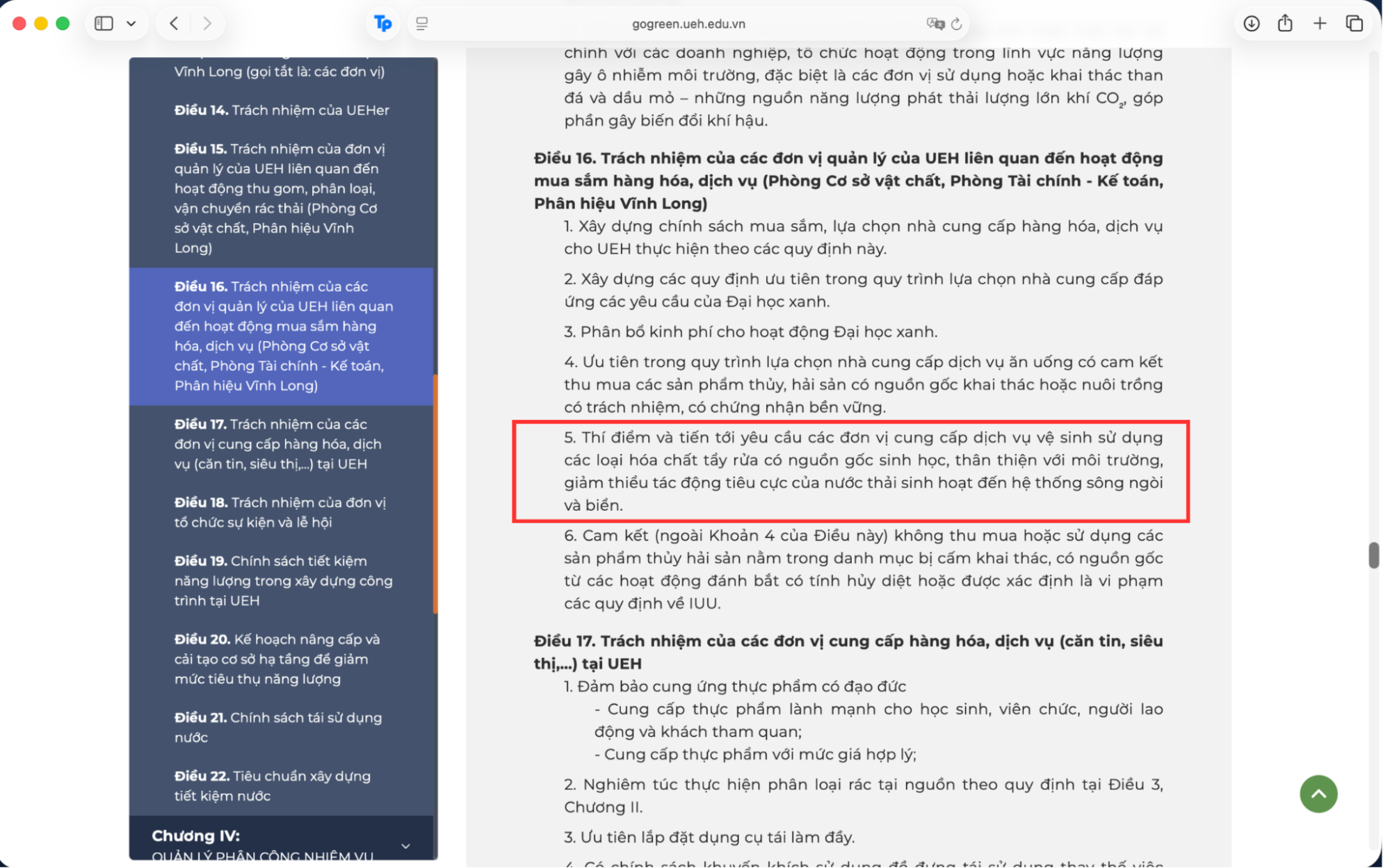
Article 21 of the Green Campus Regulations
Source: UEH Green Campus, Green Campus Regulations: https://gogreen.ueh.edu.vn/quy-dinh-thuc-hanh-dai-hoc-xanh
Second, the 2025 UEH Green Campus Project implementation plan translates these directions into environmental management tasks, infrastructure inspections and improvements to operational criteria. For water resource management, UEH focused on compiling information about the wastewater treatment system at Nguyen Van Linh Campus, including operational procedures, water quality testing results and storage tank data; documenting water-saving equipment; and incorporating provisions on water management, reuse and wastewater discharge quality into the Green Campus Regulations.
Combining governance regulations with an annual work plan provides a basis for UEH to implement, monitor and improve measures to control risks of changes to aquatic environments.
Sources:
- UEH Green Campus, Green Campus Regulations: https://gogreen.ueh.edu.vn/quy-dinh-thuc-hanh-dai-hoc-xanh
- UEH, 2025 UEH Green Campus Project Report, Governance section – Updates to the Green Campus Regulations criteria.
- UEH Portal, New Progress of the UEH Green Campus Project in 2025: https://www.ueh.edu.vn/cuoc-song-ueh/tin-tuc/nhung-buoc-tien-moi-cua-du-an-ueh-green-campus-nam-2025-hanh-trinh-van-hanh-va-lan-toa-mo-hinh-dai-hoc-xanh-ueh-den-cong-dong-75883
1.2. Objectives and scope
The plan pursues three interconnected objectives:
- Minimising physical alterations: Control solid waste and plastic waste at source, improve water management and study solutions to limit adverse impacts of infrastructure on water conditions.
- Minimising chemical alterations: Control wastewater, strengthen treatment and water quality monitoring, and prioritise environmentally friendly materials and cleaning products to reduce the risk of pollutants entering receiving water bodies.
- Minimising biological alterations: Control risks of deterioration in aquatic habitats, while combining research and conservation partnerships for river, estuarine, mangrove and coastal habitats.
The scope covers environmental management at UEH campuses and conservation research and collaboration programmes undertaken with partners, authorities and communities in relevant areas.
2. Content and Measures for Implementing the 2025 Plan
2.1. Controlling physical alterations to aquatic ecosystems
UEH seeks to prevent physical impacts on aquatic environments primarily by controlling waste at source. Under Article 3 of the Green Campus Regulations, waste is sorted, collected and transferred to appropriate treatment partners, helping to reduce the risk of solid and plastic waste entering drains, canals and receiving water bodies.
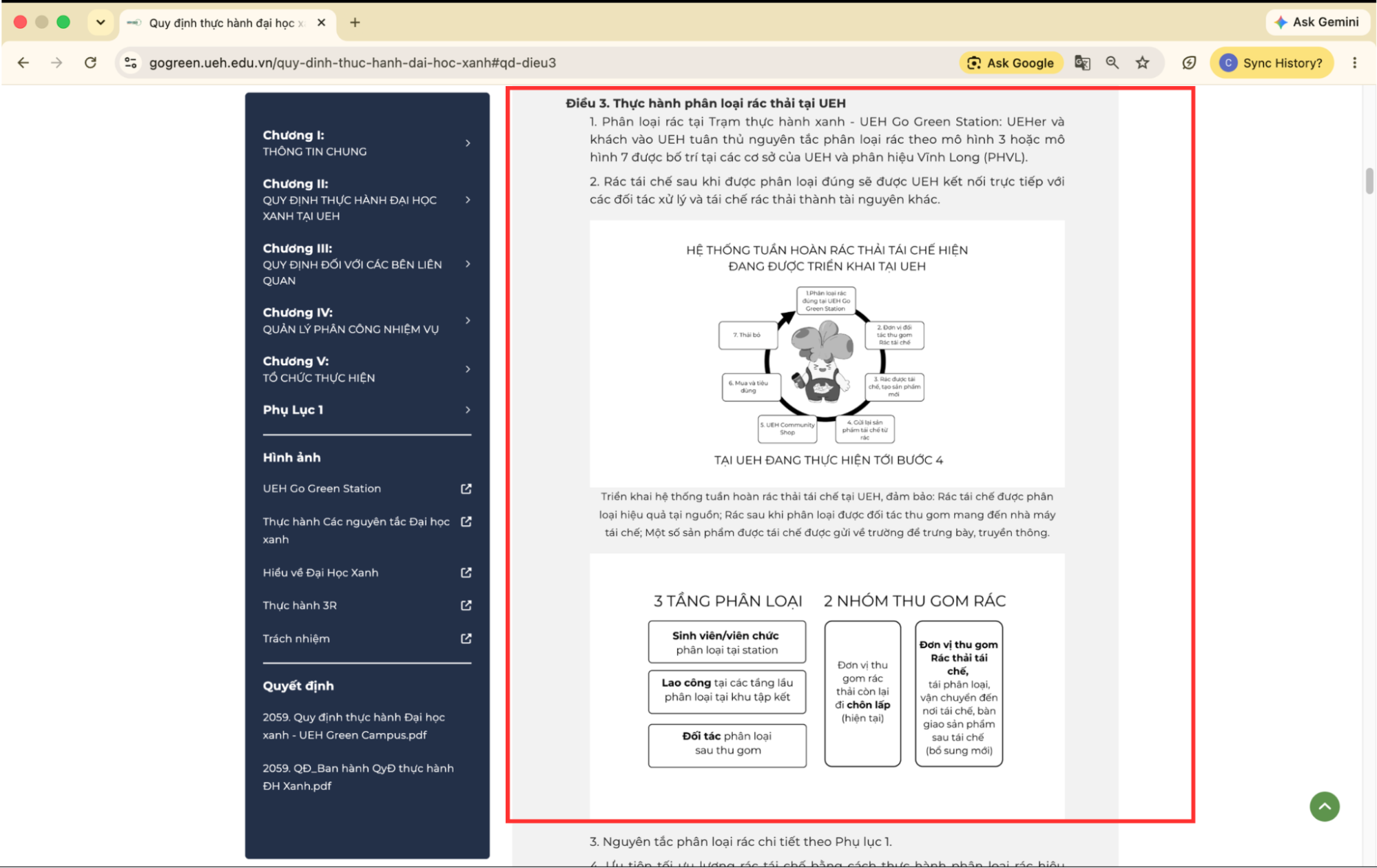
Article 3 of the Green Campus Regulations
Under the 2025 Green Campus plan, UEH continued waste measurement and management and improved operational procedures for resource management. In parallel, compiling data on the water treatment system, storage tanks and water-using equipment at Nguyen Van Linh Campus helped identify, monitor and improve water resource management.
Off campus, UEH continued the 2024–2025 GS4Infra research project in Cu Lao Dung, focusing on irrigation and disaster-prevention infrastructure such as flood embankments, canals and water-regulation sluices. Research, field surveys and community consultations provided a basis for examining infrastructure management needs amid flooding, saltwater intrusion and climate change, informing efforts to limit adverse impacts on water conditions and local livelihoods.
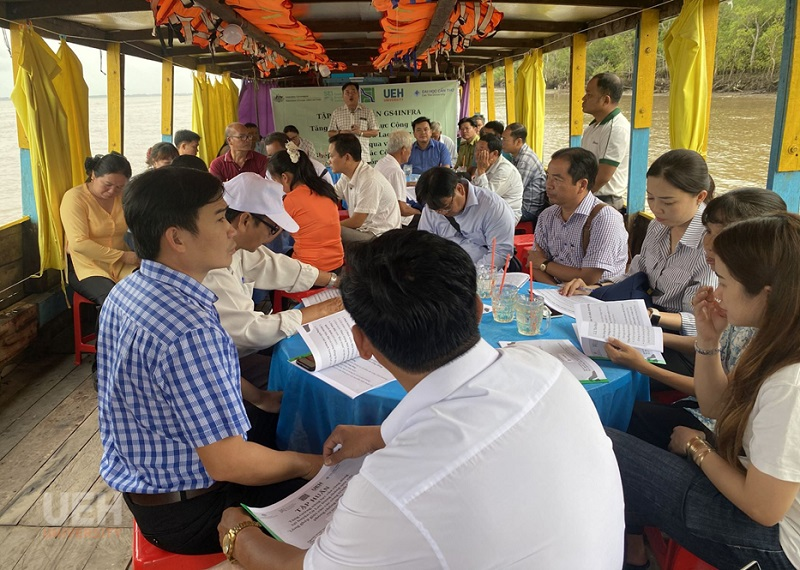
Original GS4Infra project plan; Preparatory training activity in 2024
2.2. Controlling chemical alterations to aquatic ecosystems
To address chemical pollution risks, UEH prioritises the quality control of wastewater generated by campus operations, combining water treatment measures with the selection of environmentally friendly cleaning products.
Article 15, Clause 5, and Article 16, Clause 5, of the Green Campus Regulations establish measures and directions for using safe, environmentally friendly cleaning products and chemicals. Article 21 further sets out requirements for water management, treatment, reuse and quality monitoring to reduce the risk of pollutant discharge.
Article 16, Clause 5, of the Green Campus Regulations
In 2025, water management was further specified through the UEH Green Campus Project implementation plan and reported results. At Nguyen Van Linh Campus, UEH compiled information on wastewater treatment system operating procedures, water quality test results conducted by a third party and storage tank data to support the development and improvement of water management criteria.
UEH reports that the campus wastewater treatment system uses AO technology to treat pollutants before discharge into the environment. The equipment inventory also indicates that more than 80% of water-using devices are water-saving models, contributing to more efficient resource use and operations.
These activities provide a practical basis for monitoring water quality, improving treatment procedures, reducing risks of chemical impacts on receiving waters and further refining management guidance within the Green Campus framework.
Sources:
- UEH, 2025 UEH Green Campus Project Report, Governance section – Water Resource Management.
- UEH Portal, New Progress of the UEH Green Campus Project in 2025: https://www.ueh.edu.vn/cuoc-song-ueh/tin-tuc/nhung-buoc-tien-moi-cua-du-an-ueh-green-campus-nam-2025-hanh-trinh-van-hanh-va-lan-toa-mo-hinh-dai-hoc-xanh-ueh-den-cong-dong-75883
- UEH Portal, UEH Improves Its Position in the UI GreenMetric World University Rankings 2025: https://www.ueh.edu.vn/ueh-mekong/cuoc-song-ueh-mekong/ueh-tang-hang-tren-bang-xep-hang-dai-hoc-xanh-ui-greenmetric-2025-top-896-the-gioi-va-top-5-viet-nam-75564
2.3. Limiting biological alterations and protecting aquatic habitats
UEH combines aquatic environmental quality control with research and conservation partnerships for river, estuarine and coastal ecosystems to limit adverse impacts on habitats and biodiversity.
Within the Green Campus Regulations, Article 21, Clause 5, provides for the development of biological indicators in wastewater discharge quality guidelines to protect ecosystems. Article 13, Clause 7, addresses direct collaboration with local communities to maintain shared aquatic ecosystems.
In 2025, UEH became the lead institution of the international Women4Mangrove project in Cu Lao Dung, aimed at mangrove conservation and nature-based, climate-resilient livelihoods. The project aims to restore five hectares of Sonneratia caseolaris mangrove forest, establish a community nursery and develop an educational agritourism model linked to habitat conservation.
The project team conducted field surveys, community consultations and meetings with local authorities in Cu Lao Dung and An Thanh to identify environmental protection requirements, livelihood needs and directions for implementing the conservation model. These were tangible research and planning activities in 2025, laying the groundwork for mangrove restoration and the preservation of estuarine and coastal habitats in subsequent phases.
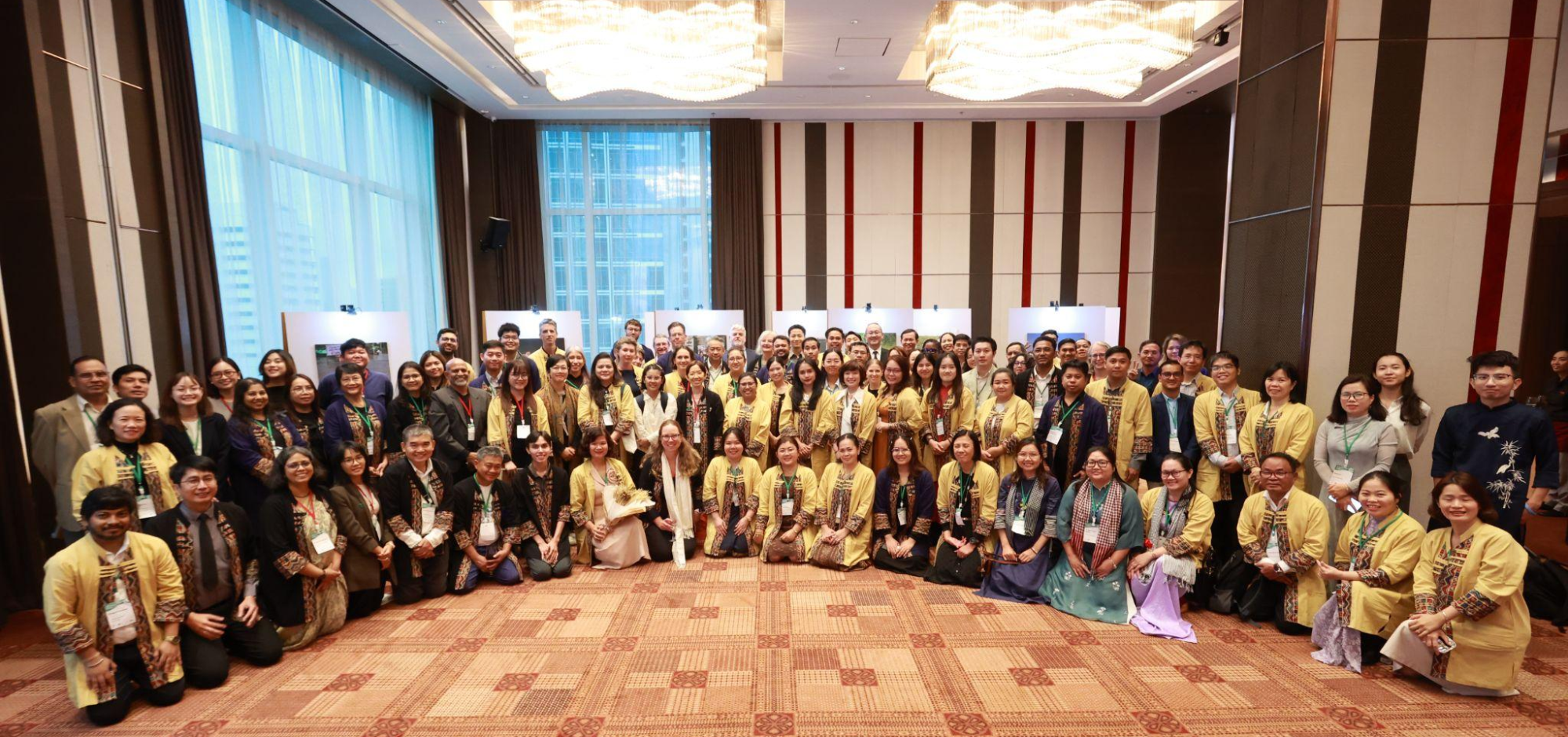
UEH project announcement, 28 November 2025; Survey and consultation, 20 December 2025
Sources:
- UEH Portal (20/12/2025), Women4Mangrove Project – Strengthening Community-Based Conservation and Educational Agritourism Linked to Mangrove Planting in the Mekong Delta: https://www.ueh.edu.vn/khoa-hoc/du-an-women4mangrove-tang-cuong-bao-ton-dua-vao-cong-dong-va-du-lich-nong-nghiep-giao-duc-gan-voi-trong-rung-tai-dong-bang-song-cuu-long-75589
- UEH Green Campus, Green Campus Regulations: https://gogreen.ueh.edu.vn/quy-dinh-thuc-hanh-dai-hoc-xanh
3. Organisation, Monitoring and Evaluation of the Plan
UEH implements the plan through its Green Campus governance framework, coordinated by the Facilities Department, operational management units and the UEH Green Campus Project Team.
Under Articles 21 and 23 of the Green Campus Regulations, relevant units are responsible for managing and monitoring water quality, consolidating resource-use data and coordinating improvements to operational procedures. This information provides a basis for assessing implementation and updating the university’s environmental management criteria.
In 2025, UEH continued this management cycle through three groups of activities:
- Information collection and review: Compile wastewater treatment system operating procedures, storage tank data and water quality testing results at Nguyen Van Linh Campus.
- Evaluation and improvement of measures: Document the proportion of water-saving devices, assess resource management effectiveness and update provisions on water conservation, reuse and wastewater discharge quality.
- Linking research and conservation: Conduct research, consultations and solution-development activities concerning irrigation infrastructure, mangrove conservation and estuarine habitats.
This implementation approach helps UEH connect campus environmental management with conservation research and partnerships, while supporting continued monitoring and adjustment of the plan in subsequent years.
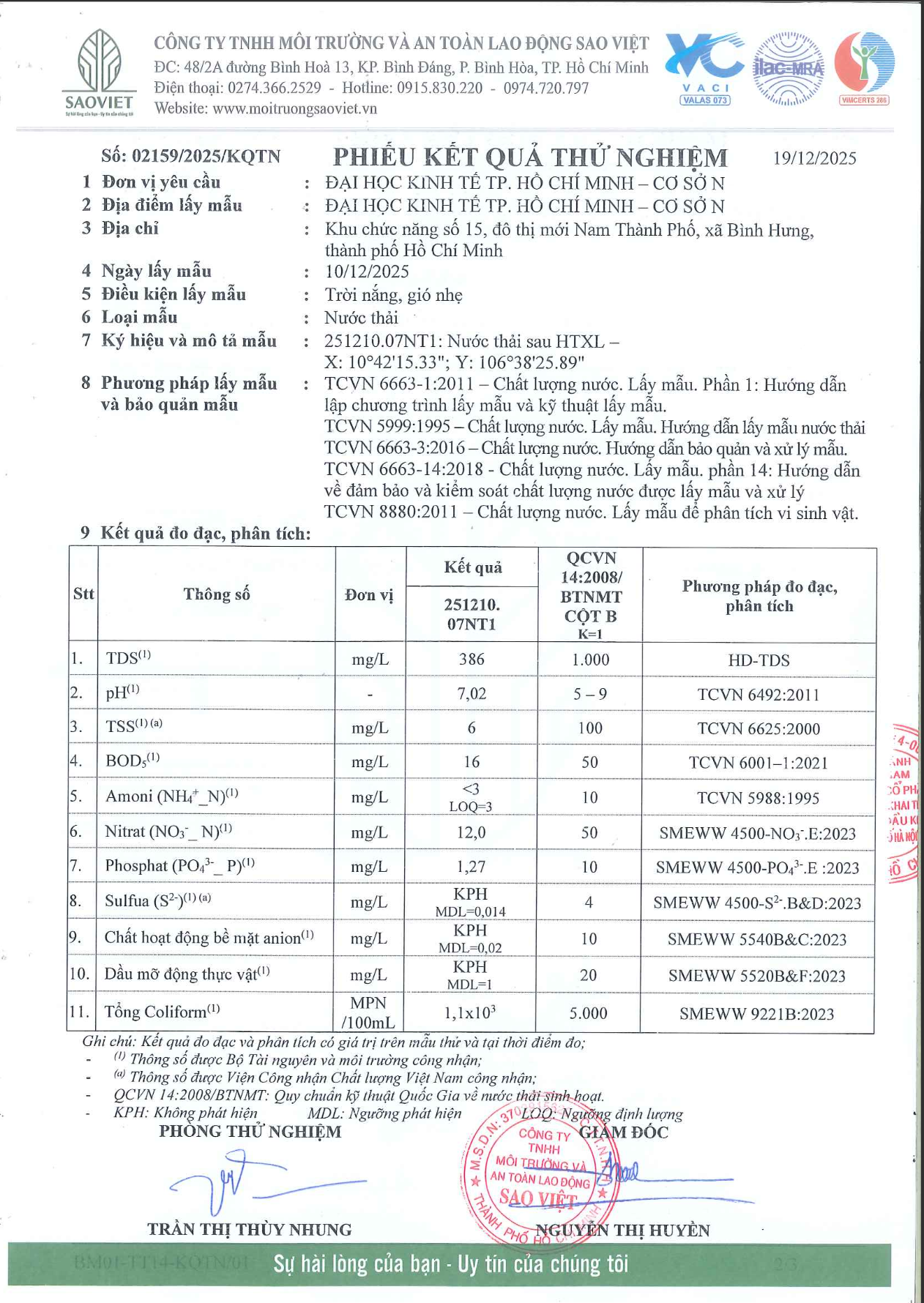 Post-treatment wastewater monitoring results at Nguyen Van Linh Campus on 10 December 2025.
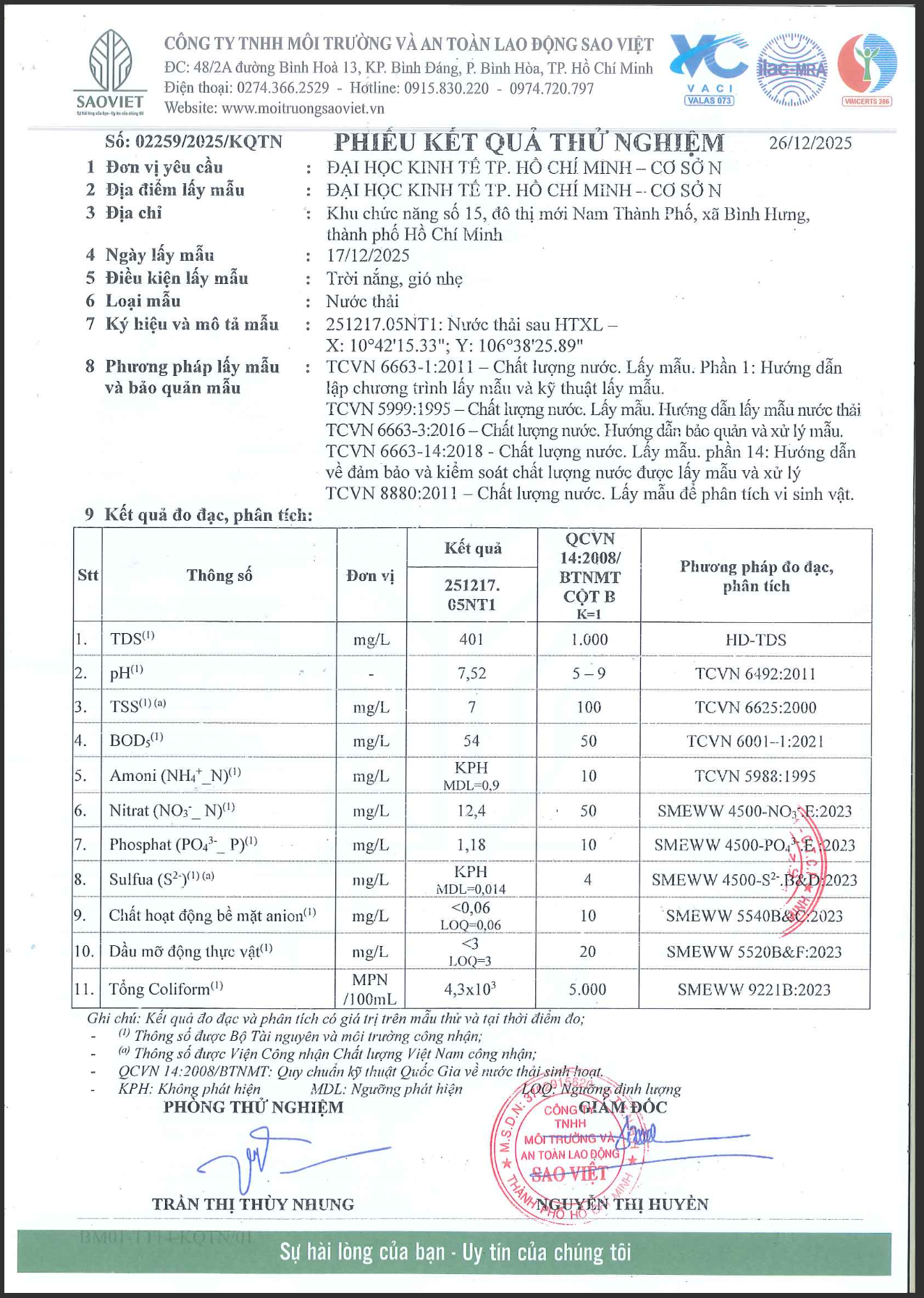
Post-treatment wastewater monitoring results at Nguyen Van Linh Campus on 17 December 2025.
4. Results of Implementing the 2025 Plan
| Plan component | Activities and results recorded in 2025 | Contribution to aquatic ecosystems |
| Wastewater control and chemical impacts | Compiled operating procedures, third-party wastewater testing results and treatment system data at Nguyen Van Linh Campus | Supports control of the risk of pollutant discharge into aquatic environments |
| Water management and minimisation of physical alterations | Documented that more than 80% of water-using equipment is water-saving; maintained waste management at source; conducted GS4Infra research on irrigation infrastructure and water conditions in Cu Lao Dung | Helps limit solid waste, improve water-use efficiency and provide research evidence for managing infrastructure impacts |
| Supporting the protection of biological components | Women4Mangrove conducted surveys, community consultations and developed directions for mangrove restoration in Cu Lao Dung | Supports planning for the protection of estuarine and coastal habitats and the maintenance of biodiversity |
| Monitoring, evaluation and improvement | Reviewed operational data, testing results and water-using equipment, and incorporated management provisions into the Green Campus Regulations framework | Strengthens the governance and monitoring basis for measures to prevent adverse impacts on aquatic environments |
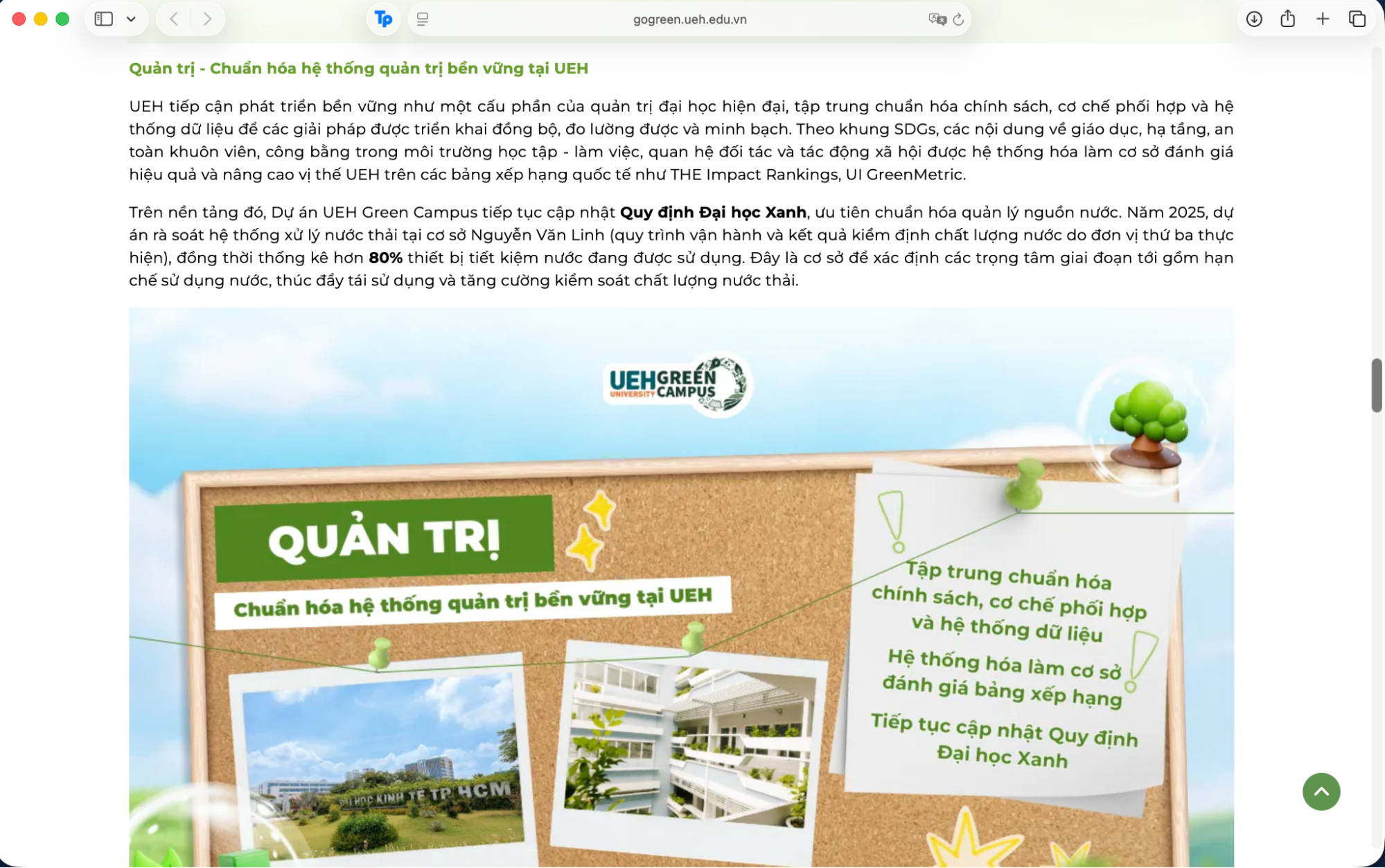
The 2025 results show that the plan was put into practice through operational management, water resource control and conservation research. Reviewing wastewater treatment systems provides direct operational evidence, while GS4Infra and Women4Mangrove add off-campus research, surveys and ecosystem protection planning.
5. Conclusion
UEH implements a plan to limit physical, chemical and biological alterations to relevant aquatic ecosystems by combining the Green Campus Regulations with the UEH Green Campus 2025 work plan and implementation results. Measures focus on waste control, water treatment and quality monitoring, efficient resource use and collaborative habitat conservation research.
The review of wastewater treatment systems, improvements in water resource management and implementation of GS4Infra and Women4Mangrove in 2025 demonstrate continuity between governance directions and practical activities, laying a foundation for minimising adverse impacts on aquatic ecosystems in line with SDG 14 – Life Below Water.