

6.5.4. Sustainable water extraction on campus
Sustainable water extraction on campus – SDG 6: Clean Water and Sanitation | 2025 reporting year
The University of Economics Ho Chi Minh City (UEH) places emphasis on solutions for collecting, storing, regulating and sustainably using natural water resources in its campus operations. In pursuit of its Multidisciplinary and Sustainable University strategy, UEH integrates green infrastructure with water resource management to reduce reliance on municipal water supplies, strengthen resilience to extreme weather and optimise water use for appropriate purposes.
At its Nguyen Van Linh Campus (Campus N), UEH has reported the implementation of rooftop rainwater harvesting systems alongside ponds designed to retain and regulate rainwater. According to the university’s supporting documentation, rainwater passes through initial filtration stages before further treatment and use; pond water has also been described as a resource for non-potable purposes, including landscape irrigation, green-space maintenance and outdoor cleaning. These measures illustrate an approach to the sustainable on-site use of natural water resources. Public information released by UEH in 2025 continued to document the operating campus, its ponds and green landscape, while the university also explored nature-based water management solutions for UEH Mekong.
- Long-term policies and strategic direction for sustainable water extraction and use
The Green Campus Regulations continued to provide an institutional framework through 2025.
In 2022, UEH issued its Green Campus Regulations under Decision No. 2059/QD-DHKT-CSVC to establish resource-efficient and environmentally responsible practices across the university. Article 2 identifies resource conservation, including electricity and water savings, as a key area of action. Article 12(1) addresses the continued implementation and evaluation of the Green Campus project in 2023–2025, providing a basis for the subsequent 2026–2030 period.
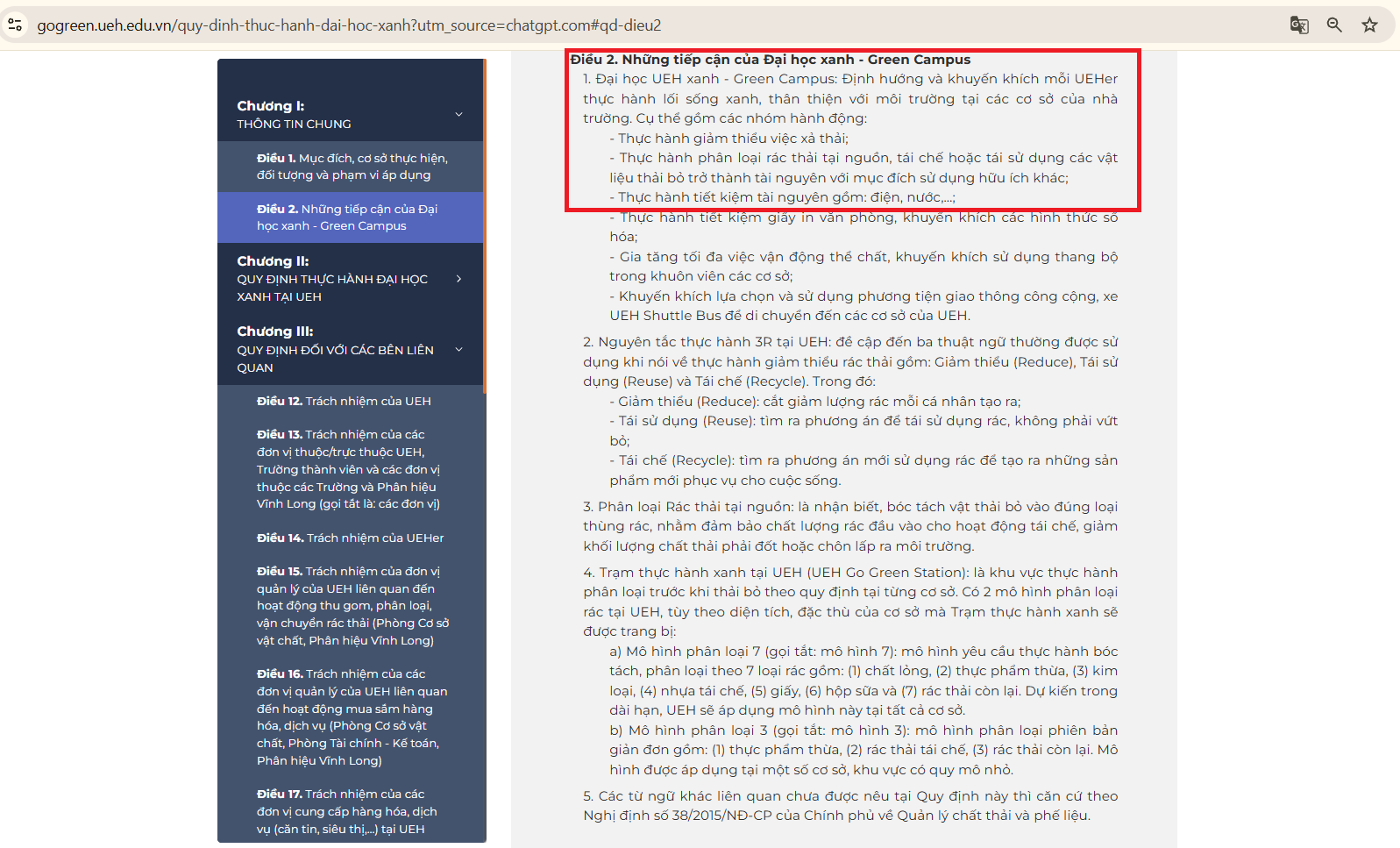
Article 12(1) on approaches to the Green Campus initiative.
Public source: Green Campus Regulations (UEH Green Campus).
https://gogreen.ueh.edu.vn/quy-dinh-thuc-hanh-dai-hoc-xanh
In the publicly available Green Campus Regulations, Article 21 – Water Reuse Policy sets out the recovery, treatment and reuse of water to reduce demand for newly supplied water. Article 21(1) refers to circular water management systems, including rainwater harvesting and reuse of treated water for non-potable uses such as irrigation, campus cleaning and equipment cooling. Article 21(3) addresses responsibility for monitoring reused-water quality, reporting water consumption and evaluating water-saving performance.
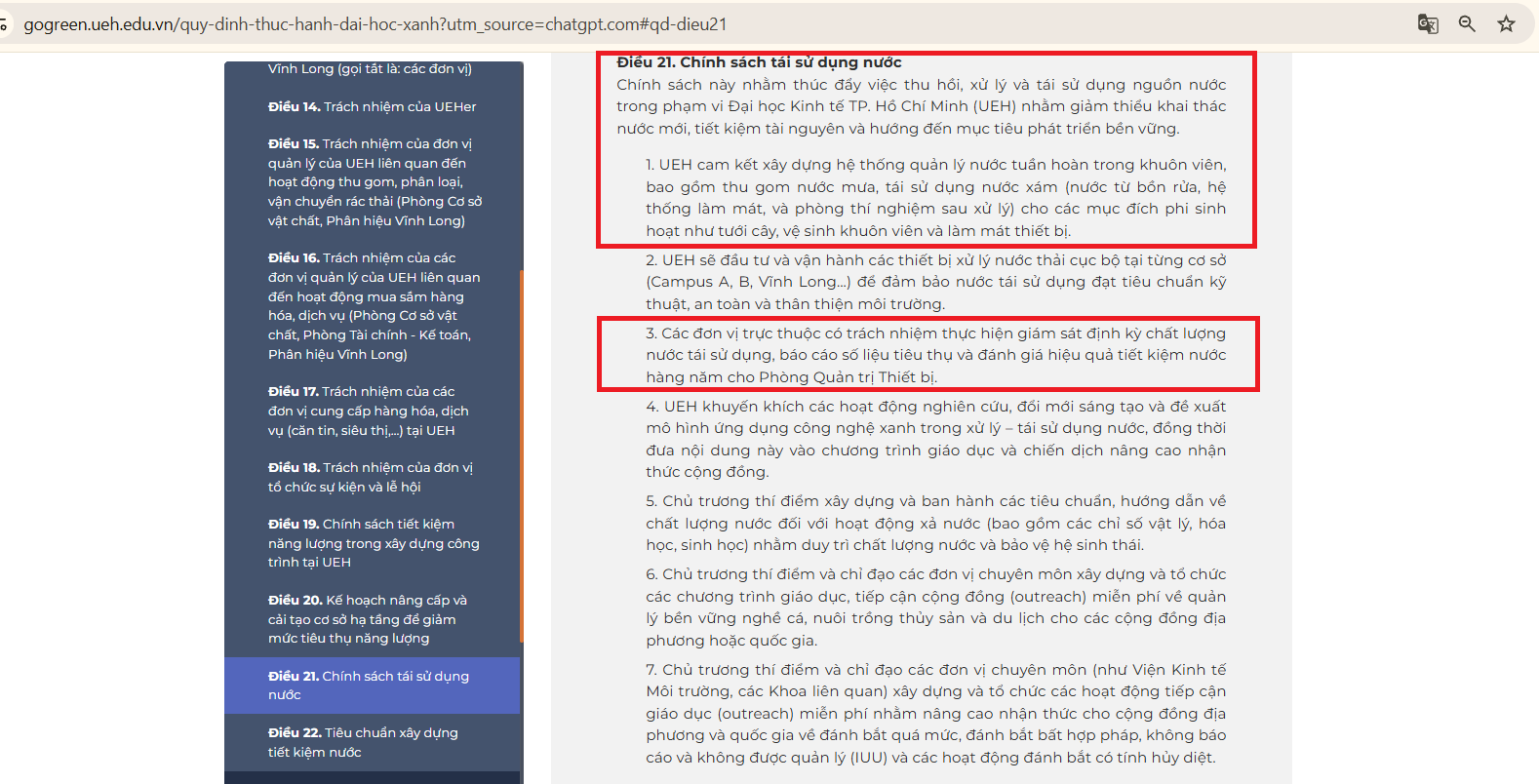
Article 21(1) and Article 21(3) of the Water Reuse Policy.
Public source: Green Campus Regulations (UEH Green Campus).
https://gogreen.ueh.edu.vn/quy-dinh-thuc-hanh-dai-hoc-xanh
In addition, Article 22 – Water-Efficient Building Standards, particularly paragraph 2, specifies the design and installation of systems for collecting and reusing rainwater or treated water in buildings. It also promotes equipment and technical measures to minimise water losses and improve water-use efficiency.
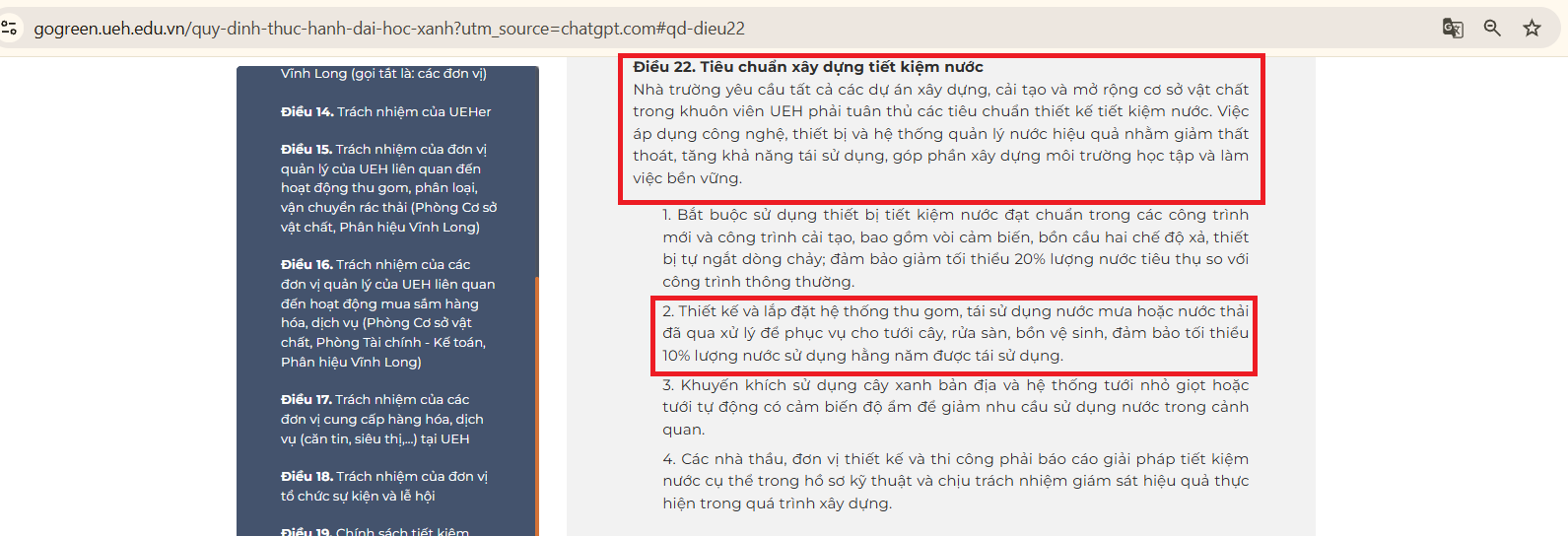
Article 22(2) on Water-Efficient Building Standards.
Public source: Green Campus Regulations (UEH Green Campus).
https://gogreen.ueh.edu.vn/quy-dinh-thuc-hanh-dai-hoc-xanh
These provisions demonstrate that UEH has established a policy framework for circular and resource-efficient water management. However, policy-level technical objectives should be distinguished from actual operating figures for individual facilities; achieved results need to be substantiated by the corresponding technical records and operational reports.
- Rainwater harvesting and use at Nguyen Van Linh Campus – Sustainable on-site use of natural water resources
2.1. Continued application of rooftop rainwater harvesting technology
UEH has reported the installation of a rainwater collection and utilisation system at Nguyen Van Linh Campus to make use of available natural water and reduce dependence on municipal supplies. Gutters and rainwater pipes on the roofs of buildings at Campus N collect runoff and direct it through debris screens and coarse filters to remove leaves, sand, dust and other initial impurities.
UEH describes the technical process as follows: rooftop rainwater capture → collection through gutters and pipes → removal of debris and impurities using screens and coarse filters → further treatment → use for suitable purposes.
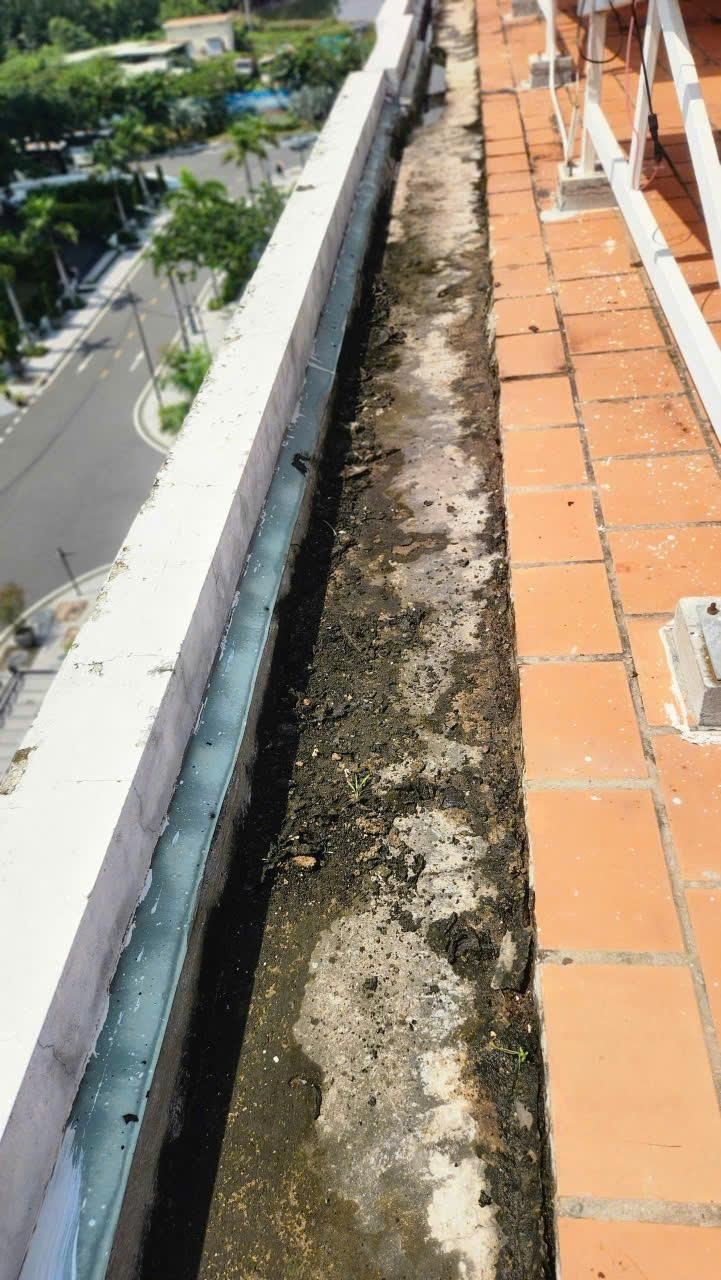
Rooftop rainwater harvesting system on buildings at UEH Campus N.
Collecting rainwater at source creates opportunities to make use of natural water resources rather than allowing all rainfall to become surface runoff. Using appropriately treated rainwater may reduce demand for municipal water and support more efficient campus water management.
2.2. Continued maintenance of green infrastructure at Campus N in 2025
Nguyen Van Linh Campus began operations on 1 January 2021 with two main building complexes, integrated technical infrastructure and landscaped green spaces. In an article published on 28 April 2025, UEH reported that the campus had been recognised by the Ho Chi Minh City People’s Committee under Decision No. 1590/QD-UBND of 24 April 2025 as one of the city’s representative construction projects.
The same article states that Campus N occupies a planned area of more than 11.1 hectares, comprising academic and administrative buildings, green spaces, ponds and open communal areas.
UEH confirms that Campus N, including its ponds, greenery and supporting infrastructure, remained in use for teaching, research and campus life in 2025.
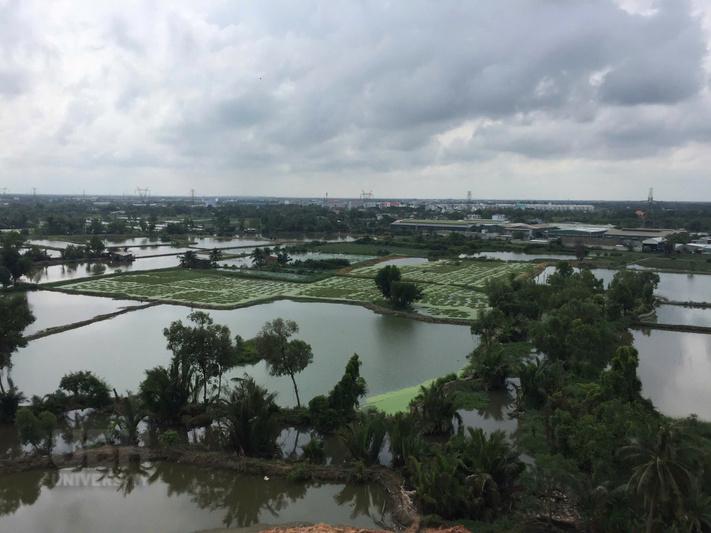
Campus N’s opening date, site area of more than 11.1 hectares and pond system.
Supporting evidence: “UEH’s Nguyen Van Linh Campus Recognised as a Representative Green, Smart and International Building in Ho Chi Minh City to Mark the 50th Anniversary of Reunification” (UEH Portal, 28 April 2025).
- Ponds at Campus N – Ecological infrastructure for water retention, regulation and use
3.1. Natural rainwater retention and regulation capacity
In addition to rooftop rainwater harvesting, UEH has developed ponds at Nguyen Van Linh Campus as part of the site’s water landscape and ecological design.
The ponds are described as natural features for retaining and regulating rainwater. The combination of open water, aquatic vegetation and biological sedimentation processes is intended to support water retention, reduce suspended matter and moderate environmental conditions on campus.
In this role, the pond system supports on-site stormwater management, enhances the ecological landscape and may improve campus resilience during heavy rainfall.
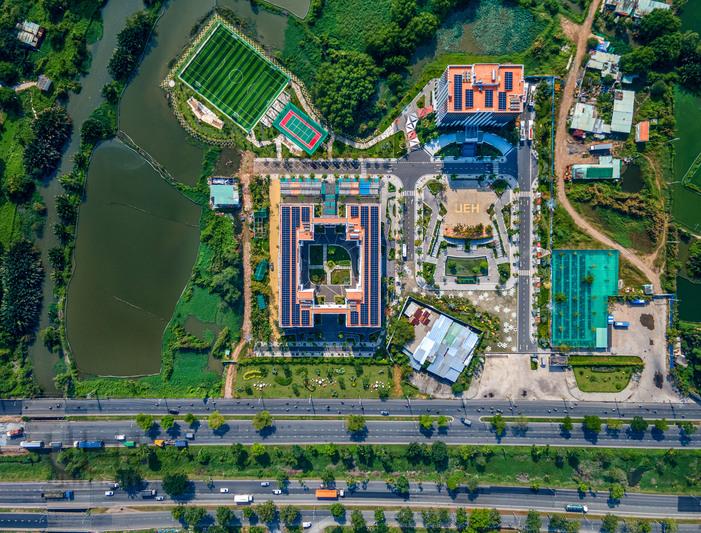
Aerial view of UEH Campus N.
Supporting evidence: “UEH’s Nguyen Van Linh Campus Recognised as a Representative Green, Smart and International Building in Ho Chi Minh City to Mark the 50th Anniversary of Reunification” (UEH Portal, 28 April 2025).
3.2. Use of pond water for non-potable purposes
Beyond their landscape function, UEH’s supporting documentation also describes the use of pond water for non-potable purposes, including irrigation, green-space maintenance and outdoor cleaning.
This is directly relevant to sustainable water extraction technology: natural water resources available on campus are not only retained but can also be used for activities that do not require potable municipal water.
Using pond water for appropriate non-potable needs may help reduce demand for newly supplied municipal water. It also connects water storage, regulation and use within an on-site ecological infrastructure system.
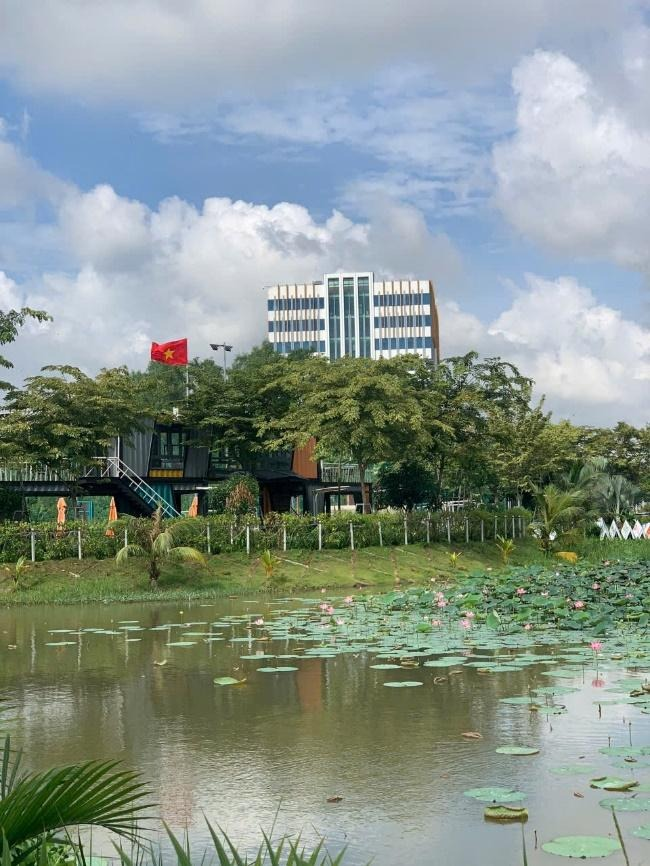
Natural pond at UEH Campus N.
Supporting evidence: “UEH’s Nguyen Van Linh Campus Recognised as a Representative Green, Smart and International Building in Ho Chi Minh City to Mark the 50th Anniversary of Reunification” (UEH Portal, 28 April 2025).
- Research and development of an adaptive campus model at UEH Mekong in 2025
On 13 January 2025, UEH published a podcast titled “Adaptive Campus Models – Solutions for a Sustainable Mekong”, featuring specialists from the Institute of Smart City and Management (ISCM) and the green building field.
During the programme, Associate Professor Dr Trinh Tu Anh introduced an adaptive campus project at UEH’s Vinh Long Branch, designed to address flooding, drought and climate change challenges in the Mekong Delta.
Dr Nguyen Minh Quang presented an approach to transforming campuses into spaces for water regulation and management through site topography, landscape design and nature-based solutions. Under this approach, university campuses can combine teaching and research functions with water regulation within an adaptive landscape system.
UEH envisages developing this model through a Living Lab approach, creating opportunities to investigate sustainable solutions suited to the natural conditions of the Mekong region.
This was an area of water management research and development highlighted by UEH in 2025, complementing the solutions described at Campus N. However, the published material does not establish that a complete water extraction system had been installed and was operational at UEH Mekong. The model is therefore presented as research and development, not counted as an operating water extraction system.
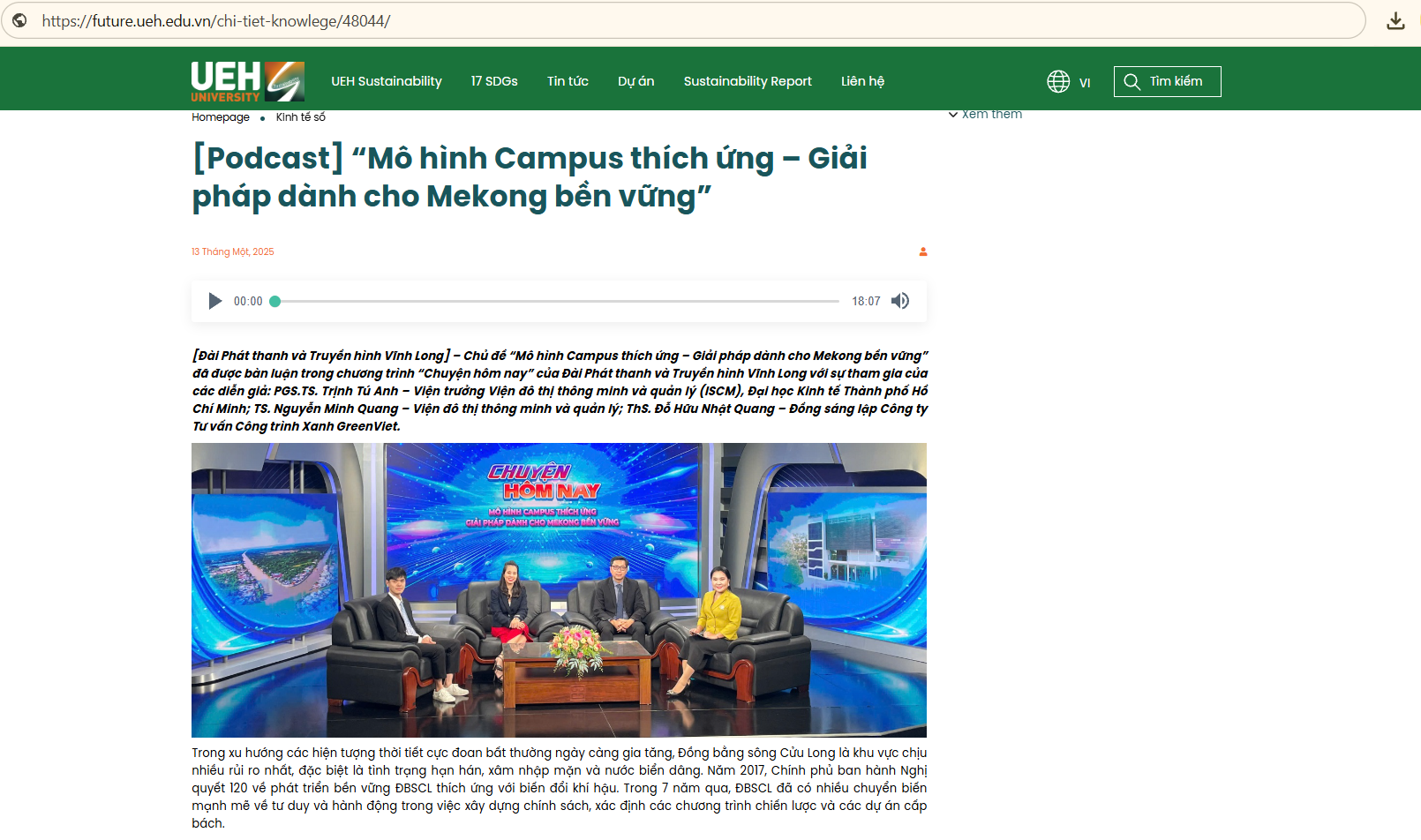
Talk show: “Adaptive Campus Models – Solutions for a Sustainable Mekong”.
Public source: [Podcast] “Adaptive Campus Models – Solutions for a Sustainable Mekong” (UEH Future, 13 January 2025).
https://future.ueh.edu.vn/chi-tiet-knowlege/48044/
- Outcomes, impacts and highlights in 2025
6.1. Technology and infrastructure outcomes
By 2025, UEH’s published materials identified Nguyen Van Linh Campus as the principal site featured for on-site natural water use solutions.
The described infrastructure includes rooftop rainwater harvesting, preliminary filtration before further treatment and use, and landscaped ponds that retain and regulate rainfall. Earlier supporting documentation also reported the use of pond water for non-potable purposes.
Regarding infrastructure scale, Campus N covers more than 11.1 hectares, commenced operations on 1 January 2021 and continued to be featured in UEH’s public reporting in 2025. Its water landscape is visible in published campus descriptions and photographs.
From an environmental perspective, these measures are intended to improve use of naturally available rainwater, retain and regulate stormwater on campus, reduce pressure on drainage infrastructure and potentially replace a portion of municipal water used for appropriate non-potable purposes. These are anticipated benefits based on the design and intended function of the solutions; actual performance remains to be quantified using operational data.
6.2. Direction for stronger performance monitoring
To improve sustainable water extraction and use, UEH aims to strengthen the monitoring of technical indicators and operational outcomes for each system. Potential indicators include rainwater storage capacity, collected and used rainwater volumes, pond water withdrawal, substitution of municipal water and water quality at points of use.
Integrating infrastructure management, water quality monitoring and data use for teaching and research can improve resource efficiency, make environmental outcomes more transparent and support the development of sustainable university campuses.