

Water-conscious building standards – Apply building standards to minimise water use
In 2025, the University of Economics Ho Chi Minh City (UEH) continued applying water-conscious building and operational standards under its Green Campus Regulations, emphasizing automatic sanitary fixtures, smart irrigation systems, rainwater harvesting, and sustainable landscaping to reduce water wastage and improve water-use efficiency. According to the 2025 Green Campus review, more than 80% of water-saving devices were in use. Facilities management records identified 100 sensor-operated urinal flush valves and 20 irrigation controllers at the Nguyen Van Linh Campus, along with 12 automatic irrigation timers at Campus V. These technologies help regulate flushing volumes and irrigation schedules and cycles, contributing to the development of resource-efficient and sustainable campus infrastructure.
1. Water-Conscious Building Policies and Standards at UEH
1.1. Green Campus Practice Regulations
UEH implements water-conscious building standards on the basis of its Green Campus Practice Regulations. The regulations are grounded in Decision No. 2059/QD-DHKT-CSVC issued in 2022, and UEH publicly introduced Green Campus practices across its facilities in 2023. According to the published regulations, the document is reviewed, updated, and supplemented annually; the publicly confirmed 2024 revision continued to provide a policy basis for implementation in the 2025 data year.
The confirmed milestones are: 2022 – Decision No. 2059/QD-DHKT-CSVC; July–August 2023 – public introduction and implementation of the Green Campus Practice Regulations; 2024 – publication of an updated version; and 2025 – continued application in the management, construction, renovation, and operation of facilities. Although the official website confirms an annual review process, it does not specify the number of revisions or the date of the final revision in 2024. Accordingly, implementation milestones are not treated as separate formal amendments.
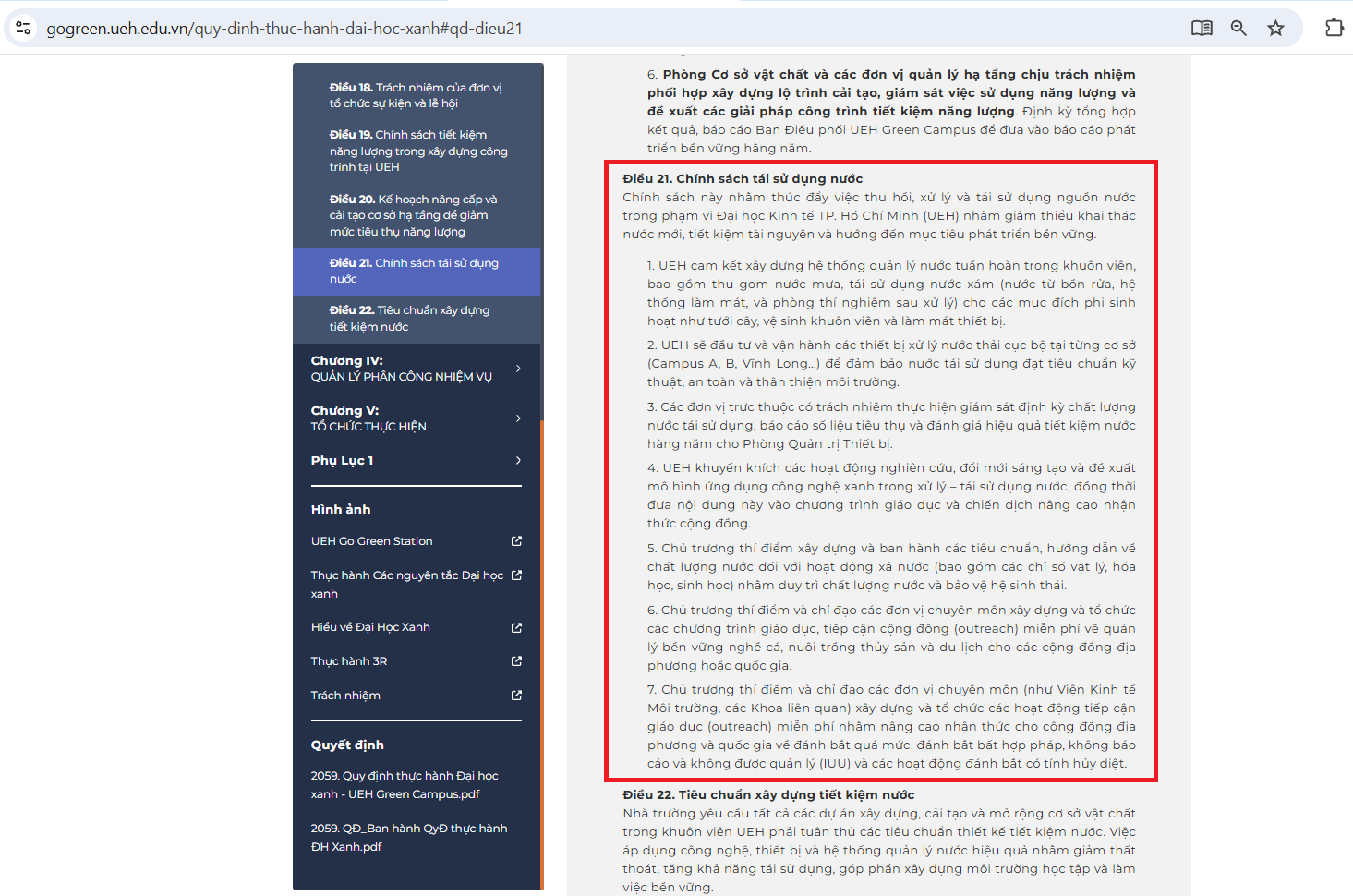
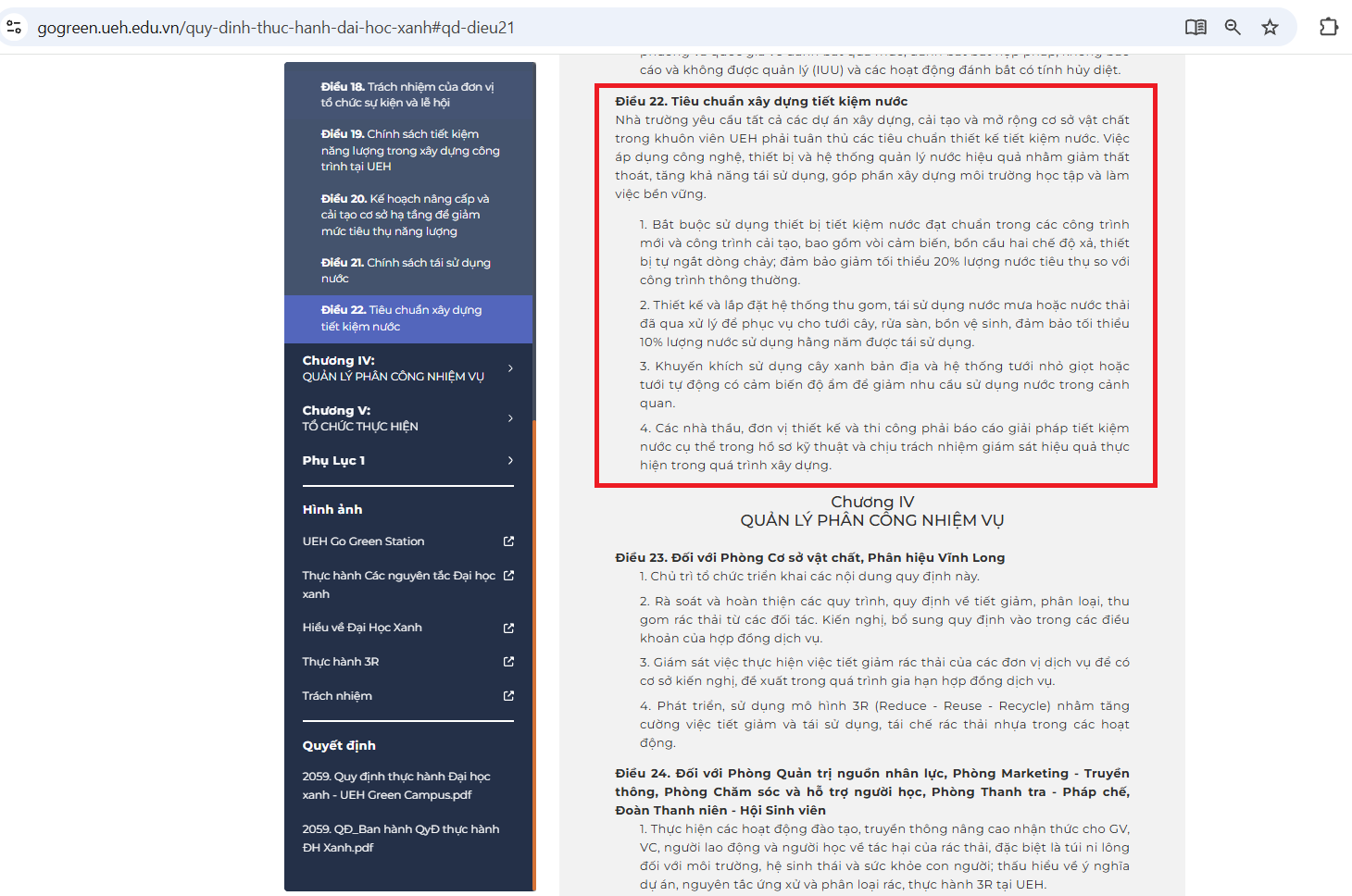
In particular, Article 22, ‘Water-Conscious Building Standards’, of the Green Campus Practice Regulations continued to apply in 2025. It requires new construction, renovation, and expansion projects to incorporate design measures that minimize water loss, improve water-use efficiency, and increase opportunities for water reuse.
The continued application of these provisions in 2025 demonstrates the continuity of UEH’s water-resource management policy and its progressive integration of water-conscious standards into facility design, construction, renovation, and operations, supporting greener and more sustainable university infrastructure.
UEH Green Campus Practice Regulations, Article 22 – Water-Conscious Building Standards.
Article 21 of the Green Campus Practice Regulations, addressing water recovery, treatment, and reuse on campus.
Public source: UEH Green Campus – Green Campus Practice Regulations.
https://gogreen.ueh.edu.vn/quy-dinh-thuc-hanh-dai-hoc-xanh
2. Implementation of Water-Saving Devices and Technologies in UEH Buildings
2.1. Automatic Sanitary Fixtures for Controlling Flush Water Consumption
UEH uses water-saving sanitary fixtures in shared facilities to regulate water flow and supply duration and to avoid unnecessary flushing.
These fixtures include sensor-operated taps, dual-flush toilets, faucet aerators, and automatic urinal flush valves. Viglacera sensor-operated urinal flush valves activate flushing in response to a sensor signal rather than relying entirely on manual operation.
According to the DFM equipment inventory compiled for the 2025 rankings submission, the Nguyen Van Linh Campus (Campus N) recorded 100 Viglacera sensor-operated urinal flush valves in its sanitary equipment category. This is the number of devices reported for that equipment category at Campus N; the source inventory does not provide individual asset identification numbers, installation dates, or inspection-confirmed operational status for each valve.
The reported technical specifications include battery operation, an operating water pressure of 0.07–0.75 MPa, a sensor detection distance of 600 mm, and a flush volume of 2.5–5 litres per cycle, depending on operating conditions.
Using sensor-operated devices helps control flushing cycles, reduce unnecessary water use, and support the installation of water-saving equipment in buildings in line with Article 22, Clause 1.
Equipment inspection and verification imagery in the 2025 documentation: Viglacera sensor-operated urinal flush valves at the Nguyen Van Linh Campus.
Source: DFM file, worksheet ‘6.1. Electricity and Water Saving (N)’.
2.2. Galcon Automatic Irrigation Controllers at the Nguyen Van Linh Campus
In addition to sanitary fixtures, UEH uses irrigation control technology to manage the timing and frequency of water supply for landscaped areas.
The 2025 DFM inventory recorded 20 Galcon 9001D 3/4-inch irrigation timers at the Nguyen Van Linh Campus for landscape irrigation management. The designation ‘9001D 3/4-inch’ identifies the device model, not an individual asset-management number. The devices can schedule irrigation start times and durations, thereby supporting operational control. The available records do not establish the installation date or individual operational inspection results for each controller.
Programmable irrigation cycles enable water supply to be managed according to schedules and plant-maintenance requirements, reducing reliance on manual watering and the risk of irrigating for longer than necessary.
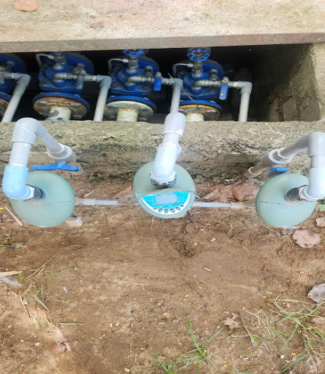
Equipment inspection and verification imagery in the 2025 documentation: Galcon 9001D irrigation controllers at the Nguyen Van Linh Campus.
Source: DFM file, worksheet ‘6.1. Electricity and Water Saving (N)’.
2.3. Whiz100 Irrigation Timers at Campus V
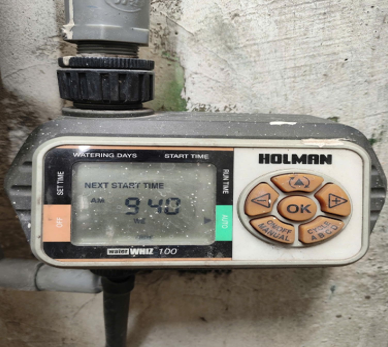
At Campus V, the 2025 DFM inventory recorded 12 Whiz100–CO4001 automatic irrigation timers, described as being used for planter boxes on balconies in the hotel area. ‘CO4001’ is a product or model designation rather than a unique asset identifier for the 12 units. The inventory confirms the quantity and usage location but does not specify installation dates or individual inspection records establishing their operational status.
The devices can be programmed for up to four on/off cycles per day, with irrigation durations ranging from one minute to six hours, and can support watering schedules by area. The equipment documentation also describes an anti-leak component at the connection point.
These timers enable scheduled irrigation management, help avoid supplying water for longer than required, and support water-conscious landscape operations at the facility.
Equipment inspection and verification imagery in the 2025 documentation: Whiz100–CO4001 irrigation timers for balcony planter boxes in the hotel area at Campus V.
Source: DFM file, worksheet ‘6.2. Electricity and Water Saving (V)’.
3. Integrating Rainwater Harvesting and Use into Infrastructure Design
3.1. Rainwater Collection System at the Nguyen Van Linh Campus
Alongside water-use control devices, UEH incorporates rainwater collection measures into infrastructure design to increase the potential use of natural water resources and reduce reliance on supplied water.
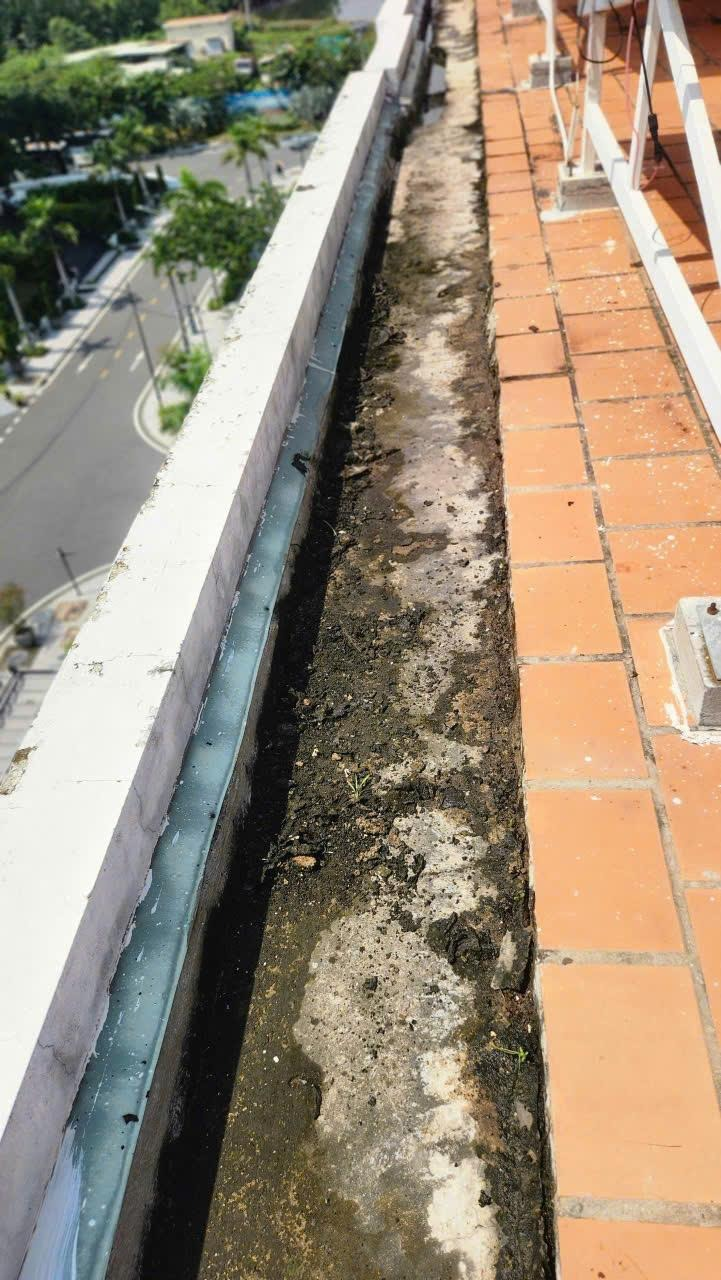
According to UEH’s published information, the Nguyen Van Linh Campus has roof gutters and rainwater downpipes on its buildings. Rainwater is collected through this drainage network and passes through debris screens and coarse filters to remove leaves, dust, sand, and other impurities before subsequent treatment stages.
This measure aligns with Article 22, Clause 2, which calls for the integration of rainwater collection and reuse systems into building design for non-potable applications.
Roof gutters and rainwater downpipes at the Nguyen Van Linh Campus, supporting the collection and potential use of natural rainwater.
Source: UEH Sustainability – ‘6.5.4. Sustainable Water Extraction Technologies on Campus’, published November 2, 2025.
https://future.ueh.edu.vn/654-cong-nghe-khai-thac-nuoc-ben-vung-trong-campus/
3.2. Landscape Water Features and Rainwater Retention
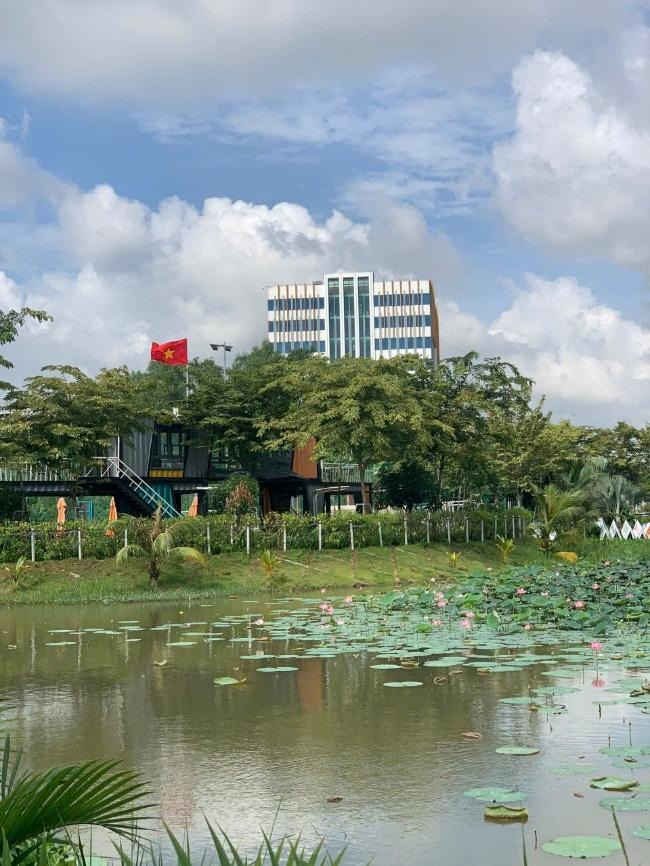
The Nguyen Van Linh Campus also includes landscaped ponds designed to receive, retain, and regulate rainwater, supporting green spaces and improving the local microclimate.
According to previously published UEH evidence, these water features are intended to support non-potable uses such as landscape maintenance and outdoor cleaning.
Combining rooftop rainwater collection with retention ponds demonstrates an infrastructure design approach that incorporates sustainable water management. However, determining the actual volume of water reused in 2025 would require verification against system diagrams, reuse supply lines, and operational records.
Landscape ponds at the Nguyen Van Linh Campus, supporting rainwater retention and regulation within the university grounds.
Source: UEH Sustainability – ‘6.5.4. Sustainable Water Extraction Technologies on Campus’, published November 2, 2025.
4. Implementation of Water-Conscious Building Standards in 2025
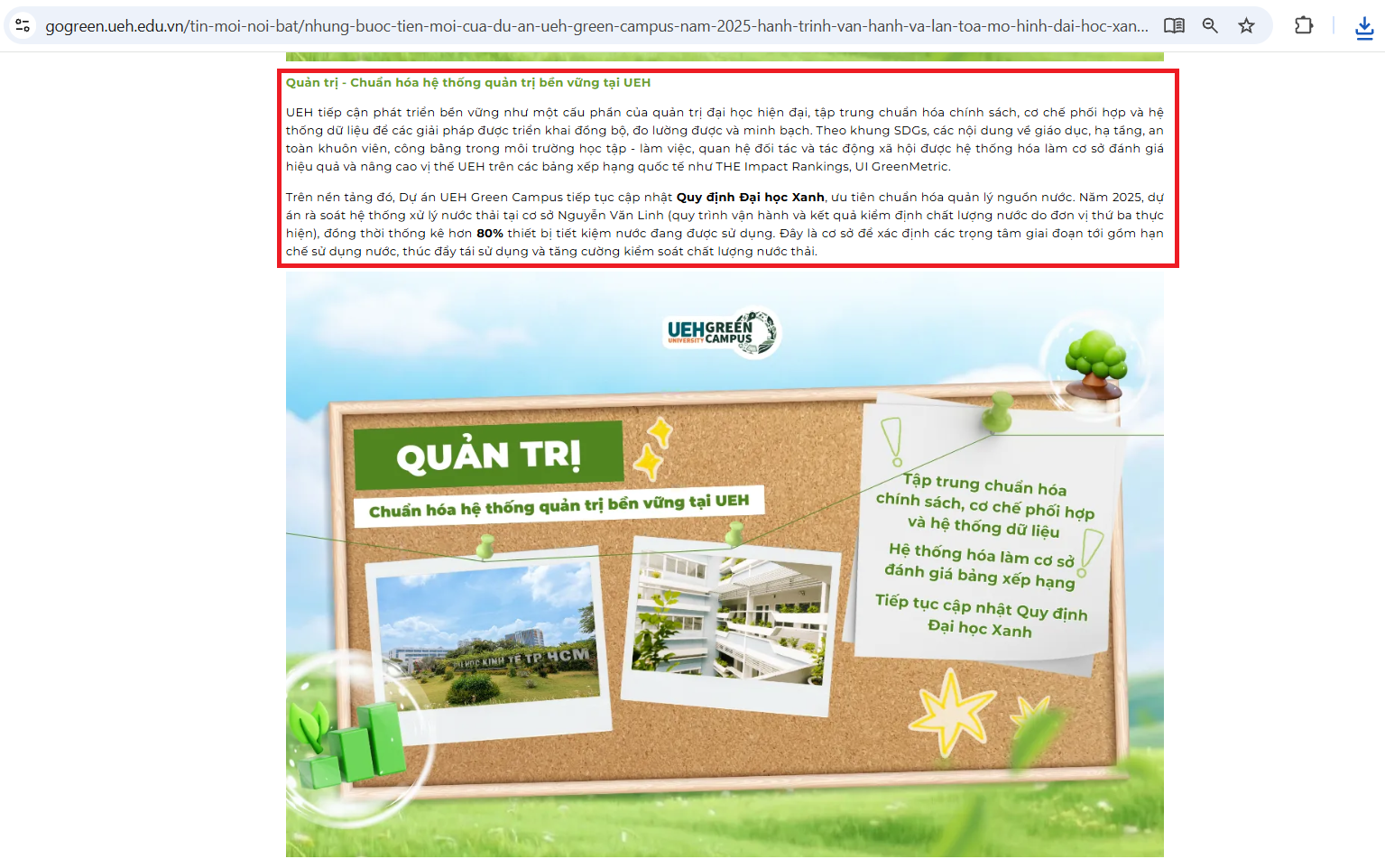
In 2025, UEH continued implementing the water-saving requirements of Article 22 of its Green Campus Practice Regulations and compiling records of equipment across its facilities. The 2025 DFM inventory lists a total of 132 devices directly related to controlling flushing and landscape irrigation: 100 Viglacera sensor-operated urinal flush valves and 20 Galcon irrigation controllers at Campus N, and 12 Whiz100 irrigation timers at Campus V. These are devices recorded in the 2025 inventory; the figure does not mean that all 132 devices were newly installed in 2025 or individually tested and confirmed operational.
According to ‘New Progress of the UEH Green Campus Project in 2025’, the university reported that more than 80% of water-saving devices were in use. UEH also reviewed the wastewater treatment system at the Nguyen Van Linh Campus, including its operating procedures and the results of water quality testing carried out by an independent third party.
UEH Green Campus 2025 annual review.
Source: UEH Green Campus – ‘New Progress of the UEH Green Campus Project in 2025: Operating and Promoting UEH’s Green University Model to the Community’, February 4, 2026, ‘Governance – Standardizing Sustainability Governance at UEH’ section.
5. Results in 2025 and Commitment to Sustainable Development
Following the introduction of the Green Campus Practice Regulations in 2023 and the publicly documented 2024 update, UEH continued applying water-conscious building standards and managing water-saving equipment in 2025. DFM records list 132 devices at Campuses N and V, comprising 100 Viglacera urinal flush valves, 20 Galcon irrigation controllers, and 12 Whiz100 irrigation timers. The 2025 Green Campus review also reported that more than 80% of water-saving devices were in use. Together, these records demonstrate how policy requirements are reflected in infrastructure management and landscape operations. Verification of individual asset codes, installation dates, and device conditions requires additional cross-checking against asset-management records and 2025 inspection reports. UEH remains committed to efficient water use, sustainable campus development, and SDG 6 – Clean Water and Sanitation.