

The University of Economics Ho Chi Minh City (UEH) has established a formal procedure for receiving, reviewing and resolving complaints submitted by employees regarding decisions or actions that affect their lawful rights and interests during their employment. In 2025, UEH issued and implemented a regulatory framework governing the receipt of petitions, the resolution of complaints and the handling of denunciations. This framework clearly defines the channels for receiving complaints, the authority responsible for handling them, the verification and dialogue procedures, the right to submit a second-time complaint, and the responsibilities for record retention. This mechanism provides a foundation for reviewing complaints relating to employment rights, income-related decisions and performance evaluations, within the scope of authority permitted by law and UEH regulations.
In 2025, UEH also organised activities to disseminate legal regulations on citizen reception, the handling of petitions and the Code of Conduct among its public employees and staff members, thereby raising awareness of the right to lodge complaints, the responsibility to resolve them and the importance of transparency in university governance.
1. Policy and Scope of Complaint Rights at UEH
UEH exercises complaint-handling procedures on the basis of the 2011 Law on Complaints, the 2013 Law on Citizen Reception and internal regulations issued by the University to ensure that feedback and complaints are received and resolved within the appropriate authority, objectively and transparently.
On 14 August 2025, UEH issued Decision No. 2410/QĐ-ĐHKT-BĐCLKSNB, together with the Regulations on the Receipt of Petitions and the Resolution of Complaints and Denunciations.
- Under Article 1, these regulations apply to cases falling within the authority of the UEH President, with the applicable groups specified as public officials, public employees and learners.
- For public officials and public employees, Clause 4, Article 2 stipulates the procedure for submitting a first-time complaint concerning matters under direct management authority. These include professional activities, management, performance evaluation and emulation and commendation, teaching-hour assignments, and matters relating to the Code of Conduct. If the complainant disagrees with the outcome of the first-time complaint resolution, they may proceed with a further complaint in accordance with the prescribed authority.
On 30 August 2025, UEH issued Decision No. 2617/QĐ-ĐHKT-BĐCLKSNB, accompanied by the Complaint Resolution Procedure KSNB.QT.01, third edition. The procedure defines the handling of complaints concerning administrative decisions and administrative acts falling within the authority of the UEH President, with the aim of protecting and restoring the lawful rights and interests of the relevant parties.
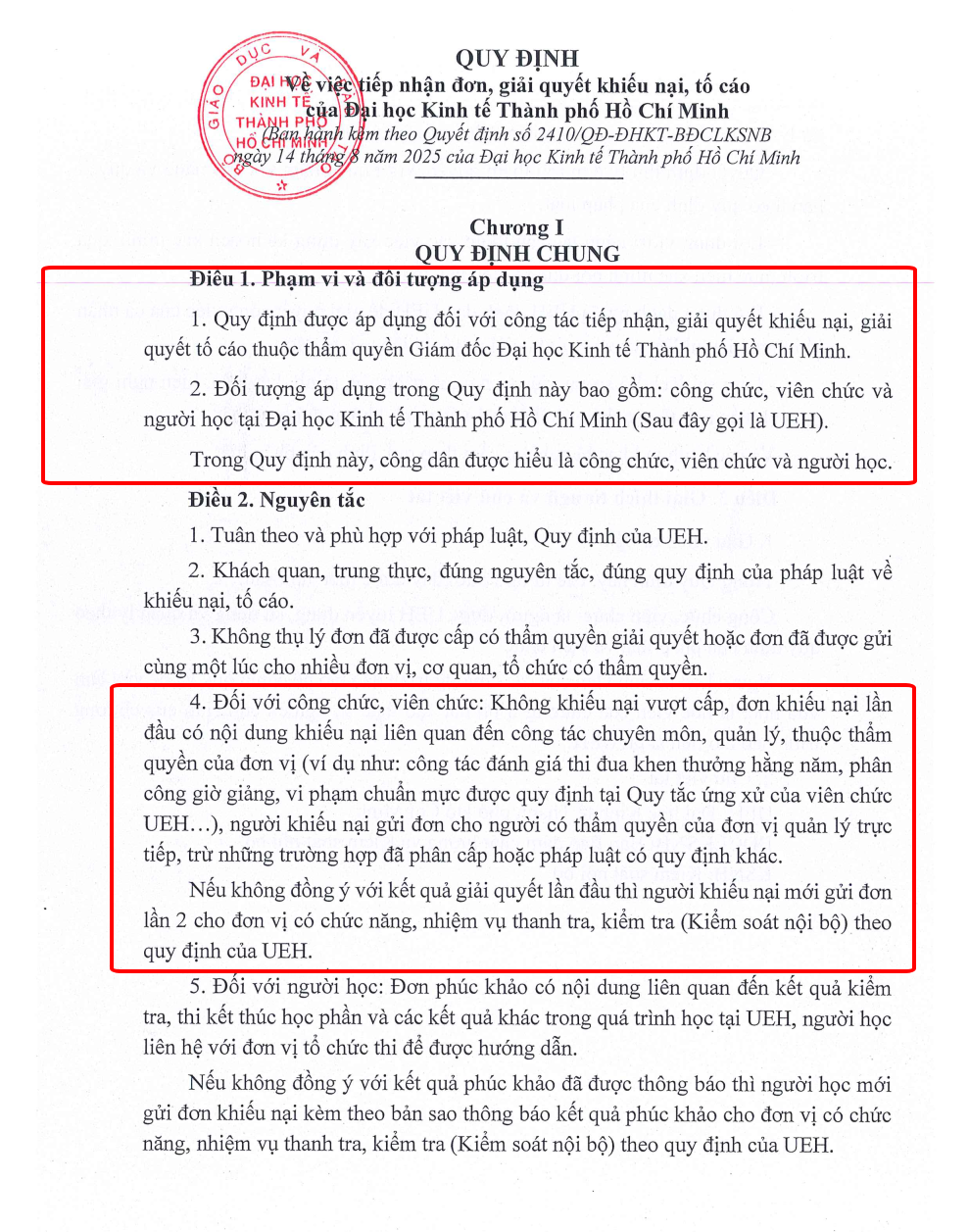
Scope of application and principles governing the complaint escalation process at UEH. Source: UEH, Regulations on the Receipt of Petitions and the Resolution of Complaints and Denunciations, issued together with Decision No. 2410/QĐ-ĐHKT-BĐCLKSNB dated 14 August 2025, Article 1 and Clause 4, Article 2.
For matters relating to salaries, allowances, additional income, bonuses and performance evaluation results, the receipt and review of complaints are determined based on the nature of the case, the complainant’s status and the corresponding authority of the relevant functional departments. The complaint mechanism concerning management decisions, work assignments and personnel evaluations provides a basis for protecting public employees’ rights and interests. Disputes arising from employment contracts are handled in accordance with the employment relationship and applicable legal regulations.
Policy sources:
- UEH – Decision No. 2410/QĐ-ĐHKT-BĐCLKSNB dated 14 August 2025 – Accompanying regulations, Article 1 and Clause 4, Article 2.
- UEH – Decision No. 2617/QĐ-ĐHKT-BĐCLKSNB dated 30 August 2025 – Procedure KSNB.QT.01, Section I, “Purpose”, and Section II, “Scope of Application”.
- UEH Future – 8.2.8. Employment Practice Appeal Process – Section on procedures for receiving and resolving complaints concerning rights in employment relationships.
2. Complaint Submission Channels and Citizen Reception Mechanisms
UEH specifies the channels for receiving complaints in Article 4 of the Regulations issued together with Decision No. 2410, enabling complainants to submit petitions and access the relevant handling units in accordance with their authority. The submission methods include:
- Postal services: Petitions may be sent to UEH through postal services.
- Direct submission: Petitions may be submitted directly to the Citizen Reception Office of the Department of Quality Assurance and Internal Control, at A214.
- Petitions forwarded by agencies and organisations: Petitions may be forwarded by agencies and organisations in accordance with legal regulations.
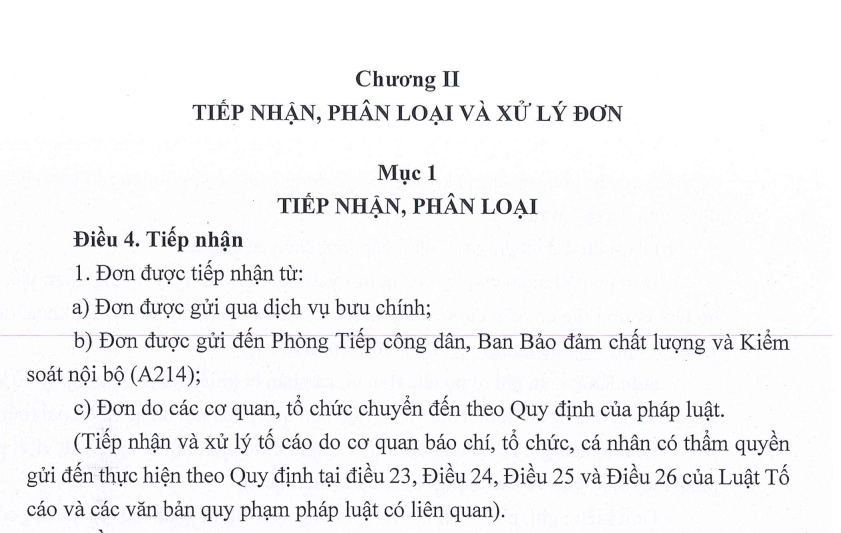
Channels for receiving complaints at UEH under Article 4. Source: UEH, Regulations on the Receipt of Petitions and the Resolution of Complaints and Denunciations, issued together with Decision No. 2410/QĐ-ĐHKT-BĐCLKSNB dated 14 August 2025, Chapter II, Article 4, Clause 1.
In addition, on 19 August 2025, UEH issued Decision No. 2514/QĐ-ĐHKT-BĐCLKSNB on the Regulations on Citizen Reception.
- Under Article 1, the scope of citizen reception includes UEH staff members, public employees, learners and other relevant individuals.
- Article 3 stipulates that citizen reception must be conducted publicly, democratically, promptly, objectively and equally, while facilitating individuals’ exercise of their rights to lodge complaints and denunciations, submit petitions and provide feedback in accordance with regulations.
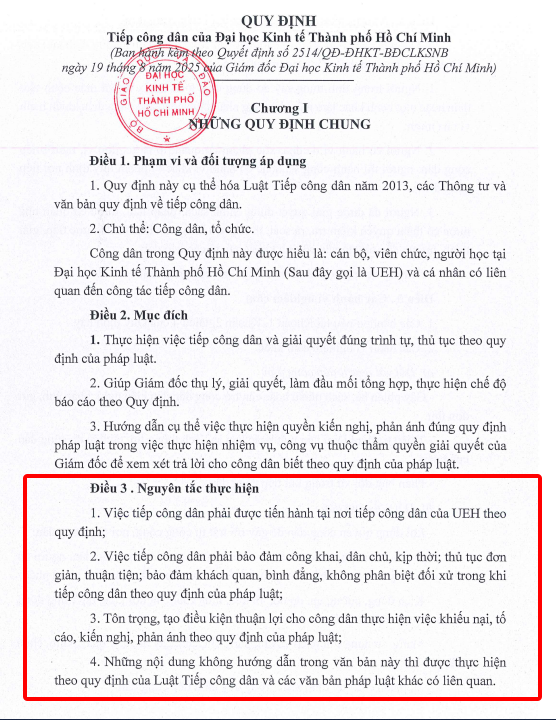
Citizen reception must be conducted publicly, democratically, promptly, objectively and equally, in accordance with Articles 1 and 3 of the Regulations on Citizen Reception. Source: UEH – Decision No. 2514 dated 19 August 2025 – Regulations on Citizen Reception.
In addition, public employees and staff members may send official emails to the Human Resources and Organisation Development Department (HOD) at hod@ueh.edu.vn to submit complaints concerning their employment rights or salaries and receive guidance and assistance in resolving them.
Publicising the submission channels, responsible units and principles of citizen reception helps public employees, staff members and other relevant individuals identify appropriate ways to raise concerns. It also supports the classification of cases and their referral to the units with the appropriate authority.
Policy sources:
- UEH – Decision No. 2410 dated 14 August 2025 – Accompanying regulations, Chapter II, Article 4, “Receipt”.
- UEH – Decision No. 2514 dated 19 August 2025 – Regulations on Citizen Reception, Articles 1 and 3.
3. Eight-Step Complaint Resolution Procedure at UEH
The Complaint Resolution Procedure KSNB.QT.01, issued under Decision No. 2617 dated 30 August 2025, establishes a clear sequence of actions, from receiving a complaint to issuing a resolution decision and retaining the relevant records.
| Step | Action | Outcome or Record |
| 1 | Receive the complaint | Record of complaint receipt |
| 2 | Classify the petition and check the conditions for acceptance | Notice of acceptance or non-acceptance |
| 3 | Issue a decision to establish a Complaint Verification Team and assign verification tasks | Verification decision and assignment of responsibilities |
| 4 | Review the administrative decision or administrative act being challenged | Initial review findings |
| 5 | Conduct verification | Verification records, documents and findings |
| 6 | Work with the complainant, the person complained against and relevant parties; organise a dialogue where necessary | Records of meetings and dialogue, and verification report |
| 7 | Issue and publicise the complaint resolution decision in accordance with regulations | Complaint resolution decision |
| 8 | Retain records | Records are managed and retained |
The procedure also specifies the statutory time limit for lodging complaints and the timeframes for resolving them in accordance with legal regulations. For complaints falling within the administrative scope, the time limit for lodging a complaint is stated as 90 days. The standard resolution period is 30–45 days for a first-time complaint and 45–60 days for a second-time complaint, depending on the nature of the case and applicable conditions.
During the verification process, the complainant and relevant parties may attend meetings and provide information, documents and evidence. Where discrepancies arise between the verification findings and the complaint, UEH organises a dialogue in accordance with the procedure to clarify the case before issuing a resolution decision.
This mechanism ensures that complaints are handled through a consistent sequence of steps, with assigned responsibilities, examination of supporting grounds and a written resolution outcome.
Evidence source:
- UEH – Decision No. 2617/QĐ-ĐHKT-BĐCLKSNB dated 30 August 2025 – Procedure KSNB.QT.01, Section II, “Scope of Application”, Section V.1, “Process Flowchart”, and Section V.2, “Description of the Process Steps”.
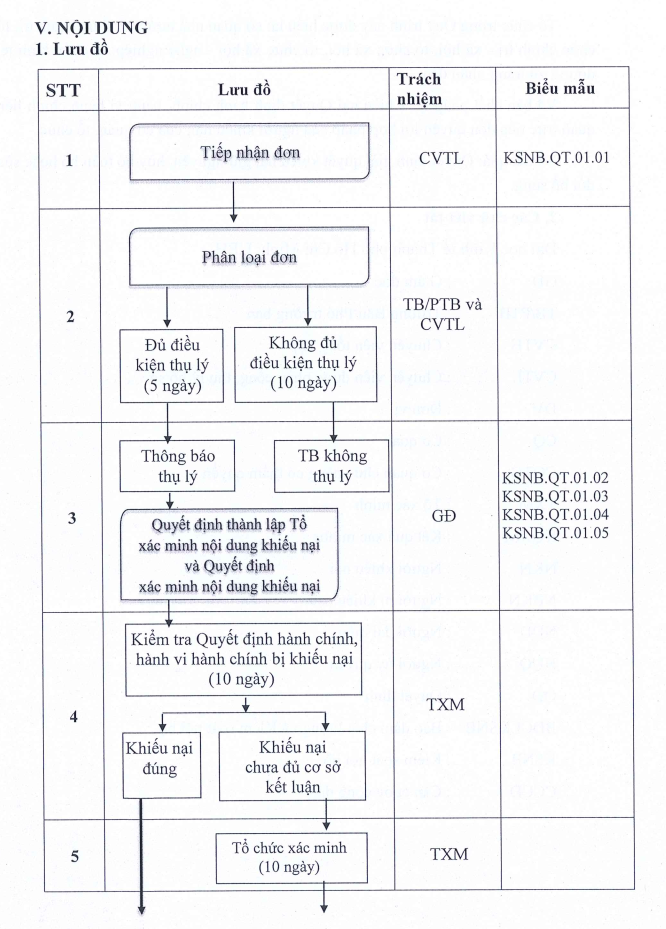
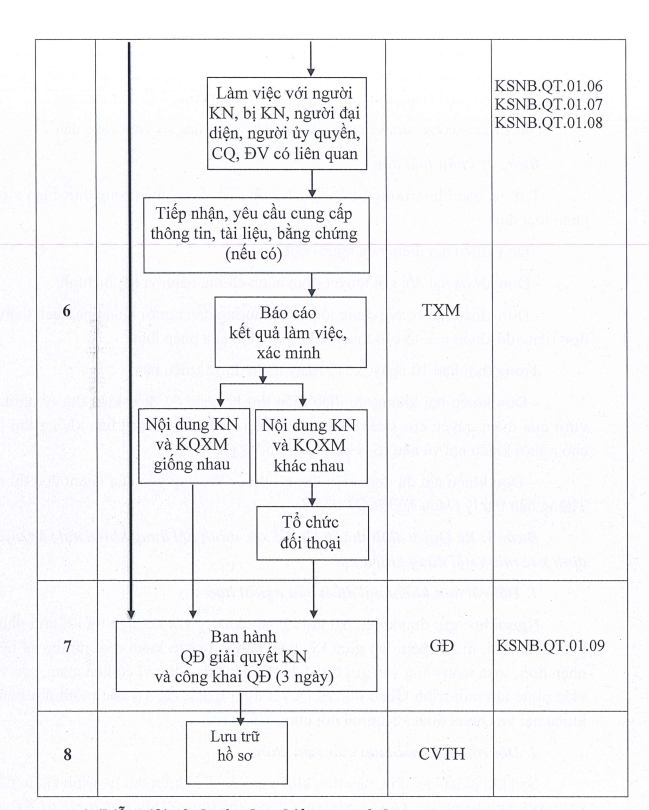
Flowchart of the eight-step complaint resolution procedure at UEH.
Source: UEH, Complaint Resolution Procedure KSNB.QT.01, issued together with Decision No. 2617/QĐ-ĐHKT-BĐCLKSNB in 2025, Section V – Contents, Subsection 1 – Process Flowchart.
4. Right to Submit a Second-Time Complaint and the Denunciation Resolution Mechanism
Under Clause 4, Article 2 of the Regulations issued together with Decision No. 2410, public officials and public employees must submit a first-time complaint to the competent unit for matters falling within its direct management authority. If they disagree with the resolution outcome, complainants have the right to submit a further complaint through the prescribed levels and authorities.
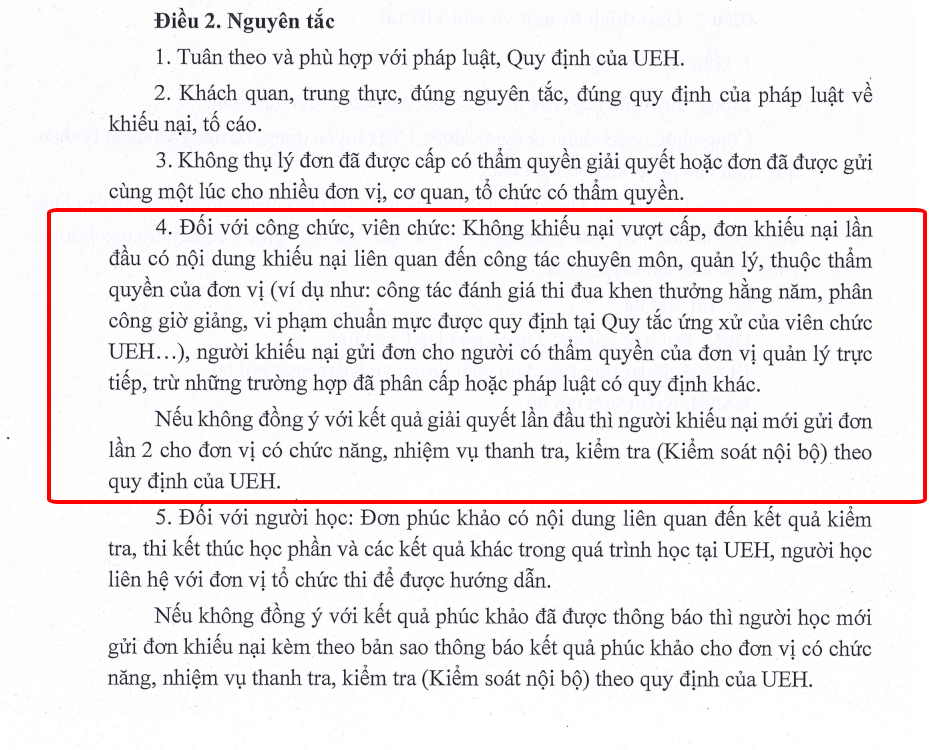

Regulations on the right to submit a second-time complaint, resolution time limits and dialogue. Source: UEH, Decision No. 2410, Clause 4, Article 2; Complaint Resolution Procedure KSNB.QT.01, 2025.
In addition to the complaint resolution procedure, UEH issued Decision No. 2616/QĐ-ĐHKT-BĐCLKSNB dated 30 August 2025, together with the Denunciation Resolution Procedure KSNB.QT.06, to receive, verify and resolve reports of acts showing signs of legal violations within its scope of authority.
The denunciation resolution procedure specifies the steps for receiving information, checking the conditions for acceptance, conducting verification, preparing reports, issuing conclusions on the denunciation, taking action and retaining records. These regulations on receiving and handling information contribute to strengthening accountability and protecting the lawful rights and interests of relevant parties.
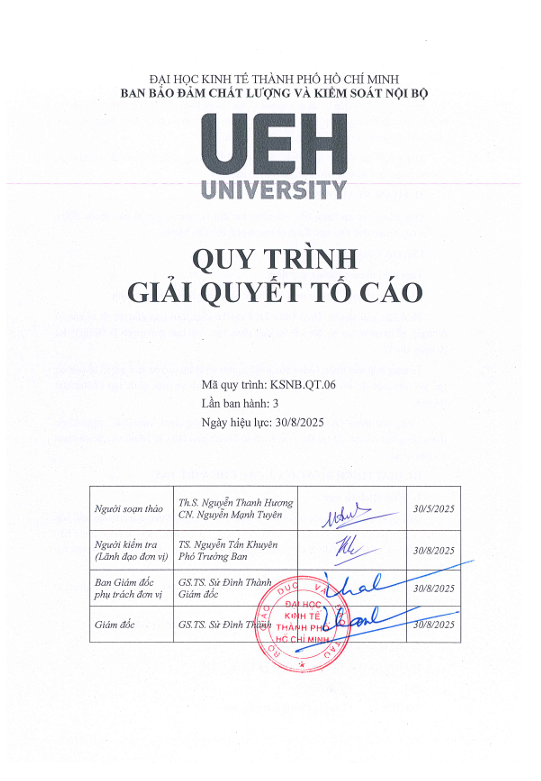
UEH has issued a separate denunciation resolution procedure, contributing to the development of a comprehensive mechanism for receiving and handling reports of acts showing signs of legal violations in university governance. Source: Decision No. 2616/QĐ-ĐHKT-BĐCLKSNB dated 30 August 2025.
Maintaining two separate mechanisms enables UEH to handle cases according to their respective nature: complaints seek a review of decisions or actions that affect lawful rights and interests, while denunciations report acts showing signs of legal violations.
Policy sources:
- UEH – Decision No. 2410 dated 14 August 2025 – Clause 4, Article 2 on the principles governing the complaint escalation process.
- UEH – Decision No. 2616 dated 30 August 2025 – Denunciation Resolution Procedure KSNB.QT.06.
5. Implementation and Dissemination Activities in 2025
In addition to issuing regulations, UEH organised legal dissemination activities to raise awareness of the right to lodge complaints, the responsibilities involved in receiving and handling petitions, and coordination among functional units.
On 19 September 2025, at its 59C Nguyen Dinh Chieu campus, UEH organised a specialised legal dissemination conference entitled “Coordination in Citizen Reception, the Resolution of Petitions and the Regulations on the Code of Conduct at UEH”, delivered in both in-person and online formats. The programme was attended by UEH leaders, representatives of various units, public employees and staff members.
At the conference, topics concerning the receipt, classification and resolution of petitions, as well as coordination responsibilities among units, were presented and discussed to establish a common understanding and support their application in university governance. The session on the Code of Conduct also contributed to strengthening the responsibilities of public employees and staff members in carrying out their duties.
The activity took place following the entry into effect of the complaint and denunciation resolution procedures on 30 August 2025, contributing to the practical implementation of the University’s newly issued regulatory framework.
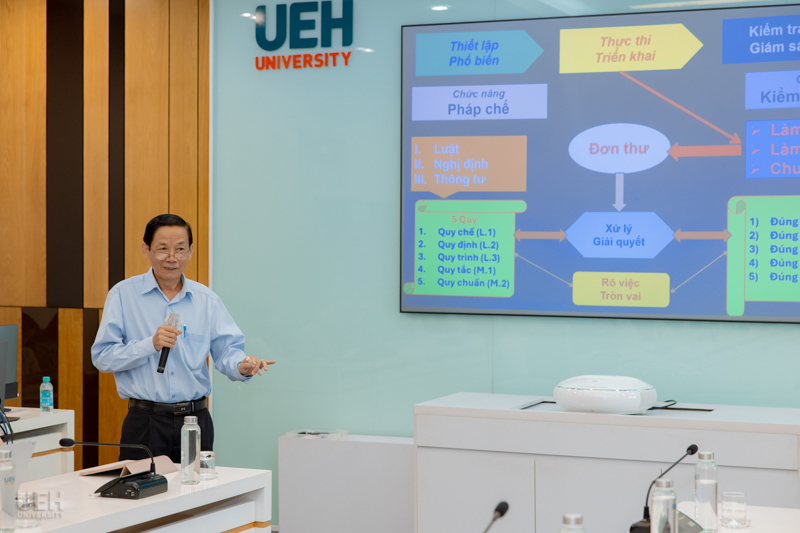
Dissemination of procedures for receiving, classifying and handling petitions at UEH. Source: UEH Portal, “Specialised Legal Dissemination Conference: Coordination in Citizen Reception, the Resolution of Petitions and the Regulations on the Code of Conduct at UEH”, published on 23 September 2025.
Summary of Evidence of Implementation in 2025
| Date | Policy / Activity | Content and Outcome |
| 14 August 2025 | Decision No. 2410 – Regulations on the Receipt and Resolution of Complaints and Denunciations | Defines the scope, applicable groups, submission channels, principles for handling petitions and responsibilities for resolution. |
| 19 August 2025 | Decision No. 2514 – Regulations on Citizen Reception | Publicises the principles of citizen reception and facilitates the exercise of the rights to lodge complaints and denunciations, submit petitions and provide feedback. |
| 30 August 2025 | Decision No. 2617 – Complaint Resolution Procedure KSNB.QT.01 | Establishes an eight-step procedure with defined authority, time limits, verification, dialogue and forms. |
| 30 August 2025 | Decision No. 2616 – Denunciation Resolution Procedure KSNB.QT.06 | Establishes a separate procedure for resolving denunciations, complementing the mechanism for protecting lawful rights and interests. |
| 19 September 2025 | Specialised Legal Dissemination Conference | Provides guidance on coordination in citizen reception, the resolution of petitions and implementation of the Code of Conduct at UEH. |
Evidence sources:
- UEH Department of Quality Assurance and Internal Control (DQAIC) – List of documents on the receipt and resolution of complaints and denunciations in 2025.
- UEH Portal – Specialised Legal Dissemination Conference: Coordination in Citizen Reception, the Resolution of Petitions and the Regulations on the Code of Conduct at UEH, published on 23 September 2025.
6. Implementation Results and Conclusion
In 2025, the University of Economics Ho Chi Minh City continued to strengthen its complaint reception and resolution mechanisms through formal regulations and procedures with clearly specified reference numbers, effective dates, scopes of application and assigned responsibilities. A key feature is Procedure KSNB.QT.01, which sets out specific steps for handling complaints, from receipt and acceptance to verification, dialogue, the issuance of resolution decisions and record retention.
Combining the complaint resolution procedure with the citizen reception mechanism, denunciation resolution procedures and legal dissemination activities contributes to enhancing transparency, accountability and access to mechanisms for protecting the lawful rights and interests of public employees and staff members.
Through its regulatory framework and implementation activities in 2025, UEH continues to foster a fair, accountable working environment that respects employees’ rights and interests, contributing to SDG 8 – Decent Work and Economic Growth.