

Towards building a fair, diverse and inclusive working environment, University of Economics Ho Chi Minh City (UEH) maintains an anti-discrimination policy covering recruitment, employment, remuneration and human resource development. The University ensures equal opportunities for lecturers, civil servants and employees, without discrimination based on religion, sexual orientation, gender, age, immigration or refugee status, or other personal characteristics. In 2025, UEH continued to implement its human resource policies based on the principle of equal opportunity, while issuing regulations and procedures for receiving and handling complaints and denunciations. These efforts contribute to protecting employees’ rights and fostering a working environment that respects diversity.
1. Workplace Anti-Discrimination Policies and Commitments
UEH identifies non-discrimination as an important principle in human resource management, applying it to recruitment, job placement, training, performance evaluation, personnel planning, appointment, remuneration, benefits and career development. The policy was reviewed and remained in effect in 2025, in alignment with the University’s human resource development strategy, its Multidisciplinary and Sustainable University orientation, and the goal of building a Happy UEH University.
Accordingly, recruitment, personnel planning and appointment processes are based on individual capabilities, achievements and job requirements, without discrimination based on gender, age, skin colour, marital status, ethnic origin, race, religion, sexual orientation, culture, beliefs, social status, or immigration or refugee status.
UEH identifies five main protected groups within the scope of its policy:
| Protected Group | Implementation Principles at UEH |
| Religion and Belief | No discrimination in employment opportunities, recruitment, evaluation or career development on the basis of religion or belief. |
| Sexual Orientation | Respects diversity in sexual orientation and ensures equality in human resource management and the working environment. |
| Gender | Ensures equality in recruitment, employment, remuneration, welfare benefits, training and appointment. |
| Age | Conducts recruitment, evaluation and personnel development based on professional standards, capabilities and the legal requirements applicable to each position. |
| Refugee Status | UEH’s publicly available human resource policy establishes the principle of non-discrimination based on immigration or refugee status, within the scope of employment conditions and relevant legal regulations. |
In addition, the policy addresses other factors, including race, skin colour, ethnic origin, marital status and social status, as well as individual differences, contributing to equal employment opportunities across the workforce.
Policy Sources:
- UEH Portal – Implementation of Human Resource Policies Linked to the 17 SDGs towards Contributing Intellectual Resources to Sustainable Development, published on 27 January 2025 – recruitment and human resource development policies, including the groups protected from discrimination.
- UEH Portal – Implementation of Human Resource Policies Linked to the 17 SDGs, published on 5 August 2026, reporting on 2025 activities – section on “UEH’s Talent Recruitment Policies and Gender-Equal Welfare Benefits”.
- UEH Future – 8.2.3. Employment Policy on Discrimination, dated 5 November 2025 – introduction and “Anti-discrimination employment policy”.
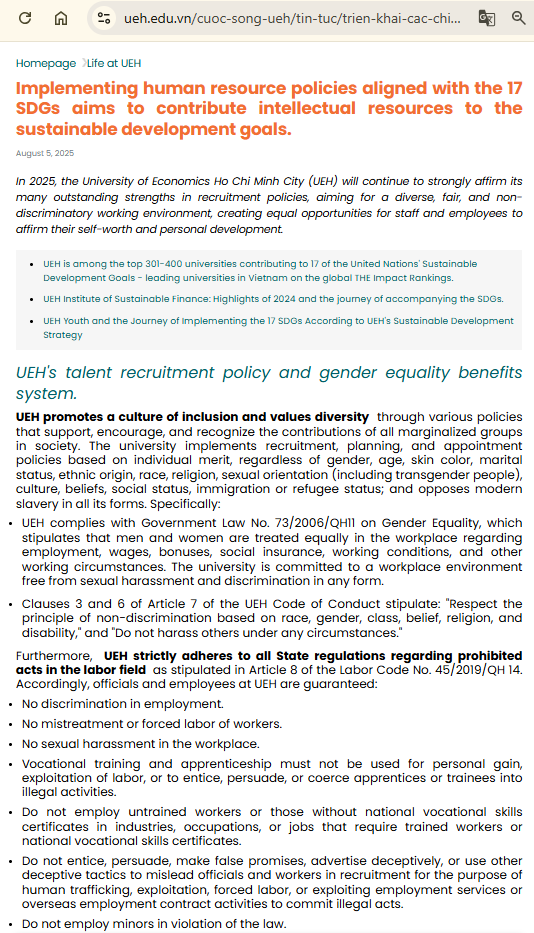
UEH’s human resource policy, demonstrating the principles of non-discrimination in recruitment, personnel planning and appointment across protected groups.
2. Legal Framework and Internal Regulations Supporting Policy Implementation
2.1. Principles of Non-Discrimination in Employment
UEH implements its anti-discrimination policy in compliance with the Law on Gender Equality No. 73/2006/QH11, the Labour Code No. 45/2019/QH14 and the University’s internal regulations.
Under Article 13 of the 2006 Law on Gender Equality, men and women are equal in recruitment standards and age requirements, and must be treated equally in the workplace in terms of employment, wages, bonuses, social insurance, working conditions and other employment-related conditions.
In addition, Clause 8, Article 3 of the 2019 Labour Code defines discrimination in employment based on personal characteristics that are unrelated to job requirements. Clause 1, Article 8 prohibits discrimination in employment. Related provisions also prohibit maltreatment, forced labour and sexual harassment in the workplace.
These regulations provide the legal foundation for ensuring equal opportunities and protecting employees’ lawful rights and interests throughout the recruitment, employment and human resource development processes at UEH.
2.2. UEH Civil Servants’ Code of Conduct
The University issued the Regulations on the Code of Conduct for Civil Servants, attached to Decision No. 695/QĐ-ĐHKT-CTCT dated 4 April 2017, establishing standards of conduct for civil servants in the performance of their duties.
Specifically, Clause 3, Article 7 stipulates the principles of respect and non-discrimination based on race, gender, class, belief, religion and disability. Clause 6, Article 7 prohibits harassment of others under any circumstances.
The Code of Conduct serves as a foundation for guiding behaviour and monitoring compliance with professional standards in the workplace, helping prevent discrimination, harassment and conduct that undermines mutual respect among UEH members.
In parallel, UEH Culture, introduced in 2017 and remaining in effect through 2025, upholds the values of respect for diversity, fairness, cooperation and responsibility, with the aim of building a professional, friendly and inclusive learning and working environment.
Furthermore, UEH publicly provides its non-discrimination policy for transgender people, demonstrating its commitment to respecting gender identity and ensuring equal opportunities. The University also maintains an employment policy against modern slavery, contributing to the protection of human rights and the development of a safe working environment.
Policy and Regulatory Sources:
- Decision No. 695/QĐ-ĐHKT-CTCT dated 4 April 2017 – UEH Civil Servants’ Code of Conduct (original PDF) – Article 2 on scope and applicable subjects; Clauses 3 and 6 of Article 7.
- UEH Knowledge Repository – UEH Culture and Code of Conduct – section on “UEH Civil Servants’ Code of Conduct”, Chapter II, Article 7.
- Law on Gender Equality No. 73/2006/QH11 – Article 13 on gender equality in employment.
- UEH Future – 8.2.3. Workplace Anti-Discrimination Policy – section on “Workplace Anti-Discrimination Policy”.
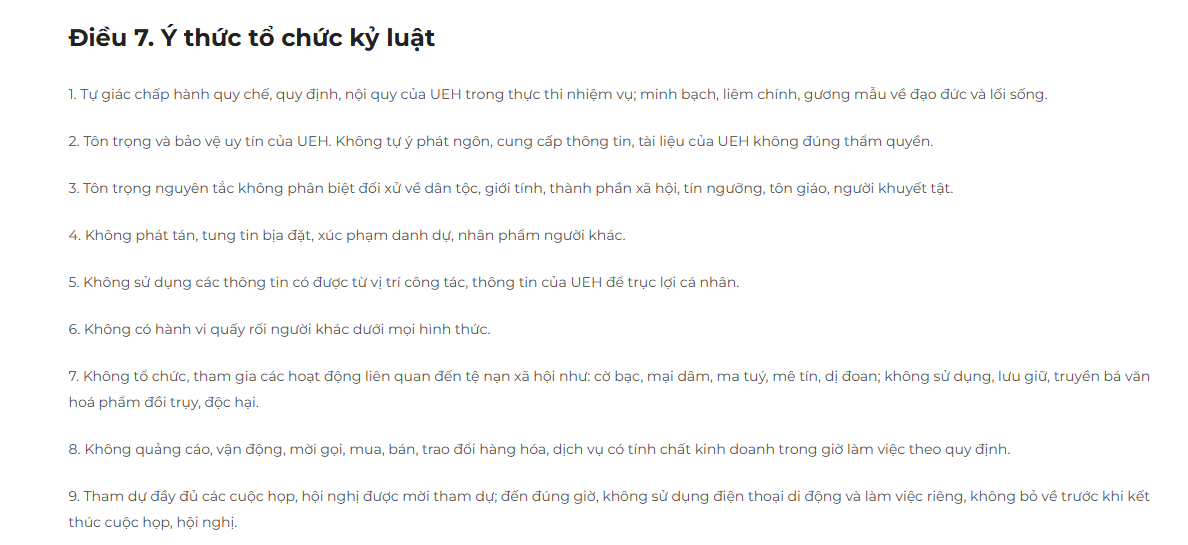
Article 7, Clauses 3 and 6 of the UEH Code of Conduct on non-discrimination and the prohibition of harassment.
Sources: UEH Code of Conduct; Law on Gender Equality No. 73/2006/QH11; Labour Code No. 45/2019/QH14.
3. Mechanisms for Receiving and Handling Complaints and Denunciations, and Protecting Reporting Individuals
To support policy implementation and protect employees’ rights and interests, UEH maintains mechanisms for receiving and handling complaints and denunciations in accordance with the law. In 2025, the University issued a set of documents to standardise the procedures for receiving, classifying, processing and resolving cases within its jurisdiction.
In 2025, UEH issued the following documents:
| Document | Date of Issuance | Content |
| Decision No. 2410/QĐ-ĐHKT-BĐCLKSNB | 14 August 2025 | Regulations on receiving submissions and handling complaints and denunciations. |
| Decision No. 2616/QĐ-ĐHKT-BĐCLKSNB | 30 August 2025 | Procedures for handling denunciations. |
| Decision No. 2617/QĐ-ĐHKT-BĐCLKSNB | 30 August 2025 | Procedures for handling complaints. |
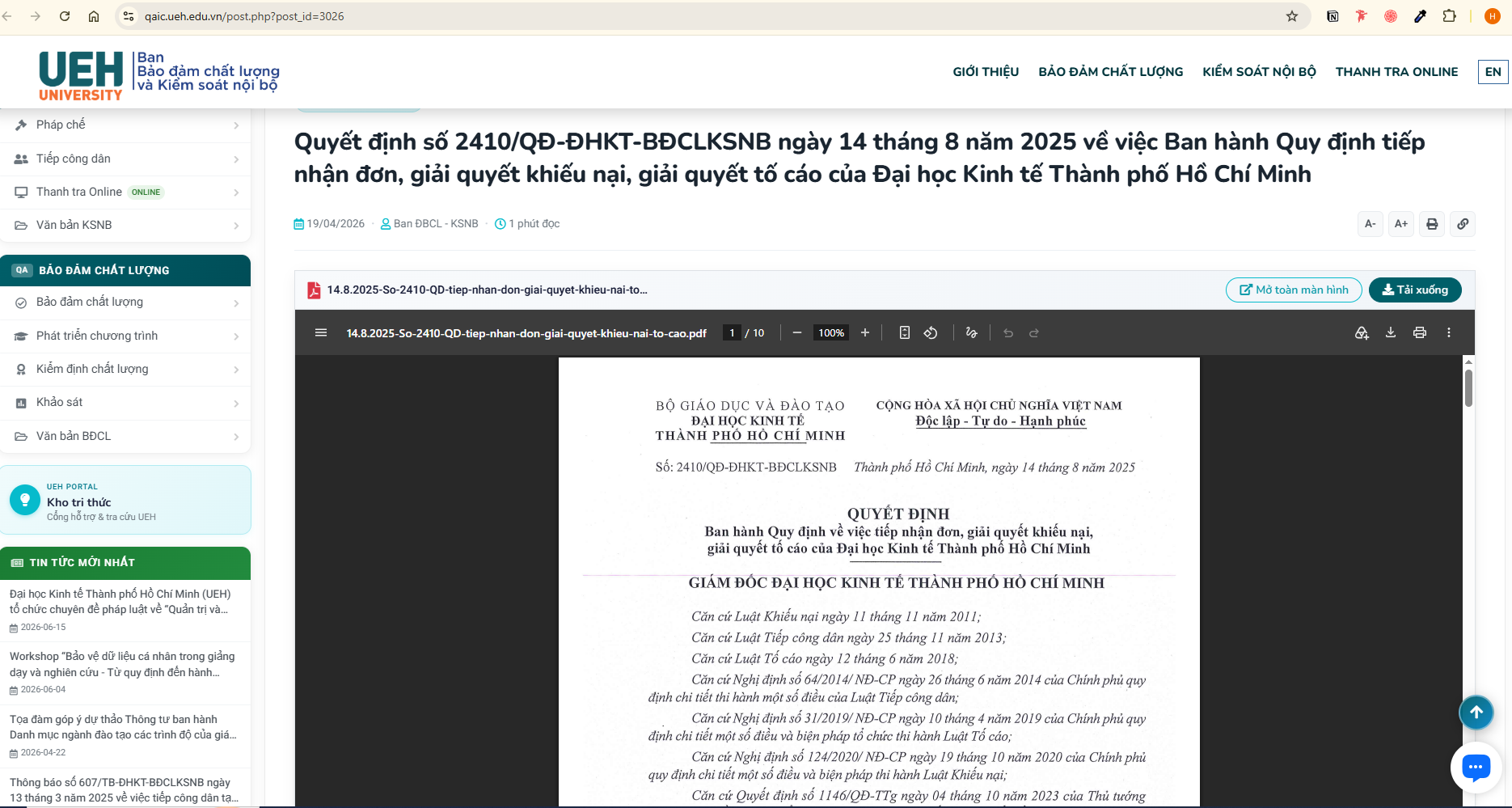
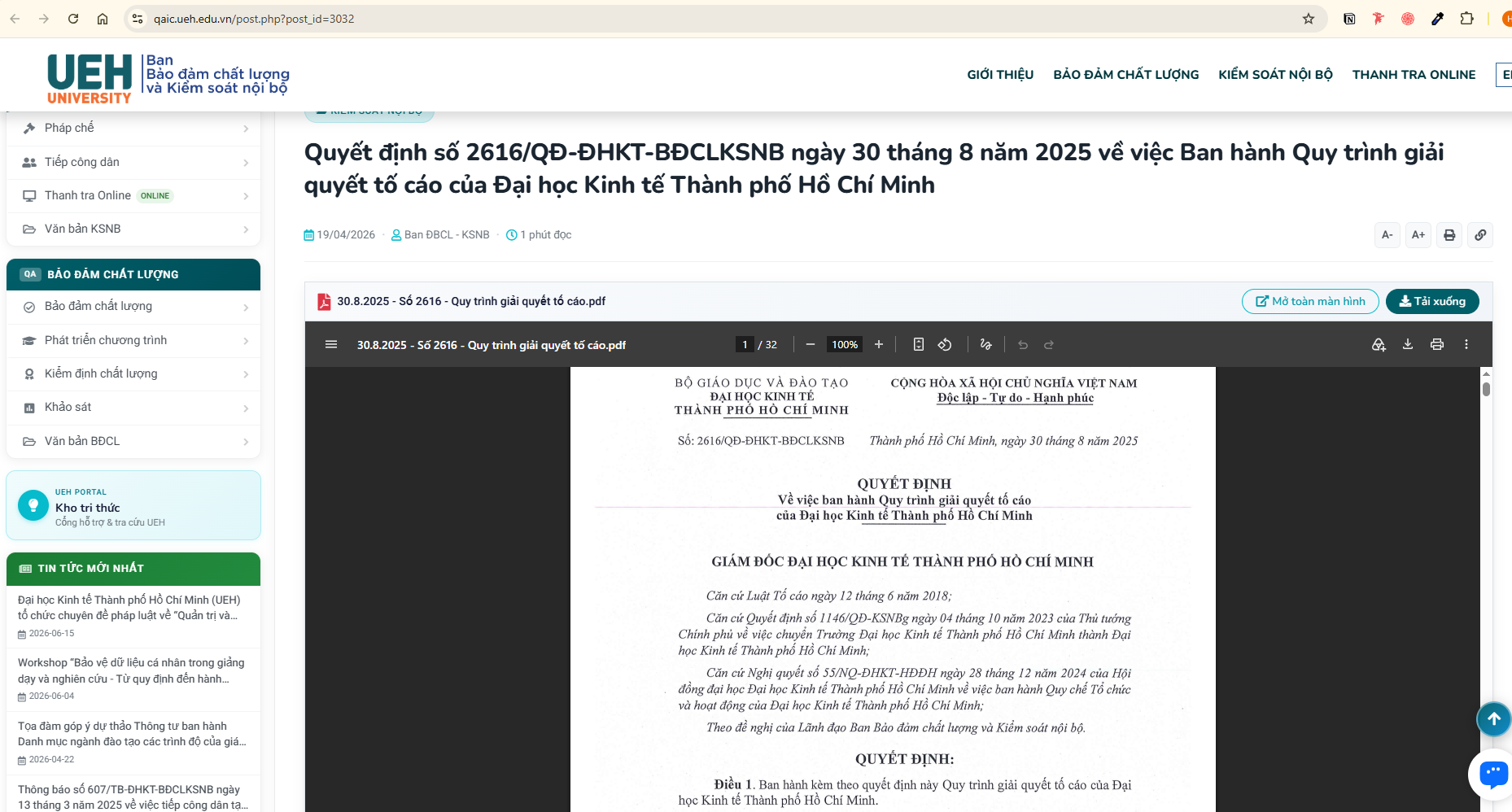
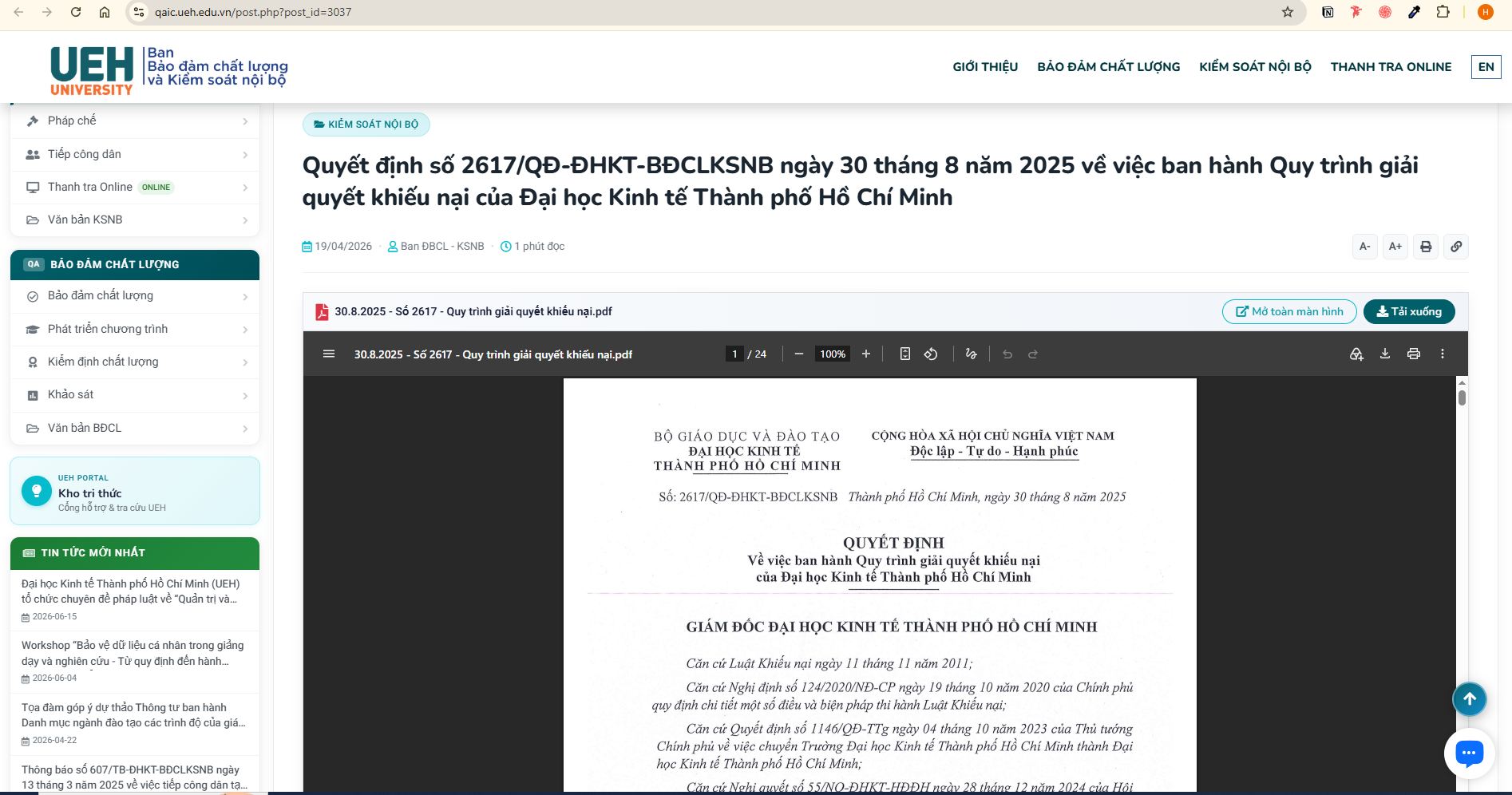
Source: UEH Quality Assurance and Internal Control Department.
These documents are implemented based on the 2011 Law on Complaints, the 2018 Law on Denunciations and other relevant regulations, ensuring that submissions are received and handled objectively, transparently and by the appropriate authority.
The documents clarify responsibilities for receiving, classifying and processing cases, with particular emphasis on the following principles:
- Confidentiality: Protecting personal information and the identities of complainants and individuals making denunciations within the scope prescribed by law.
- Transparency and Fairness: Reviewing cases objectively and in accordance with established procedures, while safeguarding the lawful rights and interests of all parties.
- Proper Authority: Receiving, classifying and resolving submissions according to their content and the responsibilities of the relevant functional units.
- Protection of Reporting Individuals: Applying measures to protect individuals making denunciations in accordance with the law and preventing unlawful retaliation, intimidation or adverse treatment.
For reports involving discrimination, harassment or violations of employment-related rights, the receipt and handling of each case are determined according to its nature, applicable scope and the authority of the relevant functional units.
UEH also publicly provides its policy on protecting individuals who report discrimination, helping raise awareness of the right to report misconduct and the mechanisms available to protect employees’ rights in the workplace.
The issuance of these regulations in 2025 contributes to strengthening the mechanisms for implementing the anti-discrimination policy, enabling civil servants, lecturers and employees to access channels for reporting concerns and requesting the resolution of conduct that may affect their lawful rights and interests.
4. Implementing Equality in Recruitment, Remuneration and Human Resource Development in 2025
In 2025, UEH continued to implement recruitment, job placement, training and human resource development activities based on professional standards, individual capabilities and job requirements, in line with its orientation towards building a fair and diverse working environment.
For example, on 31 March 2025, UEH announced a recruitment announcement for civil servants at UEH Mekong. On 10 October 2025, the University launched its talent attraction and development programme for UEH Nexus Nha Trang, alongside academic career development opportunities for individuals seeking to become Professors and Associate Professors at UEH. These announcements clearly specified recruitment quotas, qualification standards, job positions, application requirements and recruitment schedules. Applicants could access information on eligibility criteria, selection procedures and remuneration in accordance with the applicable regulations.
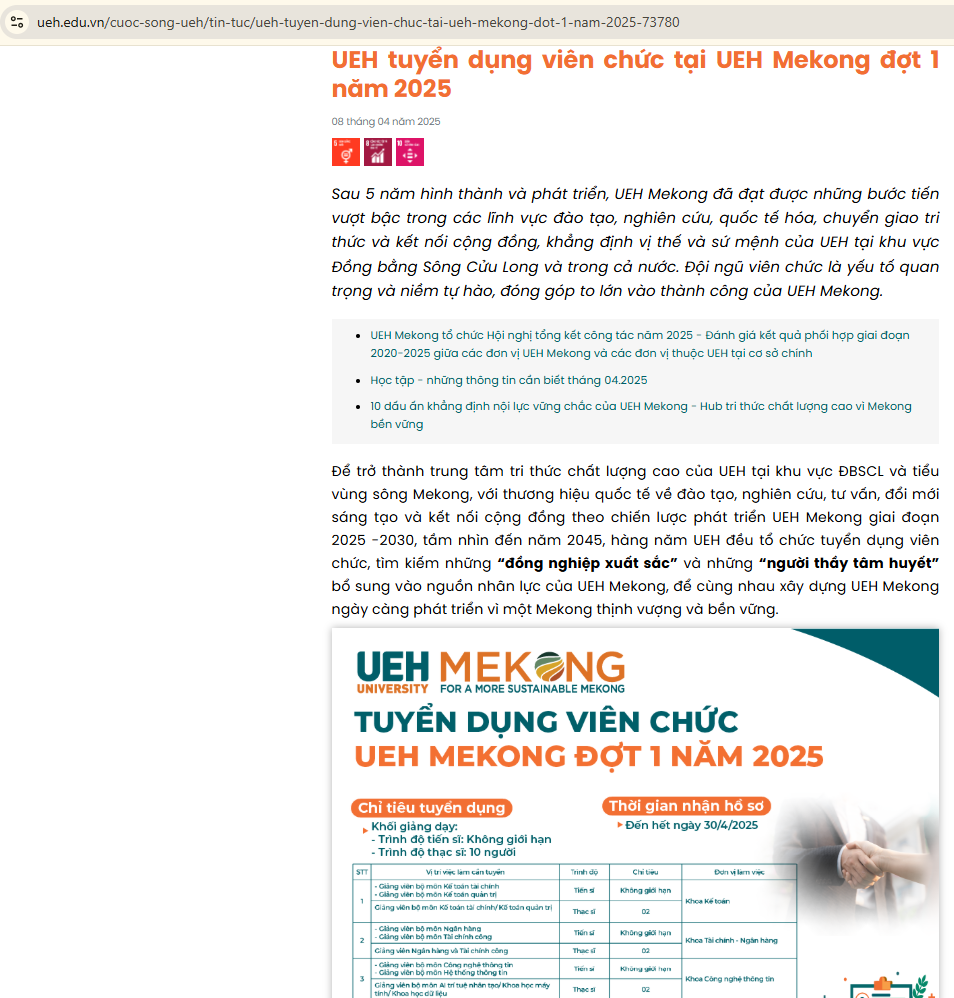
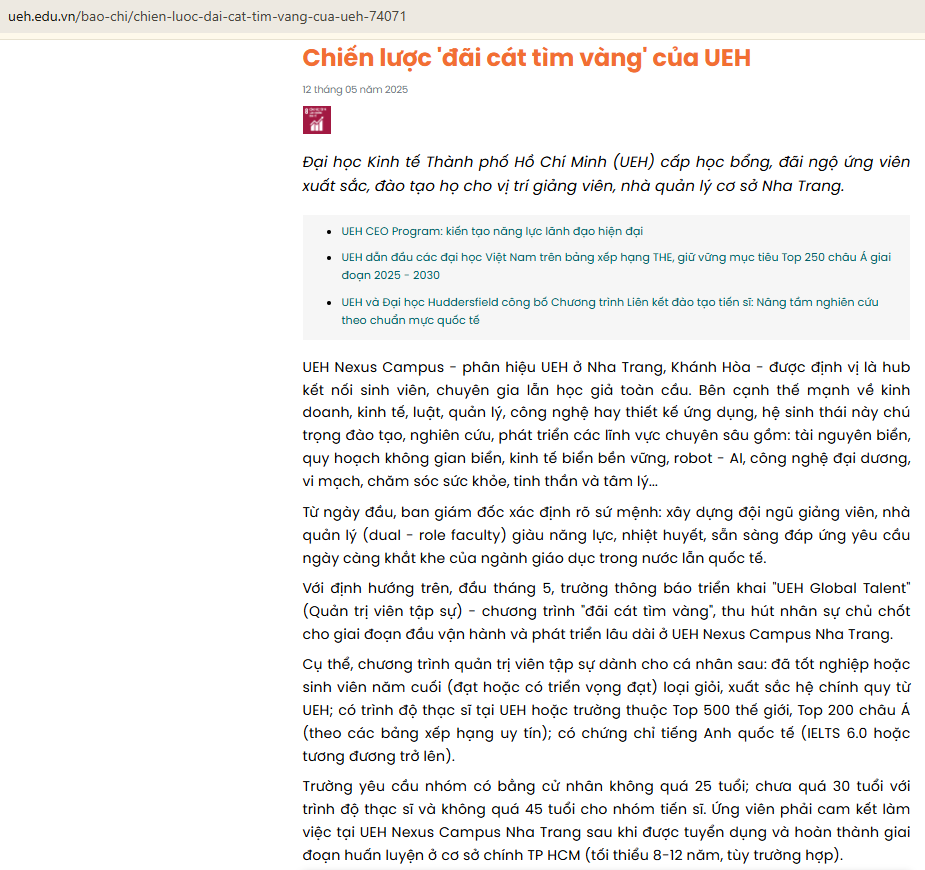
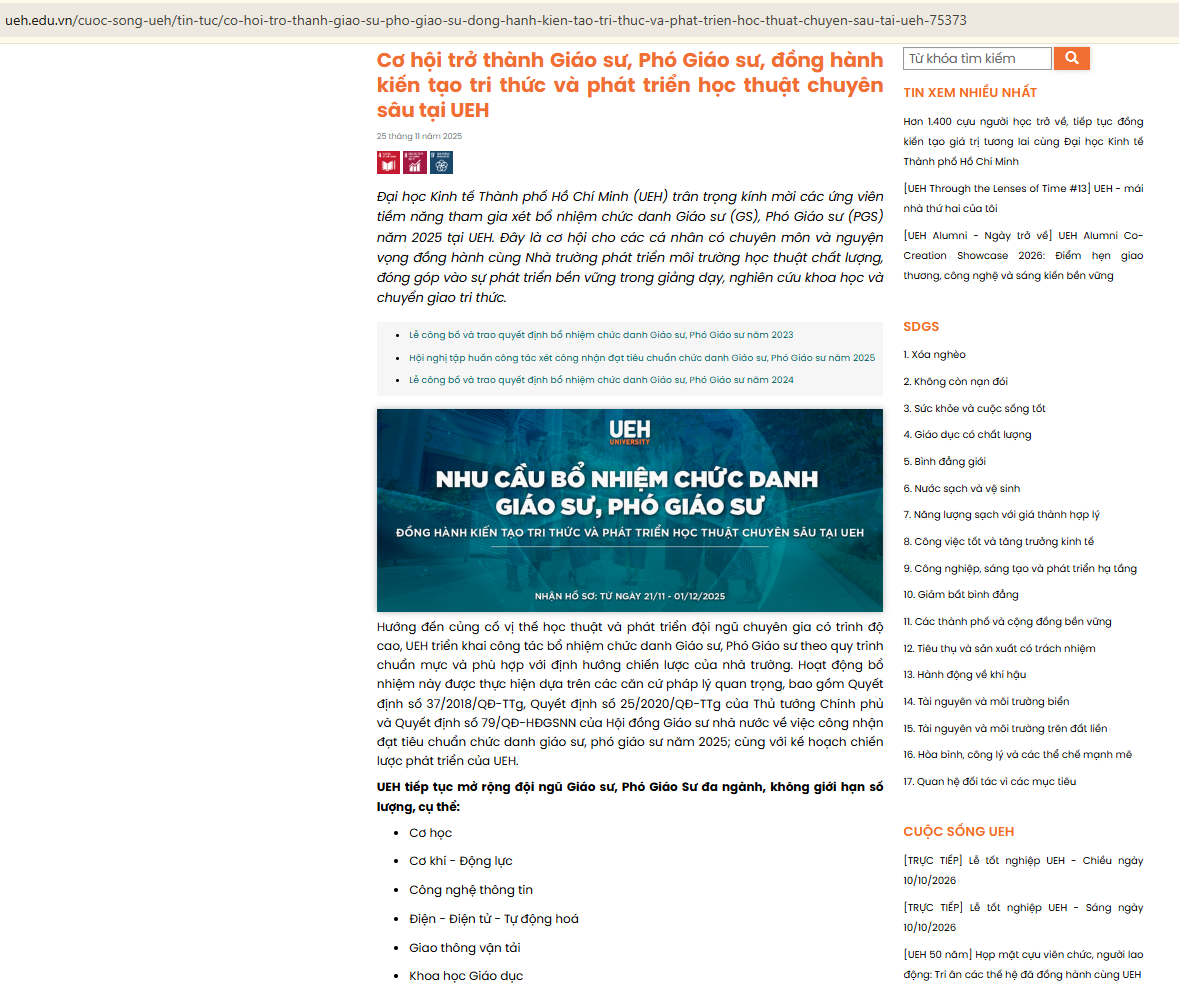
Recruitment and career development announcements published on UEH information channels in 2025.
Sources: UEH Portal – UEH Mekong Recruitment; “Searching for Talent”; Opportunities to Become Professors and Associate Professors.
At the same time, UEH’s salary and welfare policies establish that remuneration is determined by job position, qualifications, experience, responsibilities and work performance. Personal characteristics unrelated to job requirements are not used as grounds for discriminatory treatment.
5. Activities Implementing the Policy in 2025
In 2025, the University continued to implement gender-equal human resource development policies, with particular attention to training, professional development and career advancement opportunities for female civil servants, lecturers and employees. These programmes contribute to supporting women in strengthening their professional capabilities, participating in research and developing their careers in the university environment.
| Activity | Content and Results | Significance for the Anti-Discrimination Policy | Supporting Evidence |
| Non-Discriminatory Human Resource Policy | Continued implementation of recruitment, personnel planning and appointment principles based on capabilities and achievements, without discrimination based on protected personal characteristics.
Implemented open and transparent recruitment activities. |
Maintains a foundation for fair, diverse and inclusive human resource management.
Enhances transparency and access to recruitment information for candidates who meet the requirements of the positions. |
Source: UEH Portal – Human Resource Policies. |
| Mechanisms for Receiving and Handling Complaints and Denunciations | Issued Decision No. 2410 on 14 August 2025, and Decisions No. 2616 and 2617 on 30 August 2025. | Strengthens mechanisms for receiving and handling reports and protecting employees’ lawful rights and interests. | Source: UEH Quality Assurance and Internal Control Department (QAIC). |
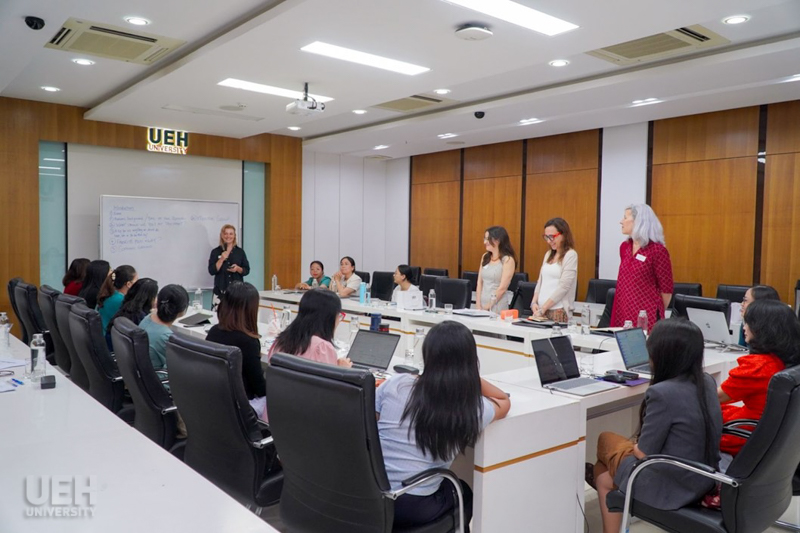
| Career Development for Female Lecturers and Researchers | From 30 July to 3 August 2025, UEH collaborated with EfD and WinEED to organise the international training programme “From Idea to Impact: Empowering Female Researchers for Grant Writing Success”, with the participation of 18 female researchers and 4 international experts. The programme focused on developing research proposal writing skills, accessing research funding and publishing internationally.
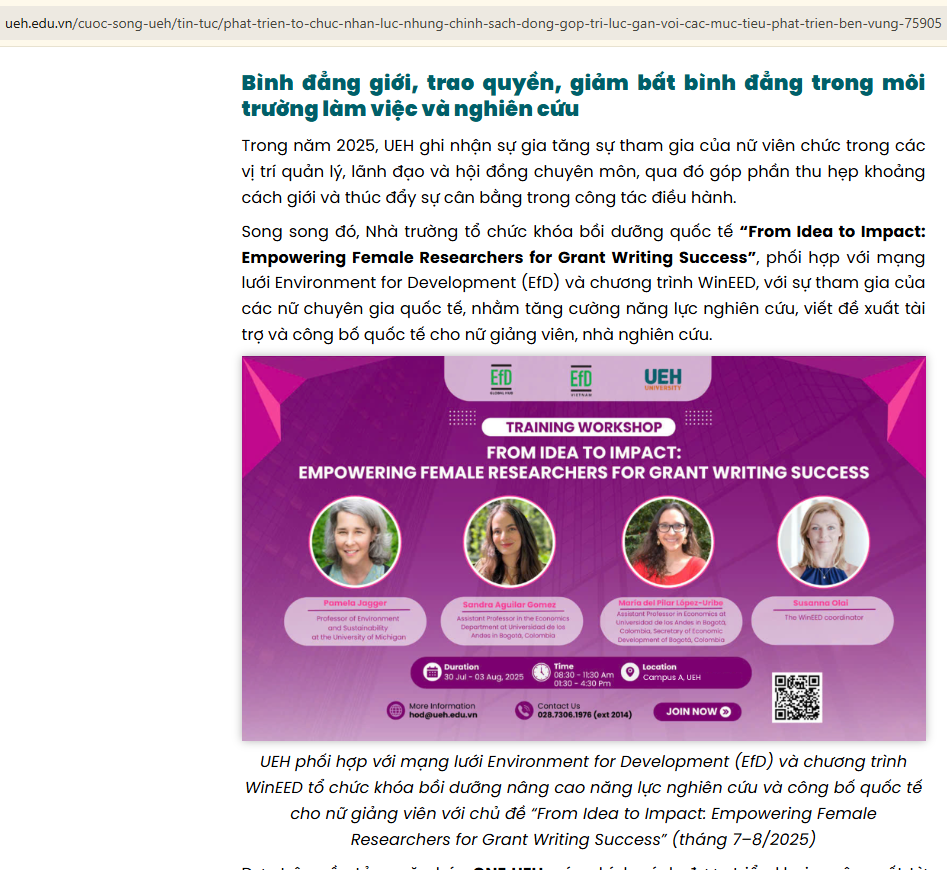
Organisation and Human Resource Development: Human resource policies contributing intellectual resources to sustainable development goals – UEH Portal, 11 February 2026.
|
Promotes gender equality and expands academic and career development opportunities for female lecturers and researchers. | UEH Portal – International Workshop, 21 August 2025. |
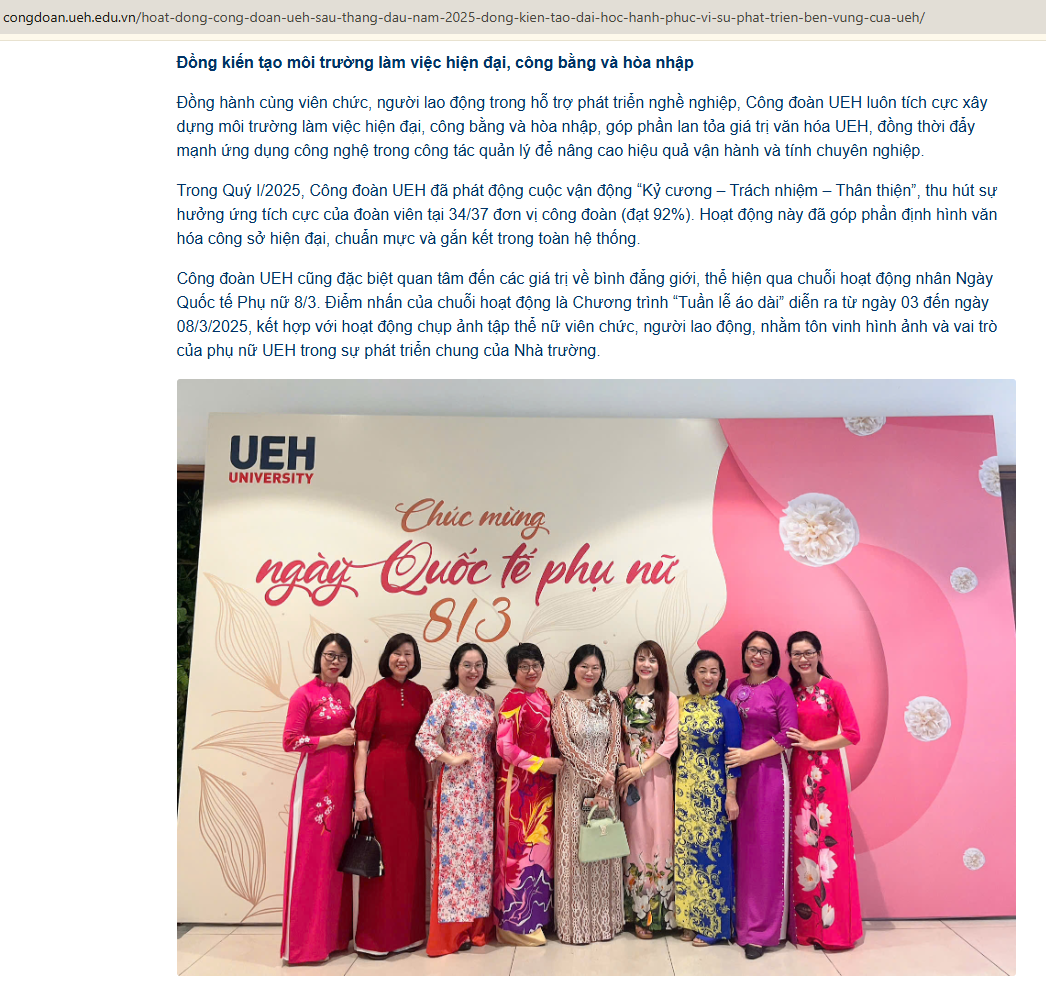
| UEH Trade Union Activities to Build a Friendly and Inclusive Working Environment | During the first six months of 2025, the UEH Trade Union implemented employee welfare activities and the “Discipline – Responsibility – Friendliness” campaign across 34 out of 37 Trade Union units (92%). It also organised activities recognising female civil servants and employees, as well as a mid-year review conference on 21 July 2025.
|
Strengthens employee representation and promotes respect, engagement and equality in the working environment. | UEH Trade Union – Activities in the First Six Months of 2025. |
| Promoting Gender Equality in Workforce Development | The 2025 results recorded that the proportion of female civil servants and employees holding leadership and management positions who received advanced training and professional development was nearly 20 percentage points higher than the Ministry of Education and Training’s 75% target. Women accounted for 52.6% of personnel holding master’s degrees, exceeding the 50% target. The proportion of female PhD holders among all PhD holders increased from 38.3% to 38.5%. | Provides practical data on support for capacity development and career opportunities for female civil servants and employees. | UEH Portal – “Implementation of Human Resource Policies Linked to the 17 SDGs”, 5 August 2026, reporting on 2025 data. |
| Maintaining Communication on Gender Equality and Prevention of Harassment | UEH maintains policy information and communication activities on identifying discrimination and sexual harassment, protecting affected individuals, and respecting diversity in gender, gender identity and sexual orientation. | Strengthens awareness of equality rights and contributes to building a culture that does not tolerate discrimination or harassment. | UEH Future – Anti-discrimination policy… |
These activities demonstrate UEH’s continued implementation of human resource management principles and employee protection measures. The anti-discrimination policy serves as a consistent foundation, while recruitment, training and complaint-handling activities support its practical implementation, reflecting UEH’s efforts to develop a fair, diverse and inclusive workforce through its management practices.
Conclusion
In 2025, University of Economics Ho Chi Minh City continued to maintain its workplace anti-discrimination policy, ensuring that recruitment, employment, evaluation, training, remuneration and career development are based on capabilities, achievements and job requirements.
UEH’s policy addresses all five groups identified under THE Sustainability Impact Ratings 2027, namely religion, sexual orientation, gender, age and refugee status, while demonstrating its commitment to respecting diversity and ensuring equal opportunities in the workplace.
Through the continued implementation of its Code of Conduct and human resource policies, as well as the issuance of regulations and procedures for handling complaints and denunciations in 2025, UEH continues to strengthen a human resource management foundation based on fairness, transparency and respect for employees’ rights and interests, contributing to SDG 8 – Decent Work and Economic Growth.