


The University of Economics Ho Chi Minh City (UEH) implements fair admission and enrollment policies without gender discrimination, combined with scholarship programs, financial support, and student care to create conditions for women to access, maintain, and develop in the higher education environment. In 2025, UEH continued to implement the policy through admission activities for Intake 51 at the Ho Chi Minh City campus (KSA) and UEH Mekong (KSV), while implementing support programs for female students, contributing to promoting equal opportunities and women’s participation in higher education.
1. Policies ensuring equal access and participation in study for women
1.1. Fair application, admission, and enrollment policies
UEH conducts admissions on the principles of openness, transparency, and ensuring equal opportunities for all candidates, including women, based on capacity, aspirations, and published admission conditions.
The policy is stipulated in UEH’s Regulations on Organizing Undergraduate Admissions (school codes KSA, KSV), issued together with Decision No. 584/QD-DHKT-DT dated February 16, 2024.
According to Clause 2, Article 3, UEH implements necessary measures to create favorable conditions and equal opportunities for candidates and to select learners according to their aspirations and suitable capacities.
Clause 1, Article 4 stipulates the principles ensuring fairness in admissions, including the right to access full information, to be objectively assessed, not to have admission opportunities restricted by requirements unrelated to capacity, to choose suitable aspirations, and to be consulted, supported, and have complaints resolved to protect legitimate rights.
These principles are consistent with Article 14 of the Law on Gender Equality No. 73/2006/QH11, ensuring equality between men and women in choosing majors, accessing, and benefiting from education policies.
In 2025, UEH continued to implement the policy through Decision No. 1647/QD-DHKT-DT dated May 22, 2025 on Undergraduate Admission Information for 2025 (school code KSA) and admission notices for Cohort 51. The University implements five admission methods, publicly discloses conditions and principles for converting equivalent admission scores, and does not impose separate restrictions on female candidates.
Evidence sources:
- UEH Department of Training – Decision issuing UEH’s Regulations on Organizing Undergraduate Admissions, school codes KSA and KSV – Decision No. 584/QD-DHKT-DT dated February 16, 2024, Clause 2 Article 3 and Clause 1 Article 4.
- UEH Department of Student Affairs – Notice of Admission Scholarship Results for Intake 51 – Full-time Undergraduate – basis: Decision 1647/QD-DHKT-DT dated May 22, 2025, five admission methods and score conversion principles.
- UEH Admissions Portal – Notice on equivalent conversion of admission scores among admission methods for Intake 51 in 2025..
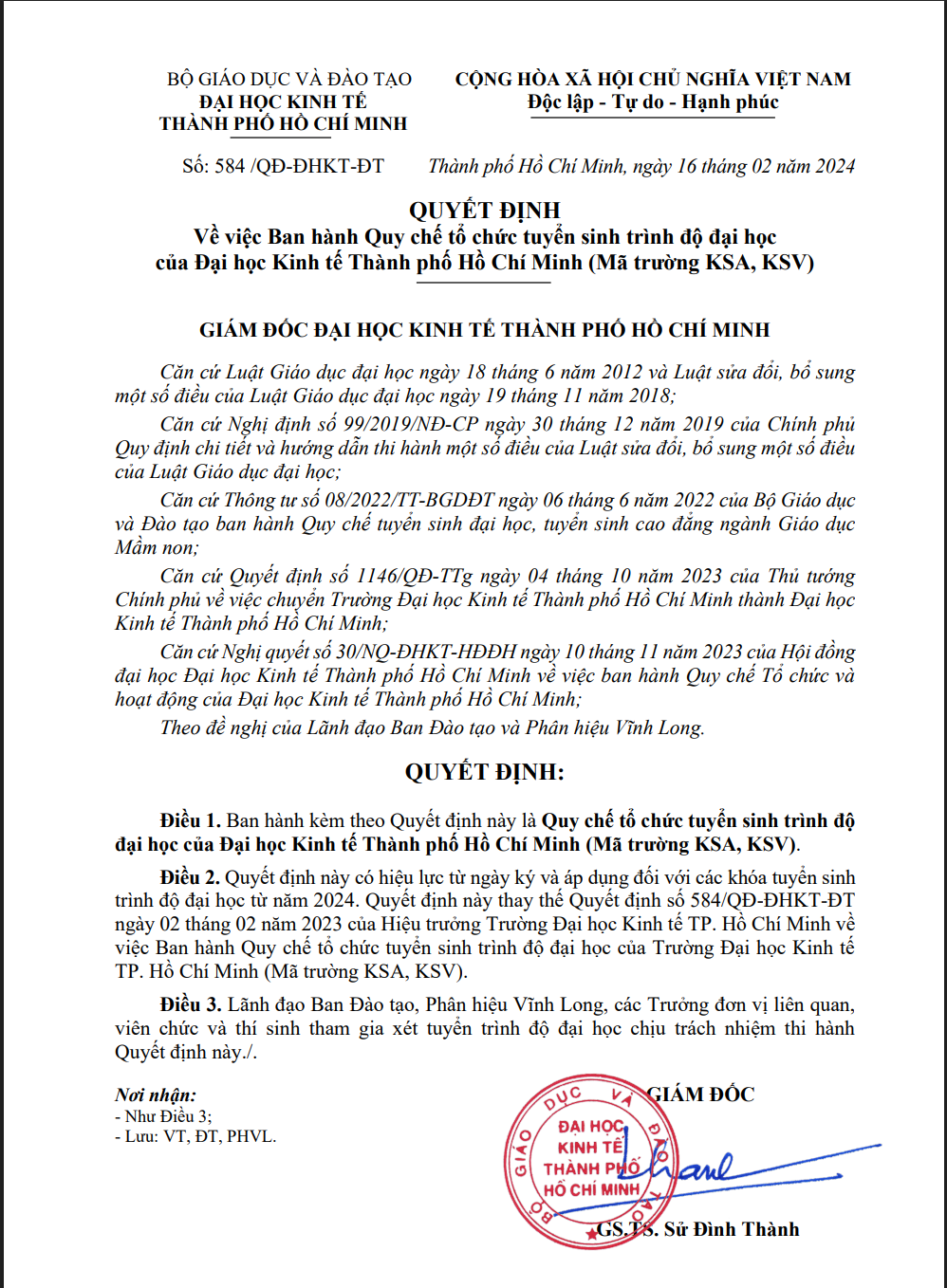
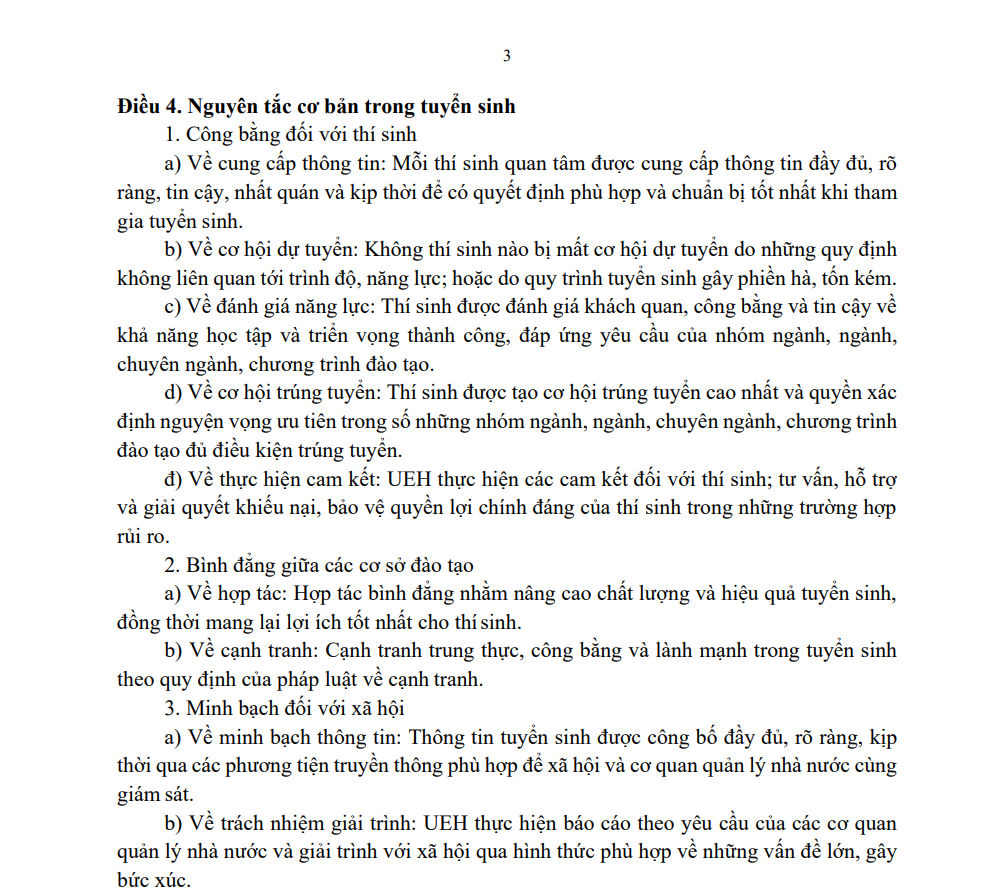
Decision 584/QD-DHKT-DT, Clause 2 Article 3 and Clause 1 Article 4 on equal admission opportunities
1.2. Scholarship policies supporting female students to continue their studies
In addition to the fair admission policy, UEH implements a scholarship system to support learners in overcoming financial difficulties, encouraging academic achievements, and creating conditions for participation in academic activities.
The policy was issued under Decision No. 2976/QD-DHKT-CSHTNH dated July 31, 2024 on Regulations on Scholarship Policies for Students at UEH, effective from the date of signing and applied from the final semester of 2024, and continued to be implemented in 2025.
According to Article 2, UEH stipulates six scholarship categories: Academic Encouragement; Dual Degree/Dual Major; International Student Exchange; Study Support; Emergency Support; and Scholarships from units outside UEH.
Among them, the Study Support scholarship is for new students with difficult circumstances and students meeting conditions regarding circumstances, academic results, and training. Article 4 stipulates full scholarships equivalent to 100% and partial scholarships equivalent to 50% of the average tuition fee for 15 credits, according to the corresponding program and review conditions. Articles 5–6 stipulate the basis for review, granting principles, and ensuring scholarship rights.
The programs are implemented according to public review conditions, creating opportunities for female students to access financial support when applying, enrolling, and during the training process.
UEH also implements the Code of Conduct under Decision No. 695/QD-DHKT-CTCT dated April 4, 2017, in which Clause 3, Article 16 does not allow repression, favoritism, discrimination, or prejudice against learners, contributing to maintaining a fair and respectful educational environment for women.
Evidence sources:
- UEH Department of Training – Full text of Decision 2976/QD-DHKT-CSHTNH and Regulations on Scholarship Policies for Students – Articles 1–6; especially Article 2 on six scholarship categories, Article 4 on full and partial scholarships
- UEH Department of Student Affairs – Notice of UEH Study Support Scholarship Program, Final Semester 2025 for new students of Intake 51 – subjects, conditions, and scholarship amounts.
- UEH Department of Student Affairs – Decision granting UEH Study Support Scholarships, Final Semester 2025 for new students of Intake 51 – recognizing 94 students awarded scholarships.
- UEH Department of Student Affairs – UEH Culture – Code of Conduct, Clause 3 Article 16.
2. Implementation of policies from application to enrollment in 2025
UEH continued to implement the admission, acceptance, and enrollment process for Intake 51 at KSA and KSV, ensuring female candidates have access to information, choose majors, and carry out procedures according to the common process.
| Stage | Implementation activities in 2025 | Results – Impact |
| Application | Publicly disclose admission methods, guide account registration, provide evidence, and track application status for Intake 51. | Female candidates have access to application procedures and choose training programs according to their capacity. Source:Guidelines for providing application evidence for Intake 51 – Full-time Undergraduate in 2025.. |
| Admission and acceptance | Implement five admission methods, publicly disclose principles for converting equivalent admission scores among methods. | Ensure opportunities to be considered under unified conditions and principles, without gender discrimination. Source:Notice of Admission Scholarship Results for Intake 51 – Full-time Undergraduate, section “Admission methods in 2025”. |
| Enrollment and access to support | Guide enrollment confirmation, electronic profile declaration, result lookup, and provide information on tuition, scholarships, dormitory, and student credit. | Support female new students in completing enrollment and accessing appropriate financial policies. Source:UEH notice guiding enrollment procedures for Intake 51 – Full-time Undergraduate in 2025, sections 3–4. |
| Expanding access at UEH Mekong | Organize online and in-person supplementary admissions, waive supplementary admission fees, and allow registration of up to three aspirations. | Reduce procedural and cost barriers, creating additional access opportunities for candidates in the Mekong Delta, including women. Source: Guidelines for supplementary admission for Intake 51 to UEH Mekong in 2025. |
3. Results of supporting female students in enrollment and study participation in 2025
3.1. Admission scholarships, study support scholarships, and financial support
In 2025, UEH continued to implement scholarship programs based on achievement, capacity, and circumstances, contributing to reducing financial barriers for learners, especially female students in need of support.
At the Intake 51 Opening Ceremony on September 26, 2025, UEH announced it had awarded more than VND 11.2 billion in admission scholarships and study support scholarships to new students of Intake 51. Among them, many female new students received awards and scholarships for outstanding achievements, demonstrating recognition and direct support for women from the enrollment stage.
For students facing difficulties, UEH implemented the Study Support Scholarship program for the final semester of 2025, with a policy of review based on circumstances and admission scores. The official scholarship granting decision recognized 94 new students of Intake 51 receiving Study Support scholarships. This is the number of students benefiting from the common policy, not a separate figure for women.
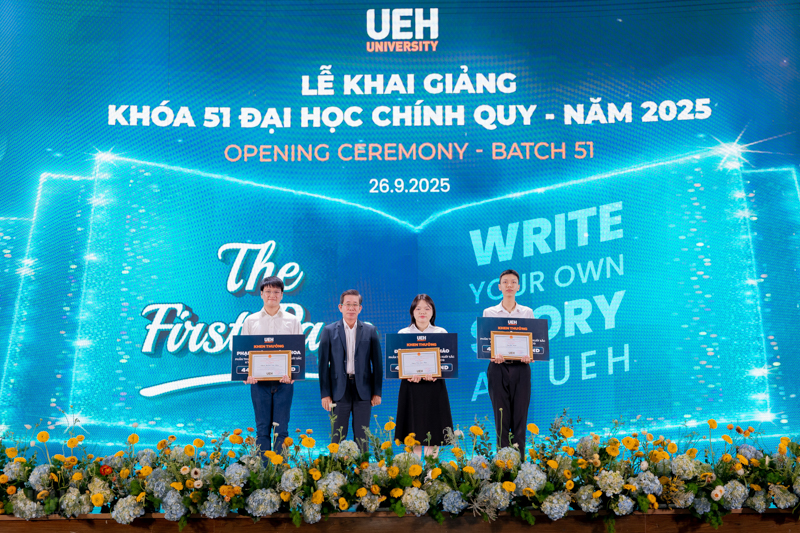
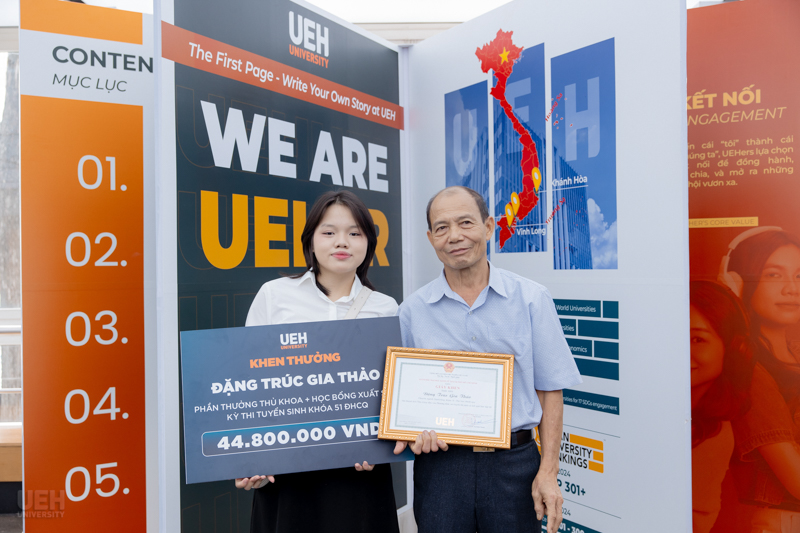
Awarding certificates, prizes, and scholarships to valedictorians of Intake 51, including female students
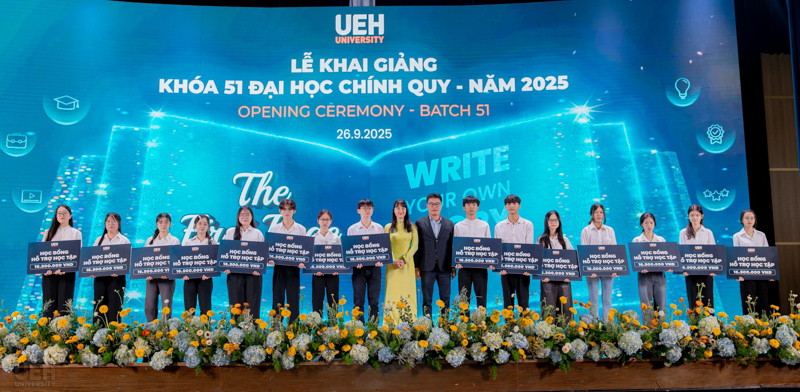
UEH awarded admission scholarships and study support scholarships to new students of Intake 51, including female students, with a total scholarship value announced at more than VND 11.2 billion in 2025. Source: UEH Portal, September 26, 2025.
Additionally, the UEH Department of Student Affairs publicly disclosed the results of 3,049 scholarship slots awarded to female students in 2025, accounting for 69.36% according to published statistics. The results reflect women’s participation in study support and development programs at UEH.
Evidence sources:
- UEH Portal – “Intake 51 Opening Ceremony – Full-time Undergraduate UEH: The First Page – Write Your Own Story at UEH”, September 26, 2025 – section “Honoring outstanding efforts”; results of more than VND 11.2 billion in scholarships and images of awards to new students.
- UEH Department of Student Affairs – “Decision granting UEH Study Support Scholarships – Final Semester 2025 for new students of Intake 51” – recognizing 94 students.
- UEH Department of Student Affairs – “UEH promotes equality and empowers women in the academic environment”, 2025 – section “Number of female students receiving scholarships at UEH reaches a high level”.
3.2. Counseling, integration, and empowerment for female students
In parallel with financial policies, UEH continued to support female students in study, psychology, life, and the process of adapting to the university environment.
The Department of Student Affairs implemented counseling activities, supported female students facing difficulties, and implemented programs to raise awareness of gender equality. Notable in 2025 were the Equal Voice 2025 program and the training session “Gender Equality: Where is the ‘gender’ limit?“, contributing to helping students identify gender stereotypes, enhance confidence, and proactively participate in academic and community activities.
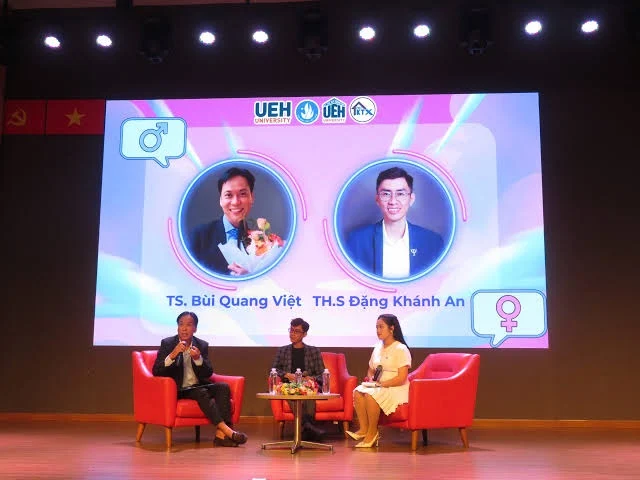
Gender Equality Competition – Equal Voice 2025
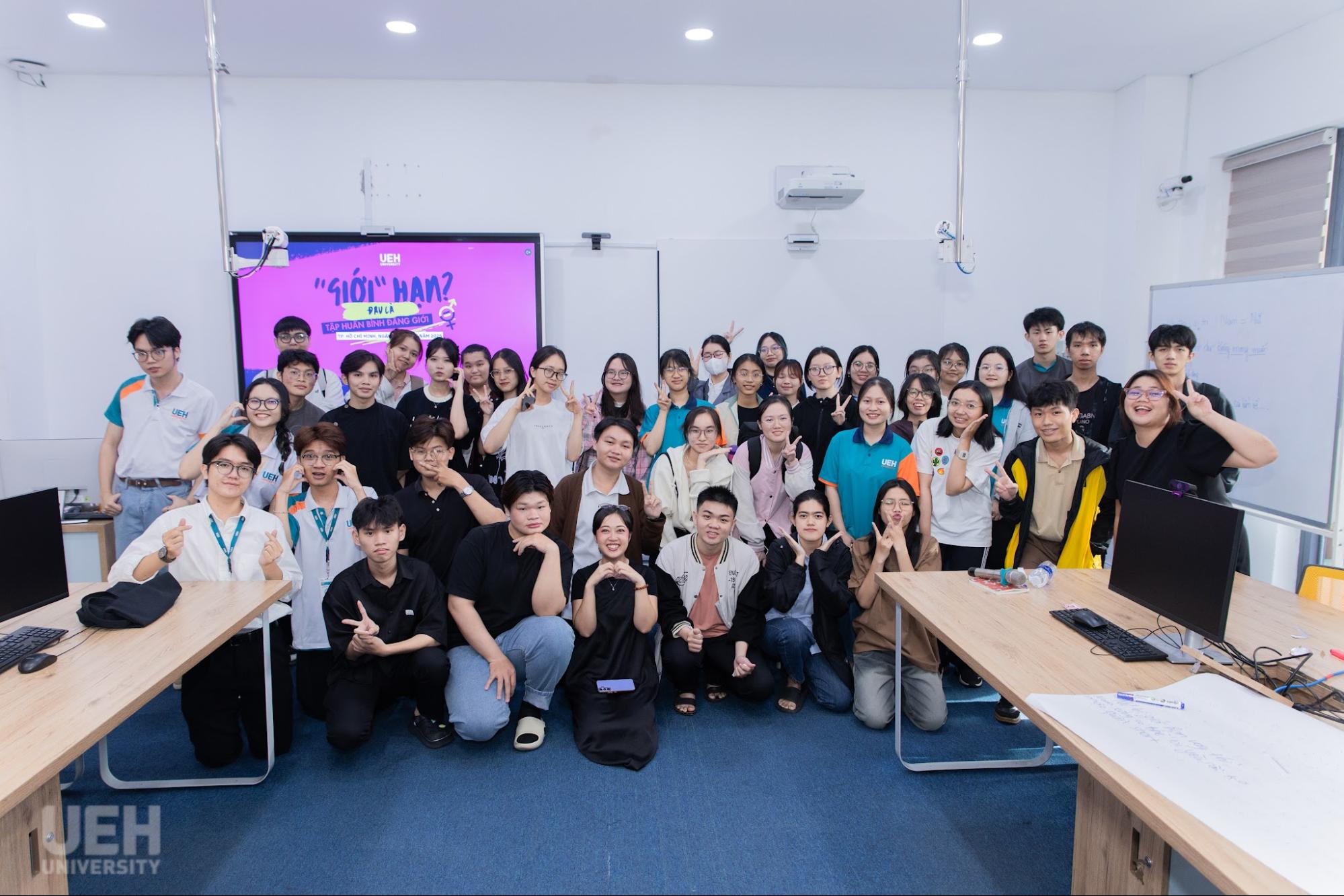
Training session “Gender Equality: Where is the ‘gender’ limit?”
Sources:
- UEH Department of Student Affairs – “UEH promotes equality and empowers women in the academic environment” – sections on counseling female students, gender equality, and empowerment.
- UEH Portal – “Exploring the ‘gender’ limit: What do UEH students say about gender equality?”, March 2025..
4. Implementation results and development orientation
Compared to 2024, UEH continued to maintain the fair admission policy under Decision 584/QD-DHKT-DT, while publicly disclosing and implementing admission conditions for Intake 51 in 2025. The scholarship policy under Decision 2976/QD-DHKT-CSHTNH continued to be implemented through support programs for new students and current students.
Notably, the awarding of more than VND 11.2 billion in scholarships to new students of Intake 51, together with scholarship results for female students and counseling and integration support activities, demonstrates the combination of fair admission policies and practical measures to support study participation.
Through the system of policies and programs accompanying learners, UEH continues to reduce financial and participation barriers, aiming for a higher education environment where women have opportunities to study, develop capacity, and pursue personal aspirations.
5. Conclusion
In 2025, the University of Economics Ho Chi Minh City continued to implement policies ensuring equal opportunities for women from application, admission, enrollment to participation in study. The policy is concretized through the Admission Regulations, the Intake 51 admission management system, the Scholarship Regulations, and student care programs.
The combination of fair admission regulations with financial support, counseling, and empowerment activities contributes to creating conditions for female students to access higher education, maintain studies, and develop according to their capacity and aspirations, contributing to SDG 5 – Gender Equality.