

University of Economics Ho Chi Minh City (UEH) implements a comprehensive remuneration and benefits policy based on the principles of fairness and transparency, ensuring that all faculty members, civil servants and employees receive an adequate living income that is competitive with prevailing benchmarks. In 2025, UEH continued to review its income distribution policies, implement measures to support employees’ livelihoods, and benchmark staff income against international living wage standards. These efforts contribute to a stable, sustainable and supportive working environment, in alignment with SDG 8 – Decent Work and Economic Growth.
1. Commitment and Policies to Ensure a Living Wage
University of Economics Ho Chi Minh City (UEH) identifies the provision of adequate income, the improvement of living conditions and the enhancement of employee welfare for faculty members, civil servants and employees as important components of its human resource development policy. These commitments are aligned with UEH’s Multidisciplinary and Sustainable University Strategy and the UEH Happy University Project.
In 2025, in line with the State’s salary policy orientations for public service units, UEH operated its remuneration and income distribution system based on the principles of fairness, openness, transparency and non-discrimination.
Building on the advantages of a fully autonomous public higher education institution, UEH structures the remuneration of its civil servants and employees around three main components:
- Base salary and allowances: Strictly comply with the applicable State regulations on salary grades, ranks and allowances.
- Additional income: Allocated based on work performance, in accordance with the University’s Internal Expenditure Regulations and Income Distribution Plan.
- Bonuses and benefits: Flexible remuneration, recognition and reward schemes are implemented in accordance with applicable regulations to appropriately recognise each individual’s capabilities and contributions.
Through these policies, UEH both ensures compliance with the State’s current salary regulations and proactively adjusts its income distribution arrangements in line with the University’s financial autonomy. This provides a foundation for protecting employees’ rights, improving human resource management and fostering a fair, transparent working environment that motivates sustainable development.
In 2025, UEH continued to implement human resource policies aligned with the 17 SDGs, mobilising intellectual contributions towards sustainable development. The policy was published on the UEH Portal on 5 August 2025. UEH’s salary and remuneration and income policies are also available in the UEH Knowledge Repository.
Notably, in July 2025, UEH issued Notice No. 1725/TB-ĐHKT-TCKHĐT on the Adjustment of the Income Distribution Plan. Under this adjustment, the allowance was increased from VND 700,000 per person per month to VND 2,800,000 per person per month through the UEH income-point conversion mechanism, equivalent to an increase of 7.5 income points. This adjustment demonstrates UEH’s proactive use of its financial autonomy to improve remuneration, increase employee income and safeguard the rights and interests of its civil servants and employees, in accordance with the income distribution plan and relevant regulations.
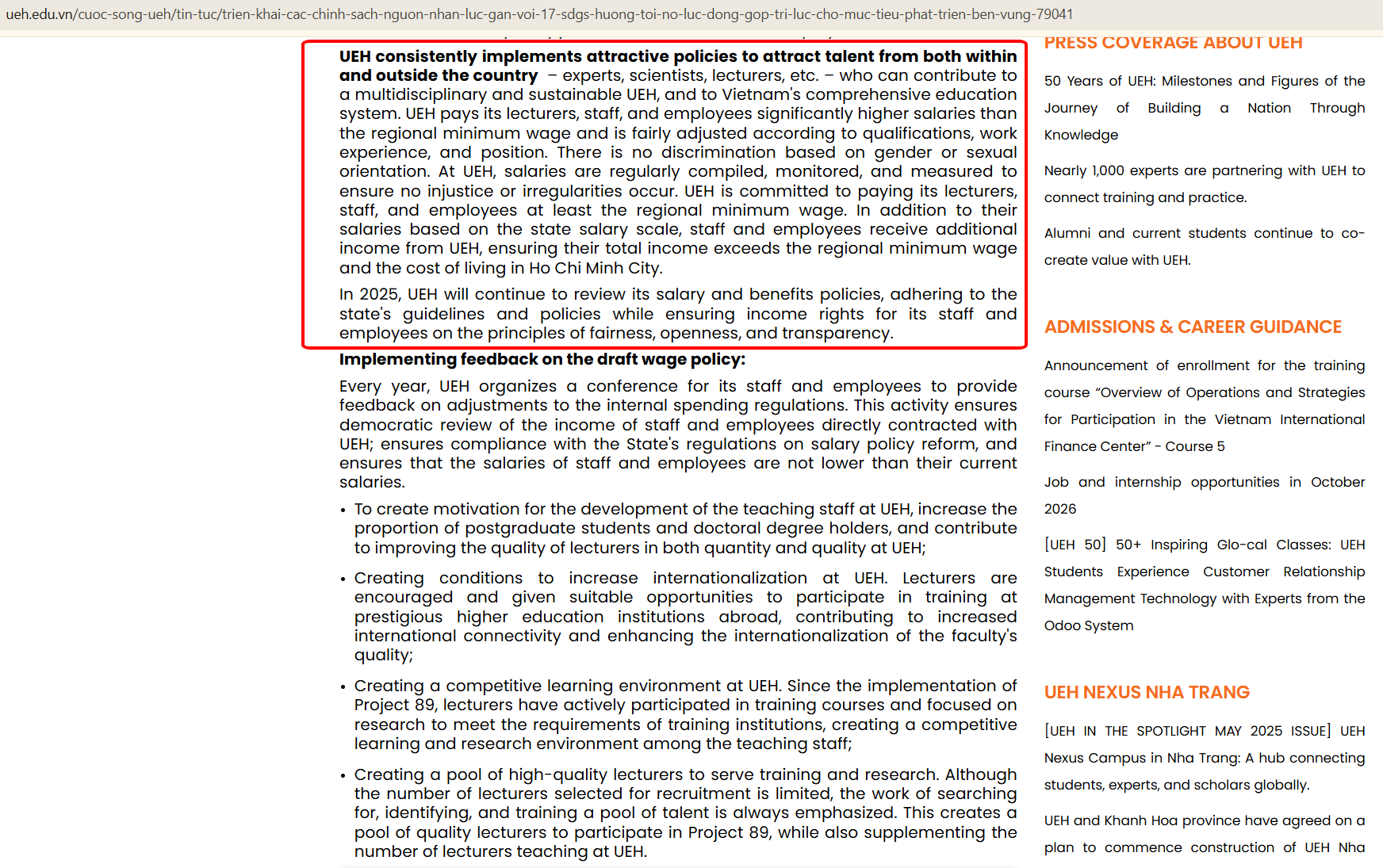
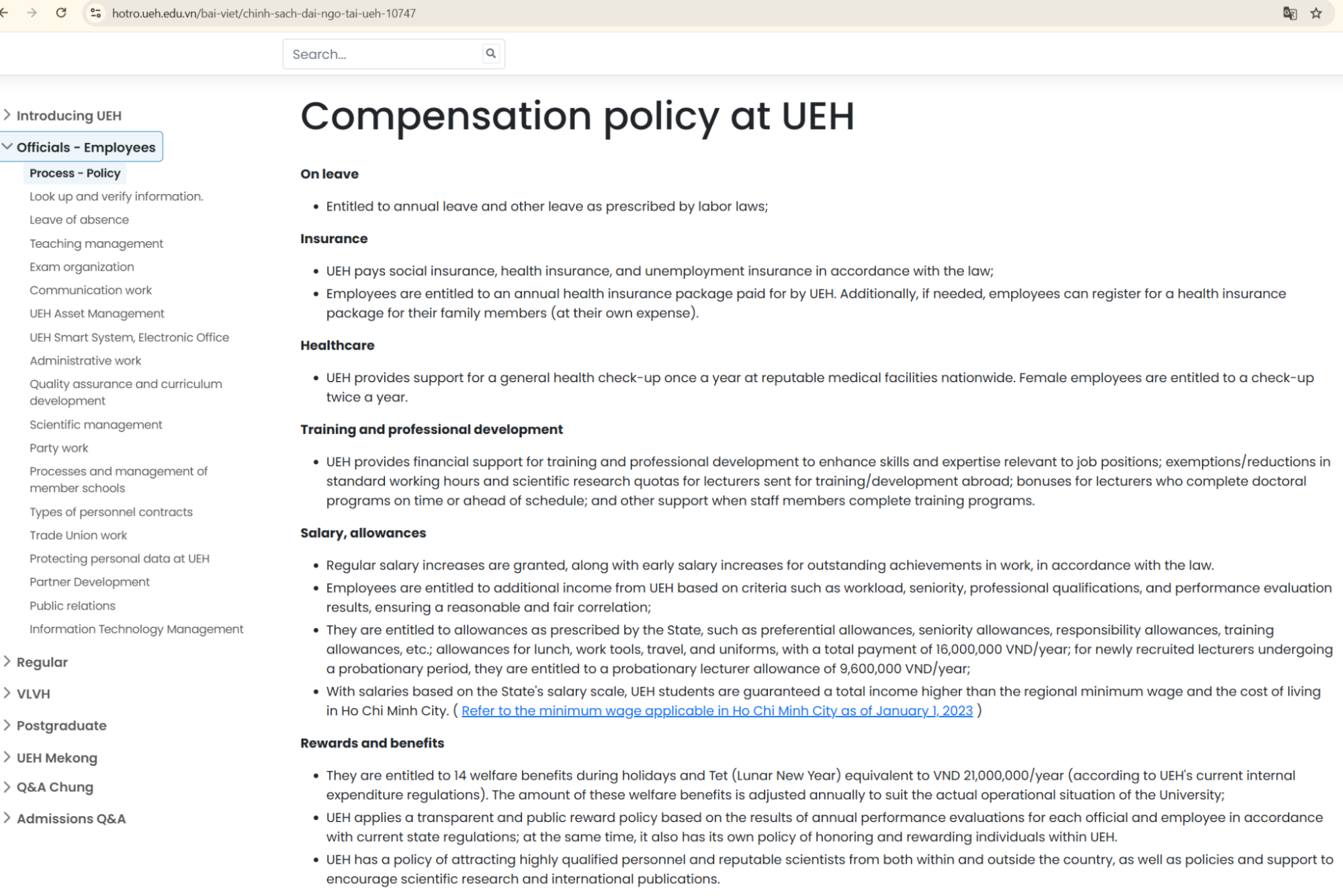
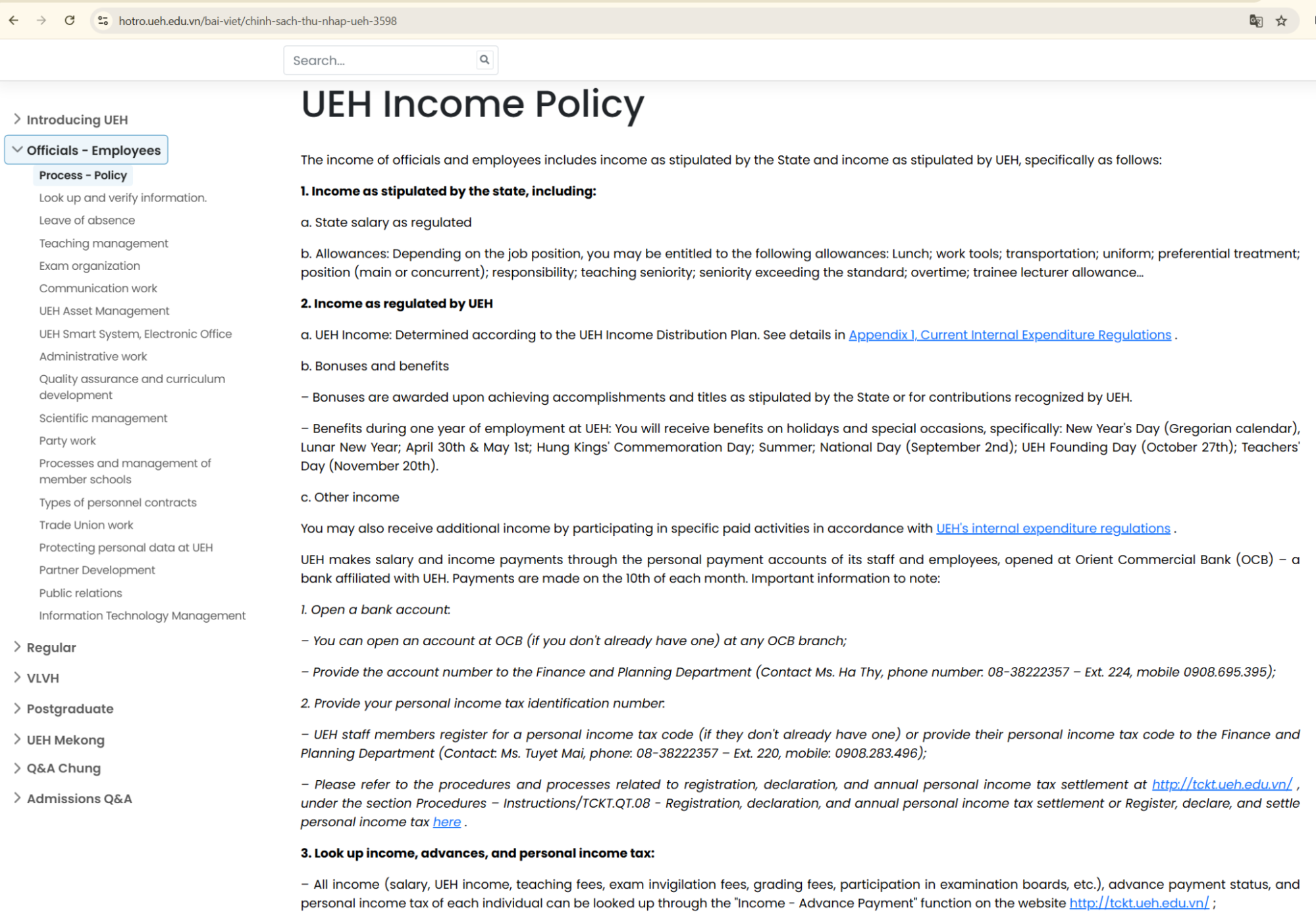
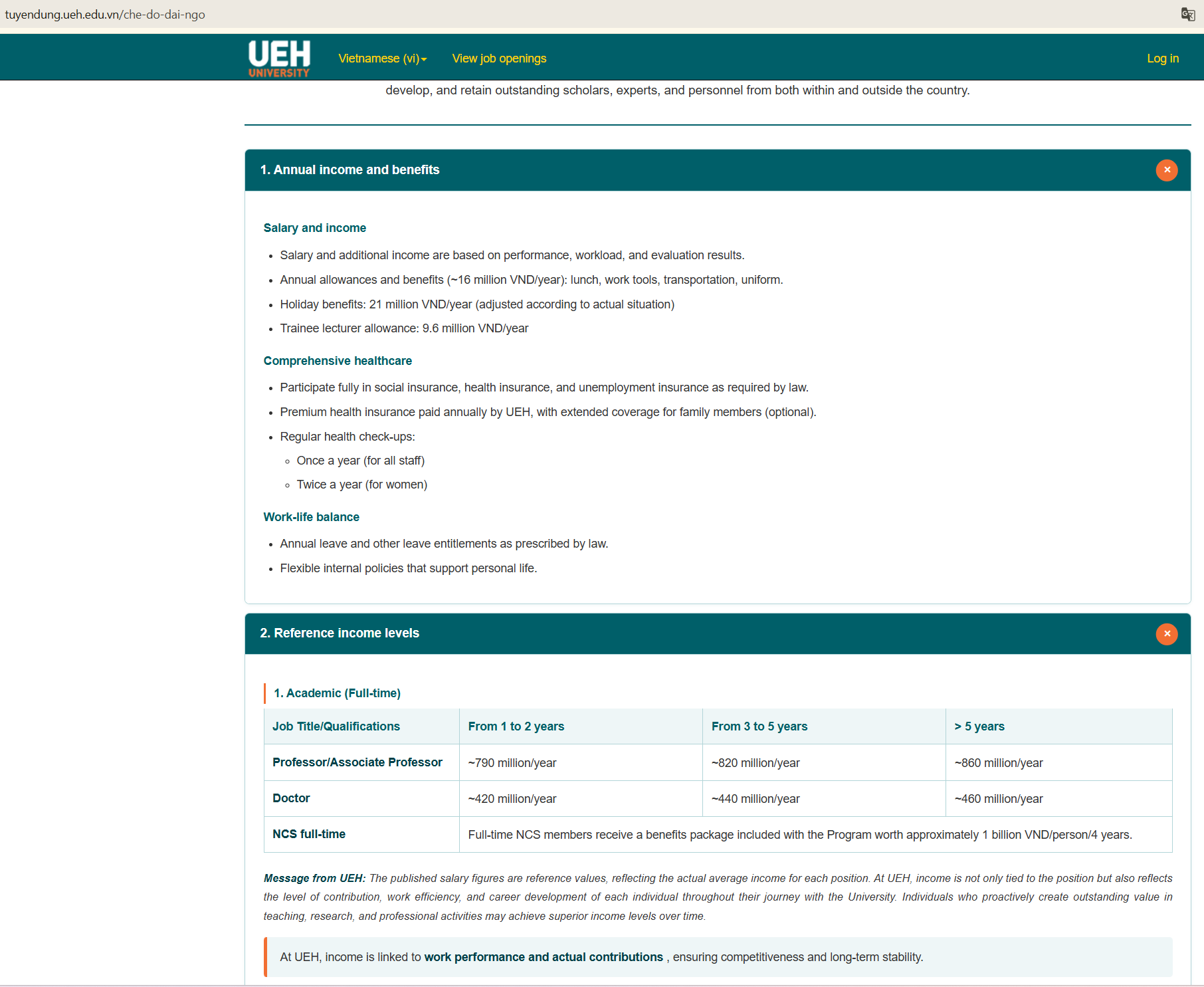
Figure. UEH’s human resource policies aligned with the 17 SDGs, demonstrating its commitment to ensuring adequate income and protecting employees’ rights and benefits.
Sources:
- UEH Portal – Implementation of Human Resource Policies Aligned with the 17 SDGs, 5 August 2025.
- UEH English – The Implementation of Human Resource Policies Linked to the 17 SDGs, 27 January 2025 – information on salary mechanisms, additional income and fairness principles, primarily reflecting policies implemented in 2024 and continued to be referenced in 2025.
- UEH Recruitment Portal: https://tuyendung.ueh.edu.vn/che-do-dai-ngo
- UEH Knowledge Repository: salary and remuneration policy; income policy.
2. Benchmarking UEH Income Against the Living Wage Standard in 2025
Under Government Decree No. 74/2024/ND-CP, the Region I statutory minimum wage applicable in 2025 was VND 4,960,000 per month, equivalent to VND 23,800 per hour.
However, the statutory minimum wage is not equivalent to a living wage, which represents the income required for workers and their families to meet essential living needs.
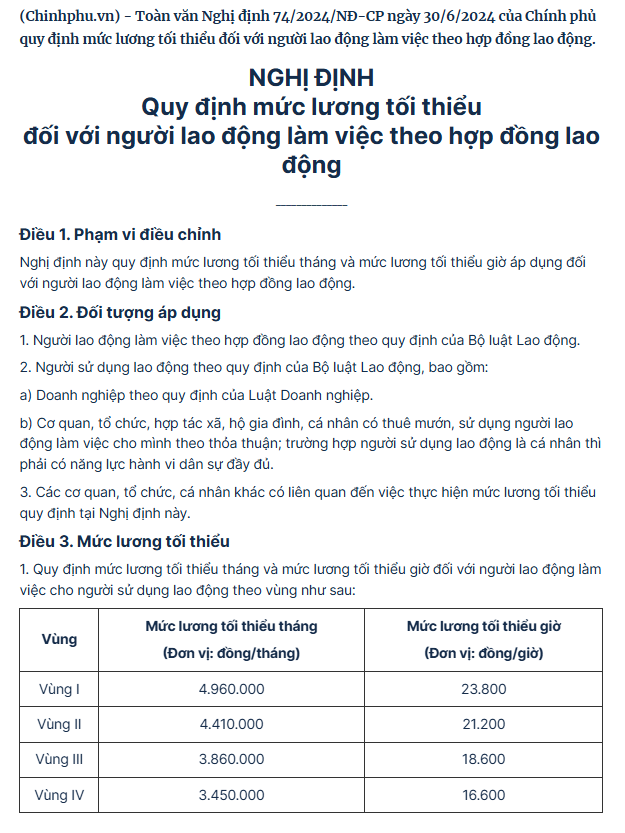
Figure 4. Region I statutory minimum wage under Decree No. 74/2024/ND-CP.
Source: Government of Vietnam – Decree No. 74/2024/ND-CP.
According to the Global Living Wage Coalition (GLWC), the 2025 living wage benchmark for Region I, Vietnam, was VND 9,294,701 per worker per month. This benchmark is calculated using the Anker Methodology, based on the costs of food, housing, healthcare, education, transport and other basic needs. Using a reference of 176 working hours per month, this is equivalent to approximately VND 52,811 per hour.
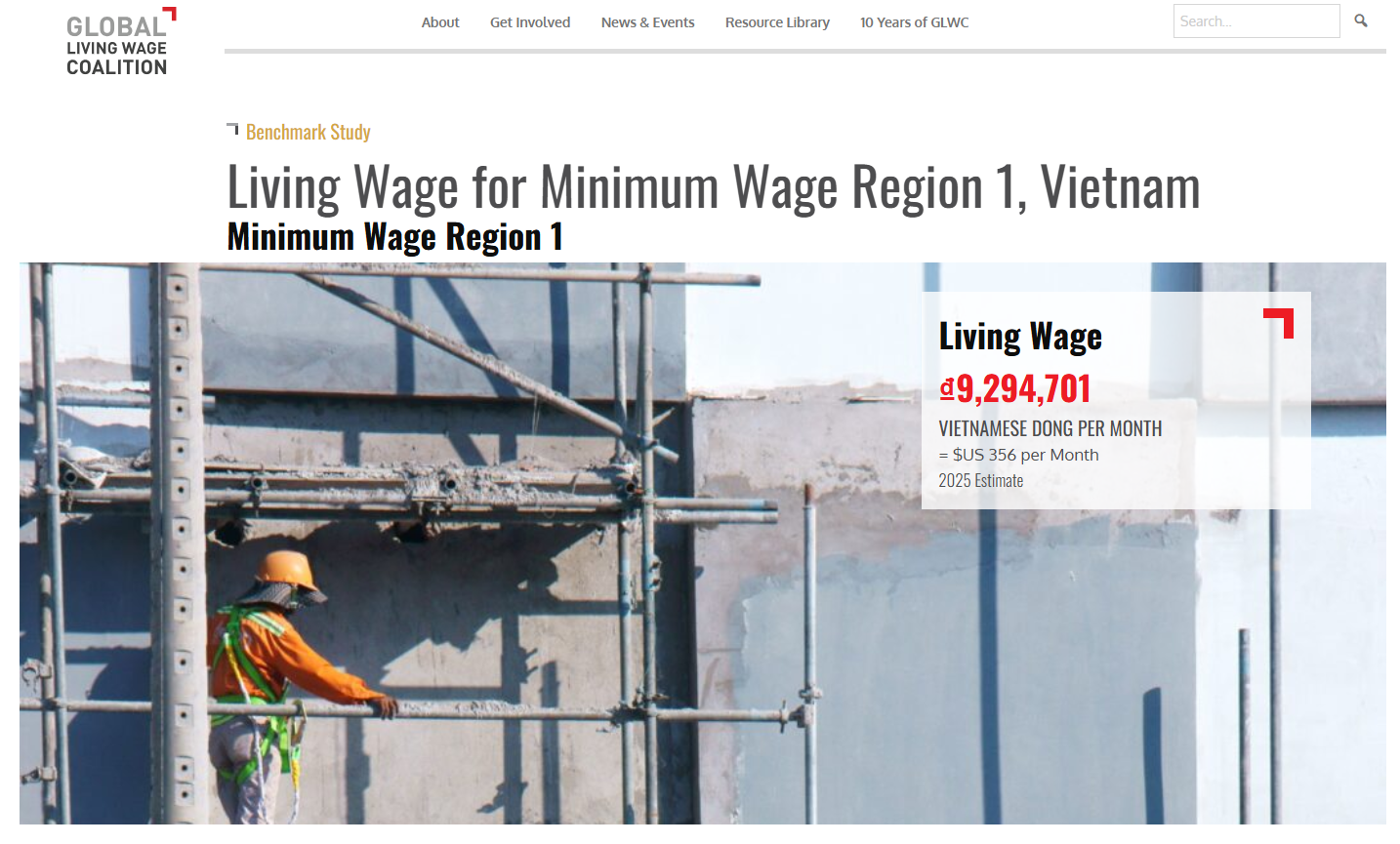
Figure 5. The 2025 living wage benchmark for Region I, Vietnam, according to the Global Living Wage Coalition.
Source: Global Living Wage Coalition – Living Wage for Minimum Wage Region 1, Vietnam.
Comparison of Actual Income with the 2025 Living Wage Benchmark
Based on the 2025 Region I living wage benchmark for Vietnam published by the Global Living Wage Coalition, amounting to VND 9,294,701 per person per month, UEH compared the regular income of faculty members, civil servants and employees included in its 2025 statistical scope. The assessment focused on employment-related regular income and excluded exceptional bonuses, one-off support payments and in-kind benefits.
According to consolidated data provided by UEH’s Human Resources and Organisation Development Department (HOD) and Department of Finance and Investment Planning, all 1,373 of the 1,373 employees within the statistical scope received income at or above the referenced living wage threshold, equivalent to 100%. The lowest reported regular income was approximately VND 15,000,000 per person per month, around 61.4% higher than the 2025 Region I living wage benchmark.
| Indicator | 2025 Result |
| Total number of employees within the statistical scope | 1,373 |
| Number of employees meeting or exceeding the living wage threshold | 1,373 |
| Compliance rate | 100% |
| Lowest regular monthly income | Approximately VND 15 million/month |
| Region I living wage benchmark | VND 9,294,701/month |
| Data providers | Human Resources and Organisation Development Department (HOD); Department of Finance and Investment Planning |
For full-time and part-time employees, living wage compliance should be determined based on hourly income and actual working hours, ensuring a consistent comparison with the reference benchmark. The consolidated results are made public together with information on the employee scope, employment arrangements and calculation methodology to ensure transparency and verifiability.
Sources:
- Global Living Wage Coalition – Living Wage for Minimum Wage Region 1, Vietnam (2025 Estimate).
- UEH 2025 Income Benchmarking Report, provided by the Human Resources and Organisation Development Department (HOD) and the Department of Finance and Investment Planning.
3. Implementation of Salary Policies and Public Disclosure of Remuneration in 2025
According to UEH’s “Public Disclosure Information 2026” report, the total expenditure on salaries and income for the University’s 2025 operations amounted to VND 821.14 billion.
| Item | 2025 Value |
| Total expenditure on salaries and income | VND 821.14 billion |
| Expenditure on salaries and income for faculty members | VND 467.44 billion |
| Expenditure on salaries and income for other staff | VND 353.70 billion |
Source: UEH Portal – Public Disclosure Information 2026, section on 2025 operating revenue and expenditure results.
These figures reflect the scale of resources UEH allocates to implementing its salary and remuneration policies, complementing the results of the comparison between actual employee income and the living wage benchmark.
In addition, UEH continues to publicly disclose its income and remuneration policies as part of its recruitment activities, enabling applicants to access information on salaries, allowances, additional income and benefits before applying. At UEH Mekong, the staff recruitment announcement dated 31 March 2025 clearly outlined income, allowances and employee support arrangements. For the UEH Global Talent Programme at UEH Nexus Campus Nha Trang, Notice No. 2306/TB-ĐHKT-PTTCNL dated 10 October 2025 disclosed expected monthly income of over VND 20 million for applicants with a bachelor’s degree, over VND 21 million for master’s degree holders, and over VND 22 million for newly graduated doctoral degree holders.
Public disclosure of remuneration arrangements enables applicants to understand income and benefits before entering the recruitment process, demonstrating UEH’s commitment to transparency in human resource management. The expected income levels stated in recruitment announcements provide supplementary evidence of UEH’s remuneration policy.
Sources: UEH Mekong recruitment announcement dated 8 April 2025; and Notice No. 2306/TB-ĐHKT-PTTCNL dated 10 October 2025.
4. Employee Benefits and Cost-of-Living Support Policies
In addition to its salary policies, UEH provides a comprehensive system of employee benefits and cost-of-living support to improve quality of life and enable faculty members, civil servants and employees to work with confidence and peace of mind. These benefits are stipulated in the Internal Expenditure Regulations, informed by collective consultation, and reviewed and adjusted through the annual Employee Conference, ensuring openness, transparency and democratic participation.
UEH provides practical support measures, including 100% complimentary accommodation at UEH Hotel for employees from UEH’s campuses and branches who are working in Ho Chi Minh City; a 20% accommodation discount for eligible groups; and dormitory accommodation at UEH Mekong or a housing allowance of VND 1,500,000 per person per month for employees who meet the eligibility requirements for off-campus accommodation support.
UEH also provides leave entitlements and welfare benefits to protect employee rights and support work–life balance for its civil servants and employees. With standard working hours of 40 hours per week (five days per week), employees are entitled to fully paid public holidays and Lunar New Year holidays; annual leave starting at 12 days, with one additional day for every five years of service; paid personal leave; and sickness, maternity and occupational accident benefits in accordance with applicable labour laws.
In terms of remuneration and benefits, civil servants and employees receive an average of eight rounds of bonuses and welfare benefits each year. Average annual welfare expenditure is approximately VND 21 million per person, equivalent to 11.6% of the average annual salary of VND 180 million per person. These forms of support help improve living conditions while supplementing UEH’s regular income policy.
At UEH, the commitment to ensuring a “living wage” goes beyond the basic income figures shown on payslips. The University has developed this commitment into a comprehensive employee benefits ecosystem. Alongside financial benefits, UEH continues to develop a green and modern working environment and promote holistic employee well-being. Key activities in 2025 included:
- Working environment and facilities: Developing a network of 16 learning and working locations in line with the Green University orientation and smart spaces; taking steps to establish UEH Wellness Space; and improving canteen facilities and living conditions.
- Physical and mental health care: Organising the UEH 2025 Employee Sports Festival, UEH Online Marathon and an eye-care programme, alongside family support activities for union members on International Women’s Day (8 March), Vietnamese Women’s Day (20 October), International Children’s Day and the Thanh Da Summer Camp.
- A culture of connection: Organising UEH Day 2025 – Together, We Share in Khanh Hoa, with nearly 900 civil servants and employees participating in sports and cultural activities, heritage appreciation and environmental protection initiatives, contributing to the ONE UEH spirit.
By combining leave entitlements, financial benefits and programmes that support employees’ well-being, UEH aims to build a happy working environment. This reflects the University’s human resource management philosophy: an adequate living income goes hand in hand with opportunities for holistic well-being and development, enabling employees to remain committed and contribute sustainably.
Sources:
- UEH Portal – Human Resource Policies Aligned with the 17 SDGs.
- UEH Trade Union – Information portal on activities and support for union members.
- UEH Green Campus – Green university environment.
5. Implementation Results and Future Directions
Compared with 2024, UEH continued to maintain its salary and additional income policies while adjusting its income distribution plan in 2025 to improve employee remuneration. In particular, benchmarking actual income against the Global Living Wage Coalition’s living wage standard demonstrates that UEH’s efforts extend beyond compliance with statutory minimum wage requirements towards meeting the essential living needs of its workforce.
In 2025, all 1,373 of the 1,373 faculty members, civil servants and employees within the statistical scope (100%) received regular income at or above the Region I living wage benchmark. The lowest regular income was approximately VND 15 million per month, which was 61.4% higher than the reference threshold of VND 9,294,701 per month. UEH will continue to review and improve its income distribution policies and monitor compliance with the living wage benchmark across employee groups.
6. Conclusion
In 2025, UEH recorded that 100% of employees within the statistical scope received income at or above the living wage benchmark, demonstrating the implementation of its commitment to providing a living wage through actual remuneration and employee benefits.
By maintaining income above the living wage threshold, applying fair and transparent income distribution mechanisms, and providing policies that support employees’ livelihoods, UEH contributes to protecting employee rights, improving quality of life and advancing SDG 8 – Decent Work and Economic Growth.