

7.4.4 – Policy development for clean energy technology
The University of Economics Ho Chi Minh City (UEH) advances its role as a research university in providing scientific evidence, sharing knowledge, and working with government authorities to develop policies on clean energy, energy efficiency, and the transition towards a low-carbon economy. Building on its Green Campus Regulations and interdisciplinary research capacity in economics, finance, public administration, and technology, UEH undertakes policy research, dialogue forums, and partnerships with local governments and domestic and international organisations. Notable activities in 2025 included a cooperation agreement with the Vinh Long Provincial People’s Committee covering clean energy policy advice, ministerial-level research projects on energy transition, and the ICBF 2025 international conference, which issued policy recommendations concerning sustainable energy markets.
1. Strategic Orientation for Participation in Clean Energy Technology Policy Development
UEH regards policy research and advisory services as a means of transferring knowledge for socioeconomic development, linking research findings to the policymaking needs of government agencies. In the energy sector, its activities focus on three priorities.
Providing scientific evidence for energy transition policies. UEH conducts research on public governance, energy markets, the economic impacts of renewable energy policies, and the role of the financial system in the transition to clean energy.
Supporting governments and stakeholders in identifying sustainable energy development priorities. Through partnerships with local authorities, academic conferences, and advisory and policy-review activities, UEH contributes to the consideration of clean energy solutions, resource efficiency, and low-emission technologies in development strategies.
Strengthening research collaboration and policy dialogue at national and international levels. UEH connects scholars, research organisations, experts, and government representatives to exchange scientific evidence, analytical models, and recommendations on energy technologies, green finance, and sustainable development.
2. Objectives, Target Groups and Scope of Implementation
Objectives: Research and policy advisory activities aim to:
– Provide information and scientific evidence to support the formulation, evaluation, and improvement of policies on clean energy and energy efficiency.
– Analyse the economic, financial, and governance impacts of adopting renewable energy technologies.
– Help government agencies consider measures to encourage clean energy investment, develop sustainable energy markets, and reduce emissions.
– Strengthen connections among universities, governments, businesses, and research organisations to improve policymaking quality.
Target groups: Local government authorities, provincial and municipal People’s Committees, ministerial-level state management agencies, organisations with policy consultation functions, and relevant international agencies and organisations.
3. Internal Commitments and Supporting Policies
UEH issued its Green Campus Regulations under Decision No. 2059/QD-DHKT-CSVC in 2022, establishing a foundation for resource management and sustainable development. In 2025, UEH continued to update and maintain these regulations. In particular, Article 10 – Community Outreach Programme on Energy Efficiency sets out UEH’s role in knowledge sharing, advisory services, and policy research.
In particular, Clause 3 of Article 10 – Research and Policy Advice on Clean Energy for Practical Application provides for promoting research, development, and application of renewable energy solutions and clean energy technologies, while supporting government agencies in formulating and improving relevant policies, as follows:
Clause 3 – Research and policy advice on clean energy for practical application. UEH promotes the research, development, and application of renewable energy solutions and clean energy technologies, while serving as an advisory and support institution for government agencies in developing and improving relevant policies. Research focuses on proposing practical application models, policy recommendations to encourage clean energy investment, and assessments of the economic and social impacts of energy-saving solutions. UEH also strengthens cooperation with research institutes, international organisations, and enterprises to facilitate technology transfer, data sharing, and the dissemination of sustainable energy-use models throughout the community.
4. Evidence of Programmes and Events Implemented in 2025
| No. | Programme/Project | Format/Category | Activities and Results | Public Source |
| 1 | UEH–Vinh Long Provincial People’s Committee Cooperation, 2025–2030: Clean Energy Policy Research and Advisory Services | Local government partnership; policy advice and review | In early 11/2025, UEH and the Vinh Long Provincial People’s Committee signed a strategic cooperation agreement for 2025–2030. Both parties agreed to undertake scientific research, policy advisory and review activities, development planning, and knowledge transfer. The partnership envisaged cooperation to identify policy issues and propose projects in clean energy, carbon emissions reduction, smart cities, and climate change adaptation.
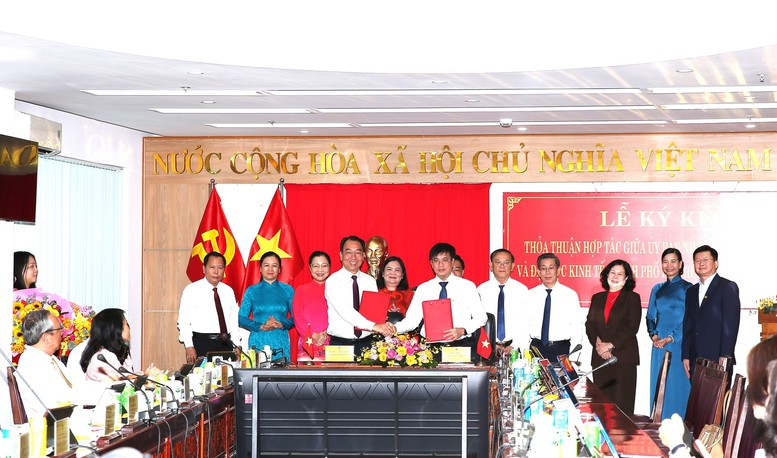
Lữ Quang Ngời, Chairman of the Vinh Long Provincial People’s Committee, and Bùi Quang Hùng, Deputy Director in charge of UEH, signing the cooperation agreement |
Government Online Newspaper – “Vinh Long Partners with the University of Economics Ho Chi Minh City: Pooling Knowledge to Open New Directions for Regional Development”, published on 3 November 2025. |
| 2 | ICBF 2025 – Publication of Policy Recommendations on Green Finance and Sustainable Energy Markets | International academic cooperation – Policy dialogue and publication of recommendations | On 01–02/12/2025, UEH organised the International Conference on Business and Finance 2025, comprising 29 parallel sessions and 8 plenary sessions, which addressed topics including energy transition, green finance, ESG, and sustainable development policies. The Sustainable Development Forum, held as part of the conference, included participants from businesses and government agencies. In particular, the conference issued policy recommendations (Policy Statement Announcement), emphasising the promotion of green finance, sustainable energy markets, and connections between research and public policy.
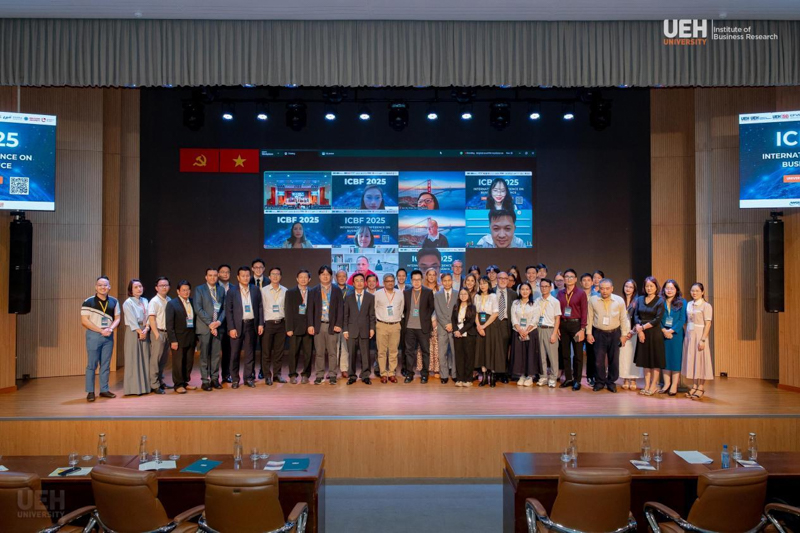
Opening session of ICBF 2025 |
Portal UEH – “Connecting Global Academic Networks and Shaping a Sustainable Future at ICBF 2025”, published on 9 December 2025. |
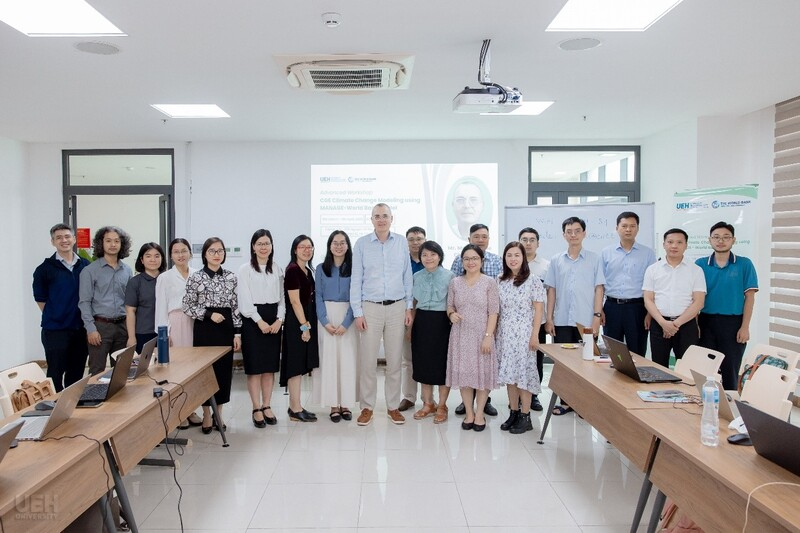
| 6 | Training on the MANAGE/CGE Model for Climate Change Analysis and Policy Evaluation | International research cooperation; capacity building in policy analysis tools | In 2025, UEH’s College of Economics, Law and Government and the Economy and Environment Partnership for Southeast Asia collaborated with the World Bank to organise advanced training on the MANAGE/CGE model. The 2025 training sessions took place online on 11–21/03 and in person on 31/03–04/04, with 17 participants from various institutions and universities across Vietnam. The programme developed skills in scenario simulation and climate impact analysis to support policy recommendations.
|
Portal UEH – “Advanced Training in the Application of Computable General Equilibrium (CGE) Models to Climate Change Analysis”, published on 15 April 2025. |
| 7 | Khanh Hoa: Dialogue on Improving Innovation Policies for Businesses | Technology policy dialogue with government agencies | On 6 November 2025, UEH and the Khanh Hoa Union of Science and Technology Associations organised a dialogue attended by representatives of provincial departments, businesses, and researchers. Renewable energy was among the province’s strategic technology priorities. Contributions from the dialogue were recorded to refine research and support local innovation policies.
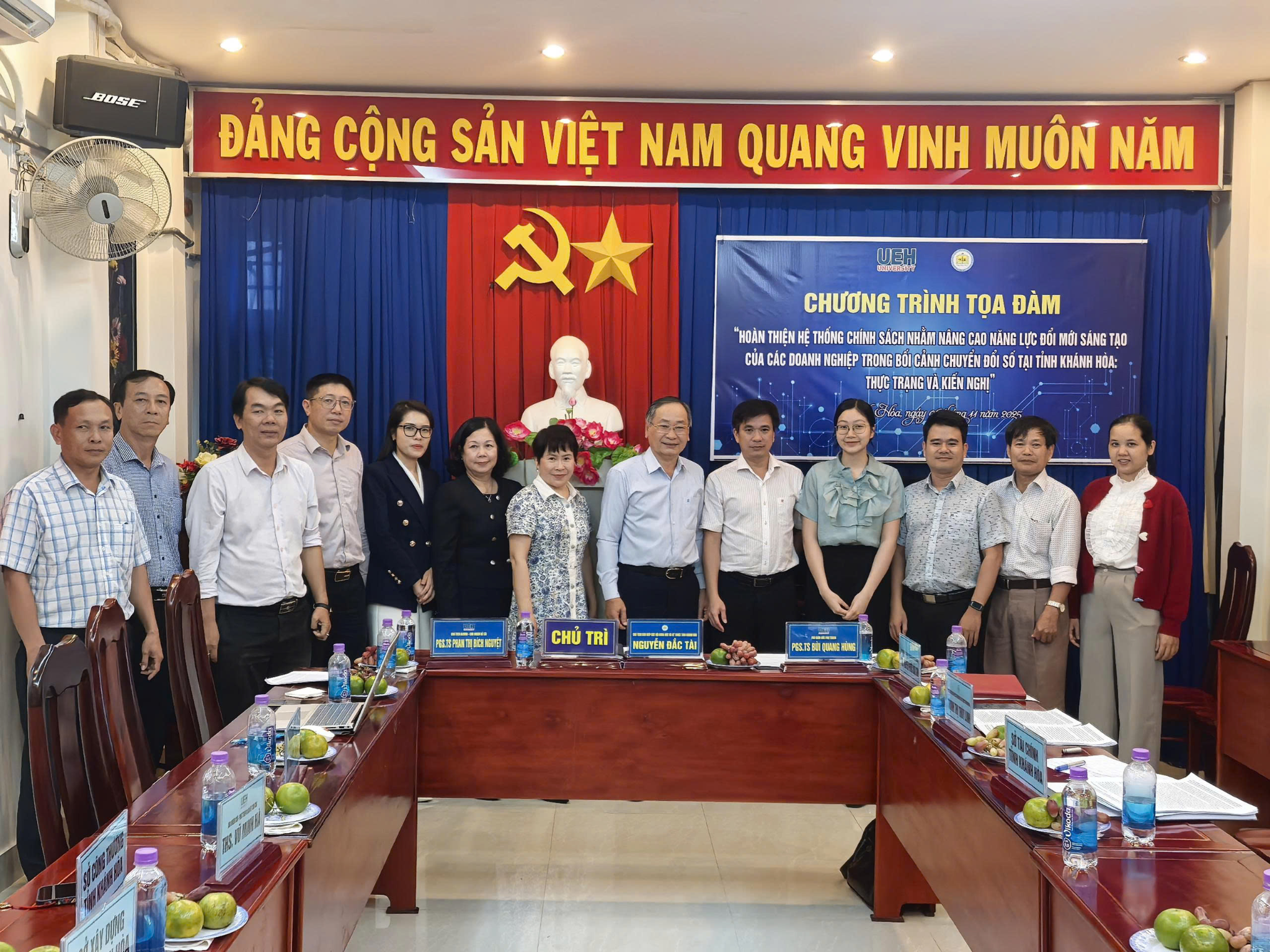
Delegates posing for a group photograph |
UEH Portal – “UEH Supports Khanh Hoa Province in Improving Policies to Enhance Business Innovation Capacity amid Digital Transformation”, published on 7 November 2025. |
| 8 | ICBF 2025 – Policy Statement Announcement on Green Finance and Sustainable Energy Markets | Publication of policy recommendations; dialogue with policymakers | On 1–2 December 2025, UEH organised ICBF, featuring thematic sessions on energy transition and green finance. The Sustainable Development Forum brought together scholars, businesses, and government representatives. The conference issued policy recommendations outlining priorities for developing green finance and sustainable energy markets. Opening session of ICBF 2025 | Portal UEH – “Connecting Global Academic Networks and Shaping a Sustainable Future at ICBF 2025”, published on 9 December 2025. |
| 9 | UEH–Vinh Long Provincial People’s Committee: Research Cooperation and Policy Advice on Clean Energy and Emissions Reduction | Government cooperation and identification of policy issues | In early November 2025, UEH and the Vinh Long Provincial People’s Committee signed a cooperation agreement for 2025–2030, covering policy advice and review, research, and knowledge transfer. The parties identified areas for joint research and project proposals related to clean energy and carbon emissions reduction. Compared with the 2017–2024 cooperation period, the new agreement broadened research themes supporting the province’s development strategy and regional connectivity. | Government Online Newspaper – “Vinh Long Partners with the University of Economics Ho Chi Minh City: Pooling Knowledge to Open New Directions for Regional Development”, published on 3 November 2025. |
| 10 | UEH–Ca Mau Provincial People’s Committee: Cooperation on Clean Energy Development Strategy Advice, 2025–2030 | Direct cooperation with provincial government | On 25 September 2025, UEH and the Ca Mau Provincial People’s Committee signed a comprehensive memorandum of understanding (MOU). The agreement established a mechanism for UEH experts to provide advice and policy review on development priorities, planning adjustments, and research in strategic fields, including clean energy. | UEH Portal – “Signing Ceremony for the Comprehensive Cooperation Agreement for 2025–2030 between the University of Economics Ho Chi Minh City and the Ca Mau Provincial People’s Committee”, published on 26 September 2025. |
5. Conclusion
In 2025, UEH continued to develop research activities and engagement with government agencies to promote energy transition policies and sustainable development. Notable outcomes included signing a cooperation agreement with the Vinh Long Provincial People’s Committee encompassing research and clean energy policy advice; undertaking ministerial-level scientific research projects on public governance of the energy transition and the economic impacts of renewable energy policies; organising a research workshop on financing the energy transition; and issuing policy recommendations at ICBF 2025.
Compared with 2024 activities, which largely focused on sharing research models, climate policy dialogue, and Green Campus development, the 2025 activities included more specialised research on energy transition governance, policy impact simulation, and connections between research and government agencies.
Through research, local partnerships, and the publication of recommendations, UEH helped broaden the scientific foundation and cooperation mechanisms supporting policy development on clean energy, energy transition, and resource efficiency. These outcomes further reflected UEH’s commitment to connecting research with policymaking and contributing to SDG 7 – Affordable and Clean Energy, particularly indicator 7.4.4 – Policy development for clean energy technology of the THE Sustainability Impact Ratings 2027.