Activity, Date, and Source
|
International Partners
|
Form of Collaboration and UEH’s Role
|
Comparative Focus
|
Outcomes
|
SDGs
|
01. UEH–Thammasat: Comparative Research on Transit-Oriented Development (TOD) and Urban Design for Truong Tho
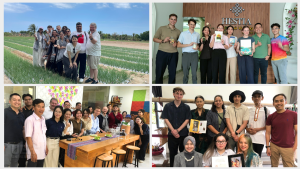
Date: 05–09/09/2025 Source: ISCM–UEH, published on 14 October 2025, “International Workshop: Urban Design Towards Transit-Oriented Development (TOD)”Article link: https://iscm.ueh.edu.vn/vi/student_life/workshop-quoc-te-thiet-ke-do-thi-huong-den-phat-trien-tod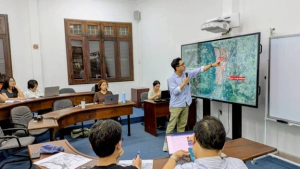
|
Thammasat University (Thailand); 20 students (10 from Vietnam and 10 from Thailand); faculty members from both universities.
|
UEH and Thammasat jointly organised a field-based design studio and surveyed Truong Tho along Metro Line 1. They guided international student teams in mapping existing conditions, conducting SWOT analyses, and critically reviewing urban design proposals.
|
The teams compared conditions in Truong Tho with TOD lessons from Singapore, Germany, Spain, Malaysia, Japan, and China, focusing on access to stations within a 400–800 m radius, compact mixed-use urban development, and integration of walking, cycling, and public transport.
|
The Vietnamese–Thai teams presented proposals to transform industrial land into multifunctional spaces, strengthen metro–bus–pedestrian connections, introduce green infrastructure and drainage solutions, and explore land value capture mechanisms.
|
SDG 9, 11, 13, 17
|
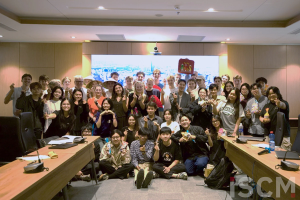
02. UEH–AVANS: Co-Developing Climate-Adaptive Urban Design Practices for Thanh Da
Date: 06–10/10/2025
Source: ISCM–UEH, published on 20 October 2025, “International Workshop ‘Finding Thanh Da Peninsula Identity – An Urban Climate Adaptive Park’”Article link: https://iscm.ueh.edu.vn/en/student_life/workshop-quoc-te-finding-thanh-da-peninsula-identity-an-urban-climate-adaptive-park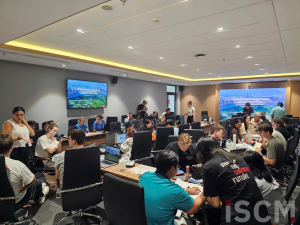
|
AVANS University of Applied Sciences (the Netherlands); 56 Vietnamese and Dutch students; six lecturers from four countries; professional consultation from Royal HaskoningDHV.
|
ISCM–UEH co-organised the workshop, provided local context, and guided field surveys in Thanh Da. The binational teams analysed flooding and riverfront spaces, and presented maps, models, and design proposals.
|
The teams compared current conditions in Thanh Da with Dutch approaches to water management, green infrastructure, ecosystem-based design, and participatory planning, adapting these lessons to the Saigon River context.
|
Four design themes were developed: Urban Wetlands and Waterscape; Urban Archipelago; Urban Hybrid Garden; and Urban Foodscape. The teams presented concept maps and climate-adaptive spatial frameworks; physical implementation had not been confirmed.
|
SDG 11, 13, 15, 17
|
03. UEH Participated in an Expert Group Developing Content and Case Studies for the ASEAN Sustainable Urbanisation Report
Date: 11–14/08/2025
Source: ISCM–UEH, published on 25 August 2025, “ISCM Participates in the ASEAN Sustainable Urbanisation Forum 2025 in Kuala Lumpur, Malaysia (August 11–14, 2025)”
Article link: https://iscm.ueh.edu.vn/en/iscm_life/iscm-participates-in-the-asean-sustainable-urbanisation-forum-2025-in-kuala-lumpur-malaysia-august-11-14-2025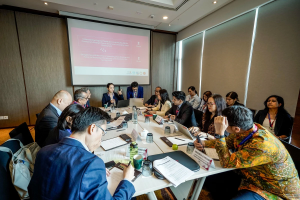
|
ASEAN Secretariat, UN-Habitat, the ASEAN Sustainable Urbanisation Forum (ASUF), and urbanisation experts from ASEAN member states.
|
Assoc. Prof. Dr. Trinh Tu Anh, representing UEH–ISCM, presented an urban co-creation model and participated in the Expert Group Meeting (EGM) on 14 August 2025 concerning the ASEAN Sustainable Urbanisation Report (ASUR).
|
The EGM discussed strategic directions, indicator frameworks, and case studies to compare urban policies across ASEAN countries and identify examples of sustainable urban development.
|
UEH contributed expert input to the development process for the second edition of ASUR (scheduled for publication in 2026). Its documented 2025 output comprised expert consultations on indicators and case studies.
|
SDG 9, 10, 11, 17
|
04. UEH–Gothenburg: Comparative Research on Four Shrimp-Farming Systems and International Practice Benchmarks
Date: Published in 2025
Source: UEH Digital Repository, “Shrimp farming industry in Vietnam: An aquaculture performance indicators approach”, Aquaculture Economics & Management, 29(2), 2025Article link: https://digital.lib.ueh.edu.vn/handle/UEH/76098
|
Researchers Ho Quoc Thong and Do Huu Luat (UEH), and Håkan Eggert (University of Gothenburg, Sweden).
|
The international co-authors conducted quantitative research using the Aquaculture Performance Indicators (API) framework and a Triple Bottom Line approach to assess economic, social, and environmental performance.
|
The study compared four shrimp-farming systems in Vietnam—extensive, semi-intensive, intensive, and super-intensive—against global benchmarks for aquaculture and post-harvest practices.
|
The published findings indicated that intensive and super-intensive systems offered economic advantages, while intensive farming faced environmental challenges; extensive farming performed better environmentally. The research identified priorities for water management, wastewater management, and production efficiency, but did not establish that the industry had adopted a policy based on the paper.
|
SDG 8, 12, 14, 17
|
05. UEH Shared Its Living Lab Model and Compared Community Regeneration Practices in Italy
Date: July 2025; article published on 26 July 2025
Source: ISCM–UEH, published on 26 July 2025, “ISCM Represents Vietnam in International Summer Camp on Sustainability and Social Innovation in Italy”
Article link: https://iscm.ueh.edu.vn/en/news/iscm-represents-vietnam-in-international-summer-camp-on-sustainability-and-social-innovation-in-italy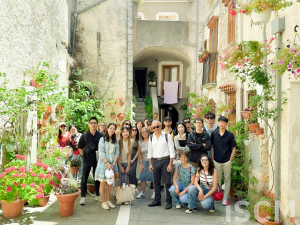
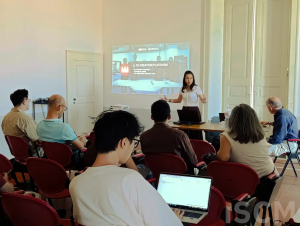
|
University of Basilicata (Italy), Handong Global University (South Korea), local communities, and international scholars.
|
UEH–ISCM representatives shared UEH’s Co-Creation and Living Lab models and worked with partners to explore Living Lab initiatives in Potenza and Ascea Marina, engaging local communities on the revitalisation of inland regional economies.
|
They compared UEH’s Living Lab approach with Italian practices for testing social innovation solutions, regenerating spaces, developing agriculture, and conserving heritage in local communities.
|
UEH shared its co-creation experience and gained insights into community regeneration and heritage-based economic development. This was an academic exchange and experimentation activity.
|
SDG 8, 11, 12, 17
|
|
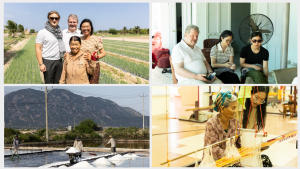
FHNW (Switzerland), partner universities from Indonesia, Malaysia, the Philippines, and Singapore, as well as businesses and communities in Khanh Hoa.
|
UEH lecturers and students joined international teams to survey and interview local enterprises, guide field-data analysis and research, and review group reports.
|
The teams assessed livelihoods, agri-food business models, and local products, and discussed potential improvements informed by international experience in entrepreneurship and sustainable marketing.
|
The teams proposed green marketing strategies, business model innovation, product value enhancement, and market expansion. Their reports were reviewed by lecturers from UEH, FHNW, and UTM. This was a practical exercise in jointly developing solutions.
|
SDG 4, 8, 9, 12, 17
|
07. UEH Compared International Practices in Smart Urban Development and Flood Management in Singapore
Date: 16–19/10/2025 Source: ISCM–UEH, published on 21 October 2025, “ISCM’s Visit to Singapore — Strengthening Partnerships in Smart and Sustainable Urban Development”
Article link: https://iscm.ueh.edu.vn/en/iscm_life/iscms-visit-to-singapore-strengthening-partnerships-in-smart-and-sustainable-urban-development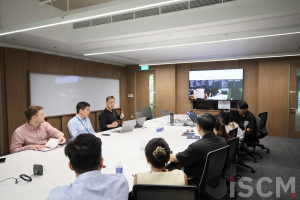
|
SUTD, Land Transport Authority (LTA), NUS, Urban Redevelopment Authority (URA), Sustainable Singapore Gallery.
|
The ISCM delegation met directly with research institutions and government agencies in Singapore to discuss integrated planning, public transport, digital urban models, and the Microclimate Digital Platform.
|
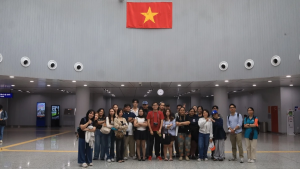
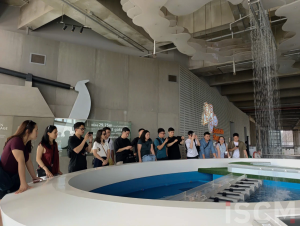
The delegation examined LTA’s multimodal transport model, URA’s data-driven planning, and Bishan–Ang Mo Kio Park’s transformation of a concrete river channel into an ecological public space integrating flood management and community recreation.
|
UEH identified practices that could serve as references for Vietnamese cities and discussed potential joint research opportunities. This activity involved learning from and evaluating international experience.
|
SDG 9, 11, 13, 17
|
08. UEH Shared Smart Urban Pedagogy and Living Lab Practices at VNxSymposium 2025
Date: 04–06/07/2025
Source: ISCM–UEH, published on 17 July 2025, “The Turning Point of Innovation for ISCM at VNXSYMPOSIUM 2025”
Article link: https://iscm.ueh.edu.vn/en/iscm_life/the-turning-point-of-innovation-for-iscm-at-vnxsymposium-2025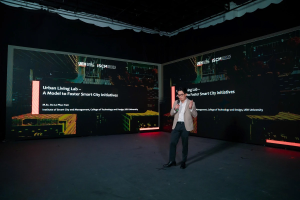
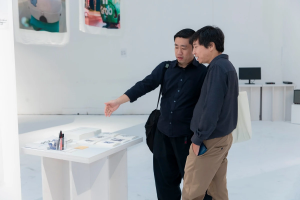
|
RMIT Vietnam, RMIT Melbourne, Western Sydney University, University of Jakarta, KAIST, and design studios.
|
UEH–ISCM collaborated in organising the programme. Lecturer Do Le Phuc Tam presented “Smart Urban Pedagogy at UEH”, introducing open studios, data-driven design, and Living Labs; participating teams exhibited projects addressing flooding and green infrastructure.
|
UEH shared its design education practices with the international network through four themes: FuturesX, SocietyX, PedagogyX, and RegenX.
|
UEH’s studio–Living Lab learning model and sustainable urban design projects were shared at an international forum, helping disseminate best practices.
|
SDG 4, 11, 13, 17
|