

The University of Economics Ho Chi Minh City (UEH) publicly affirms its commitment to integrity, transparency and zero tolerance for corruption and bribery in governance, teaching and research. These principles are put into practice through a code of conduct, disciplinary regulations, assigned internal control responsibilities, and mechanisms for receiving and resolving reports of wrongdoing. In 2025, UEH continued to refine its regulations on handling submissions and disseminate legal guidance to its staff, contributing to an accountable and trustworthy university environment aligned with SDG 16 – Peace, Justice and Strong Institutions.
1. Commitments and Policies for an Ethical University Environment
UEH identifies integrity, transparency and accountability as principles to be upheld throughout the University’s activities. On its Vietnamese and English sustainability webpages, UEH publishes its commitment to zero tolerance for corruption, bribery and breaches of professional ethics. Public disclosure enables public employees, other employees, students and stakeholders to access UEH’s governance principles. [Source]
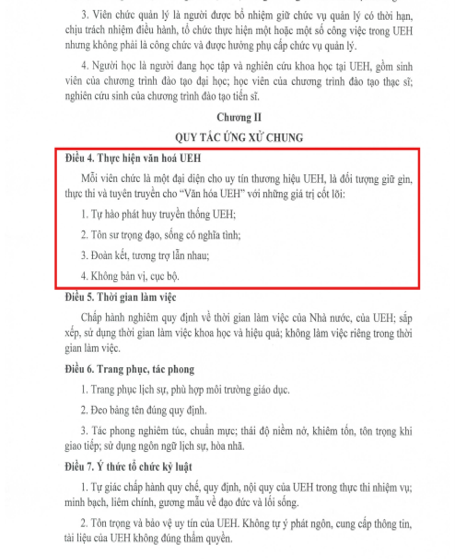
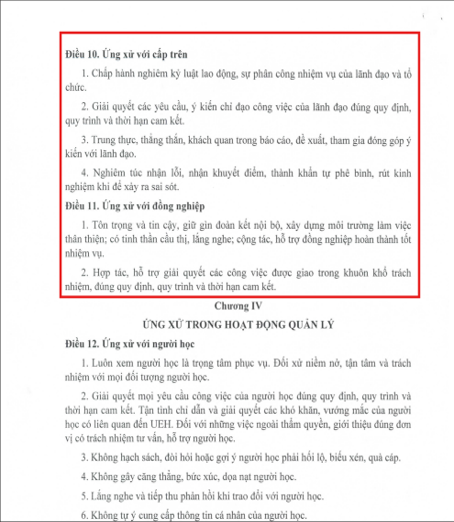
The internal policy framework comprises Decision No. 695/QĐ-ĐHKT-CTCT dated 4 April 2017, issuing the Regulations on the Code of Conduct for UEH Public Employees, and Regulation No. 1238/QyĐ-ĐHKT-TCHC dated 3 May 2018 on disciplinary action and compensation liability for public employees and other employees. Together, these documents link the prevention of conduct motivated by improper personal gain with mechanisms for addressing violations. [Source]
As the legal foundation, the Law on Anti-Corruption No. 36/2018/QH14 dated 20 November 2018 establishes the responsibilities of agencies, organizations and units in preventing, detecting and addressing corruption. Clause 1, Article 4 includes responsibilities for receiving and handling feedback and reports of wrongdoing, and protecting the lawful rights and interests of information providers; Articles 10–12 specify the content, forms and responsibilities for openness and transparency. This provides the legal framework against which UEH’s policies and implementation can be assessed.
Sources:
- UEH’s published commitment to combating corruption and bribery.
- Decision No. 695 – Code of Conduct for UEH Public Employees.
- Regulation No. 1238 – Disciplinary Action and Compensation Liability.
- Law on Anti-Corruption No. 36/2018/QH14 – Official Gazette version.
2. Specific Regulations for Preventing and Addressing Corruption and Bribery
UEH incorporates integrity requirements into professional relationships and services for students. Under Decision No. 695, Clause 3, Article 12 prohibits harassing students or demanding or suggesting that they offer bribes, gifts or other benefits; Clause 4, Article 16 prohibits creating difficulties for students or suggesting that they provide gifts, arrange meals or assist with tasks for improper personal gain. [Source]
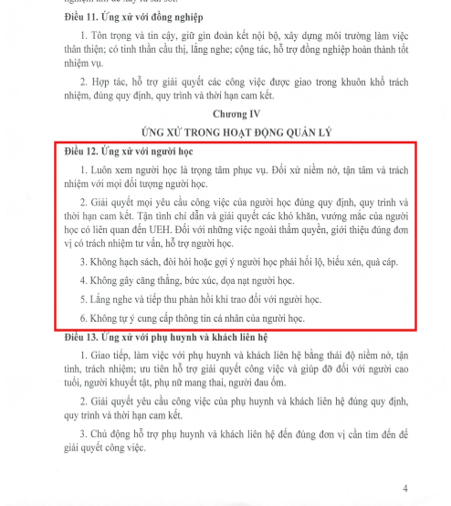
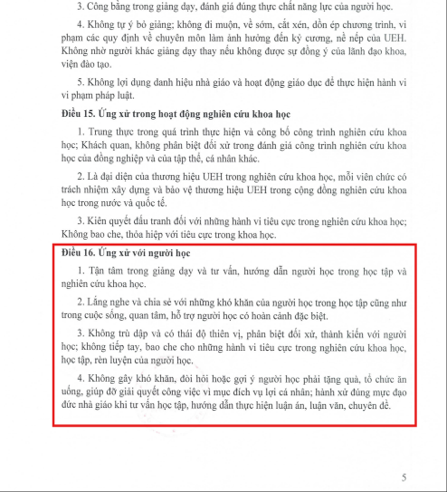
These rules identify prohibited conduct in student services, teaching and academic supervision. Articles 17–18 also establish responsibilities for implementation, monitoring and handling violations, linking standards of conduct to the responsibilities of units and individuals. [Source]hotro.ueh.edu.vn
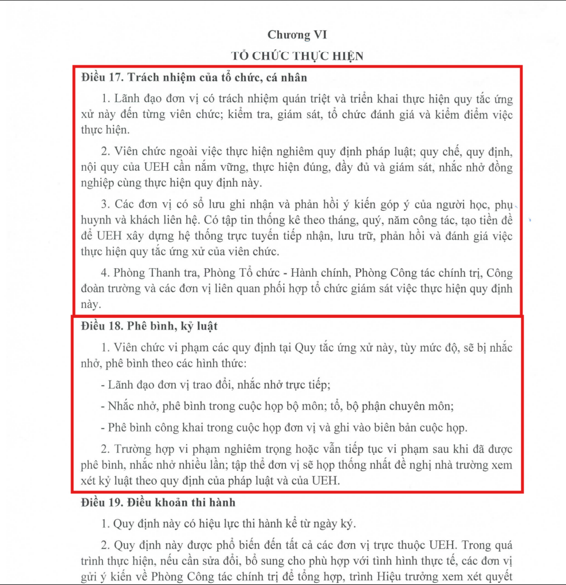
With regard to sanctions, Regulation No. 1238 identifies the following cases:
| Provision | Relevant Content |
| Clause 4, Article 4 | 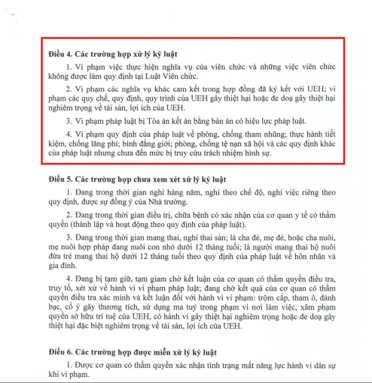
Violations of anti-corruption law are subject to disciplinary action, including cases that do not warrant criminal prosecution. |
| Clause 5, Article 11 | 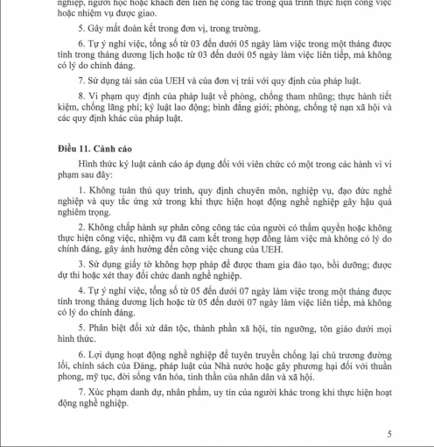
Removal from office is prescribed for public employees holding managerial positions who give, receive or broker bribes in the circumstances specified by this provision. |
| Clause 4, Article 12 | Dismissal is prescribed for public employees who engage in corruption in the circumstances specified by this provision. |
Sanctions must be applied in accordance with the persons covered, conditions and authority specified in each provision.
3. Refining Procedures and Providing Implementation Guidance in 2025
In 2025, UEH issued documents on receiving submissions, resolving complaints and reports of wrongdoing, and receiving citizens; it also provided staff with guidance on procedures and standards of conduct.
| No. | Programme / Document | Format / Category | Content and Results | Public Source |
| 1 | Regulations on receiving submissions and resolving complaints and reports of wrongdoing – 14 August 2025 | Refinement of internal regulations | UEH issued Decision No. 2410/QĐ-ĐHKT-BĐCLKSNB, establishing a framework for receiving and handling submissions and specifying the responsibilities of relevant parties. | Decision No. 2410 and attached PDF. |
| 2 | Procedure for resolving reports of wrongdoing – 30 August 2025 | Detailed procedural guidance | UEH issued Decision No. 2616/QĐ-ĐHKT-BĐCLKSNB, adding a dedicated procedure for resolving reports of wrongdoing within its authority. | Decision No. 2616 and attached PDF. [Source]qaic.ueh.edu.vn |
| 3 | Regulations on receiving citizens – 19 August 2025 | Mechanism for direct reception | UEH issued Decision No. 2514/QĐ-ĐHKT-BĐCLKSNB, providing a basis for organizing citizen reception and receiving matters within the prescribed scope. | Decision No. 2514 and attached PDF. [Source]qaic.ueh.edu.vn |
| 4 | Conference on thematic legal guidance – 19 September 2025 | Implementation guidance | UEH held the conference in person at Campus A and online for leaders, public employees and other employees. Topics included receiving, classifying and handling submissions; coordination responsibilities; and the Code of Conduct. | UEH Portal, published on 23 September 2025. [Source]www.ueh.edu.vn |
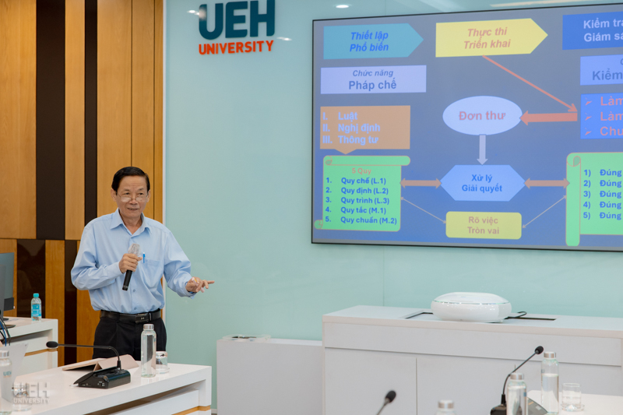
Figure 1. Dr. Nguyễn Tấn Khuyên presents a thematic session on coordination in receiving citizens and handling submissions at UEH, 19 September 2025.
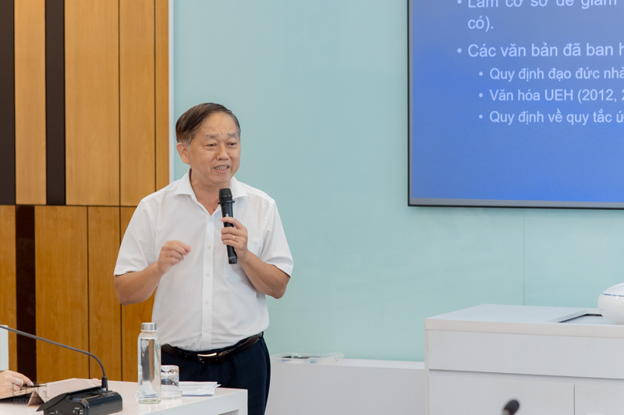
Figure 2. Dr. Nguyễn Thiện Duy presents UEH’s Code of Conduct regulations, 19 September 2025.
Source for both photographs: Department of Quality Assurance and Internal Control; Department of Communications and Partnerships; conference article on the UEH Portal, published on 23 September 2025. www.ueh.edu.vn
- Internal Control, Whistleblower Confidentiality and Information Disclosure
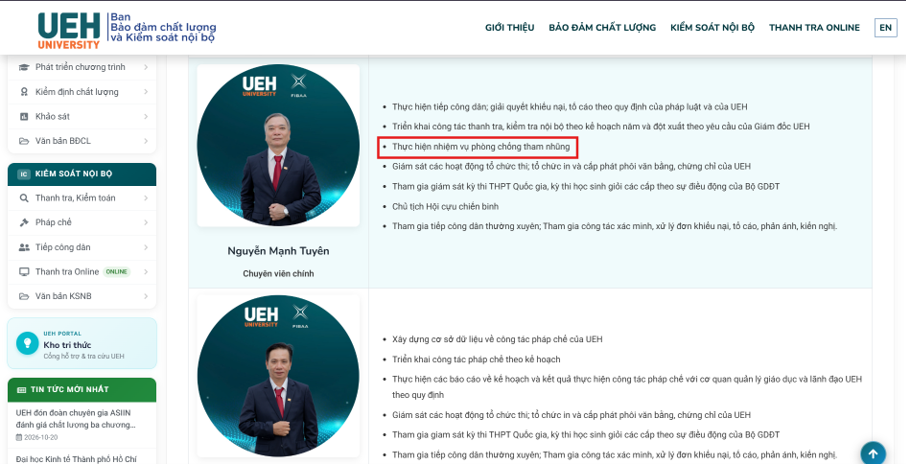
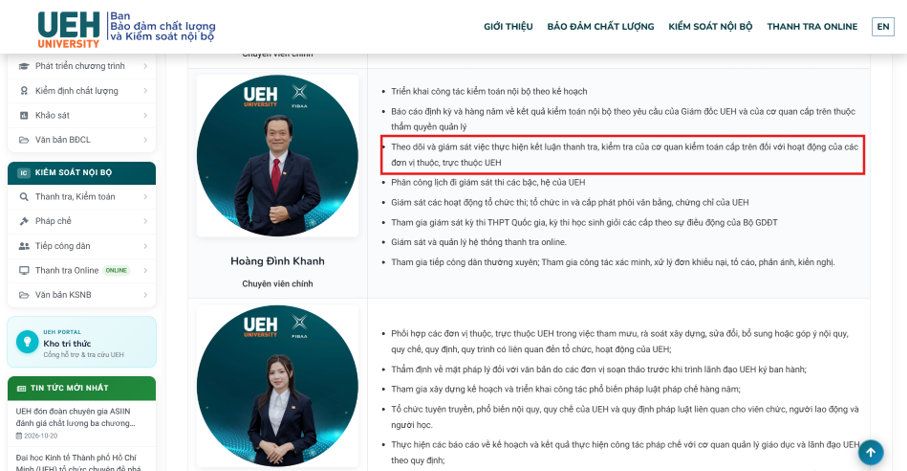
UEH publicly discloses the allocation of duties within the Department of Quality Assurance and Internal Control. Its personnel structure webpage specifies responsibilities for preventing and combating corruption, inspections, examinations and handling submissions; it also assigns responsibilities for internal audits, reporting results and monitoring the implementation of inspection and examination conclusions. Identifying responsible units and personnel links the commitment to integrity with specific implementation responsibilities. [Source][Source:qaic.ueh.edu.vn]
Regarding whistleblowers, UEH’s public article on resolving complaints and reports of wrongdoing states the requirement to maintain confidentiality during the resolution process. This source demonstrates a general commitment to confidentiality; protective measures in individual cases must follow the relevant procedures and legal provisions. [Source]ueh.edu.vn
The evidence article published in 2025 also states that UEH implements asset and income declarations under Decree No. 130/2020/NĐ-CP dated 30 October 2020. The Decree governs the control of assets and income of persons holding positions of authority in agencies, organizations and units. [Source]future.ueh.edu.vn
Sources:
- QAIC personnel structure and allocation of duties.
- UEH’s publicly disclosed mechanism for resolving complaints and reports of wrongdoing.
- Decree No. 130/2020/NĐ-CP – Government Portal.
- Implementation Results and Directions for Further Improvement
Compared with the evidence article published in 2025, which focused on disciplinary regulations, asset declarations and information disclosure, this synthesis provides greater detail on rules for preventing bribery, sanctions and responsibilities for internal control. Three documents and one conference from 2025 were selected to illustrate improvements to procedures and implementation guidance. These are the items compiled in this article, rather than university-wide statistics, and do not provide sufficient grounds to conclude that the number of activities increased compared with the previous year.
Publicly disclosing prohibited conduct, assigning responsibilities and maintaining mechanisms for receiving feedback provide a foundation for detecting, reviewing and addressing violations. Results should continue to be monitored through implementation records and reports from the responsible unit, ensuring consistency between published policies and actual practice.
- Conclusion
Through its public commitments, rules for preventing bribery, sanctions and internal control mechanisms, UEH establishes a foundation for integrity, transparency and accountability in governance. The documents and legal dissemination activities undertaken in 2025 further specify the responsibilities of units, public employees and other employees, helping to safeguard the learning and working environment and strengthen stakeholder trust.