

The University of Economics Ho Chi Minh City (UEH) uses written procedures to identify external partners, assess needs, agree on priorities and implement collaborative activities. In 2025, UEH engaged local authorities, public agencies, businesses and other organisations through formal agreements, policy dialogues, implementation reviews and programmes that served local residents and communities.
1 Written procedures for partnership development
Regulation No. 3124/QĐ-ĐHKT-VP of 26 October 2022 sets out the authority and procedures for signing and implementing cooperation documents with local authorities, agencies and other organisations in Viet Nam and abroad.
| Process stage | Provision | Application |
| Identify partners and assign responsibility | Articles 1 and 7 | Identify external partners within the scope of the regulation and assign the responsible management unit. |
| Assess needs and expected effects | Article 8(1) and (3) | Check partner information in the customer relationship management system (CRM); document its functions and areas of work, the purpose of cooperation and expected effects. The proposal can identify intended beneficiaries and their needs at this stage. |
| Review the proposal and identify contacts | Articles 9 and 10(2) | Review the proposed cooperation and establish contacts for coordination. |
| Record and disclose the agreement | Articles 12 and 13 | Archive the agreement, circulate it to relevant units, update the CRM and publish information in accordance with the assigned responsibilities. |
| Implement, monitor and report | Article 14(1), (2) and (4) | Assign implementation and reporting responsibilities; record activities in the CRM and monitor progress. |
Source: Regulation No. 3124, Articles 1, 7–10 and 12–14
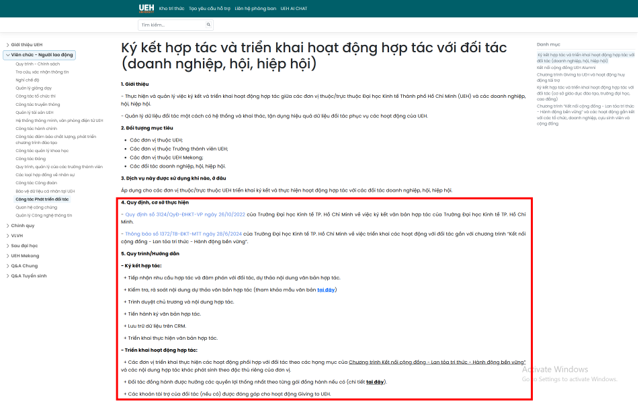
Figure 1. Public guidance on concluding and implementing partnerships with businesses, associations and professional bodies.
Source: UEH Knowledge Base, partnership guidance, sections 4–5.
Article 14 Implementation and follow up
Article 14(1) assigns the management unit responsibility for monitoring implementation and compiling reports. The implementing unit carries out the agreed work and reports activities or changes. Other UEH units cooperate within their assigned functions. Following the signing of an MOU, the implementing unit must undertake a concrete cooperative activity within six months. Activities are recorded in the CRM. Under Article 14(4), the management unit reports results in writing every six months or when requested.
Units can be assigned according to the activity and its beneficiaries. For instance, the implementing unit may work with the student support unit on an activity for students. Article 14(2) names the student care and support office, under its name at the time of issue, as a unit authorised to update the CRM directly. Responsibility for a specific programme is established in its activity plan or assignment record.
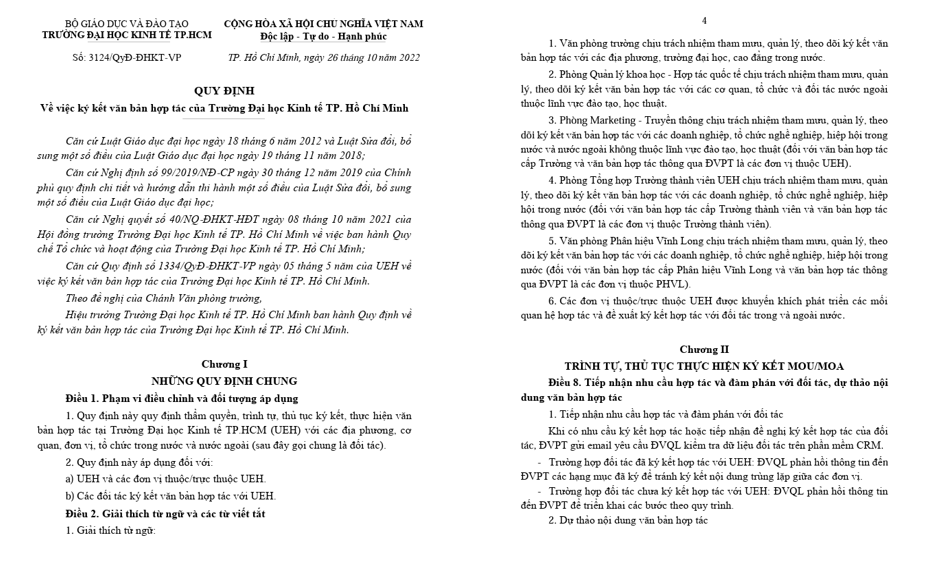
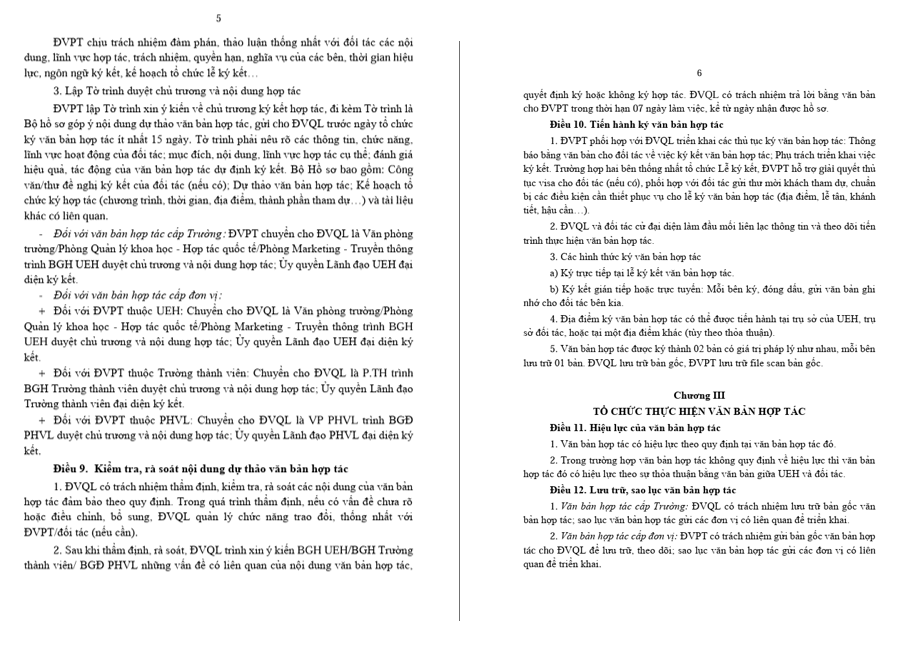
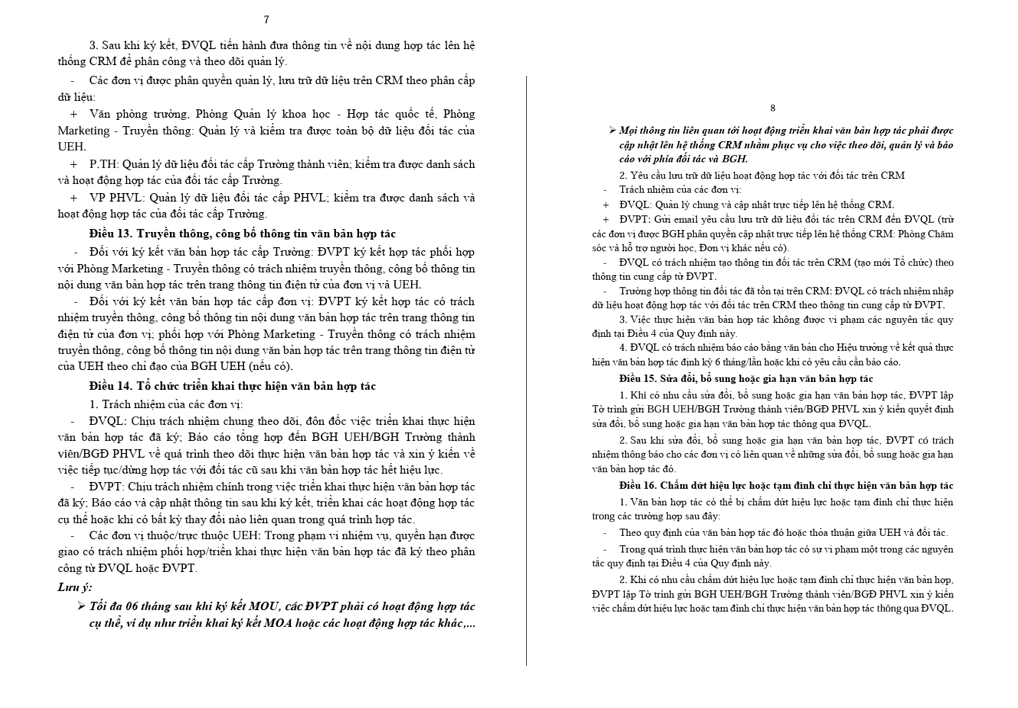
Figure 2. Responsibilities for implementation and monitoring after signature.
Source: Regulation No. 3124, Article 14(1), (2) and (4)
2 Identification of local stakeholders and beneficiaries
An implementing partner helps identify needs, organise activities or provide resources. A beneficiary receives support, gains access to knowledge or uses the results. One stakeholder can perform both roles: for example, a local business may host interns and benefit from access to talent, while a public agency may co-organise an activity and use the resulting advice.
| Stakeholder group | Identification in activity records | Forms of engagement or benefit |
| Local authorities and public agencies | Locality, responsible agency and policy or operational need | Policy advice, staff training, digital transformation and implementation reviews |
| Businesses, associations and professional bodies | Organisation, area of work, skills needs and role | Internships, training, professional exchange and knowledge transfer |
| Local residents and communities | Locality and participants or recipients, such as parents, children, households or schools | Learning resources, educational activities, welfare support and community infrastructure |
| Civil society organisations and community bodies | Organisation and role in outreach, delivery or receipt of support | Education, volunteering and assistance to groups with identified needs |
| Local start-ups and support organisations | Project team, start-up, incubator or support organisation, location and needs | Advice, training, incubation and access to resources |
These categories describe how stakeholders can be identified at activity level. They are not a list prescribed by Regulation No. 3124. Article 8(3) provides the basis for identifying the purpose and expected effects of cooperation, while Article 14 governs assignment, implementation and follow-up. Activity plans, notices and outcome reports identify the actual beneficiaries. UEH students may benefit from a programme, but their participation alone does not establish engagement with stakeholders outside the University.
3 Community engagement programme
Since 2020, UEH has implemented its Community Engagement, Knowledge Sharing and Sustainable Action programme. It brings together government agencies, academics, businesses, professional organisations and alumni to apply academic expertise to community needs.
| Area | Partners | Beneficiaries and support |
| Education and workforce development | Businesses, professional bodies, local agencies and alumni | Students gain access to internships and skills development. Agencies and businesses can access training tailored to their needs. |
| Research, advisory services and knowledge transfer | Authorities, public agencies, researchers and businesses | Local agencies receive evidence and solutions for public management. Businesses and other groups can use applied research findings. |
| Innovation and entrepreneurship | UEH Institute of Innovation and ecosystem partners | Students, project teams and start-up organisations are identified in the records of each support programme. |
| Community education and social initiatives | UEH units, authorities, schools and local partners | Parents, children and residents take part in learning activities. Volunteering and welfare programmes serve groups with identified needs. |
Source: UEH Community Engagement Strategy 2011–2025, article 74263
Source: UEH Community Engagement Review for 2025, article 75904
4 Coordination of local partnerships
UEH reorganised its University Office under Resolution No. 20/NQ-ĐHKT-HĐĐH of 25 April 2024 and strengthened its communications and partnership development function under Resolution No. 41/NQ-ĐHKT-HĐĐH. On 1 December 2025, UEH announced an assignment for Mr Lê Tuấn Hà to head the University Office team responsible for general operations, engagement and local partnership management. The assignment decision and related documents specify the team’s responsibilities.
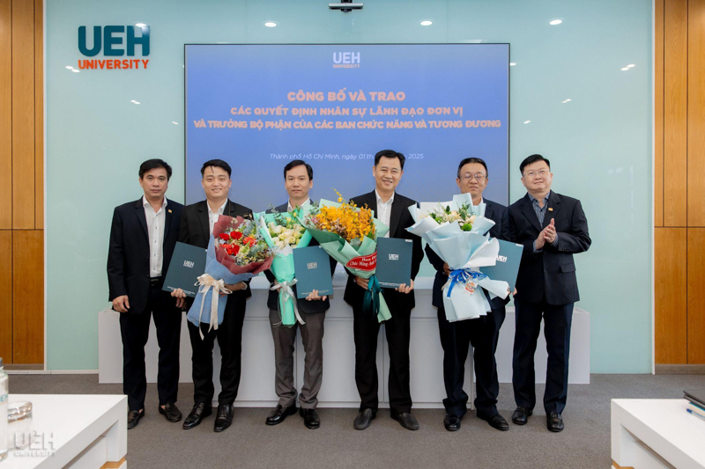
Figure 3. UEH announces the assignment of responsibility for local partnership coordination in 2025.
Source: UEH Portal, article 75430, 2 December 2025.
5 Selected stakeholder engagement activities in 2025
The 15 cases below document selected activities and milestones in workforce development, policy research and advice, and engagement with businesses and communities. Signed agreements establish a framework for cooperation. Planned activities are reported separately from completed work.
| Activity and date | Partners and beneficiaries | Engagement | Outcome and source |
| Vĩnh Long partnership 25 February |
Provincial People’s Committee and local agencies | 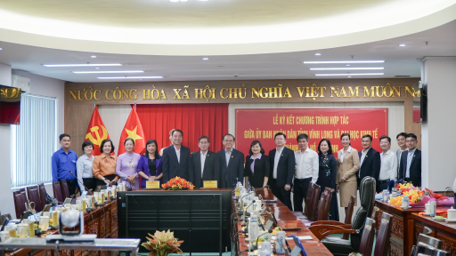
Agreed priorities in training, research, knowledge transfer and policy advice. UEH proposed annual tasks and joint coordination. |
Signed the 2025–2030 cooperation programme. UEH Portal, 25 February 2025, article 73485. |
| Local policy dialogue 4 April |
Local leaders from the Southeast, Central Highlands and Central Coast; regulators and researchers | 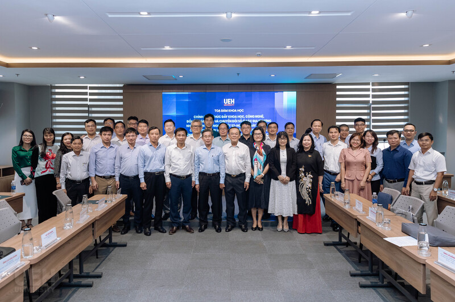
Discussed local needs and options in science, technology, innovation and digital transformation. |
Six presentations informed the dialogue. UEH Portal, 9 April 2025, article 73791. |
| UEH Mekong policy dialogue 17 April |
Ministry of Science and Technology, Vĩnh Long leaders and Mekong Delta agencies | 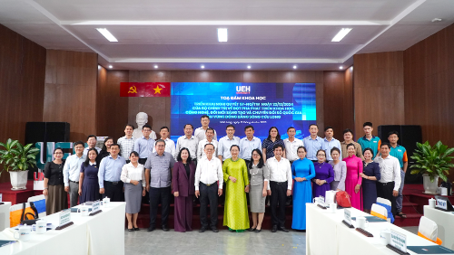
Discussed how to implement Resolution 57 in the regional context. |
Held a dialogue linking public authorities, academia and business. UEH Portal, 18 April 2025, article 73845. |
| Khánh Hòa review 16 May |
Provincial People’s Committee and departments | 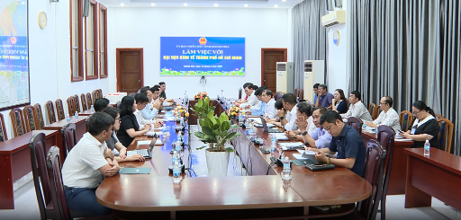
Reviewed the 2023–2028 agreement and discussed training, research and transfer needs. |
The province responded to proposals and tasked its departments with follow-up. UEH Portal, 18 May 2025, article 74142. |
| SATRA partnership 19 June |
Saigon Trading Group (SATRA) | 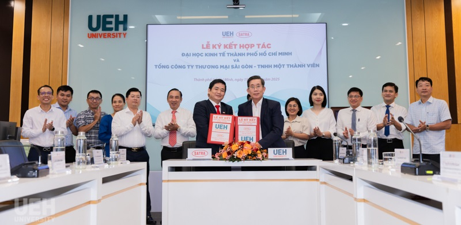
Linked education and research with business practice in Ho Chi Minh City. |
Signed a cooperation agreement. UEH Portal, 20 June 2025, article 74360. |
| Recognition in Bà Rịa–Vũng Tàu June |
Provincial People’s Committee and partner agencies | 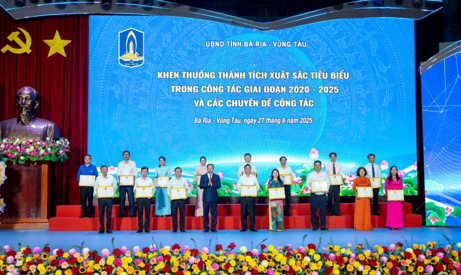
Recognition of multi-year cooperation in research, advice and local development. |
UEH received a provincial commendation for cumulative contributions. UEH Portal, 30 June 2025, article 74401. |
| Cà Mau partnership 25 September |
Provincial People’s Committee and local agencies | 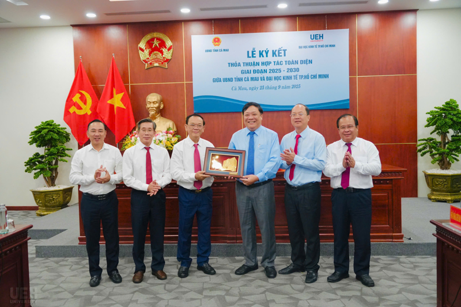
Agreed priorities in training, research and advice on the marine economy, energy, climate, logistics and urban development. |
Signed a 2025–2030 agreement. UEH Portal, 26 September 2025, article 74866. |
| UEH Mekong agency and business partnerships 6 October |
Nearly 20 agencies and businesses, including Vĩnh Long partners; UEH Mekong learners are intended beneficiaries | 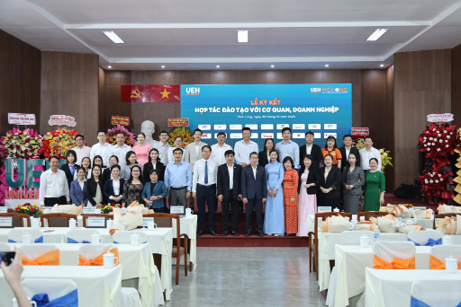
Connected education with the practical needs of regional employers and public agencies. |
Established partnerships with external organisations. UEH Portal, 9 October 2025, article 74956. |
| An Giang partnership 18 October |
Provincial People’s Committee and local agencies | 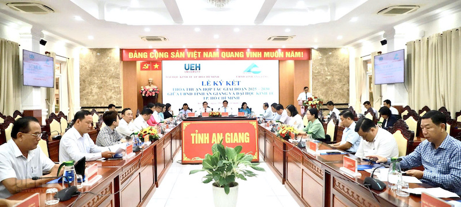
Agreed to cooperate on training, research and policy advice. |
Signed a 2025–2030 agreement. UEH Portal, 20 October 2025, article 75088. |
| Vĩnh Long partnership after the merger November |
Provincial People’s Committee and departments | 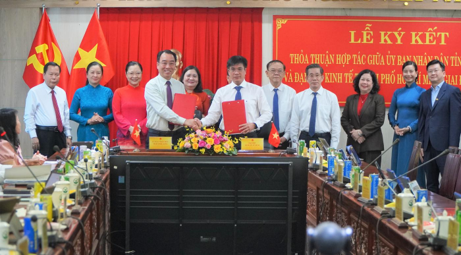
Identified priorities in training, research, advice, digital transformation, business and regional links. |
Signed a 2025–2030 agreement for the reorganised province. UEH Portal, 3 November 2025. |
| Gia Lai partnership 13 November |
Provincial People’s Committee and departments; commune officials are an intended beneficiary group | 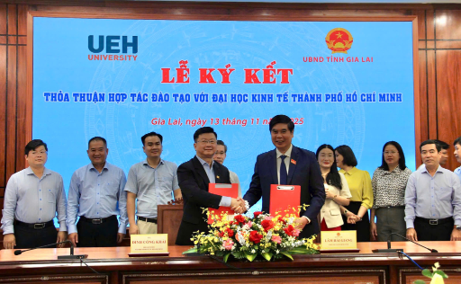
Identified research, advisory and training priorities, including capacity development for commune officials. |
Signed a 2025–2030 agreement. UEH Portal, 14 November 2025. |
| Đắk Lắk partnership 14 November |
Provincial People’s Committee and specialist agencies | 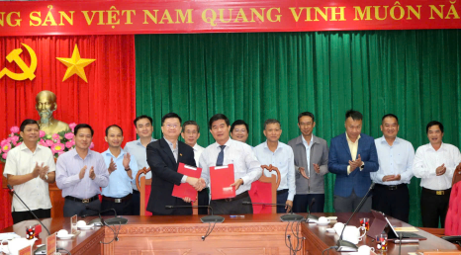
Agreed priorities in training, policy advice, research, technology and innovation. |
Signed a 2025–2030 agreement. UEH Portal, 14 November 2025, article 75283. |
| Cần Thơ partnership 26 November |
City People’s Committee and local agencies | 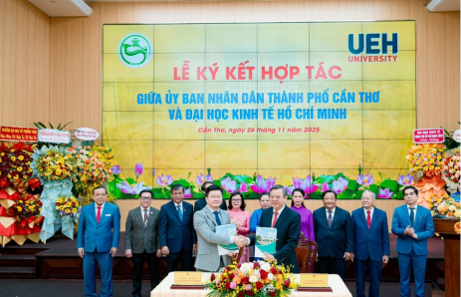 Discussed policy, training, research, innovation, digital transformation and smart city development. |
Signed a 2025–2030 agreement. UEH Portal, 27 November 2025, article 75403. |
| Tây Ninh partnership 12 December |
Provincial People’s Committee, UEH and academic partners | 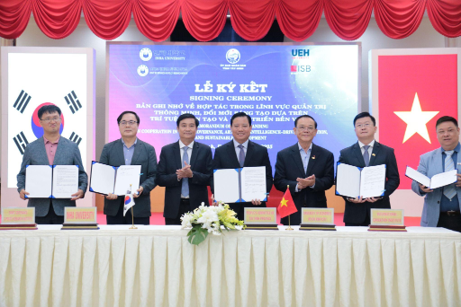
Linked local governance needs with AI, training and digital transformation advice. |
Signed an agreement. Activities for 2026–2028 were planned. UEH Portal, 13 December 2025. |
| Khánh Hòa implementation plan December |
Provincial People’s Committee and implementing agencies | 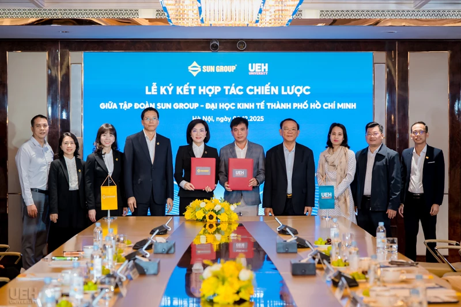
Developed arrangements for policy, training, research, digital transformation and smart city cooperation. |
Khánh Hòa Newspaper reported that the province issued an implementation plan. The original plan is needed to confirm detailed assignments. Khánh Hòa Newspaper, 19 December 2025. |
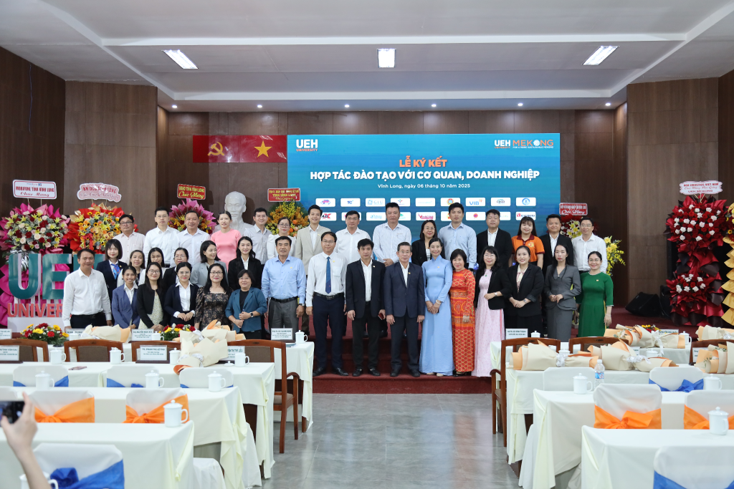
Figure 4. UEH Mekong engages local agencies and businesses in 2025.
Source: UEH Portal, article 74956, 9 October 2025.
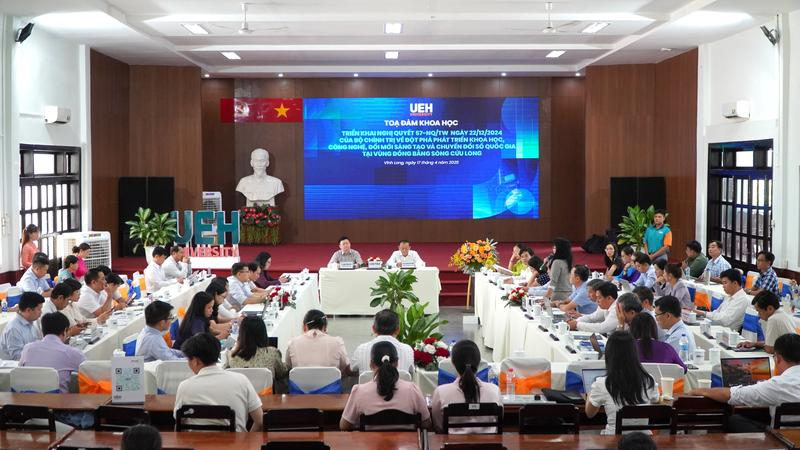
Figure 5. UEH Mekong discusses science, technology and digital transformation with local representatives.
Source: UEH Portal, article 73845, 18 April 2025.
Conclusion
In 2025, UEH linked local needs with the responsibilities of implementing units and the intended benefits of each activity. Regulation No. 3124 establishes a process from receiving requests to assigning responsibilities, implementing activities and reporting results. The community engagement programme extends UEH’s education, research and knowledge transfer to public agencies, businesses, organisations and residents.
The Vĩnh Long, Khánh Hòa and UEH Mekong cases illustrate joint planning, review after signature and engagement with local organisations. Family Connect and volunteering in Vĩnh Long also identify specific beneficiaries, including parents, children, schools, households and communities using local infrastructure.