

15.2.2 – Sustainably farmed food on campus
In 2025, the University of Economics Ho Chi Minh City (UEH) continued to implement, review, and update its policy prioritizing sustainably farmed food on campus under the Green Campus Regulations (Decision No. 2059/QD-DHKT-CSVC) and the Ethical Sourcing Policy, giving preference to organic food, locally grown agricultural products, and products certified to VietGAP or GlobalGAP standards. The policy was translated into purchasing criteria, traceability requirements, and supplier monitoring at canteens and food service providers across UEH campuses, contributing to sustainable agriculture, land resource protection, and food quality and safety for campus users.
1. Internal commitments and supporting policies
2022: Establishment and development of the policy
UEH established its Green Campus governance framework through the Green Campus Regulations under Decision No. 2059/QD-DHKT-CSVC. During implementation, UEH progressively specified responsible food sourcing requirements for canteens, convenience stores, restaurants, and food service outlets.
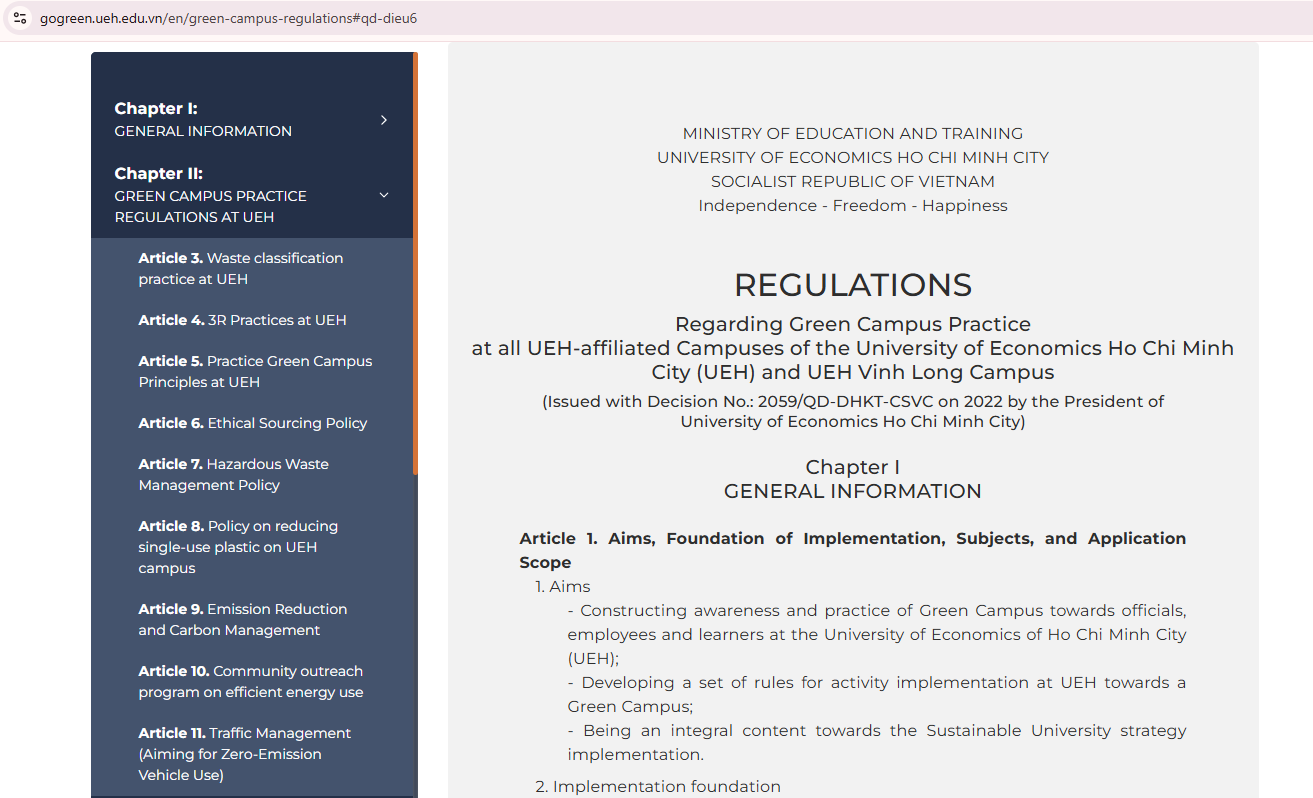
UEH published the Green Campus Regulations under Decision No. 2059/QD-DHKT-CSVC
Public source: UEH Green Campus website, ‘Green Campus Regulations’
https://gogreen.ueh.edu.vn/en/green-campus-regulations
According to UEH’s published policy, ethical food sourcing provisions were introduced in 2022 and were subsequently updated, adjusted, and expanded in 2025. Article 6 – Ethical Sourcing Policy establishes the principle of purchasing food only from suppliers that meet food safety and traceability requirements, while prioritizing local agricultural products, organic food, or products certified to VietGAP and other appropriate standards.
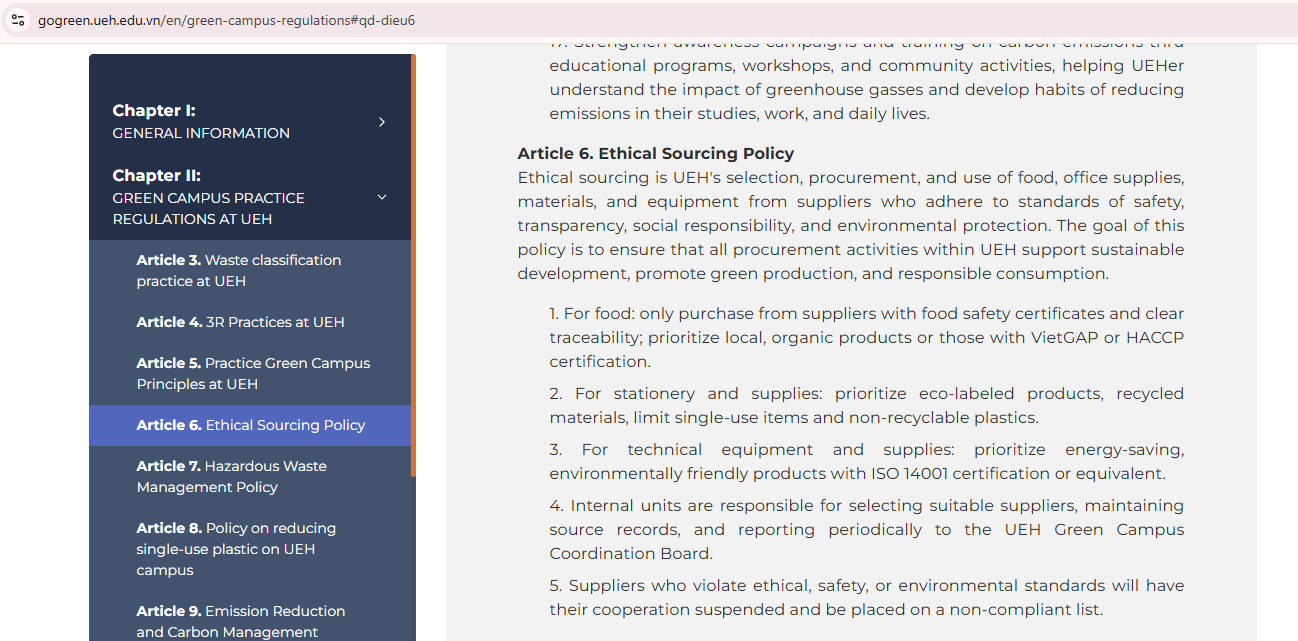
Article 6 – Ethical Sourcing Policy in UEH’s Green Campus Regulations
Public source: UEH Green Campus website, ‘Article 6. Ethical Sourcing Policy’
https://gogreen.ueh.edu.vn/en/green-campus-regulations
In addition, UEH’s evidence article for THE Impact Rankings criterion 15.2.2, published on 3 November 2025, recorded supplementary pilot provisions for Clause 6, Article 10 of the Green Campus Regulations. These provisions prioritize food service suppliers committed to sourcing sustainably farmed food, including VietGAP-certified or organic products, and favor locally produced goods.
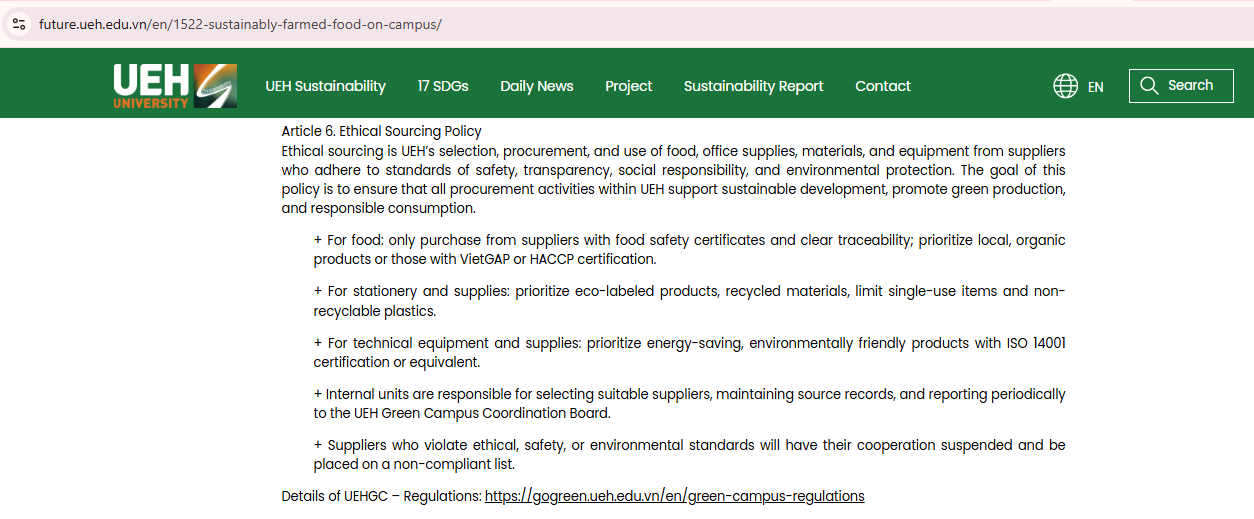
Supplementary Clause 6, Article 10 of the Green Campus Regulations on prioritizing sustainably farmed, certified food at UEH
Public source: UEH Future, ‘15.2.2. Sustainably farmed food on campus’, 7 November 2025
https://future.ueh.edu.vn/en/1522-sustainably-farmed-food-on-campus/
2025: Reviewing, updating, specifying, and strengthening supply chain management
Building on this policy framework, UEH focused in 2025 on reviewing food purchasing and procurement criteria and the responsibilities of food service units under its Green Campus system.
The UEH Green Campus Project Report 2025 documented updates to requirements concerning sustainably farmed food, safe origins, and transparent supplier traceability. The review covered canteens, supermarkets, service outlets, and internal operating units, prioritizing local food, sustainably produced food, or products with relevant certifications such as VietGAP and GlobalGAP.
The 2025 update of the Green Campus Regulations organized these requirements under the following provisions:
Article 6, Clause 1 – Responsible Procurement Policy.Priority was given to food with clear and verifiable origins that met food safety requirements. The policy also encouraged locally produced, seasonal, organic, or VietGAP-, GlobalGAP-, and otherwise appropriately certified food to help promote sustainable agriculture.
Article 17, Clauses 1–3 – Responsibilities of internal purchasing and supply units.Units were required to purchase in accordance with Article 6, select suppliers meeting environmental and quality criteria, and inspect and retain records of supplier origins and certifications. In addition, Article 17, Clauses 5–6 provided for monitoring supplier compliance during contract implementation and periodically consolidating and reporting the results of responsible procurement policy implementation.
These provisions reflected an integrated management approach covering food selection, supplier selection, record verification, and implementation monitoring. The updated provisions continued to serve as a basis for UEH to strengthen the management of sustainably farmed food on campus; the effective date of the updated regulations still requires confirmation from the approval decision.
2. Long-term orientation under the Comprehensive Wellbeing University Initiative
In late 2025, as part of the UEH Development Strategy for 2025–2030, UEH continued to develop its Comprehensive Wellbeing University Initiative (UEH Wellbeing – Flourishing University) to improve the quality and sustainability of learning, working, and daily living environments. The initiative covered physical and mental health, community connection, personal development, careers, financial wellbeing, and the university environment. It emphasized healthy nutrition and responsible food consumption to encourage the UEH community to choose nutritious food and consider its origins and environmental impacts. This orientation further reinforced the long-term strategic foundation for sustainable food sourcing, selection, and consumption policies at UEH, supporting a healthy university environment that respects people and ecosystems.
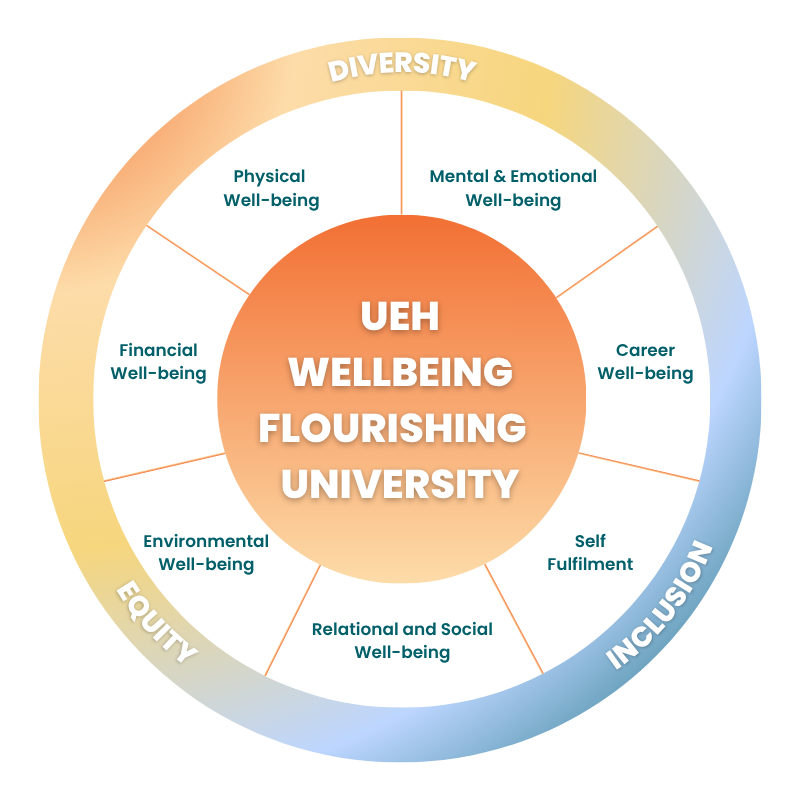
The UEH Wellbeing – Flourishing University model aims to support holistic human development
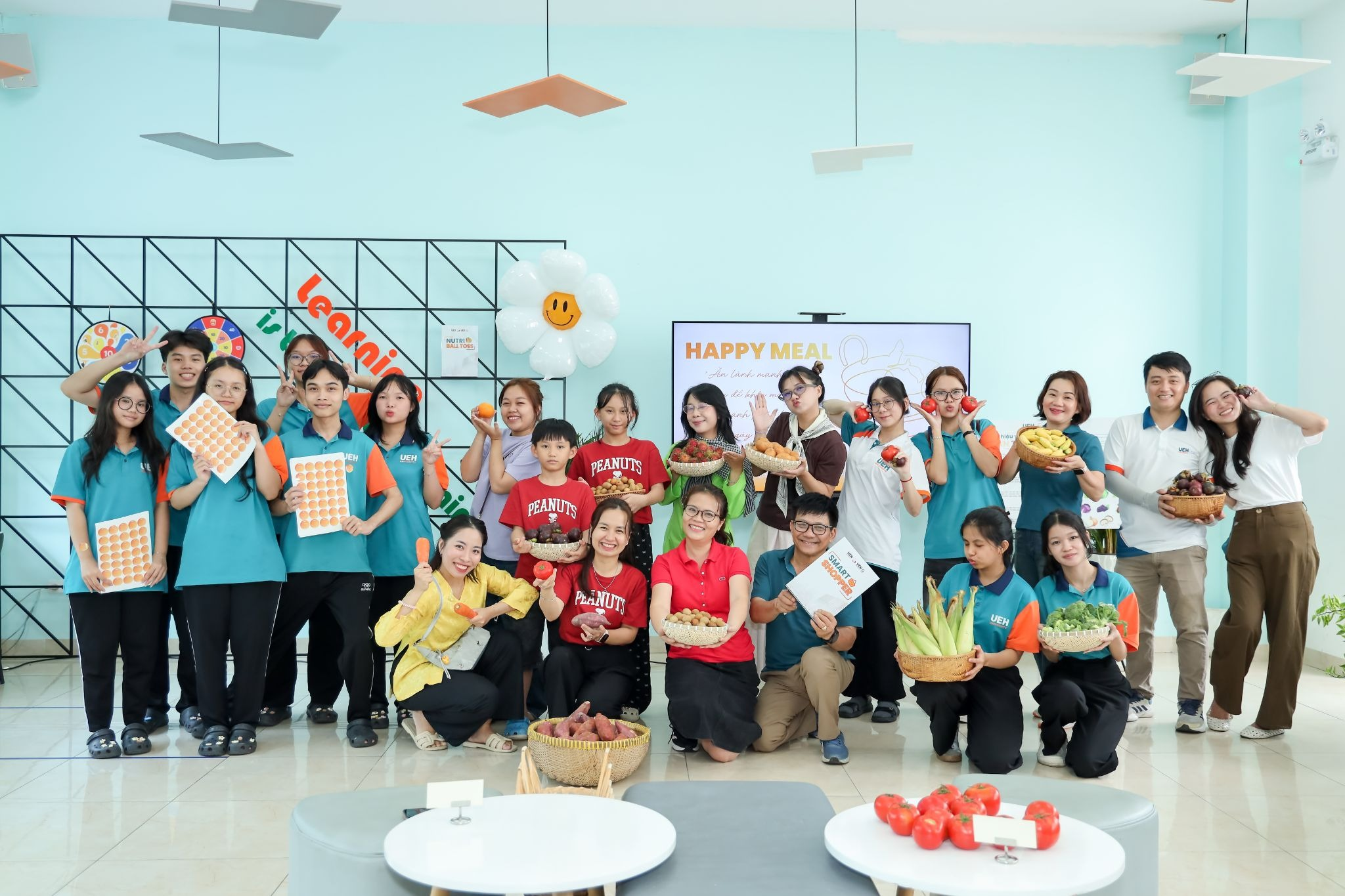
The Happy Meal activity, one of the action themes of the UEH Wellbeing – Flourishing University Initiative
3. Evidence of policies and programmes implemented in 2025
In 2025, UEH continued implementing responsible food sourcing policies while reviewing and refining supplier requirements and responsibilities. UEH also carried out practical programmes and activities aimed at providing sustainable food, reducing waste, and promoting sustainable agriculture. Key measures are summarized below:
| No. | Document/Programme/Activity | Implementation year | Target group | Description | Public source |
| 1 | 12.2.1. Ethical Sourcing Policy | 2024 – 2025 | Purchasing units, canteens, supermarkets, convenience stores, and food suppliers | UEH published a policy prioritizing local and organic food or products meeting VietGAP standards. In particular, suppliers were required to comply with food safety regulations and provide traceability, while internal units were assigned responsibility for record retention and supplier monitoring.
This policy established a basis for responsible food sourcing decisions. The article published in 2025 confirmed the policy’s development from 2024 and its continued application to supply chain management in 2025.
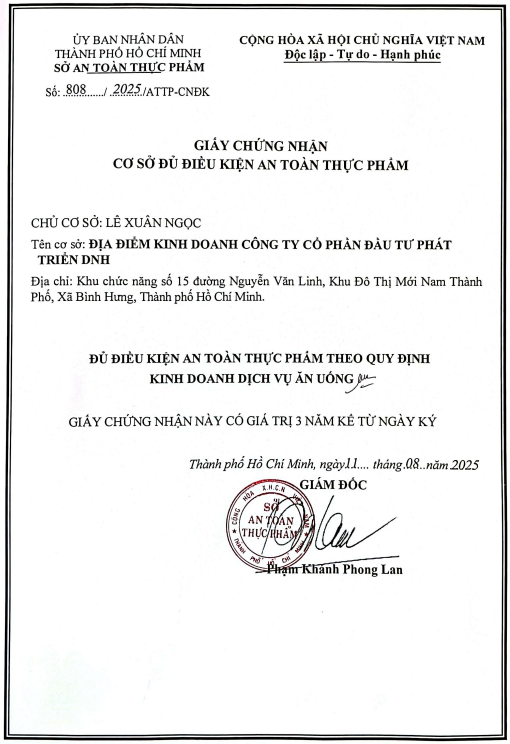
Food safety eligibility certificate issued in August 2025 for the business premises of DNH Development Investment Joint Stock Company at UEH’s Nguyen Van Linh campus
Food safety eligibility certificate issued in November 2022 to DNH Development Joint Stock Company at UEH’s Nguyen Van Linh campus |
UEH Future, ‘15.2.2. Sustainably farmed food on campus’, 7 November 2025
https://future.ueh.edu.vn/en/1522-sustainably-farmed-food-on-campus/ |
| 2 | Review of food procurement and supply partner criteria at UEH | 2025 | Canteens, convenience stores, supermarkets, service outlets, and internal operating units | UEH reviewed and surveyed procurement criteria, prioritizing local products, sustainably produced goods, and products certified to VietGAP or GlobalGAP standards. In particular, UEH required suppliers to ensure transparency of product origins, quality certifications, and supplier traceability.
This review was intended to strengthen campus food supply management and provide a basis for further standardizing procedures and partnership arrangements. |
UEH Green Campus Project Report 2025 |
| 3 | Sustainable Food Procurement Policy – Green Campus Food Policy | 2024 – 2025 | UEH canteens, food suppliers, and local agricultural producers | In 2025, UEH continued prioritizing ingredients from organic and local producers and reported maintaining long-term contracts with certain suppliers of organic vegetables and safe seafood. According to the published article, approximately 65% of ingredient procurement expenditure in 2024 went to local suppliers, including 40% certified organic products. This contributed to supporting a sustainable food supply chain. | UEH Future, ‘2.5.4. Sustainable Food Procurement’, 2025
https://future.ueh.edu.vn/en/254-sustainable-food-purchases/ |
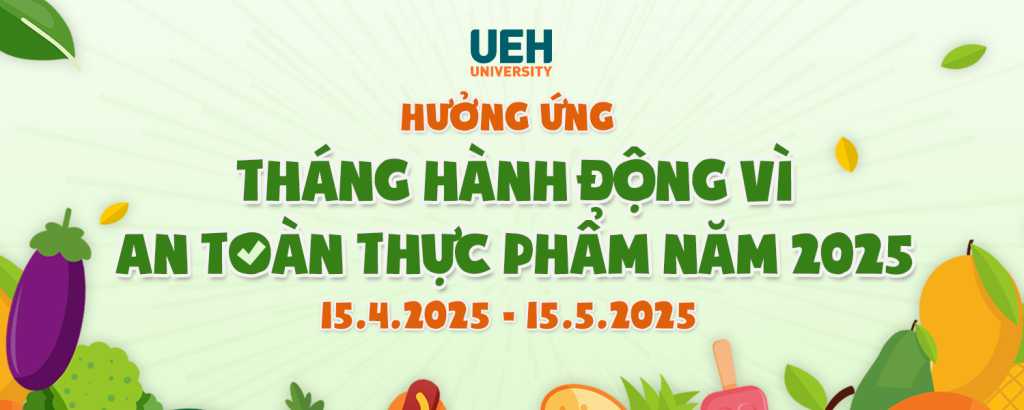
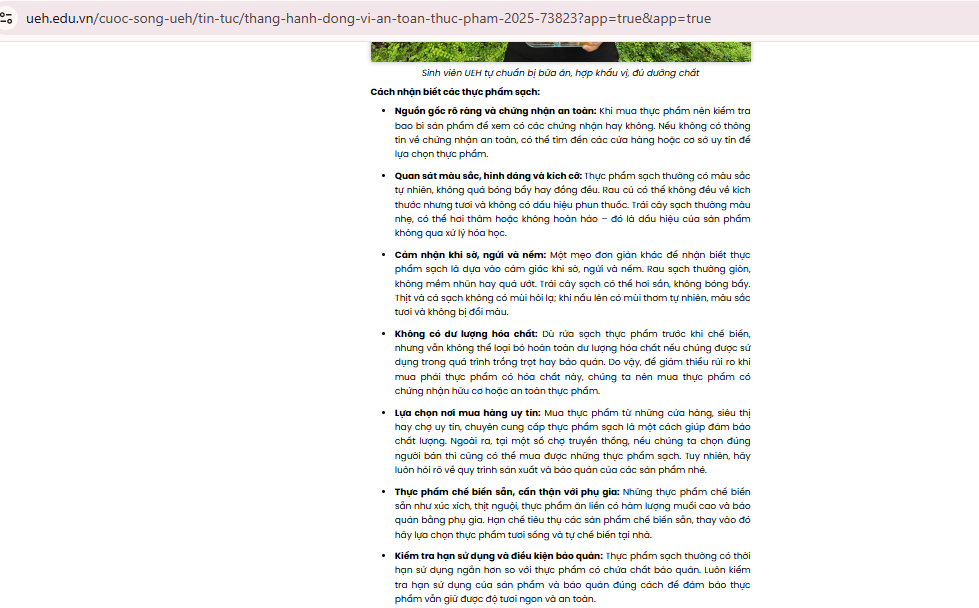
| 4 | Food Safety Action Month 2025 – Raising awareness of food with transparent origins and appropriate certification | April 2025 | Students, academic and administrative staff, employees, and the UEH community | From 15 April to 15 May 2025, UEH supported the ‘Food Safety Action Month 2025’ campaign, focusing on raising campus community awareness of choosing and consuming safe food with transparent origins. Through communications, UEH encouraged students and employees to prioritize fresh food, check product origins and certifications on packaging, choose organic or safety-certified products, and learn about suppliers’ production processes. The activity increased awareness of responsible food consumption, supported the Responsible Procurement Policy, and encouraged demand for food produced to appropriate standards, contributing to SDG indicator 15.2.2 – Sustainably Farmed Food on Campus.
UEH supported Food Safety Action Month 2025
Guidance on checking product origins and certifications on packaging, choosing organic products, and learning about production and preservation processes |
UEH Portal, ‘Food Safety Action Month 2025’, 15 April 2025
https://www.ueh.edu.vn/cuoc-song-ueh/tin-tuc/thang-hanh-dong-vi-an-toan-thuc-pham-2025-73823 |
| 5 | UEH Mekong Agribusiness Programme – Developing human resources and sustainable agricultural value chains | 2025 | Agribusiness students, partner enterprises, and cooperatives | In 2025, UEH Mekong (Vinh Long Campus) continued delivering its interdisciplinary Agribusiness degree programme, integrating economics, management, and agricultural techniques to develop professionals capable of managing agricultural and food value chains from production and processing to trade and consumption. The programme helped develop human resources and disseminate knowledge about responsible agricultural value chains, complementing UEH’s efforts to promote a sustainable food supply.
Agribusiness programme at UEH Mekong |
UEH Portal, ‘UEH Mekong Agribusiness Programme: Training high-quality human resources, ready for integration and the creation of sustainable value chains’, 8 September 2025 |
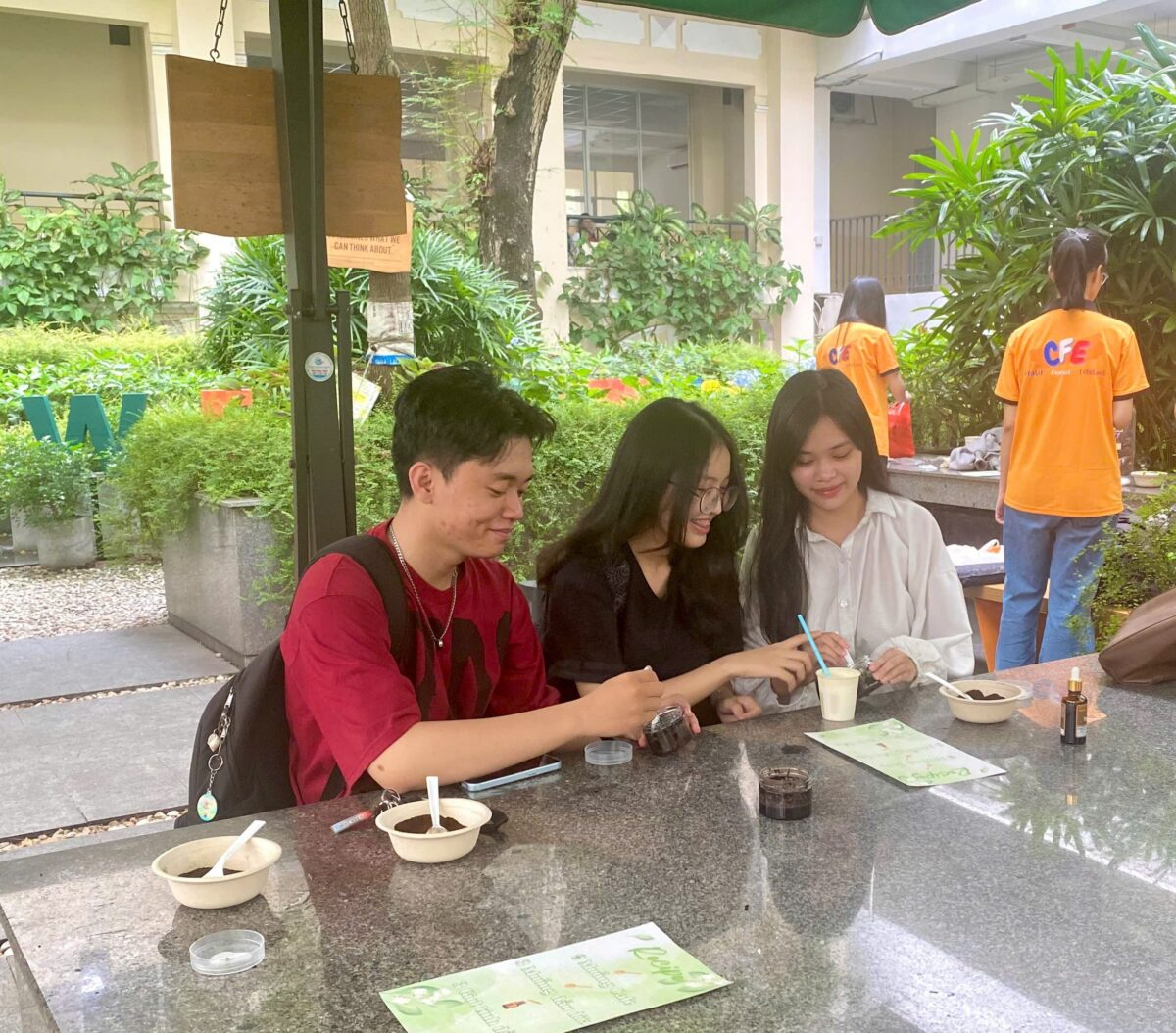
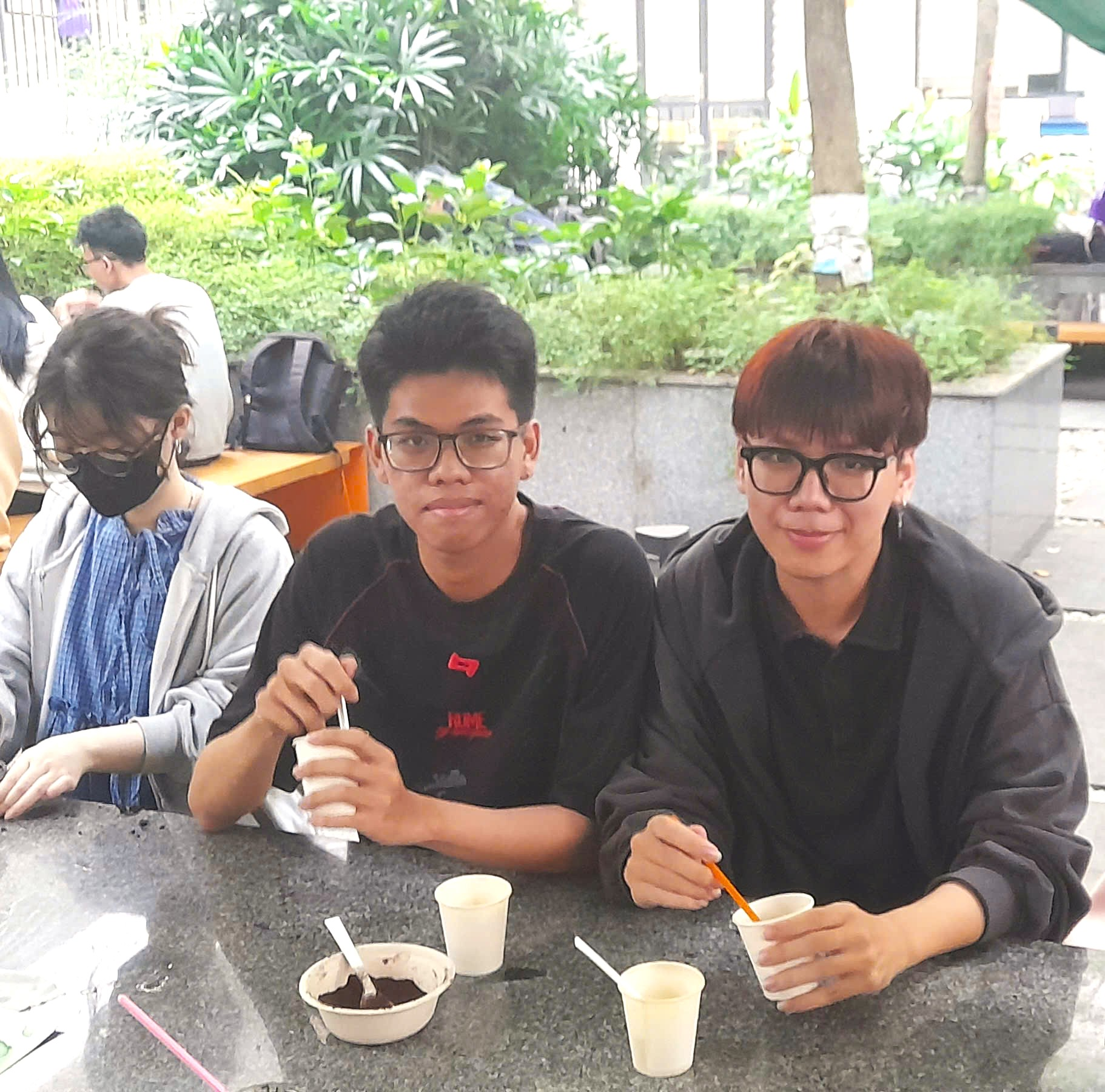
| 6 | ‘Écho Vert – Green Echo’: Raising awareness of sustainable consumption and efficient resource use | 2025 | UEH students | From 23 November to 2 December 2025, the UEH French Club (CFE) organized ‘Écho Vert – Green Echo’, engaging approximately 1,000 students in hands-on activities on sustainable consumption based on the 3R principles (Reduce – Reuse – Recycle). The programme combined waste reduction communications, waste sorting guidance, and a workshop on reusing agricultural-origin ingredients such as coffee and coconut oil to create personal care products. Through practical activities, UEH encouraged students to use resources efficiently, reduce waste, and adopt responsible consumption habits. This educational activity complemented UEH’s orientation toward sustainable food sourcing and consumption on campus and was linked to SDG 15.
‘Organic Body Scrub from Coffee and Coconut Oil’ workshop, raising awareness of agricultural-origin ingredients and waste reduction |
UEH Youth, ‘UEH Green Campus 2025 Activity Series – UEH French Club (CFE): Écho Vert – Green Echo’, 6 December 2025 |
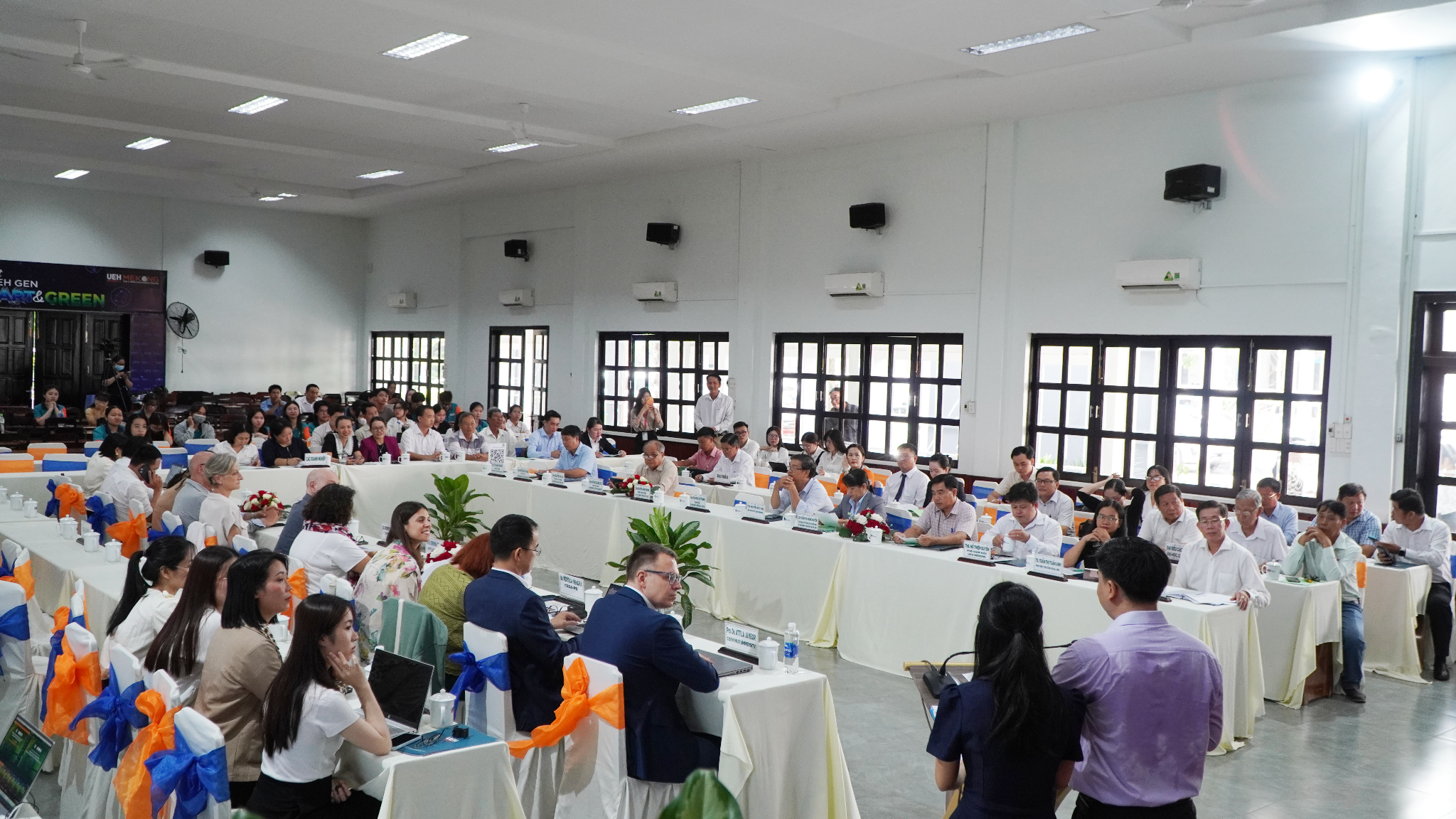
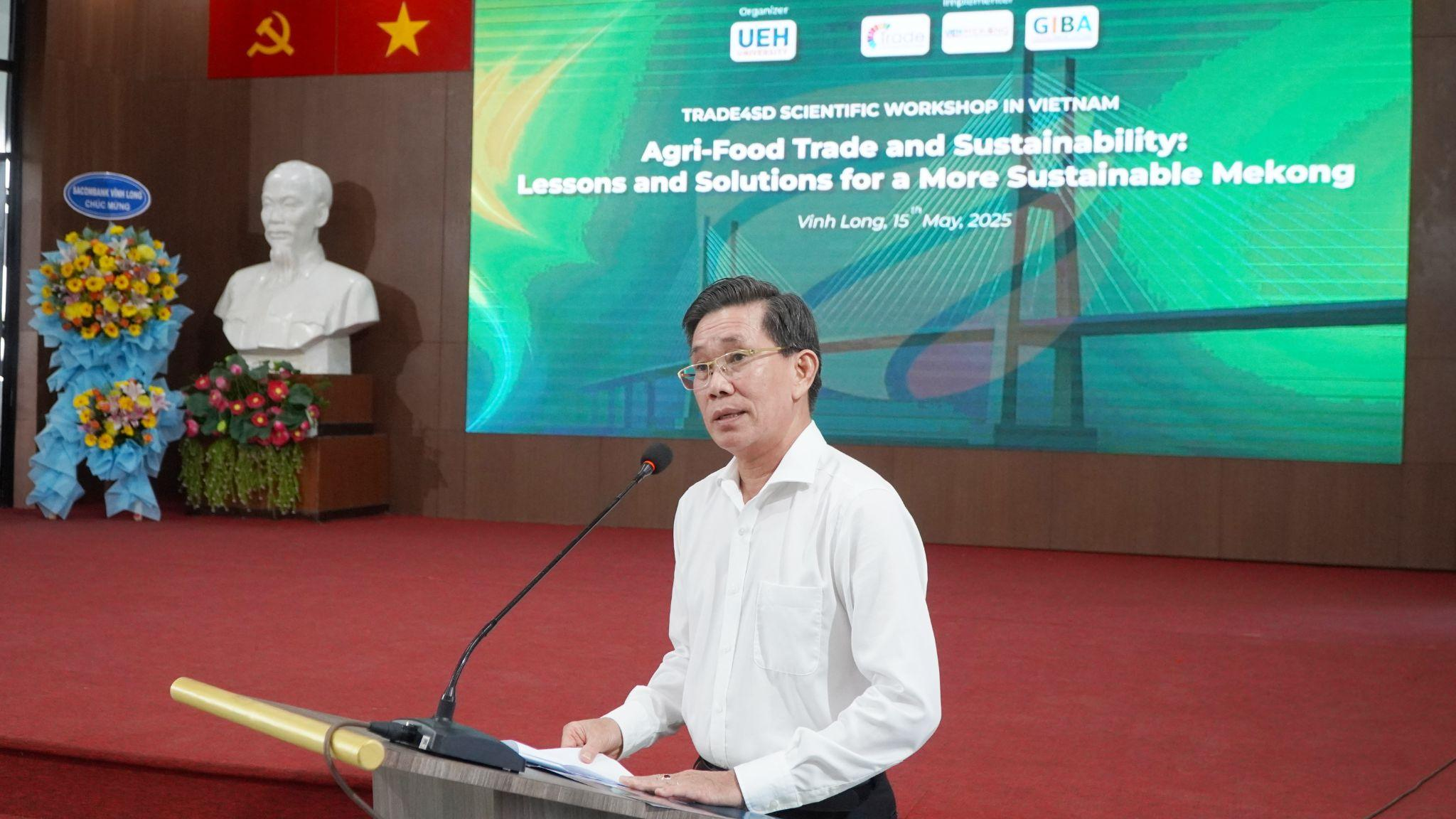
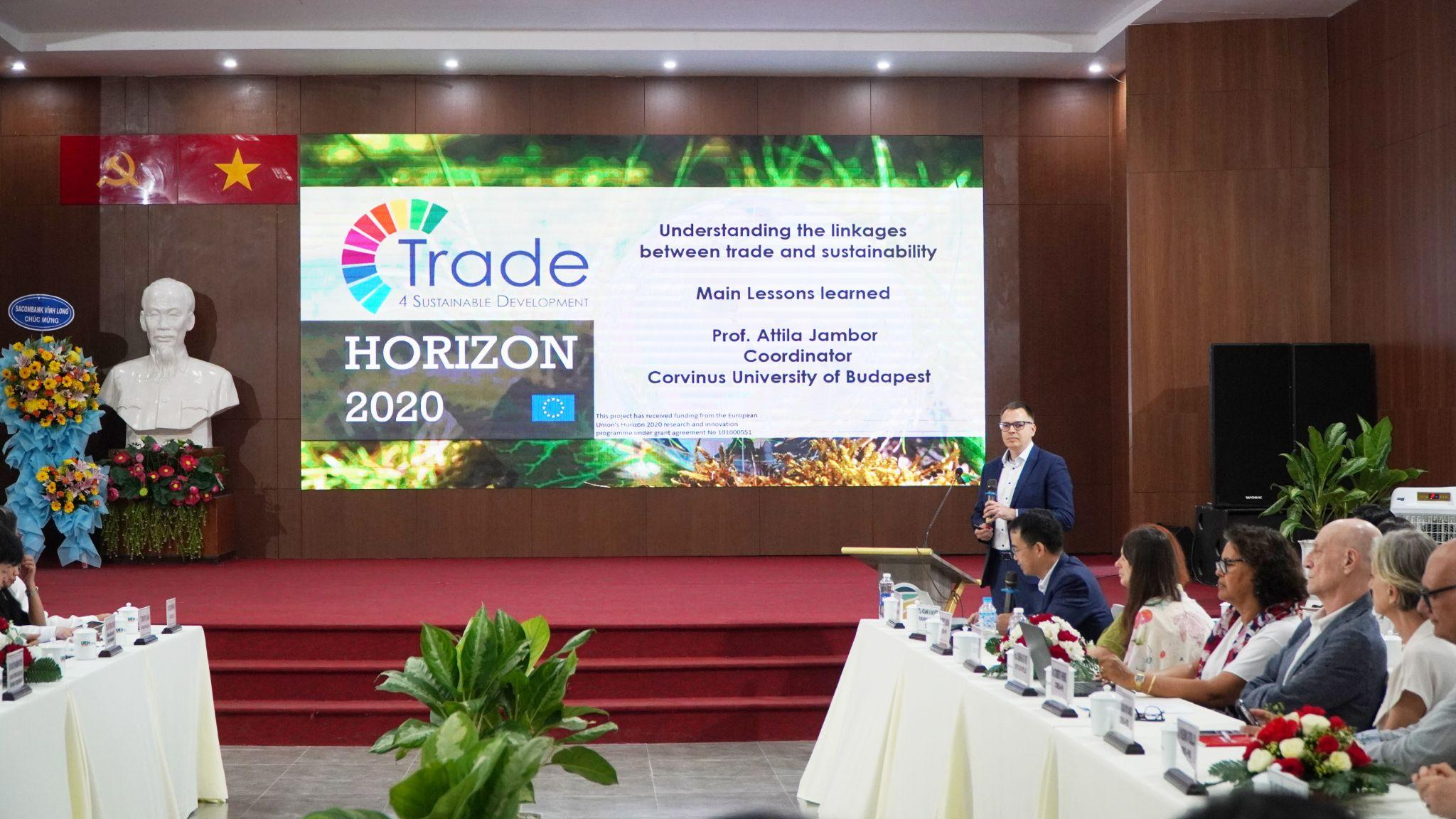
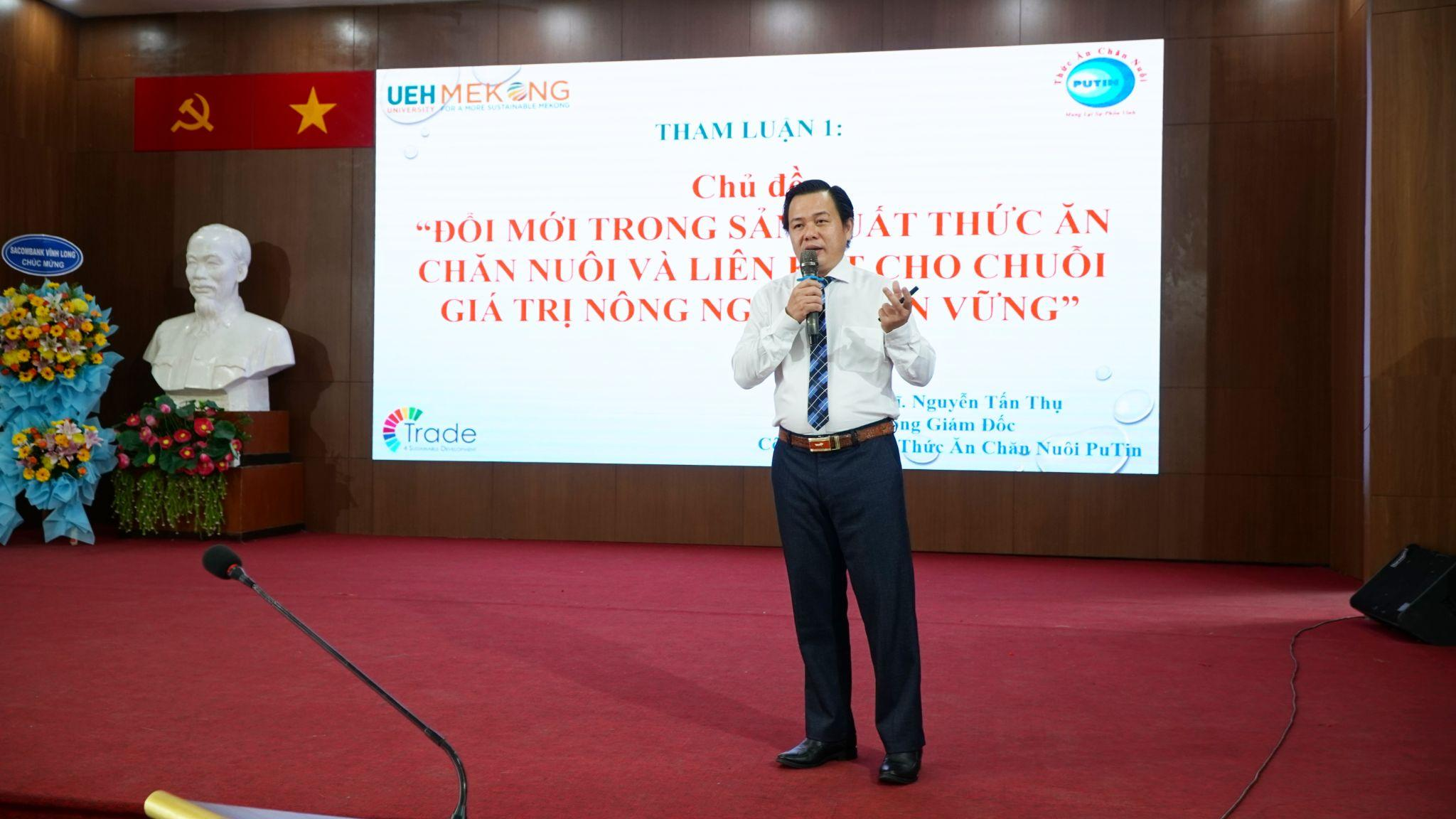
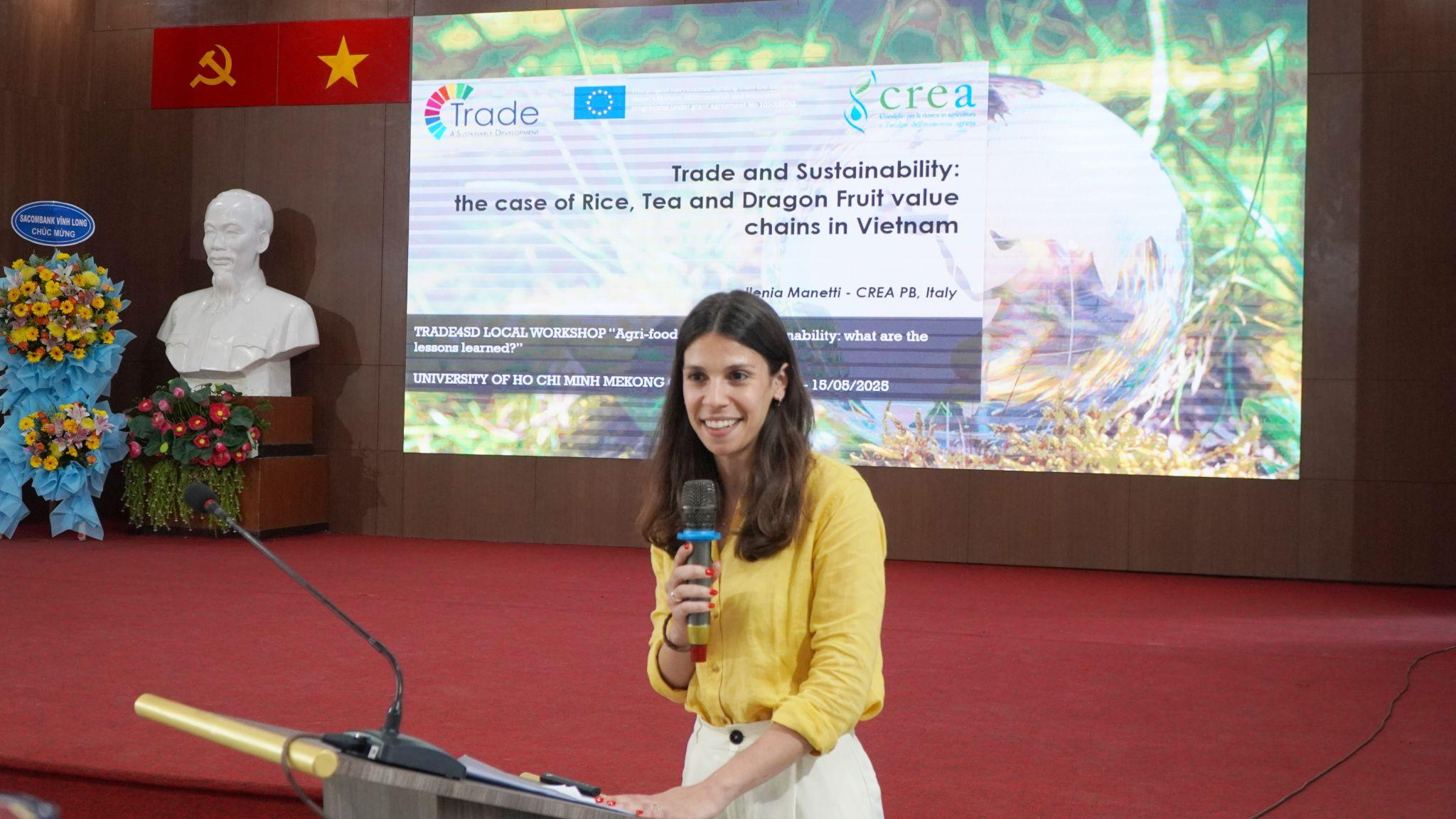
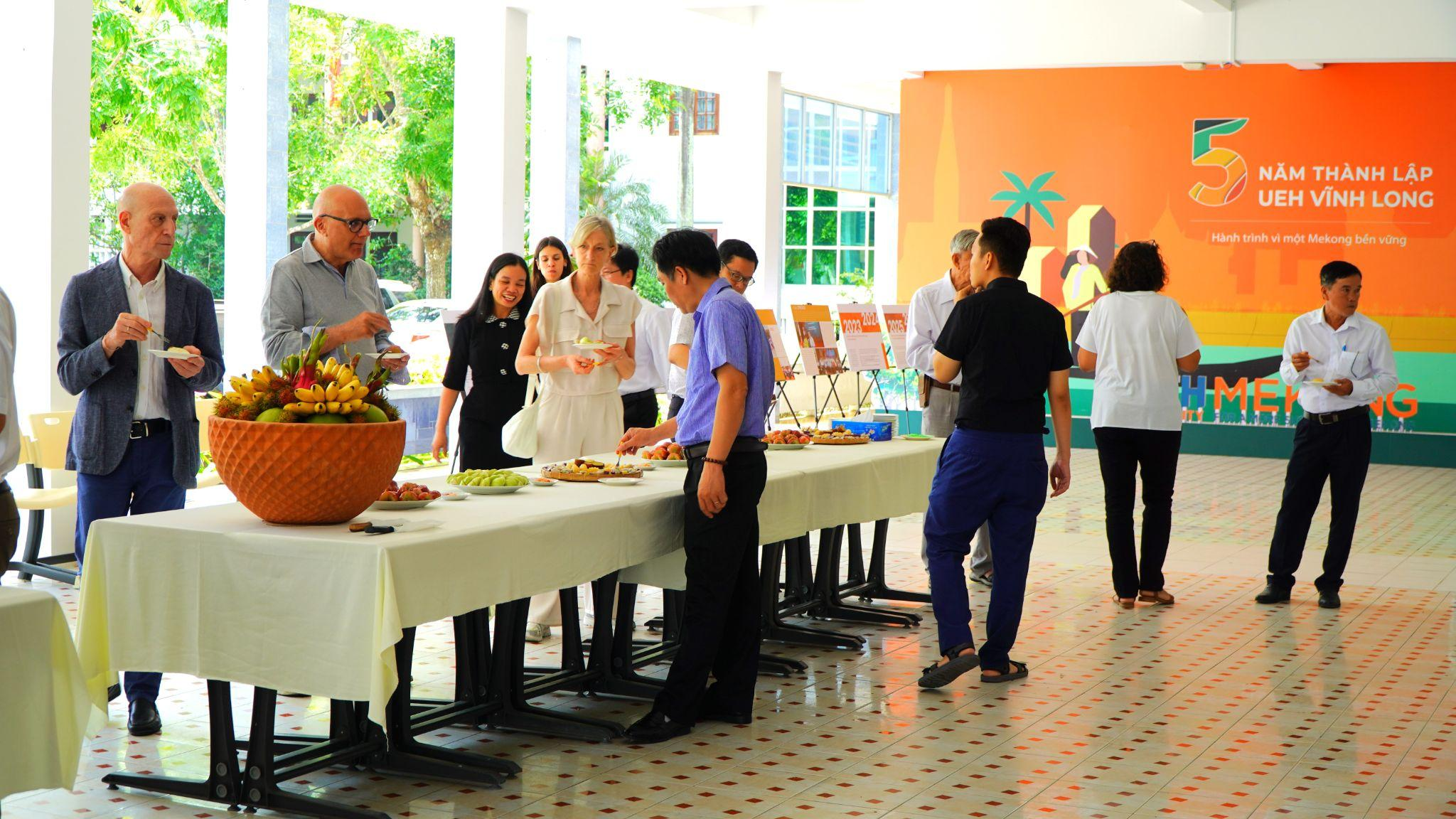
| 7 | Scientific seminar on ‘Agricultural Trade and Sustainable Development’ – Promoting transparent and responsible agricultural supply chains | 2025 | International experts, researchers, government agencies, businesses, lecturers, and UEH Mekong students | On 15 May 2025, UEH held the international scientific seminar ‘Agricultural Trade and Sustainable Development: Lessons and Solutions for a More Sustainable Mekong’ at UEH Mekong under the EU-funded TRADE4SD project, attended by over 120 participants. The seminar examined and discussed solutions for sustainable agricultural value chains, particularly rice, tea, and dragon fruit, with an emphasis on responsible production standards, traceability, supply chain transparency, and linkages between businesses and farmers. Through academic exchange and practical experience, it disseminated knowledge of sustainable agricultural sourcing, aligned with UEH’s Ethical Sourcing Policy prioritizing responsibly farmed food.
Overview of the scientific seminar
Speakers presenting on Vietnamese agricultural value chains at the seminar
Participants explored agricultural product origins |
UEH Portal, ‘UEH hosts scientific seminar on Agricultural Trade and Sustainable Development: Lessons and Solutions for a More Sustainable Mekong’, 16 May 2025 |


4. Conclusion
The Green Campus Regulations and Ethical Sourcing Policy provided UEH with a foundation for campus food supply management based on safety, transparency, and the prioritization of sustainable agricultural production methods.
Building on this foundation, UEH continued reviewing criteria for campus purchasing and food service units in 2025, emphasizing agricultural products with relevant cultivation certifications, prioritizing local products, and strengthening traceability requirements. Mechanisms for supplier selection, record retention, and monitoring helped support a transparent and responsible food supply chain.
These activities and policies contributed to SDG 15 and indicator 15.2.2 – Sustainably Farmed Food on Campus by strengthening requirements for food produced through sustainable farming practices, thereby encouraging land resource management and environmental protection in agricultural production.
Through the reviewed, updated, and expanded regulations and policies, UEH continued improving its mechanisms for managing and verifying food sources to ensure that policies prioritizing sustainably farmed food were applied comprehensively and consistently across the university’s food services.