

The University of Economics Ho Chi Minh City (UEH) remains committed to ensuring equitable access to education for applicants from the lowest 20% of households by income (the bottom 20%). During the 2025 admissions cycle, with an overall admissions target of 7,980 places, UEH placed no separate cap on applicants eligible for admissions priority. It fully applied regional and applicant-category preferences, direct admission and preferential consideration in accordance with Ministry of Education and Training (MOET) regulations, while reserving 165 study-support scholarships for disadvantaged first-year students at enrolment. In 2025, UEH enrolled 402 new students from the bottom 20%, accounting for 5.27% of new entrants, compared with 169 students (2.16%) in 2024.
To implement this commitment, UEH publicly announced priority policies at the opening of the admissions season and published detailed guidance on documentation proving priority-applicant status and priority regions via its Admissions Portal. UEH identifies the bottom 20% on the basis of household economic circumstances, not simply an applicant’s admissions-priority category or geographic area. Eligible applicants must belong to poor or near-poor households under Vietnam’s 2022–2025 multidimensional poverty standard (Decree No. 07/2021/ND-CP), with certification from local authorities, or have evidence that household income per capita falls within the country’s lowest income quintile according to the General Statistics Office’s Vietnam Household Living Standards Survey. UT1/UT2 and KV1 priority categories, ethnic-minority applicants, persons with disabilities and applicants from the Mekong Delta are not automatically classified in the bottom 20%; they are included only if the required economic evidence is available.
Alongside admissions preferences, UEH links recruitment to financial assistance so that disadvantaged applicants do not forgo higher education. In 2025, financially disadvantaged entrants were eligible for full or partial study-support scholarships worth up to VND 15.6 million per award. At UEH Mekong, tuition fees were only 60% of those in Ho Chi Minh City; applicants with household registration in the Mekong Delta could receive first-semester tuition exemptions of 100% or 50% in three programmes. The policy is applied nationwide, contributing to SDG 1 (No Poverty) and SDG 4 (Quality Education).
| Policy / Mechanism | Applicable subjects | Implementation in 2025 | Result |
|---|---|---|---|
| Uncapped priority admissions with regional and applicant-category preferences | Candidates belonging to priority groups (UT1, UT2) and priority areas (KV1, KV2-NT, KV2); only candidates with proof of poverty, near-poverty, or low income are included in the bottom 20% group. | The policy will be announced at the start of the admissions season (February 14, 2025).
Issuance of guidelines for providing supporting documents for registration and admission to Course 51, including documents for priority groups and priority areas (June 2, 2025). Priority points will be added according to the regulations of the Ministry of Education and Training for all admission methods that use scores. 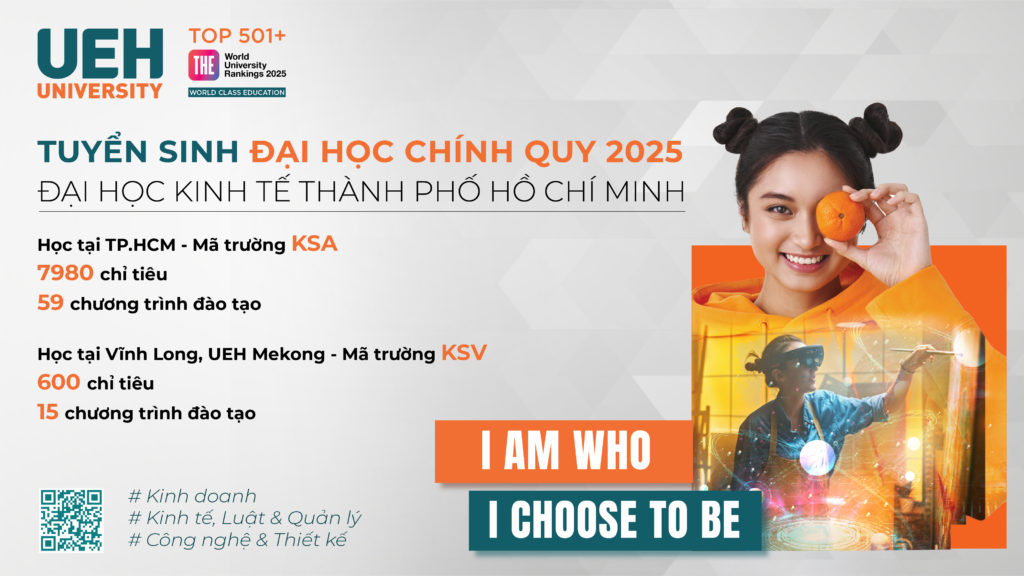 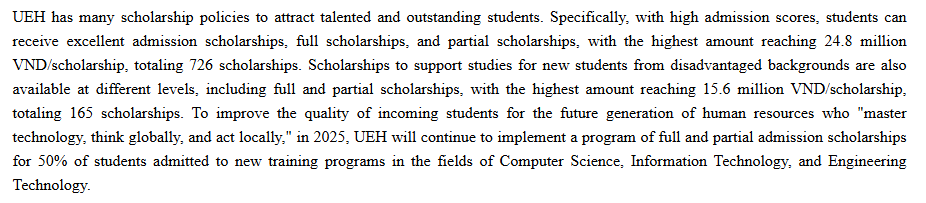 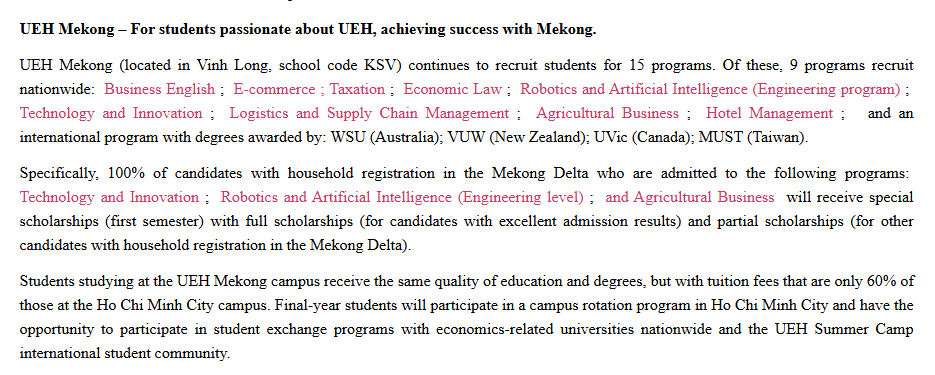
Image: Information on regular university admissions in 2025 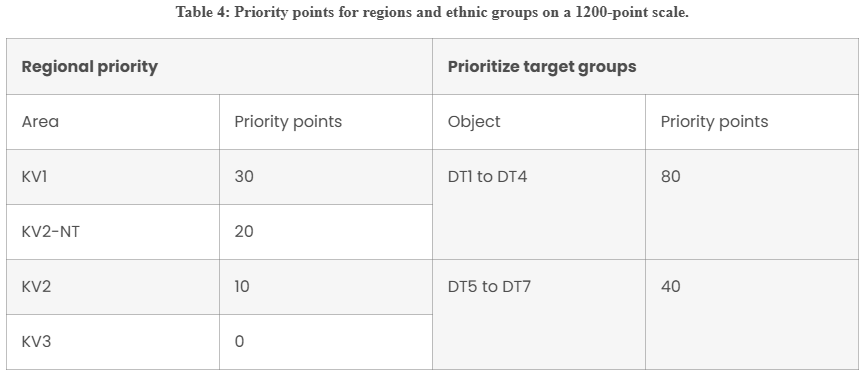
Source of evidence: Instructions for providing proof of registration for the 51st intake (full version available on the Admissions Portal) (UEH Admissions Portal) |
Total enrollment quota for 2025: 7,980 (including 600 quotas for UEH Mekong).
New students starting their studies in 2025: 7,620. 402 freshmen are in the bottom 20% group, accounting for 5.27% of the total freshmen (in 2024: 169 students, 2.16%). |
| Direct admission and priority admission will be conducted according to the regulations of the Ministry of Education and Training. | Candidates with severe disabilities, candidates from very small ethnic minority groups, candidates from poor districts and areas with special difficulties, and other eligible candidates as stipulated. | Method 1 of the five admission methods for 2025 is direct admission as regulated by the Ministry of Education and Training.
UEH has issued a separate announcement regarding direct admission for Course 51. |
Eighteen disadvantaged candidates will be granted direct admission or priority consideration for admission in 2025. |
| Scholarships to support the studies of new students with full eligibility.
difficult situation |
New students of Course 51 who are orphans, from poor or near-poor households, or have difficult family circumstances. | Full and partial scholarships, with the highest amount being 15.6 million VND per scholarship, are announced along with the admission information to reassure disadvantaged candidates so they can apply.
Awarded at the Opening Ceremony of Course 51 of the Undergraduate Program (September 26, 2025). 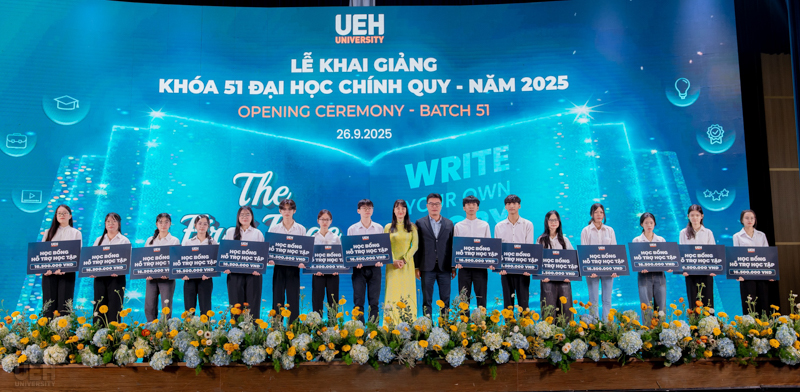
Image: Leaders of UEH member universities award scholarships to support the studies of new students of Course 51 who are from disadvantaged backgrounds. Source of evidence: Opening Ceremony of Course 51, UEH Undergraduate Program: The First Page – Write Your Own Story at UEH (UEH Portal, September 26, 2025) |
165 scholarships are available to support the studies of underprivileged new students.
Over 11.2 billion VND in scholarships and study support were awarded to new students of the 51st cohort. |
| Priority is given to applicants from the Mekong Delta region at UEH Mekong. | Candidates with household registration in the Mekong Delta, a region with a high percentage of poor and near-poor households, are eligible. Policies are applied geographically; when compiling the bottom 20% group, only candidates with evidence of poverty, near-poverty, or low income are considered. | 650 enrollment slots, 15 programs; 6 programs with separate admissions within the Mekong Delta region.
Tuition fees are 60% of those at the Ho Chi Minh City campus. 100% or 50% tuition fee waiver for the first semester for candidates with household registration in the Mekong Delta who are admitted to the three programs: Technology and Innovation, Robotics and Artificial Intelligence, and Agricultural Business. 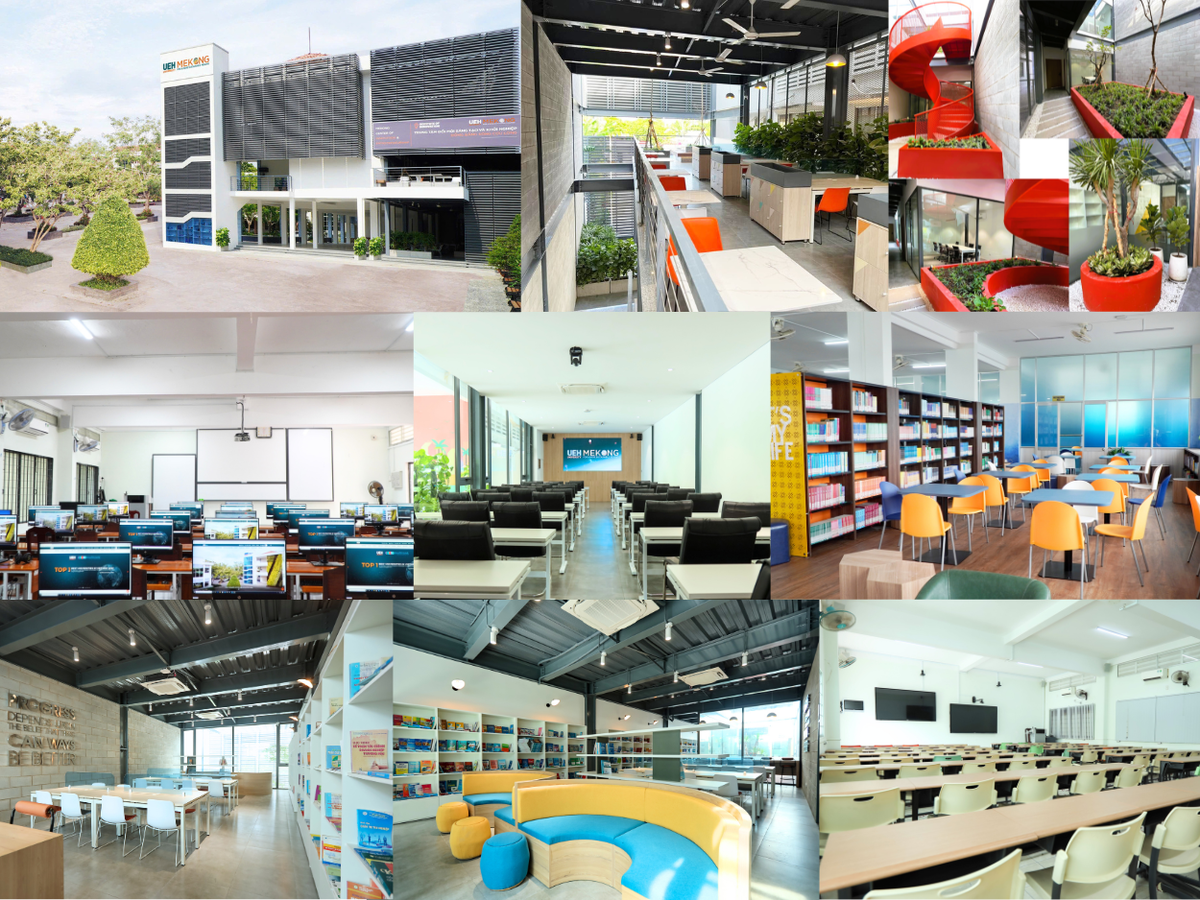
Image: Modern facilities at UEH Mekong Source of evidence: University Admissions 2025: UEH Mekong – A choice to “dare to be different” for candidates nationwide (UEH Portal, June 9, 2025) |
730 million VND in awards and scholarships for new students of the 51st cohort at UEH Mekong.
525 new UEH Mekong students will have household registration in the Mekong Delta in 2025. |
| Program to reach and support disadvantaged candidates before university entrance exams. | High school students from poor and near-poor households, students in disadvantaged areas in the Mekong Delta and southern provinces; parents and high schools. | UEH Mekong provides in-person and online admissions counseling throughout the admissions season: guidance on application documents, procedures, proof of poverty or near-poverty status; information on tuition fees, scholarships, and loans to help disadvantaged students overcome financial barriers to university. UEH Mekong maintains a Zalo group for admissions counseling and provides direct counseling to students and parents.
Long-term cooperation with local authorities and high schools: The 2025 Conference of Leaders of Departments of Education and Training and Leaders of High Schools in the Mekong Delta region at UEH Mekong focuses on coordinating career guidance and admissions counseling. 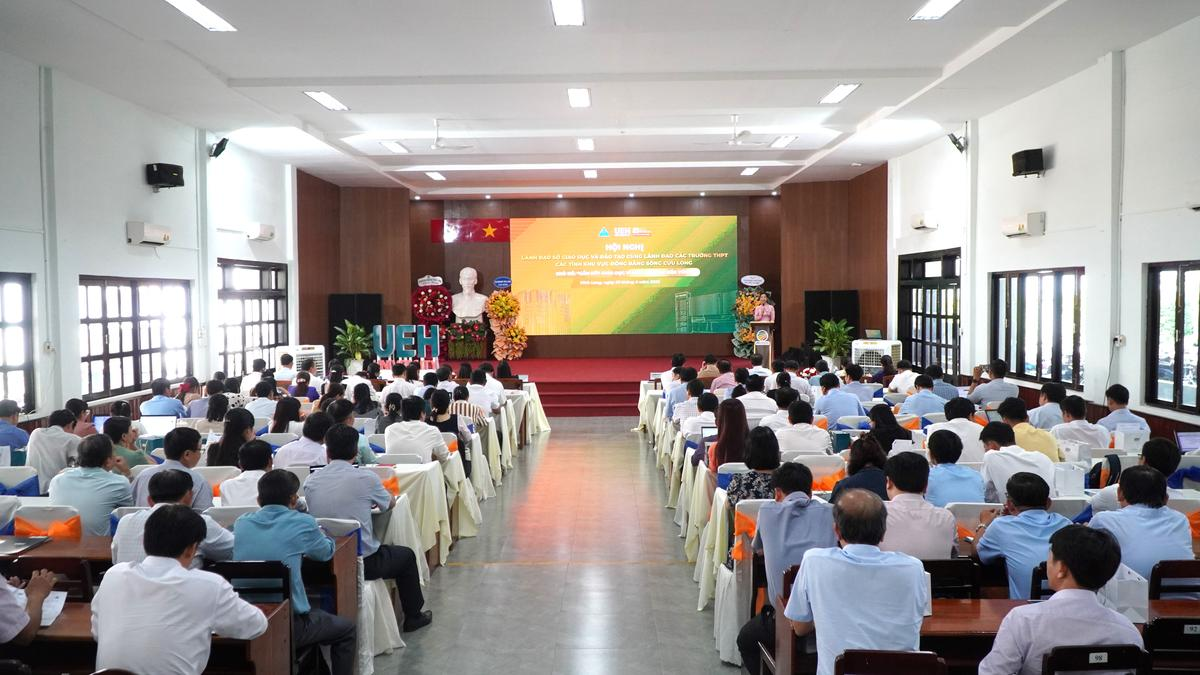
Source of evidence: Conference of Leaders of Departments of Education and Training and Leaders of High Schools in the Mekong Delta region in 2025 (UEH Mekong Portal); Career guidance program “Preparing for University – UNI on the go” 2025 (July 18, 2025) and Campus tour 2K7 at UEH Mekong for high school students in the Mekong Delta. 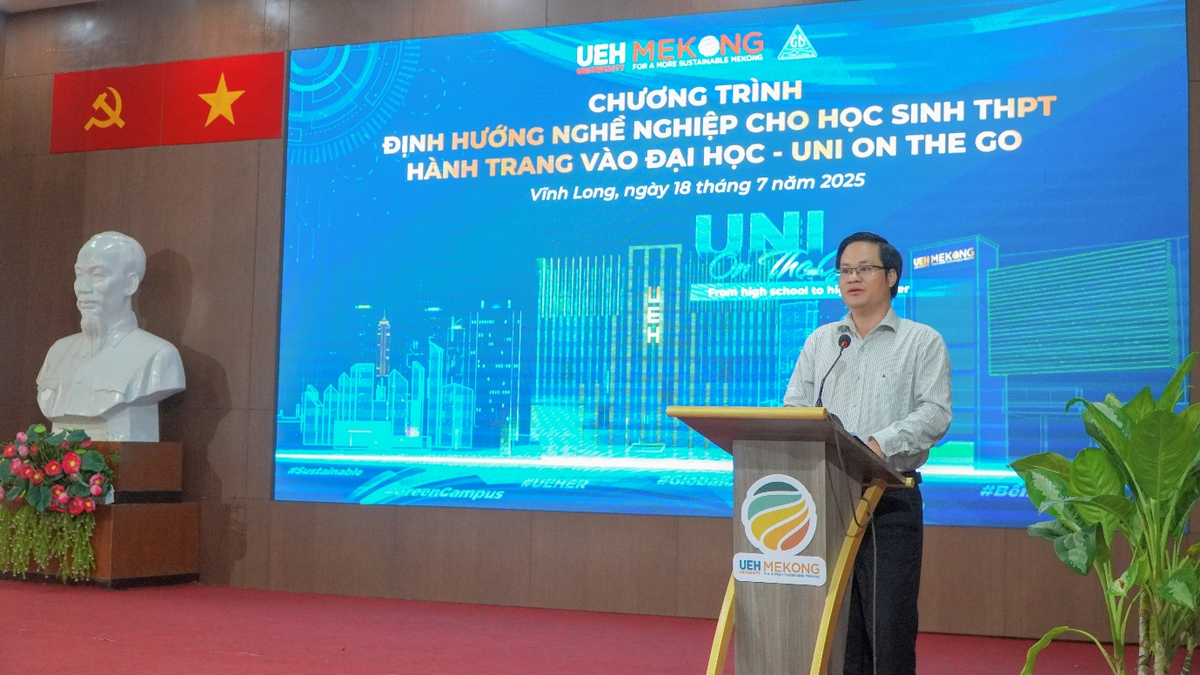
Source of evidence: UNI on the go 2025 (Portal UEH); The announcement included scholarships to support studies (165 scholarships, up to 15.6 million VND per scholarship) along with admission information; the “Exam Support Program” (June 25-27, 2025) and “Support for School” program to assist new students upon enrollment. 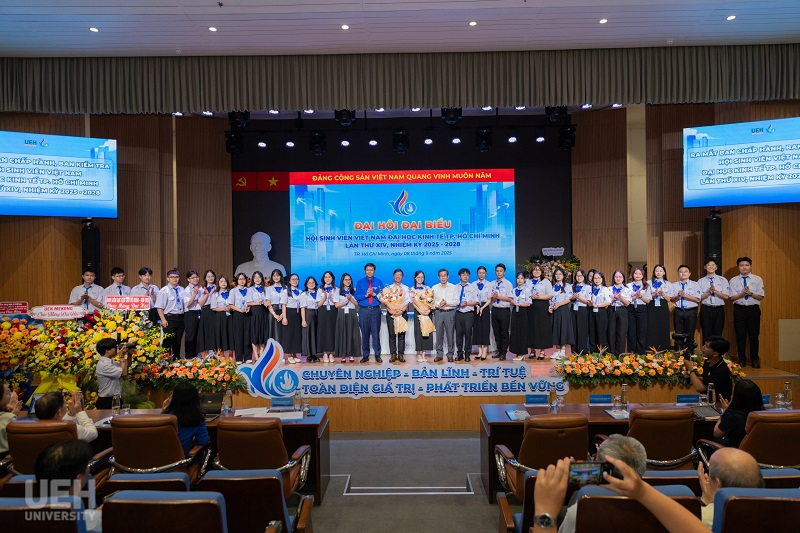
|
Over 2,100 new students received assistance in finding accommodation upon enrollment (Supporting Students to School). |
Table 1. Priority areas in the 2025 admissions process.
Priority areas are determined by where the candidate spent the longest time studying in high school and only apply in the year of high school graduation and the following year; active military and police personnel are entitled to priority based on their stationed location if they have served for 18 months or more.
| Area | Object | Priority points (on a scale of 30) |
|---|---|---|
| KV1 | Candidates are high school students from communes in areas I, II, and III of ethnic minority and mountainous regions; particularly disadvantaged communes in coastal and island areas; border communes; and particularly disadvantaged villages. | +0,75 |
| KV2-NT | Candidates who studied at high schools in localities not belonging to Zones 1, 2, and 3. | +0,5 |
| KV2 | Candidates are high school students in towns and cities under provincial administration; and suburban districts of centrally-administered cities. | +0,25 |
| KV3 | Candidates who study at high schools in the inner districts of centrally-governed cities. | 0 |
Table 2. Priority groups in the 2025 admissions process.
For candidates with a total score of 22.5 or higher, priority points are calculated in descending order according to the formula of the Ministry of Education and Training; each candidate is only entitled to the highest priority level.
| Group | Subject (summary) | Priority points (on a scale of 30) |
|---|---|---|
| UT1 (01–04) | 01: Ethnic minority people who have been residing in Zone 1 for more than 18 months.
02: Production workers with at least 5 years of direct experience, including at least 2 years as a provincial-level outstanding worker. 03: Wounded soldiers, sick soldiers; active military personnel and police officers serving in Zone 1. 04: Relatives of martyrs; children of wounded soldiers and sick soldiers with a disability of 81% or more; children of Heroes. |
+2 |
| UT2 (05–07) | 05: Youth volunteers; active military personnel and police officers not falling under category 03.
06: Ethnic minorities with permanent residence outside Zone 1; children of war invalids and sick soldiers with a disability rate of less than 81%. 07: Severely disabled person. |
+1 |
Table 3. Admissions outcomes for students from the bottom 20%
2025 admissions outcomes for the bottom 20%:
| Year | Freshmen are in the bottom 20% | Percentage of new students | Source |
|---|---|---|---|
| 2022 | 206 | 3,10% | 2022 Admissions Report |
| 2023 | 158 | 2,17% | 2023 Admissions Report |
| 2024 | 169 | 2,16% | 2024 Admissions Report |
| 2025 | 402 | 5,27% | 2025 Admissions Report |
These examples confirm that UEH not only fully implements the preferential policies as stipulated but also proactively links admissions with financial support, helping candidates in the bottom 20% have the opportunity to be admitted and feel secure in enrolling.
Note: “Bottom 20%” refers to candidates from poor or near-poor households according to the multidimensional poverty standard for the period 2022–2025 (Decree No. 07/2021/ND-CP) or whose average per capita income falls within the lowest 20% according to the Household Living Standards Survey. Priority groups and regions in admissions (UT1, UT2, KV1), ethnic minorities, people with disabilities, and candidates from the Mekong Delta are only counted if corresponding economic evidence is provided. New student data is compiled from the annual admissions report of the Training Department.
Compared with the previous year, UEH strengthened its admissions approach for students from the bottom 20%, moving beyond admissions preferences to integrate financial support from the start of recruitment. In 2024, evidence focused primarily on verifying priority categories and regions. In 2025, the university announced those preferences together with 165 study-support scholarships for disadvantaged entrants and special tuition and scholarship measures for Mekong Delta applicants. The overall admissions target increased from 7,900 to 7,980 places, widening opportunities for applicants nationwide. UEH enrolled 402 students from the bottom 20%, accounting for 5.27% of new entrants. These outcomes demonstrate how linking admission preferences with financial assistance can improve access to higher education for economically disadvantaged applicants.
Therefore, it can be seen that UEH’s admissions policy for the bottom 20% group is implemented continuously, transparently, and increasingly comprehensively, ensuring that disadvantaged candidates not only have the opportunity to be admitted but also have the necessary conditions to begin their university journey.