

13.3.3 Co-operative planning for climate change disasters
In 2025, the University of Economics Ho Chi Minh City (UEH) continued to collaborate with local authorities and government agencies in research, consultation and the development of responses to climate change-related disasters in the Mekong Delta and coastal areas.
Key initiatives included the national-level research project KX.01.04/21-30 on climate-resilient regional transport infrastructure, accompanied by consultations with authorities in Vinh Long, Can Tho, Dong Thap and An Giang; the GS4Infra project, which examined irrigation and disaster prevention infrastructure in consideration of vulnerable population groups; and the Women4Mangrove project, which worked with local authorities and communities to develop approaches to mangrove conservation and climate-resilient coastal livelihoods. These activities connected research, policy consultation and practical needs, contributing evidence to support climate risk reduction planning at local and regional levels.
1. National-Level Research Project KX.01.04/21-30 – Research and Consultation on Climate-Resilient Infrastructure Development in the Mekong Delta
In 2025, UEH led national-level research project KX.01.04/21-30, on innovative approaches to mobilising and efficiently using resources for the development of climate-resilient transport infrastructure in the Mekong Delta, headed by Associate Professor Dr Bui Quang Hung. The project sought to establish an analytical basis and propose solutions for infrastructure capable of withstanding flooding, saltwater intrusion, erosion and other climate-related challenges specific to the region.
At the local level, during a consultation in Vinh Long on 8 September 2025, UEH researchers worked directly with leaders of the Provincial People’s Committee and specialised departments to gather practical issues informing research into climate-resilient infrastructure development. The Department of Construction presented transport infrastructure planning orientations through 2030, with a vision to 2045; theDepartment of Finance discussed resource mobilisation options; and the Department of Agriculture and Environment analysed climate change impacts on infrastructure and proposed adaptation measures. Feedback, planning information and local needs were incorporated into research under KX.01.04/21-30, helping to develop the basis for policy recommendations on climate-resilient infrastructure in Vinh Long and the wider Mekong Delta.
Subsequent activities in Can Tho, Dong Thap and An Giang broadened exchanges with government agencies, experts and relevant stakeholders.
At the regional level, findings from local consultations were connected through the broader research programme on transport infrastructure development across the Mekong Delta. On 6 December 2025, the UEH–NEU conference series further discussed scientific foundations, experiences and policy recommendations concerning climate-resilient regional infrastructure development.
Through research and collaboration with authorities in 2025, UEH contributed to scientific evidence, discussed possible approaches and proposed ways to integrate climate adaptation requirements into local infrastructure planning and regional connectivity. Public sources confirm the research, consultation and policy recommendations, but do not establish that a disaster response plan resulting from the project had been approved or implemented by authorities.
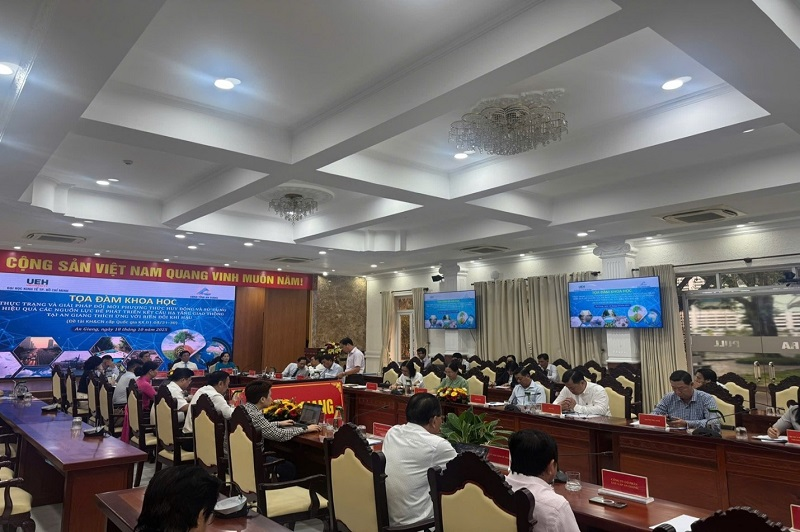
Participants consulting and exchanging views at the seminar.
Source: UEH – Project KX.01.04/21-30 and consultations in An Giang; UEH–NEU National Scientific Conference, December 2025 (UEH Portal, 22 October 2025) UEH–NEU National Scientific Conference Series: Transport Infrastructure Development in the Mekong Delta and the Digital Economy in the New Context (UEH Portal, 6 December 2025)
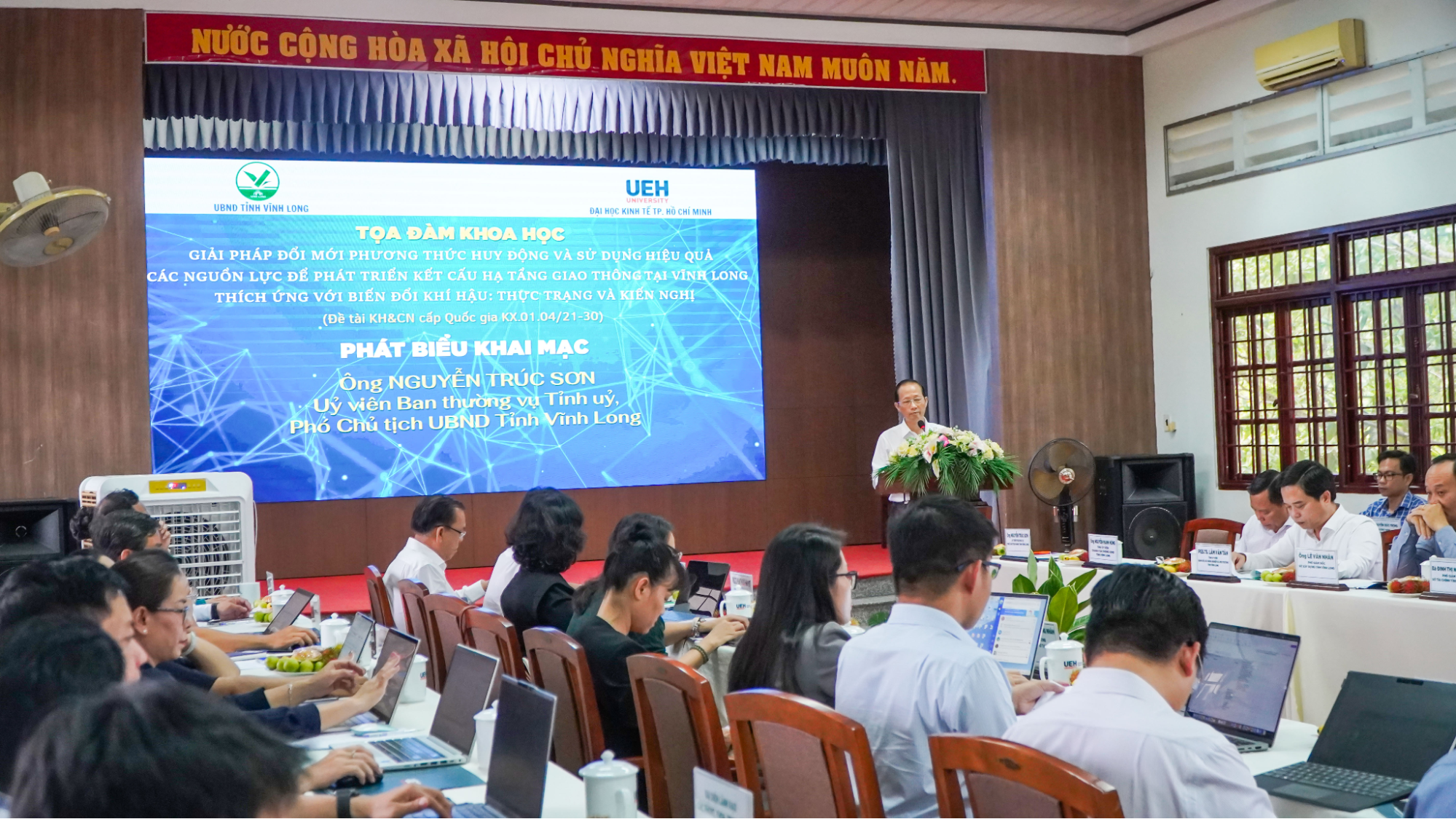
Vinh Long provincial leaders delivering remarks.
Source: Scientific Seminar on Mobilising and Efficiently Utilising Resources for Climate-Resilient Transport Infrastructure Development in Vinh Long, held at UEH Mekong (UEH Mekong Portal, 11 September 2025)
UEH Portal (11 September 2025), Vinh Long consultation
https://www.ueh.edu.vn/ueh-mekong/khoa-hoc/toa-dam-khoa-hoc-giai-phap-huy-dong-va-su-dung-hieu-qua-nguon-luc-de-phat-trien-ha-tang-giao-thong-vinh-long-thich-ung-bien-doi-khi-hau-tai-ueh-mekong-74795
Press coverage citing the Vinh Long Provincial People’s Committee (9 September 2025), seminar co-organised with UEH
https://www.ueh.edu.vn/bao-chi/toa-dam-khoa-hoc-giai-phap-doi-moi-phuong-thuc-huy-dong-va-su-dung-hieu-qua-cac-nguon-luc-de-phat-trien-ket-cau-ha-tang-giao-thong-tai-vinh-long-thich-ung-voi-bien-doi-khi-hau-74770
UEH Portal (12 September 2025), Can Tho consultation
https://ueh.edu.vn/ueh-mekong/khoa-hoc/toa-dam-khoa-hoc-tai-can-tho-doi-moi-sang-tao-va-phat-trien-ha-tang-giao-thong-thich-ung-bien-doi-khi-hau-74802
UEH Portal (13 October 2025), Dong Thap consultation
https://ueh.edu.vn/khoa-hoc/chuong-trinh-toa-dam-khoa-hoc-tai-dong-thap-doi-moi-phuong-thuc-huy-dong-va-su-dung-hieu-qua-cac-nguon-luc-de-phat-trien-ket-cau-ha-tang-giao-thong-tai-dong-thap-thich-ung-voi-bien-doi-khi-hau-75023
UEH Portal (22 October 2025), An Giang consultation
https://ueh.edu.vn/khoa-hoc/ueh-dong-hanh-cung-tinh-an-giang-tim-loi-giai-cho-phat-trien-ha-tang-giao-thong-ben-vung-thich-ung-bien-doi-khi-hau-75102
UEH Portal (6 December 2025), UEH–NEU conference series
https://ueh.edu.vn/bo-tu-nghi-quyet/chuoi-hoi-thao-khoa-hoc-quoc-gia-ueh-neu-phat-trien-ha-tang-giao-thong-vung-dong-bang-song-cuu-long-va-kinh-te-so-trong-boi-canh-moi-75455
2. GS4Infra Project – Collaborative Disaster Response Planning and Community Protection in Cu Lao Dung
UEH worked with Can Tho University, government agencies and local communities on GS4Infra, a project addressing the integration of gender considerations into irrigation and disaster prevention infrastructure amid climate change in Cu Lao Dung District, Soc Trang. The project investigated solutions for the design, management and allocation of resources for flood protection dykes, canals and saline-water control sluices, taking account of the needs of women and other vulnerable populations.
During the consultation on 2 January 2025, the project team worked with local technical agencies to organise discussions and exercises on resource allocation, identify barriers to access to disaster prevention infrastructure and gather proposals from officials and residents. These outcomes provided a research and consultation foundation for subsequent project stages. Activities and results specifically achieved in 2025 still require substantiation through survey reports, consultation records or corresponding research outputs.
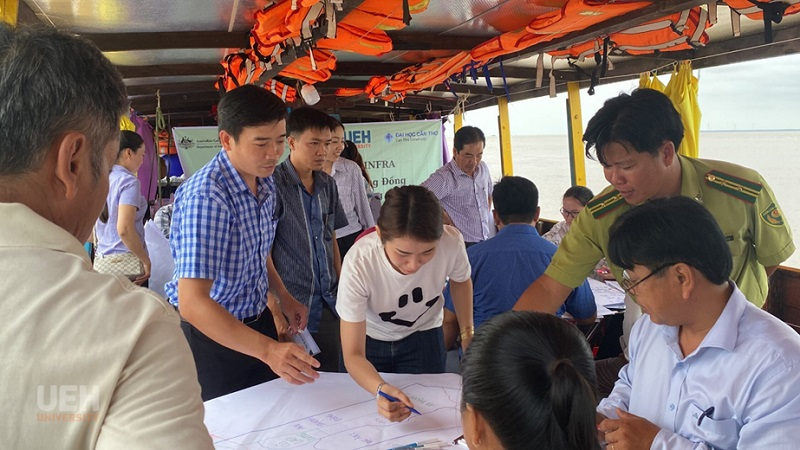
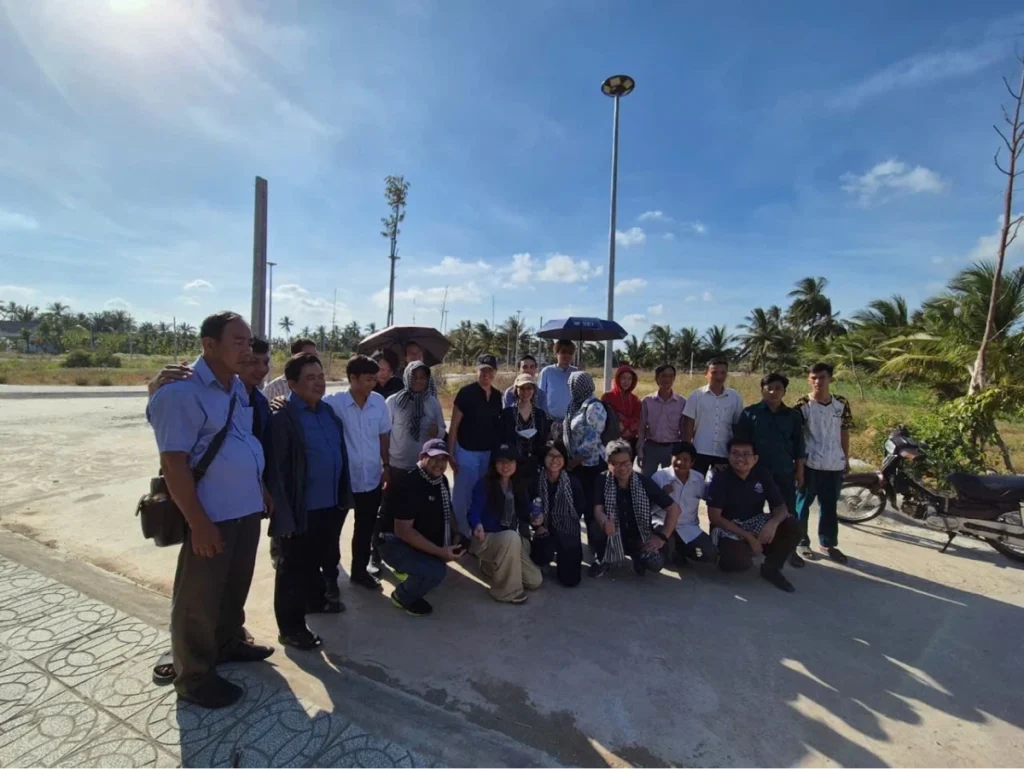
Photographs: Researchers and representatives of local agencies conducting field surveys and discussions.
3. Women4Mangrove Project – Consultation with Authorities and Communities on Coastal Adaptation Solutions
In December 2025, UEH worked with the authorities of An Thanh and Cu Lao Dung communes and local community groups to hold consultations on mangrove conservation and restoration in conjunction with sustainable livelihoods. The project was scheduled to run for 14 months, from 30 September 2025 to 30 November 2026, with targets to restore five hectares of mangrove forest, establish a women-managed nursery and develop local products and community-based tourism linked to conservation. Based on field visits and community survey findings, the project team and stakeholders discussed livelihood needs, environmental protection requirements, participation responsibilities and upcoming implementation milestones.
Through field surveys and consultations with authorities, women and community groups in Cu Lao Dung, UEH helped identify livelihood needs, environmental requirements and priority activities in developing a community-based mangrove conservation plan. This contributed to nature-based climate adaptation planning in the coastal area and laid a foundation for reducing vulnerability to climate impacts in subsequent stages.
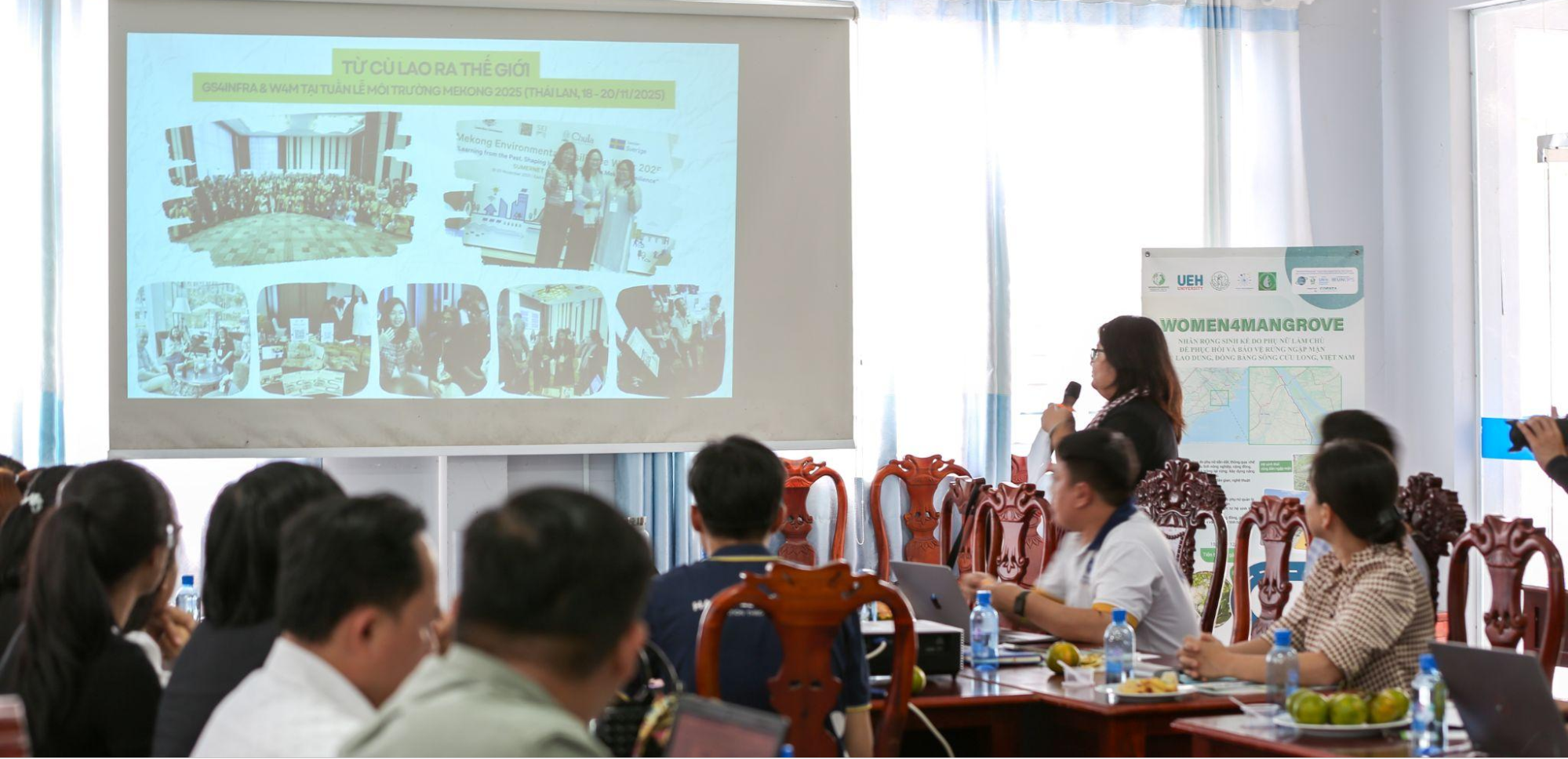
A project representative presenting to delegates.
Source: UEH – Women4Mangrove Project (School of Tourism website; Can Tho Newspaper – Project Launch on 10 December 2025.
4. Cai River International Design Competition – Proposals to Reduce Flooding and Erosion in Khanh Hoa
In 2025, UEH and the Khanh Hoa Provincial People’s Committee co-organised the fourth International Design Competition – Heritage Corridor along the Cai River. The six-month competition attracted 500 applicant registrations from 160 teams representing 25 countries and selected five outstanding design proposals. The proposals focused on restoring riverine ecosystems, creating adaptable urban spaces and applying nature-based solutions to reduce flood and erosion risks. Notably, the Nha Trang Elasticity proposal outlined a three-phase, 15-year programme involving conversion of flood-prone areas into wetlands for flood regulation, a 6.5-kilometre ecological pedestrian bridge, beach and dune restoration, and green buffer zones to mitigate riverbank erosion. The competition produced five design and planning proposals that could inform subsequent assessments of climate-resilient urban development in Khanh Hoa. These measures and timelines were proposals, not completed works.
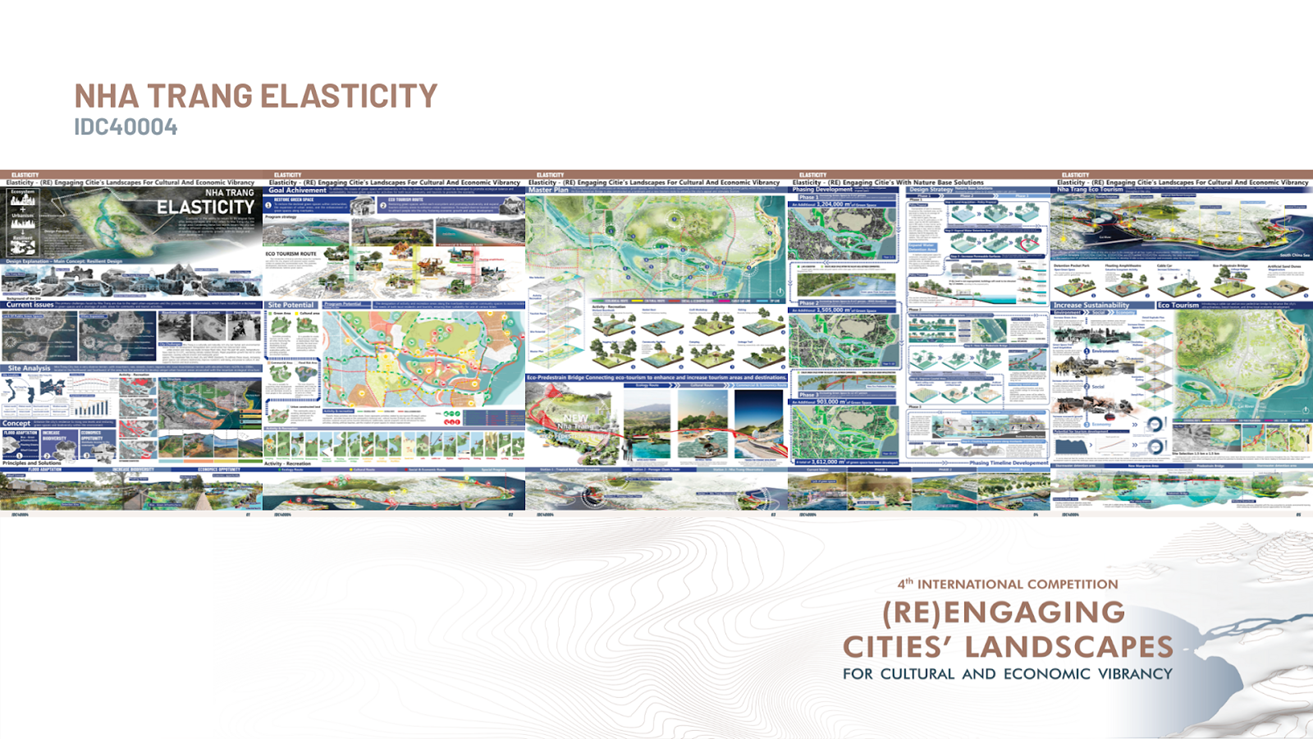
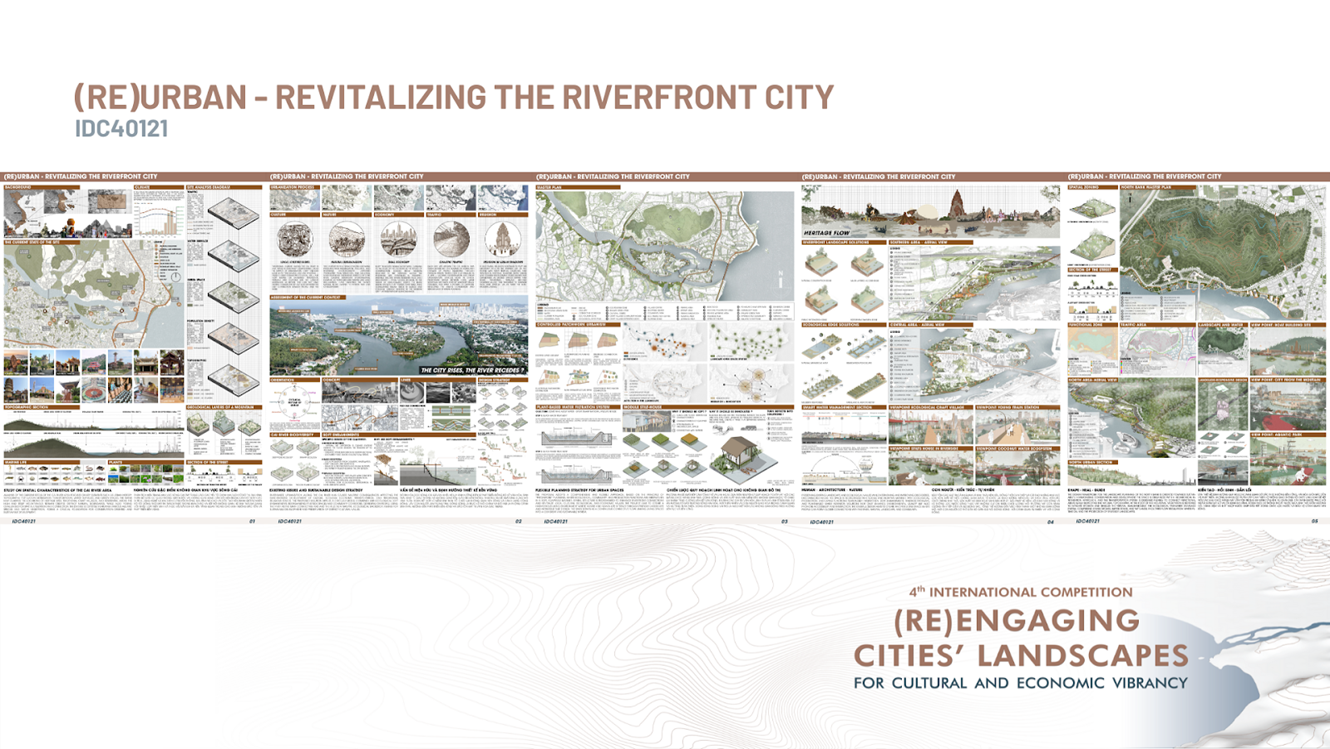
Images of the two highest-ranked competition projects, assessed as practical and appropriate.
Source: Fourth International Design Competition – Heritage Corridor along the Cai River, Khanh Hoa: Five Outstanding Design Projects Reaffirm the River’s Future Role (UEH Mekong Portal, 20 October 2025)
https://www.ueh.edu.vn/ueh-nexus-nha-trang/cuoc-thi-thiet-ke-quoc-te-lan-4-cung-duong-di-san-ven-song-cai-tinh-khanh-hoa-5-du-an-thiet-ke-xuat-sac-khang-dinh-lai-vai-tro-cua-song-cai-trong-tuong-lai%C2%A0-75066
4. NCTD 2025 Conference – Sharing Climate Adaptation Solutions with Mekong Delta Departments and Agencies
On 31 October 2025, UEH Mekong hosted a special session of the National Conference on Technology and Design (NCTD 2025), with more than 200 delegates and over 58 papers, including 13 submissions from Mekong Delta government departments and agencies. Discussions addressed applications of technology in smart agriculture, efficient resource use and mitigation of climate change impacts on local production and livelihoods. In particular, a representative of the Vinh Long Department of Agriculture and Environment presented high-technology agricultural models, examined challenges related to saltwater intrusion and proposed policy directions suited to local conditions. The conference facilitated exchanges among government, researchers and businesses, generating information and recommendations for climate-resilient agricultural development in the Mekong Delta. It demonstrated regional policy dialogue, but did not confirm that a specific disaster response plan had been jointly developed at the conference.
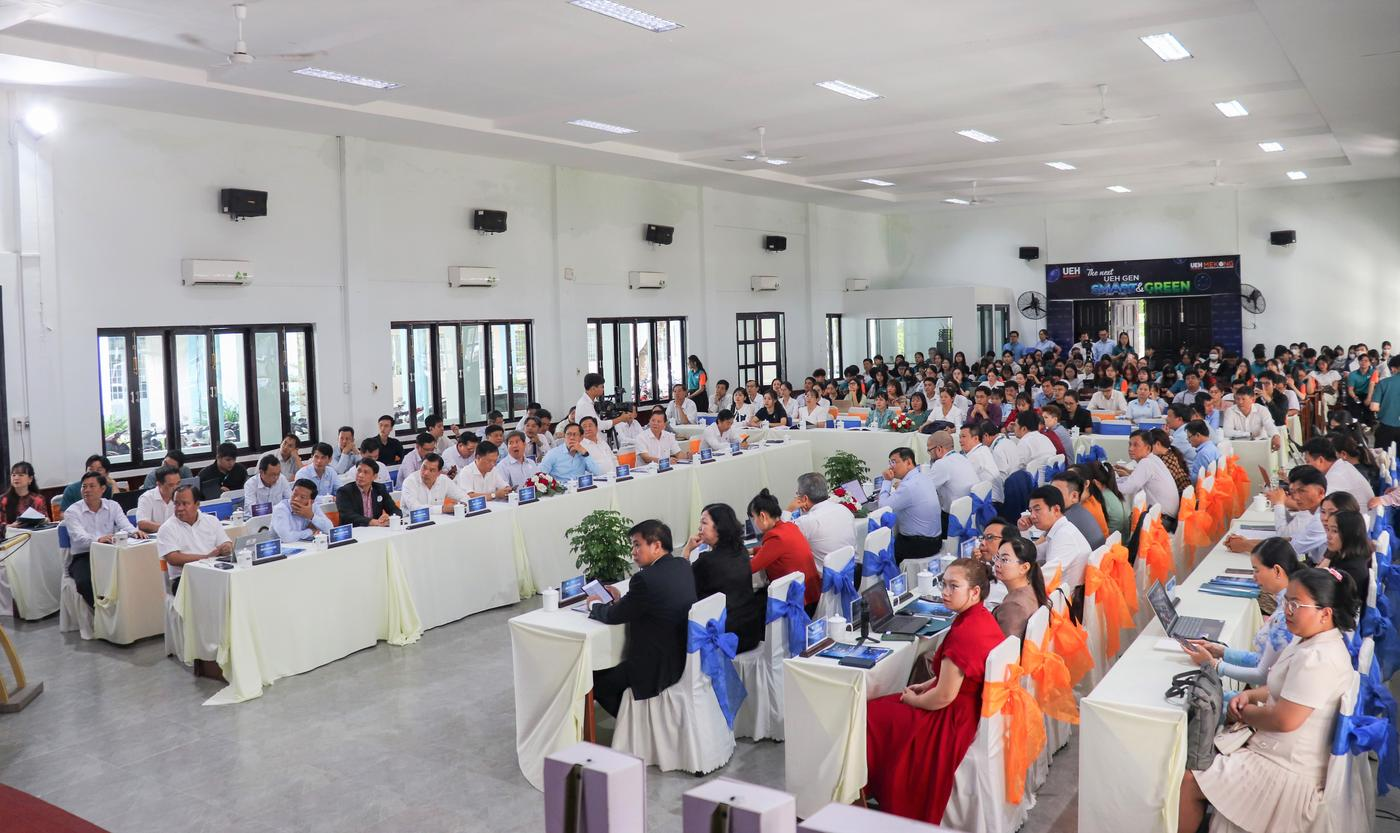
Overview of the conference.
Source: NCTD 2025 Conference at UEH Mekong (UEH Portal, 1 November 2025)
- UEH and the Khanh Hoa Provincial People’s Committee Organised the Ocean Futures 2025 Conference on Coastal Urban Planning and Resilience.
On 1 October 2025, UEH, through its Institute of Smart City and Management (ISCM), co-organised the international conference Ocean Futures 2025 – Smart Technology and Sustainable Coastal Living with the Khanh Hoa Provincial People’s Committee. Participants included two Vice Chairs of the Provincial People’s Committee, government agencies, specialists and international organisations. Discussions explored climate-adaptive coastal urban planning, including green infrastructure, ecological dykes, ecosystem restoration and marine spatial management, with the aim of limiting flooding and erosion risks and protecting communities. UEH presented findings from a proposal to establish a national ocean technology research centre commissioned by the Provincial People’s Committee. The conference provided research options and planning experience to support policy consultations on climate-resilient coastal urban development in Khanh Hoa.
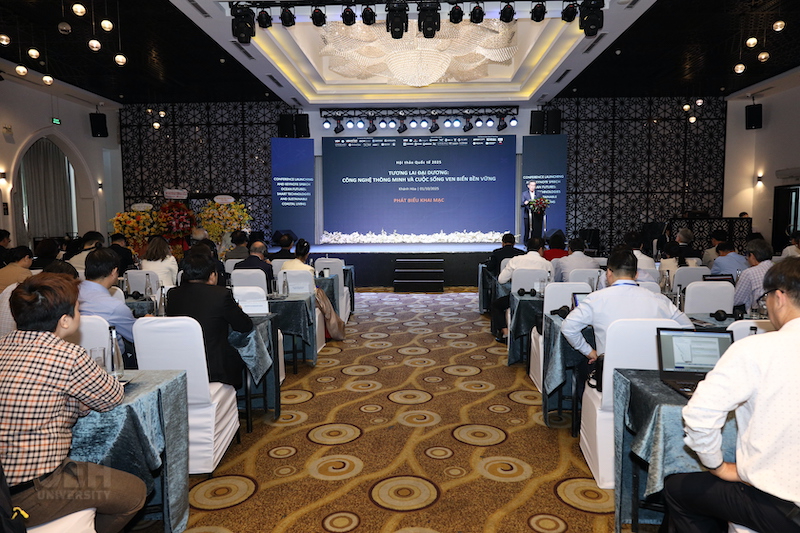
Photograph of the conference, featuring local government leaders, international experts and UEH leaders.
- UEH Collaborated with Local Authorities on Climate Adaptation Solutions for Coastal Communities in Ben Tre
In 2025, UEH conducted research and transferred climate adaptation solutions to coastal communities in Ben Tre, linked to local sustainable livelihood development needs. Through research collaboration, UEH examined challenges facing coastal livelihoods and transferred adaptation solutions suited to local circumstances to help communities reduce their vulnerability to climate change. The work formed part of UEH’s locally oriented research programme; in 2025, the university conducted ten consultancy and knowledge-transfer contracts and fourteen policy review studies commissioned by government agencies. UEH thereby reported adaptation knowledge-transfer activities for local stakeholders, contributing research evidence to support coastal livelihoods.
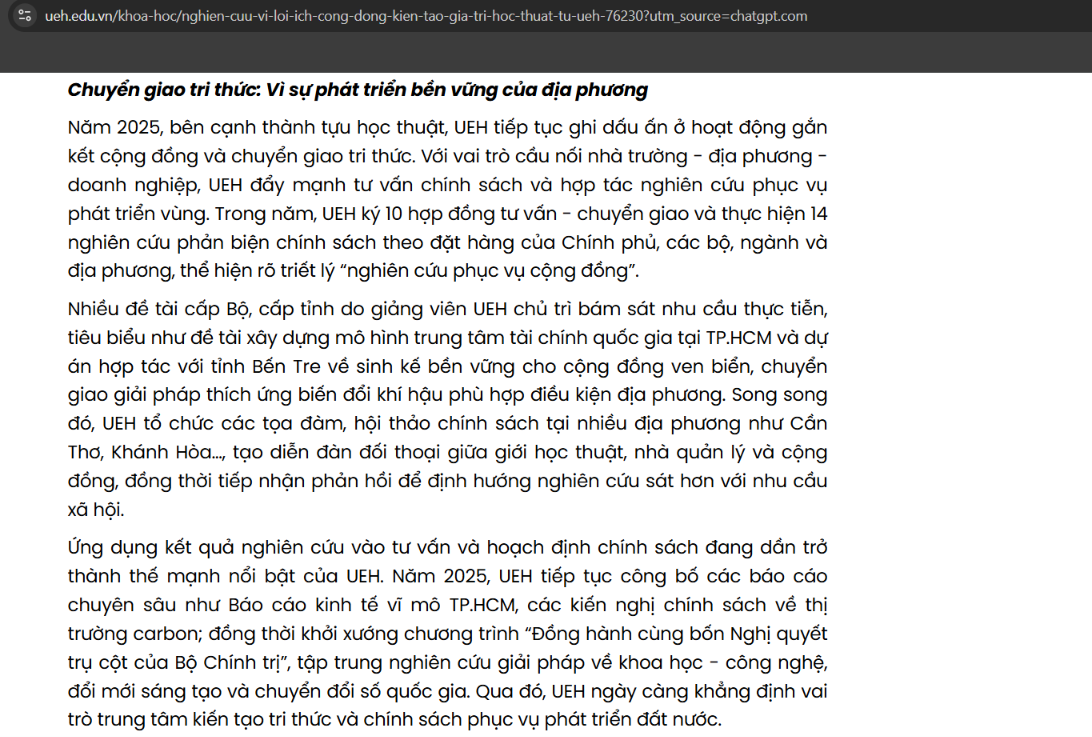
Image showing data reported in the article on technology and knowledge transfer to Ben Tre Province.
Source: Research for Community Benefit: Creating Academic Value from UEH (UEH Portal, 16 February 2025)
Conclusion: Collaborative Planning for Climate Change-Related Disasters in 2025
In 2025, UEH continued research and consultations with authorities to develop responses to climate change-related disasters at local and regional levels. The main initiative was national-level project KX.01.04/21-30, linking consultations in Vinh Long, Can Tho, Dong Thap and An Giang with climate-resilient transport infrastructure development across the Mekong Delta. GS4Infra and Women4Mangrove complemented this work through approaches addressing disaster prevention, livelihoods and the involvement of vulnerable coastal communities.
These activities demonstrated UEH’s contribution to connecting scientific research with authorities and communities to identify risks, discuss options and propose solutions to strengthen climate resilience. In doing so, UEH provided scientific and practical foundations for collaborative planning for climate change-related disasters at local and regional levels, consistent with SDG 13 – Climate Action.