

13.2.1. Low-carbon Energy Use Tracking
As Vietnam works toward its commitment to achieve net-zero emissions by 2050, the transition to low-carbon energy requires not only the development of clean energy sources but also effective measurement, monitoring, and management of energy consumption. In line with national strategies on green growth and climate change response, the University of Economics Ho Chi Minh City (UEH) has progressively integrated energy monitoring into its operational governance, consistent with its vision of becoming a multidisciplinary and sustainable university. By tracking electricity consumption, solar power generation, and operational data across its campuses, UEH is establishing a data foundation to assess low-carbon energy use, improve resource management, and plan its institutional green transition.
1. Policies and Strategic Directions for Low-carbon Energy
In implementing Vietnam’s net-zero emissions commitment for 2050 announced at COP26, the Government has progressively strengthened its policy framework for green growth, energy efficiency, and the transition to low-emission energy sources. The National Green Growth Strategy for 2021–2030, with a vision to 2050 (Decision No. 1658/QD-TTg dated 1 October 2021), and the National Climate Change Strategy to 2050 (Decision No. 896/QD-TTg dated 26 July 2022) set out directions for reducing greenhouse gas emission intensity, improving energy efficiency, and expanding renewable energy. These strategies call for a data-driven approach to energy management that enables performance assessment and supports long-term emission reduction decisions.
At the legislative level, the 2020 Law on Environmental Protection (Law No. 72/2020/QH14) establishes the framework for greenhouse gas emission mitigation, while the Law on Economical and Efficient Use of Energy (Law No. 50/2010/QH12) defines organizations’ responsibilities for rational and efficient energy use and encourages renewable energy technologies. These principles are further detailed in Decree No. 06/2022/ND-CP, as amended and supplemented by Decree No. 119/2025/ND-CP, providing a basis for greenhouse gas emission management and monitoring. Regarding clean power development, Decision No. 768/QD-TTg dated 15 April 2025 on the Revision of Power Development Plan VIII continues to encourage rooftop solar power for on-site consumption, consistent with energy transition directions for educational institutions and public buildings.
Building on national policy directions, UEH has progressively translated its sustainability objectives into institutional resource and energy management policies. Under the Green Campus Regulations, UEH identifies electricity and water conservation and efficient resource use as principles to be applied university-wide. Article 5, in particular, emphasizes the responsibility of the UEH community to conserve resources.
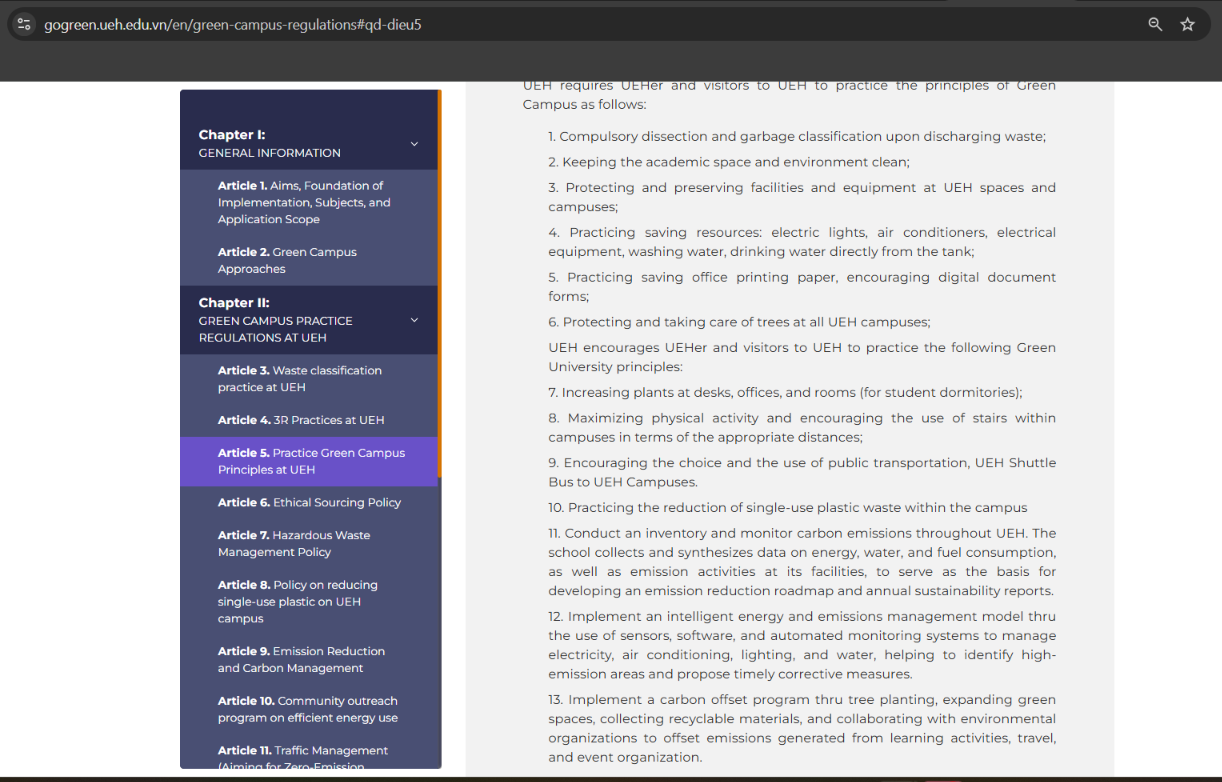
Article 5 of the UEH Green Campus Regulations under Decision No. 2059/QD-DHKT-CSVC
Publicly available source: UEH Green Campus Website, “Green Campus Regulations”
Article 9, “Emission Reduction and Carbon Management,” publicly establishes provisions concerning the collection of energy consumption data and the monitoring and management of carbon emissions as a basis for assessing and improving operations and research. It connects national green transition objectives with energy governance and Green Campus development at UEH.
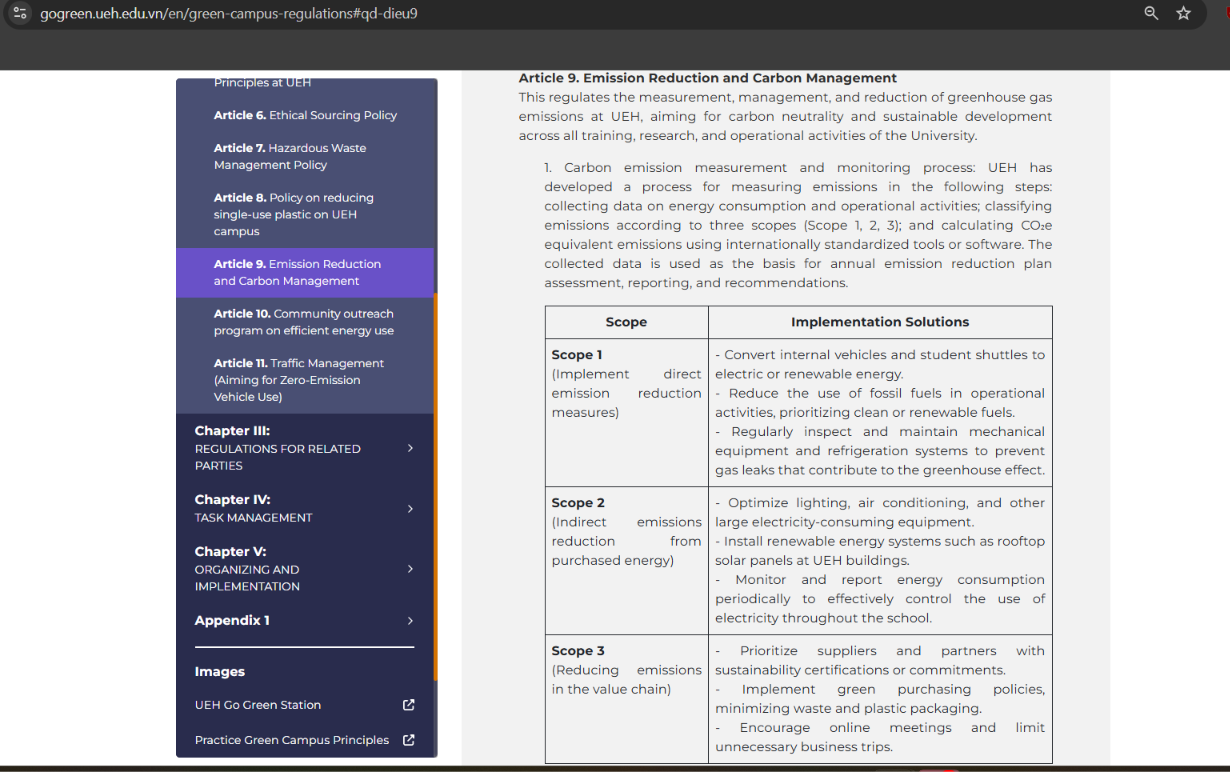
Article 9 of the UEH Green Campus Regulations under Decision No. 2059/QD-DHKT-CSVC
Publicly available source: UEH Green Campus Website, “Green Campus Regulations”
UEH focuses on three main policy areas:
+ Green energy: Gradually expanding solar power systems at campuses N, A, and B; pursuing the development of the UEH Green Living Hub at Nguyen Van Linh Campus and UEH Nexus Campus Nha Trang in accordance with green building standards; and exploring applications at UEH Mekong, with the aim of increasing renewable energy’s share of total electricity consumption.
+ Energy and water management: Applying a monitoring, reporting, and verification (MRV) approach to track electricity, water, and indirect emission sources, thereby optimizing resource-use efficiency.
+ Green mobility: Implementing policies that encourage staff, lecturers, and students to use bicycles, electric vehicles, and public transportation, while developing pedestrian-supporting infrastructure, in line with the direction of Decree No. 06/2022/ND-CP on greenhouse gas mitigation and ozone layer protection.
2. Scope and Measurement Methodology
Building on its Green Campus development direction and established energy management policies, UEH continued to maintain and progressively improve low-carbon energy monitoring and measurement across its campuses in 2025. Drawing on the monitoring model piloted at UEH Mekong, the University aims to standardize the collection, storage, and analysis of operational data while making greater use of solar power system data from campuses A, B, and N. Tracking energy consumption alongside renewable electricity generation provides a foundation for progressively assessing low-carbon energy use, improving resource governance, and expanding measurement coverage across the institution.
Measurement is based on actual operational data sources, including electricity consumption recorded through utility bills and electricity meters; solar power generation monitored through supervisory systems and operating records; and water consumption and counts of private vehicles entering and leaving campuses where such statistics are collected. Information is recorded, stored, and consolidated by reporting period, supporting consumption comparisons, identification of resource-use trends, and evaluation of operating efficiency. As it develops its systems, UEH emphasizes continuity, consistency, and data traceability to improve the reliability of year-on-year energy monitoring.
In terms of methodology, UEH continues to apply the principles of the measurement, reporting, and verification (MRV) framework as a guiding approach to energy and emissions data management. Measurement focuses on recording energy consumption and energy from low-carbon sources; reporting involves aggregating, classifying, and comparing data for each reporting period; and verification is pursued through reviewing data completeness, consistency, and verifiability. For assessing energy-related emissions, the analysis refers to greenhouse gas inventory principles and emission factors appropriate to Vietnam, drawing on technical guidance from the IPCC and IEA.
Maintaining the MRV approach while progressively improving monitoring enables UEH to move beyond recording individual consumption indicators toward a dataset that can support a comprehensive assessment of energy use and emissions. The University thereby seeks to distinguish low-carbon energy from other energy sources, calculate the share of low-carbon energy in total consumption, and inform energy efficiency and green transition planning. This also supports the continued development of data-driven energy governance in line with UEH’s sustainability direction for 2025–2030.
Using this monitoring methodology, operational data from UEH Mekong continue to serve as a reference for assessing year-on-year trends in electricity and water consumption and campus transport activity, illustrating the maintenance and improvement of resource management at the campus.
| Indicator | 2023 | 2024 | 2025 |
| Electricity consumption (kWh) | 267.900 | 302.766 | 328.932 |
| Water consumption (m³) | 21.479 | 15.970 | 13.394 |
| Motorcycle entries and exits (number of movements) | 66.023 | 79.745 | 92.536 |
| Total learners (full-time students, other students, postgraduate students, and short-course trainees) | 1.972 | 2.462 | 2.808 |
Assessment of Monitoring Results at UEH Mekong, 2023–2025
+ Electricity consumption: In 2025, electricity consumption at UEH Mekong reached 328,932 kWh, an increase of 22.78% compared with 2023. However, its annual growth rate slowed from 13.01% in 2024 to 8.64% in 2025. Notably, while the number of learners rose from 1,972 in 2023 to 2,808 in 2025, an increase of 42.39%, electricity consumption per learner declined steadily from 135.85 to 122.98 and then to 117.14 kWh per learner, representing a reduction of 13.77% over two years. This trend indicates an improvement in electricity-use intensity relative to learner numbers even as total electricity demand increased. It provides a basis for UEH Mekong to further strengthen energy management, implement electricity-saving measures, and progressively expand renewable energy use, particularly solar power, to meet growing demand sustainably.
+ Water consumption: In 2025, freshwater consumption at UEH Mekong decreased to 13,394 m³, 16.13% lower than in 2024 and 37.64% below the 2023 level. Despite a 42.39% increase in the learner population during 2023–2025, water consumption per learner declined steadily from 10.89 m³ per learner in 2023 to 6.49 in 2024 and 4.77 in 2025, a reduction of 56.21% over the two-year period. These results indicate increasingly efficient water use relative to the learner population and demonstrate the value of maintaining consistent consumption monitoring and assessment. UEH Mekong continues to strengthen monitoring, control water losses, and evaluate water conservation measures to sustain these positive results over the longer term.
+ Campus transportation activity: In 2025, UEH Mekong recorded 92,536 motorcycle entries and exits, up 40.16% compared with 2023, reflecting increased transportation activity on campus. However, the growth rate of vehicle movements slowed from 20.78% in 2024 to 16.04% in 2025. Although the rate of increase moderated, the growing volume of vehicles continues to necessitate measures to manage the environmental impacts of commuting. Continuous monitoring data provide a foundation for UEH Mekong to improve its approach to estimating indirect transportation emissions (Scope 3), promote green mobility policies, encourage lower-emission transport, and develop a sustainable campus transport environment.
In addition, UEH maintains solar energy monitoring systems at campuses N, A, and B, enabling regular recording of renewable electricity generation and total electricity load during operations. Data have been consolidated continuously across 2023–2025, providing a basis to assess the share of low-carbon energy, monitor changes, and progressively strengthen institutional energy management.
| Indicator | 2023 | 2024 | 2025 |
| Electricity generated by solar power systems (MWh) | 522,91 | 550,21 | 508 |
| Total electricity consumed by all loads (MWh) | 2.386,04 | 2.452,81 | 2.467 |
| Ratio of solar electricity generation to total electricity load (%) | 21,92% | 22,43% | 20,59% |
During 2023–2025, UEH continued to measure and monitor solar electricity generation and total electricity load at campuses N, A, and B. The recorded ratio of solar generation to total load was 21,92% (2023), 22,42% (2024), and 20,59% (2025), with a difference of approximately 1,33 percentage points (difference between 2025 and the 2023 baseline year) . Although the ratio decreased in 2025 compared with the previous year, solar electricity continued to account for more than 20% of total load across the three campuses, demonstrating continuity in renewable energy utilization and monitoring. UEH continues to use the regularly collected data to assess operating performance, identify factors affecting generation output, and improve management measures, with the aim of increasing the share of low-carbon energy in future years.
- Summary
The results for 2025 show that UEH continued to maintain and progressively improve its data-based energy measurement systems, monitoring solar generation and total electrical loads at campuses N, A, and B alongside resource consumption and transportation activity at UEH Mekong. Maintaining a continuous dataset for 2023–2025, guided by measurement, reporting, and verification (MRV) principles, provides a foundation for assessing low-carbon energy use, identifying changes, and determining measures to improve operating efficiency. In particular, experience gained from existing monitoring systems informs UEH’s plans to integrate energy monitoring and management solutions and green building design principles from the early development stages of two new infrastructure projects: UEH Green Living Hub at Nguyen Van Linh Campus and UEH Nexus Campus Nha Trang. UEH is thus progressively moving from energy monitoring in existing facilities toward energy governance integrated from the infrastructure design stage, laying the groundwork for wider measurement coverage, a higher share of low-carbon energy, and contributions to Vietnam’s net-zero emissions target for 2050.