


In 2025, UEH provided free access to food security knowledge, practical skills and technological approaches for local farmers, cooperatives, food producers, processors and other stakeholders, particularly in the Mekong Delta. Its activities addressed sustainable agriculture, aquaculture and resilient food systems through open knowledge-sharing events, applied research, dialogue with producers and dissemination of research findings.
Key activities included UEH Mekong’s international TRADE4SD workshop on sustainable agri-food trade, NCTD 2025 sessions on smart agriculture and high-technology production, and continued ACIAR-supported research into food losses along the pangasius value chain. Through Research Contribution for All and specialist research institutes, UEH also disseminated findings on climate-adaptive production, resource management, agricultural value addition and sustainable food supply chains.
Knowledge was shared through face-to-face exchanges, publicly available research outputs and participation in relevant professional workshops without access fees. These channels enabled businesses, producer groups and other community stakeholders to exchange experience and consider practical ways to implement more sustainable agricultural and aquaculture practices.
| Work | Form – Target | Deployment | Results / Impacts |
| Disseminating knowledge: International workshop “Agri-Food Trade and Sustainability: Lessons and Solutions for a More Sustainable Mekong” (TRADE4SD project – EU) | Format: Free, live.
Level: Local, International. Target audience: agricultural, food, and animal feed businesses; leaders of departments, agencies, and banks in Vinh Long and other provinces in the Mekong Delta; researchers and students. |
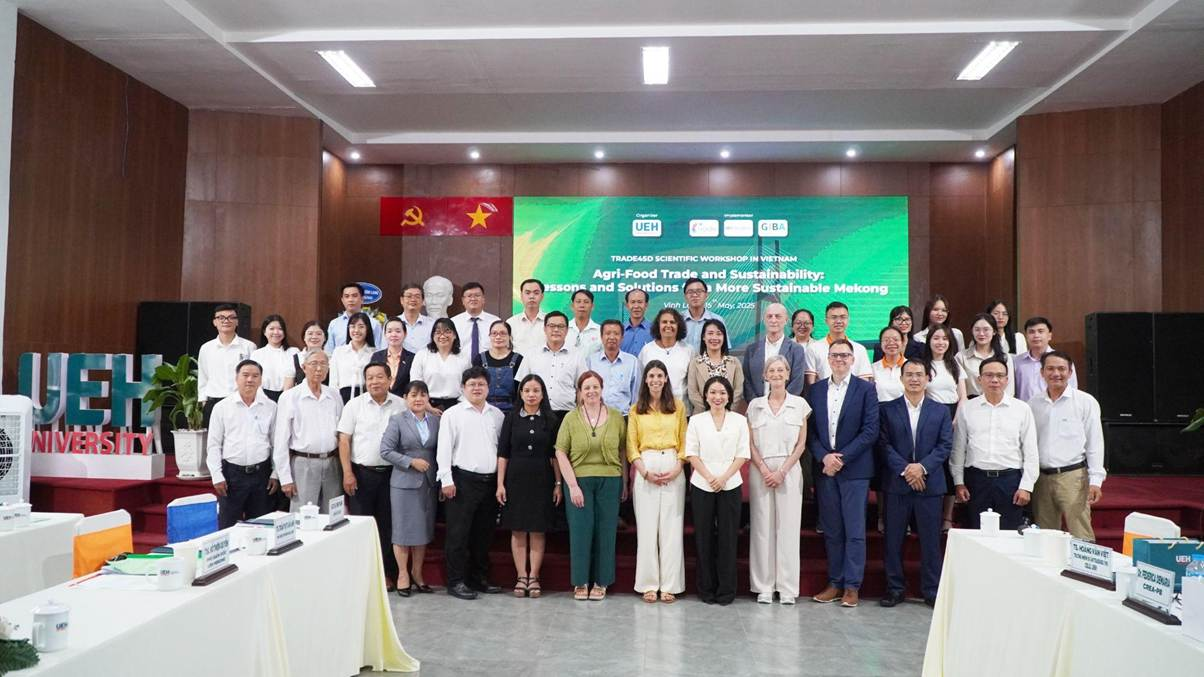
On May 15, 2025, at UEH Mekong (Vinh Long), UEH organized the international workshop “Agri-Food Trade and Sustainability: Lessons and Solutions for a More Sustainable Mekong” within the framework of the TRADE4SD project funded by the European Union.
The workshop connected a group of experts from Corvinus University (Hungary), the Montpellier Agricultural Research Institute (France), and the Council for Agricultural and Economic Research (CREA, Italy) with businesses, management agencies, and stakeholders in the agro-food value chain in the Mekong Delta. The shared content includes enhancing the sustainability of agricultural trade, analyzing the value chains of rice, tea, and dragon fruit, export standards, traceability, production linkages, and adapting to international market requirements. In particular, Mr. Nguyen Tan Thu – General Director of PUTIN Animal Feed Co., Ltd. shared his experience in innovating animal feed production to meet safety standards, traceability, and linkages with partners in the supply chain. Representatives from SA KY Food Joint Stock Company presented the difficulties regarding sustainability certification, market fluctuations, and the requirements of free trade agreements, while also discussing solutions to enhance the competitiveness of local food businesses. Source – UEH Portal, May 16, 2025: UEH Mekong, April 19, 2025:
Image: Overview of the scientific conference “Agri-Food Trade and Sustainability” Source of evidence: UEH organized a scientific conference on the theme “Agricultural Trade and Sustainable Development: Lessons and Solutions for a More Sustainable Mekong” (UEH Mekong Portal, May 16, 2025) – Original image file
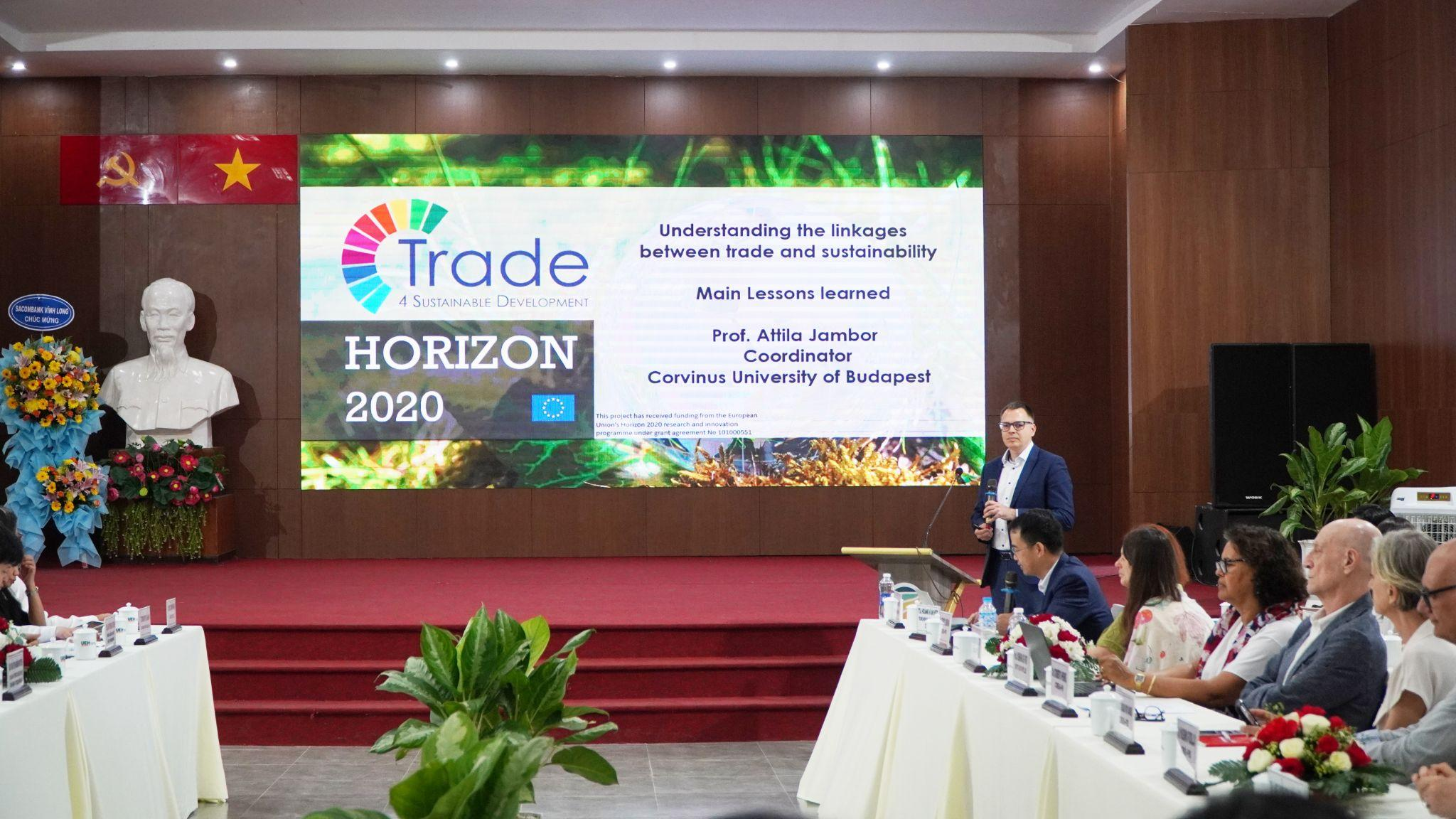
Image: Prof. Dr. Attila Jambor – Director of the Institute for Sustainable Development, Corvinus University, presenting at the conference. Source of evidence: UEH organized a scientific conference on the theme “Agricultural Trade and Sustainable Development: Lessons and Solutions for a More Sustainable Mekong” (UEH Mekong Portal, May 16, 2025) – Original image file |
The workshop attracted more than 120 delegates, including international experts, management agencies, businesses, and relevant units in Vinh Long and the Mekong Delta.
The initiative aims to facilitate access for agricultural and food producers and processors to knowledge about production standards, value chain linkages, sustainable trade, and solutions to improve the efficiency of agricultural business. The topics discussed provide a basis for businesses and stakeholders to adjust their production, processing, and export activities in a responsible manner. |
| Disseminating knowledge and technology: NCTD 2025 Workshop – Plenary session with the presentation “Application of high technology in smart agricultural production: A case study of Vinh Long province” and the thematic session “Smart Agriculture and Sustainable Rural Development” | Format: Sharing knowledge directly at the workshop and publicly disclosing research information on the UEH Portal.
Level: Local, national. Target audience: Organizations and units operating in the agricultural sector, cooperatives, agricultural production and trading businesses, and stakeholders interested in digital transformation of agriculture in the Mekong Delta. |
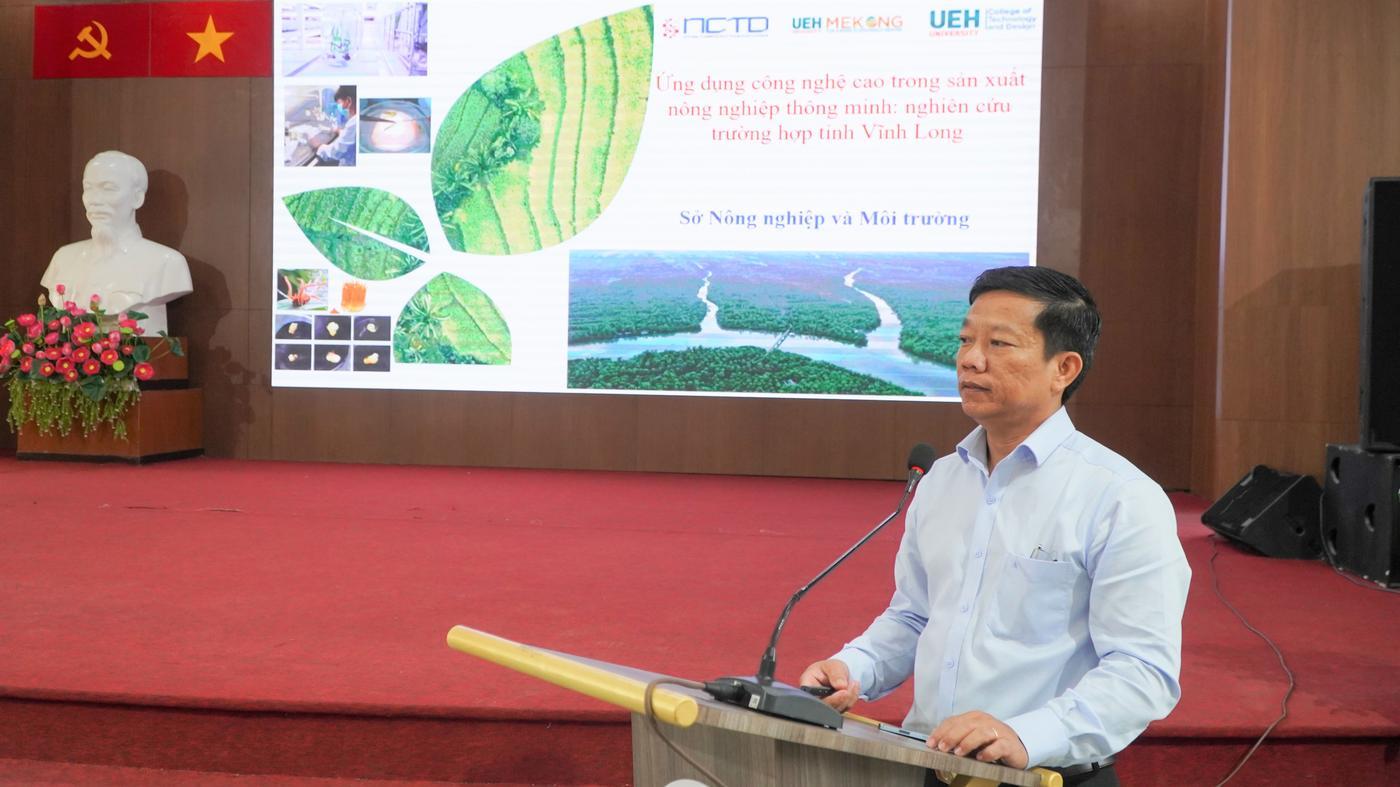
On October 31, 2025, UEH organized the National Scientific Conference on Technology and Design (NCTD 2025) at UEH Mekong, with the opening plenary session featuring a presentation titled “Application of High Technology in Smart Agriculture Production: A Case Study of Vinh Long Province” by Mr. Nguyen Quoc Tuan – Deputy Director of the Department of Agriculture and Environment of Vinh Long Province.
Mr. Nguyen Quoc Tuan presented the topic “Application of High Technology in Smart Agricultural Production: A Case Study of Vinh Long Province”. The presentation provided practical insights, models, and outstanding results in the application of high technology in the province, especially in the context of Vinh Long facing challenges such as climate change, saltwater intrusion, and the need to improve the quality of agricultural products. Based on this, it proposed policies and solutions suitable to the geographical characteristics and resources of Vinh Long province. The thematic session “Smart Agriculture and Sustainable Rural Development” was moderated by Dr. Bui Xuan Huy, Faculty of Business Information Technology, UEH.
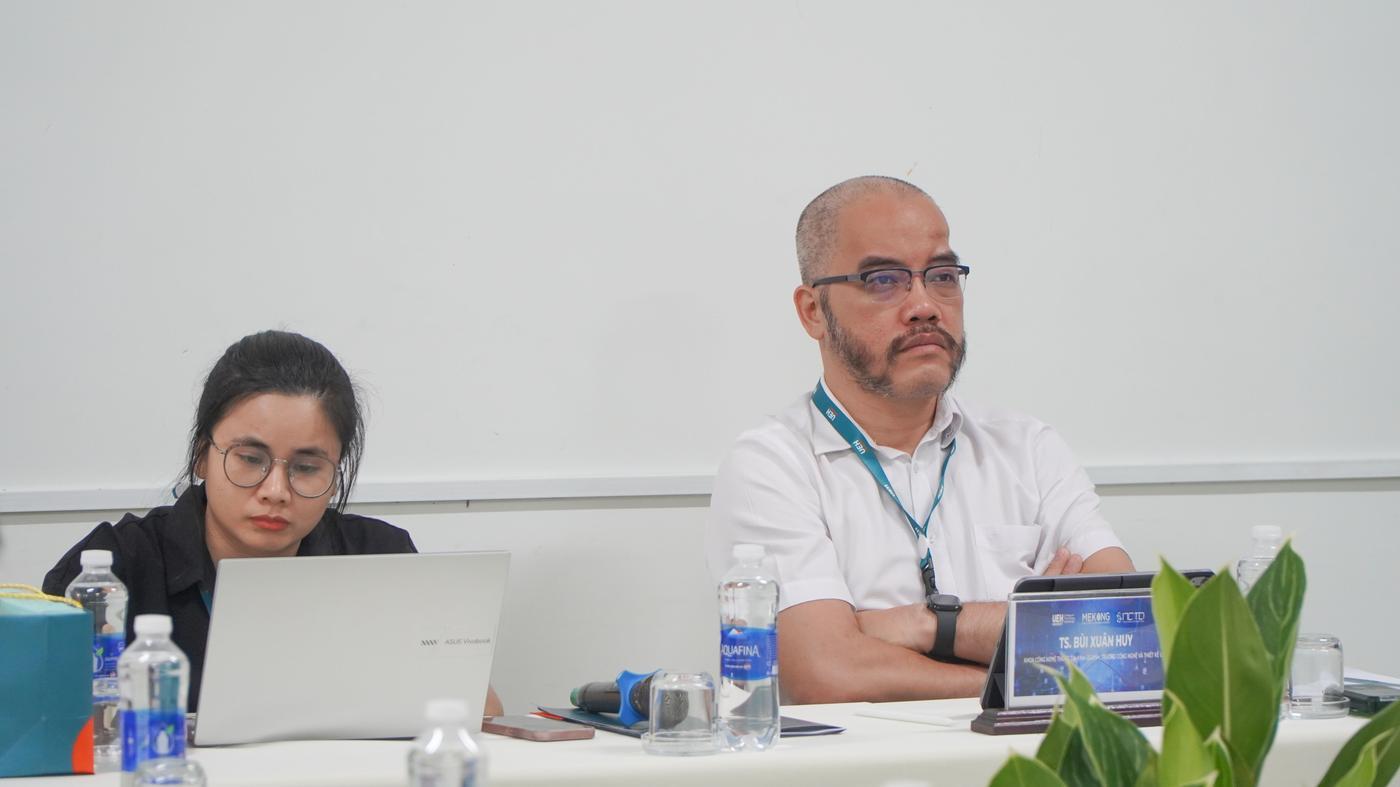
Dr. Bui Xuan Huy – Faculty of Business Information Technology, UEH School of Technology and Design, moderated the session “Smart Agriculture and Sustainable Rural Development”. The thematic session focused on discussing the applications of digital technology, artificial intelligence (AI), the Internet of Things (IoT), and big data in agriculture, aiming to improve production efficiency, resource utilization, and adaptation to climate change. The expert reports introduce specific application content, including the combination of production experience and AI; digital marketing solutions to enhance the value of OCOP products in the Mekong Delta; and drivers of digital transformation for agricultural cooperatives. Source – UEH Portal, November 1, 2025: |
The workshop provides a forum for disseminating knowledge on smart agriculture, production technology, cooperative management, and enhancing the value of agricultural products for stakeholders. Expert information is made public through the UEH Portal, contributing to expanding access to technological solutions and sustainable agricultural production management. |
| Knowledge Dissemination and Survey: ACIAR CS/2020/209 Project “Food Losses in the Mekong River Basin Pangasius Value Chain” | Forms of distribution: Free, direct, and indirect.
Level: Local, national, international (Vietnam, Cambodia, Laos). Target audience: fish breeders, commercial pangasius farmers, traders, processing and exporting businesses, and fisheries management agencies. |
UEH is the lead institution for the project (proposed by HAPRI Institute), funded by ACIAR (Australia) and IDRC (Canada), approved by the Ministry of Education and Training, and implemented from 2023 to June 2026.
This research project on the pangasius value chain in Vietnam and the Mekong River basin aims to identify the causes of food loss and waste and propose solutions to reduce losses in production, harvesting, transportation, processing, and distribution. Based on the research and surveys on the pangasius value chain conducted in previous phases, the ACIAR CS/2020/209 project continues to disseminate knowledge on reducing food loss in 2025. On September 29, 2025, the project’s expert team published a review of 19 studies in the Agriculture and Environment Newspaper, identifying hotspots causing losses in the pangasius value chain, from breeding, commercial farming, harvesting, transportation to processing. The publicly available information, along with recommendations on improving farming conditions, managing diseases, optimizing transportation, and utilizing by-products, provides farmers and processing businesses with a scientific basis for choosing solutions to reduce losses and improve resource efficiency. Previously, on September 30, 2024, the project announced initial findings of 30–50% losses during the commercial farming phase. This is the foundational result of the research process, followed by knowledge dissemination activities in 2025.
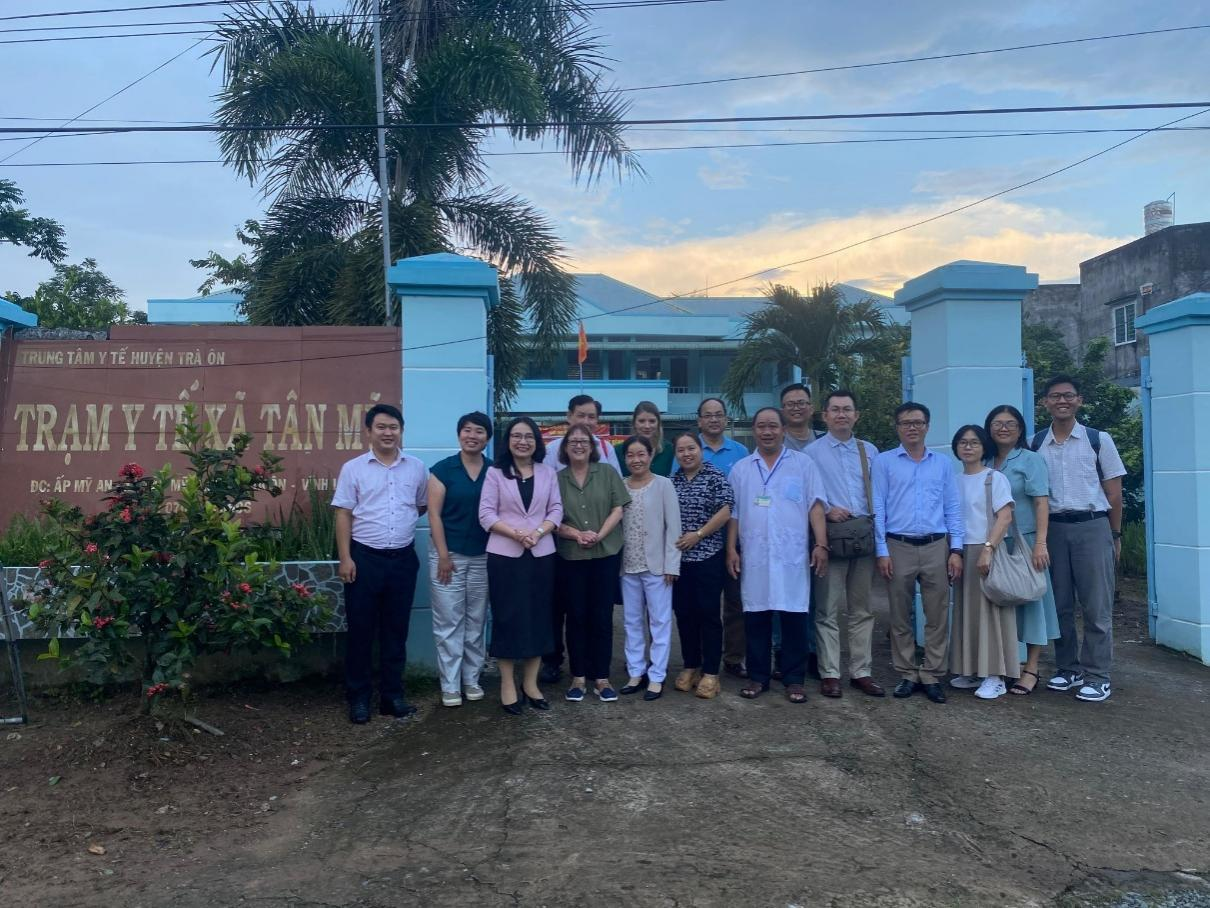
Image: Research team surveys Sao Mai catfish processing plant (Dong Thap province) Source of evidence: 2024 background research results: Commercial pangasius are lost by up to 30–50% during the farming stage (Vietnam Agriculture and Nature Newspaper)
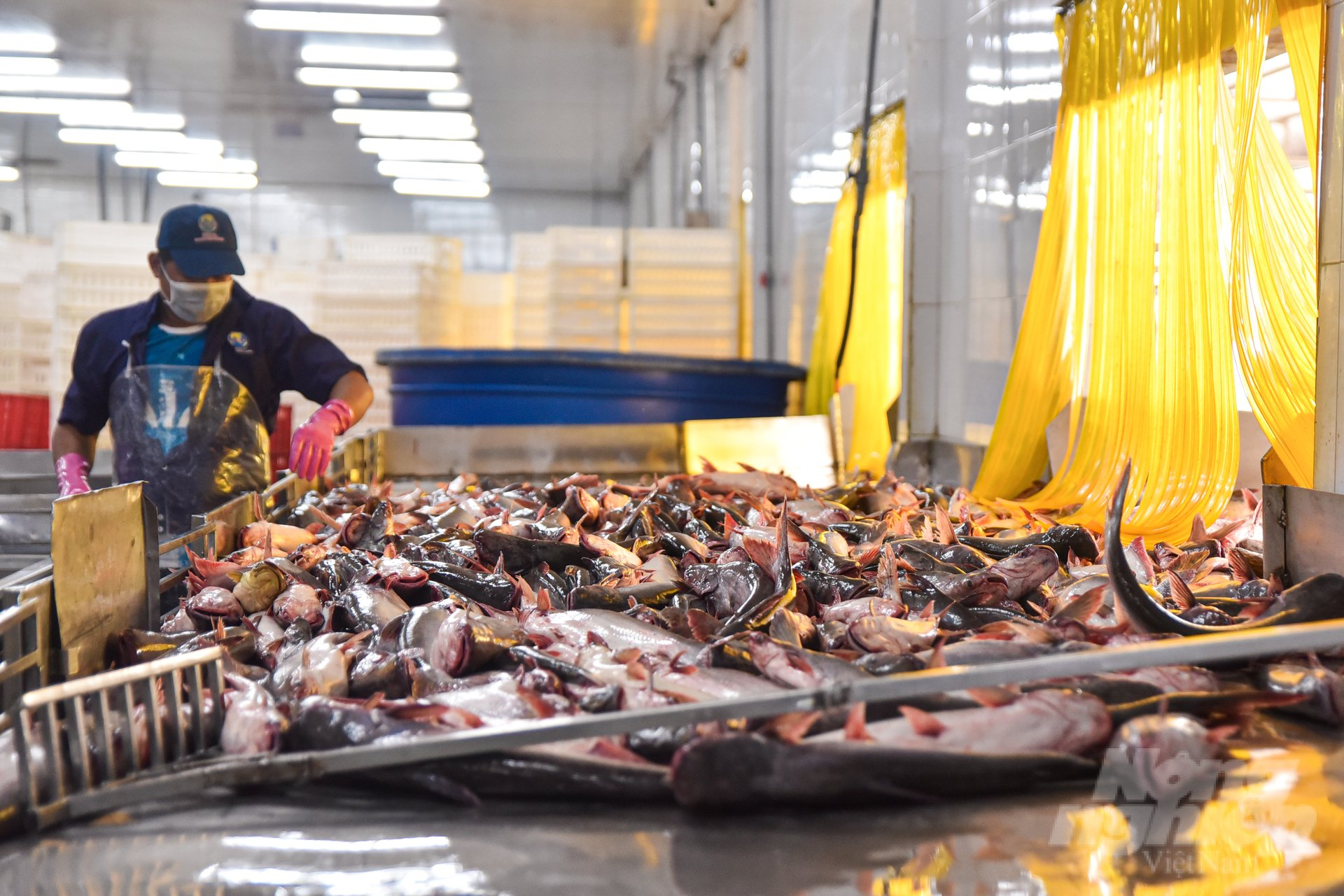
Image: Processing is the stage with the biggest losses in the pangasius value chain. Source of evidence: Results published in 2025: Identifying loss hotspots in the pangasius value chain and ACIAR interventions (Vietnam Agriculture and Nature, September 29, 2025) Source 3 – UEH Portal, introducing the ACIAR project and the role of HAPRI: Source 4 – UEH Portal, summary of HAPRI activities in 2025: |
The research findings of the ACIAR project, built upon previous survey phases and further synthesized and disseminated in 2025, identify key loss hotspots in the pangasius value chain. The findings regarding losses in commercial farming, environmental conditions, processing efficiency, and byproduct utilization provide a scientific basis for farmers and businesses to consider solutions to reduce losses and improve production efficiency.
Losses during the commercial farming phase can reach 30–50%. Adverse environmental conditions, such as low pH and high salinity, can increase fish mortality rates. The processing stage requires approximately 2.8 kg of raw fish to produce 1 kg of commercial fillet. Pangasius fish by-products are not being fully utilized, creating room for the development of circular economy solutions and enhancing product value. The research team shared proposed solutions such as improving farming conditions, using microbial preparations and seaweed extracts, optimizing harvesting and transportation operations, enhancing the efficiency of the cold chain, and utilizing processing by-products. By publicly disclosing findings and applied solutions, UEH and its partners provide freely accessible technical knowledge to pangasius farmers, processing businesses, and entities in the seafood supply chain. |
| “Research, application and dissemination of knowledge on regenerative agriculture – HAPRI’s IP8 Project 2025” | Format: Providing free access to information and applied research results through UEH’s public channels.
Level: National, International. Beneficiaries of research knowledge include: farmers, cooperatives, businesses producing and trading green agricultural products, agricultural support organizations, and policy-making agencies. |
In 2025, the Health and Agriculture Policy Research Institute (HAPRI) continued to implement Intervention Package 8 (IP8) project, in collaboration with CIAT of the Alliance of Bioversity International, focusing on researching solutions for sustainable agricultural development, enhancing the value of green agricultural products, and building market mechanisms to encourage regenerative farming methods.
The project contributes to the formation of applied knowledge on market linkages, enhancing the value of agricultural products, and developing responsible production models. The results are disseminated by HAPRI through its 2025 activity summary report on the official UEH portal, allowing interested parties to access research information free of charge.
Image: Vietnam-Australia project to improve nutrition for disadvantaged rural children. In addition to the IP8 project, on January 14, 2025, UEH announced the thematic study “Food Security and Sustainable Agriculture: From Policy to Practice in the Context of Climate Change,” summarizing and disseminating HAPRI’s research on farmers’ livelihoods, water resource management, and adaptive agricultural development in the Mekong Delta. The content provides reference solutions such as freshwater and brackish water management according to ecological conditions, crop restructuring to adapt to drought and salinity, improving irrigation systems, diversifying production, and enhancing the effectiveness of agricultural extension activities to suit the actual needs of small-scale farmers. Publicly publishing this topic on UEH Future contributes to providing a free source of knowledge for farmers, agricultural support organizations, businesses, and local authorities to refer to in the process of developing sustainable production models. Source – UEH Future, January 14, 2025: |
In 2025, HAPRI continued to implement the IP8 project and disseminate research information on regenerative agriculture, enhancing the value of green agricultural products and developing markets for sustainable agricultural products. This activity contributes to the formation of a knowledge base for farmers, cooperatives, production enterprises, and agricultural support units to refer to in improving production models and connecting to markets. |
| Sharing knowledge: Freely disseminating research findings on farmers, rural areas, and sustainable food (Research Contribution section) | Format: Free, indirect.
Level: Local. Target audience: farmers, clean food businesses, agricultural management agencies in Ho Chi Minh City and the Mekong Delta. |
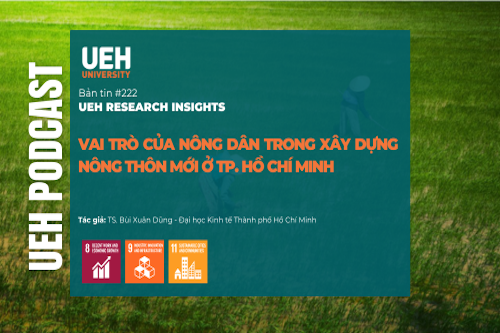
On May 28, 2025, UEH published a research paper on the role of farmers in building new rural areas in Ho Chi Minh City, which analyzed the need for applying technology in agricultural production, technical training, farm economic management, smart irrigation, and modern farming methods.
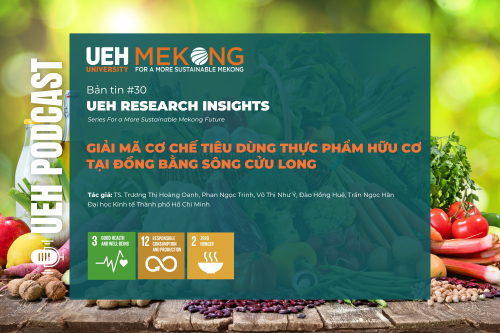
On September 17, 2025, UEH Mekong announced a study on the mechanisms of organic food consumption in the Mekong Delta, analyzing consumer behavior and willingness to pay, and providing useful market information for businesses producing and trading organic food. The content is published free of charge on the UEH Portal, and sent via enews to partner businesses and alumni, contributing to facilitating access to research information and solutions for improving production quality and developing sustainable agricultural markets for farmers, food businesses, management agencies, and other stakeholders.
Image: The role of farmers in building new rural areas in Ho Chi Minh City.
Image: Decoding the mechanisms of organic food consumption in the Mekong Delta |
Recommendations include improving farmers’ skills; mobilizing social organizations and businesses to participate in technical training and financial support for farmers.
Providing practical implications for businesses developing the clean and organic food industry in the Mekong Delta provinces. |
| Two-way dialogue: Workshop “Bustling preparations for Tet business and the start of 2026” with businesses in Vinh Long province. | Format: Free, live.
Level: Local. Target audience: Businesses and production facilities (including agricultural products and food) in Vinh Long province. |
On the morning of December 9, 2025, at UEH Mekong, the university, in collaboration with the Vinh Long Provincial Business Association and the Mekong Connect Forum Coordination Board, organized a workshop.
Experts and businesses, including local food producers, discussed purchasing power and goods circulation after natural disasters and epidemics; transparency in product quality standards; and green cash flow management. Provincial representatives shared information about export industries, support for testing and standardization, and trade promotion.
Image: Experts exchange information about goods in preparation for Tet (Lunar New Year). Source of evidence: Vinh Long organizes workshop “Bustling preparations for Tet business and the start of 2026” (Nhan Dan Newspaper) (UEH Mekong Portal – Press, December 13, 2025) |
Businesses receive updated market information and product quality standards before the Lunar New Year season.
Launching the “Pre-Mekong Connect” series of activities to connect businesses in the Mekong Delta region. |


Results of implementation in 2025 and highlights compared to 2024.
| Target | Actual results in 2025 |
| TRADE4SD at UEH Mekong | May 15, 2025; over 120 delegates |
| NCTD 2025 – Smart Agriculture | October 31, 2025; includes presentations on high technology and a thematic session. |
| ACIAR on the pangasius value chain | Review of 19 studies published on September 29, 2025 |
| HAPRI IP8 | Further research and application development continued in 2025. |
| Free access | Publicly available research papers; free workshops. |
In 2025, UEH continued to promote access to knowledge on food security, sustainable agriculture, and aquaculture through academic exchanges with local businesses, applied research projects, and the public dissemination of scientific results.
A highlight of 2025 was the international TRADE4SD workshop at UEH Mekong, attracting over 120 delegates, including agricultural and food processing businesses and international experts. In addition, the ACIAR project on food loss in the pangasius value chain continued to disseminate research findings, identify loss hotspots in commercial farming, processing, and distribution, and introduce solutions to reduce losses, improve production efficiency, and optimize resource utilization.
Compared to 2024, when research activities on the agricultural and aquatic value chain focused on field surveys, data collection, and building a scientific foundation, in 2025 UEH continued to promote the dissemination of applied knowledge through specialized workshops and the publication of research results. Notable events include TRADE4SD with over 120 delegates attending, NCTD 2025 with smart agriculture solutions, and the ACIAR project continuing to publish recommendations to reduce losses in the pangasius value chain. These activities demonstrate a continuity from research to knowledge sharing, creating opportunities for agricultural and food businesses, cooperatives, and stakeholders to access solutions for sustainable production.
Through collaboration between UEH Mekong, HAPRI, and domestic and international research partners, UEH continues to play a crucial role in connecting knowledge with local practices, contributing to enhanced access to knowledge, skills, and solutions for sustainable agricultural and aquaculture development, aiming towards SDG 2 – Zero Hunger.