

6.5.5. Cooperation on water security
THE Sustainability Impact Ratings 2027 | SDG 6 – Clean Water and Sanitation | Reporting year: 2025
University of Economics Ho Chi Minh City (UEH) collaborates with government agencies, local authorities and research partners to support water security, irrigation infrastructure management, and responses to saltwater intrusion, flooding and climate change, particularly in the Mekong Delta. These partnerships involve interdisciplinary research, field surveys, consultations with public authorities and policy recommendations on water resource governance.
In 2025, UEH continued its GS4Infra research collaboration on irrigation infrastructure in Cu Lao Dung, Soc Trang, and signed two comprehensive cooperation agreements for 2025–2030 with the People’s Committees of Ca Mau Province and Can Tho City. These broader sustainable development agreements provide a framework for future research and policy advice, including potential work on water governance, water supply, salinity intrusion, flooding and water infrastructure in the Mekong Delta.
- Regional research collaboration and policy advice for the Mekong Delta
Level of cooperation: Regional cooperation.
Under its Multidisciplinary and Sustainable University Strategy, UEH identifies research, policy advice and community engagement as important means of addressing local and regional development challenges.
In the Mekong Delta, water security is affected by changing river flows, drought, saltwater intrusion, flooding and competing water demands from agriculture, aquaculture, industry and households. Addressing these challenges requires collaboration among public authorities, universities, research organisations and communities.
Through its academic units and interdisciplinary projects, UEH examines water governance, irrigation infrastructure operations, ecosystem-based resource management and policy approaches that consider the needs of different population groups.
UEH also develops comprehensive cooperation frameworks with local authorities, connecting sustainable development, the green and marine economies, and climate adaptation with regional needs. These frameworks can support future work on water resource governance, supply and drainage infrastructure, salinity intrusion, flood risk and coastal ecosystem protection. They should not, however, be interpreted as evidence that dedicated water-security projects have already been implemented under every agreement.
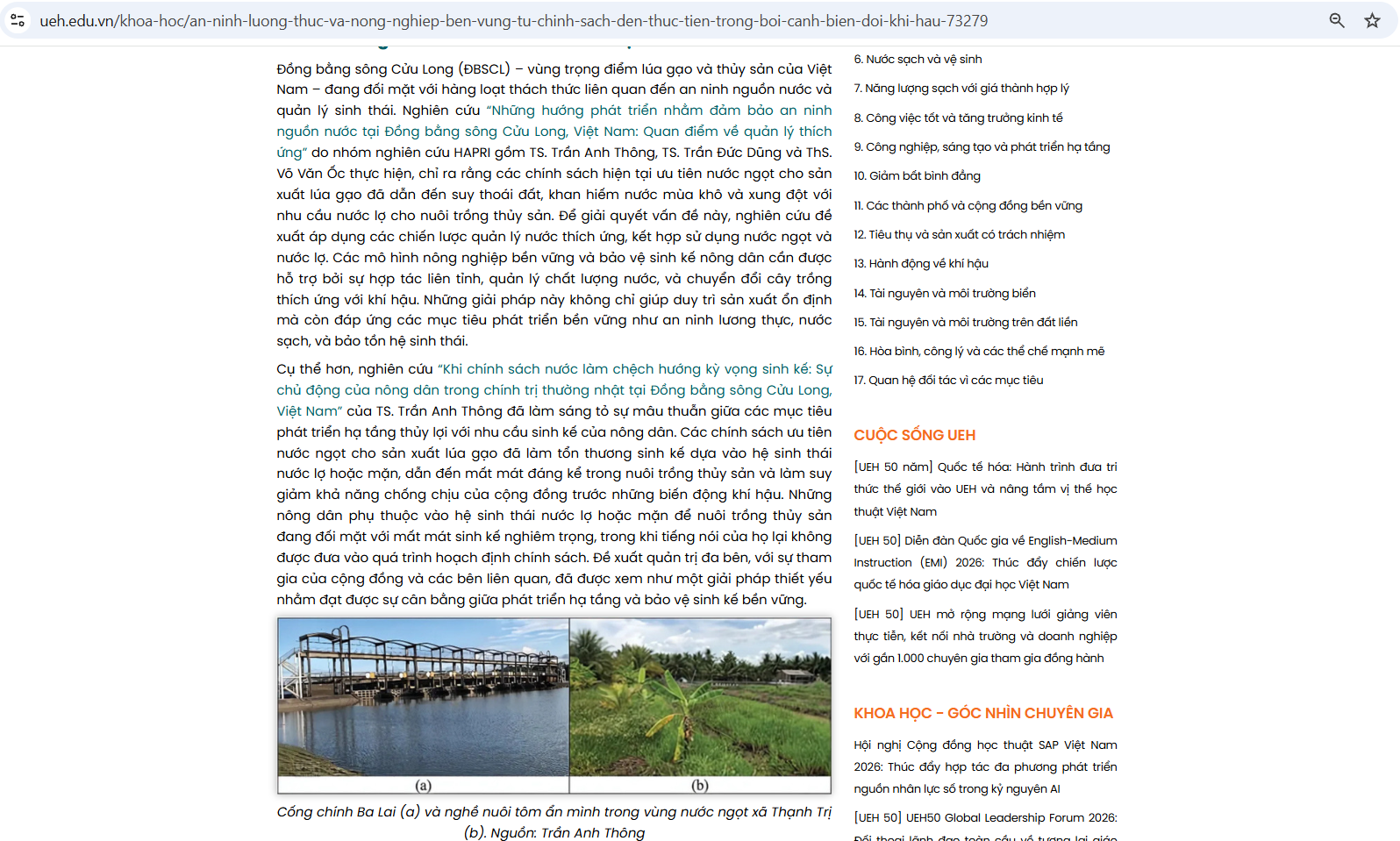
Research on Mekong Delta water security, adaptive management and interprovincial cooperation.
Public evidence: Food Security and Sustainable Agriculture: From Policy to Practice in the Context of Climate Change (UEH Portal, 14 January 2025).
- GS4Infra – Cooperation with local government on irrigation infrastructure and water security
Level of cooperation: Local government cooperation.
UEH worked with the Cu Lao Dung District Department of Agriculture and Rural Development, the Soc Trang Provincial Irrigation Sub-Department, and representatives of An Thanh Dong and An Thanh Nam communes on the GS4Infra research project. The project addresses gender mainstreaming in irrigation infrastructure and disaster risk reduction in the context of climate change, with support from the Mekong Thought Leadership and Think Tanks Network (MTT).
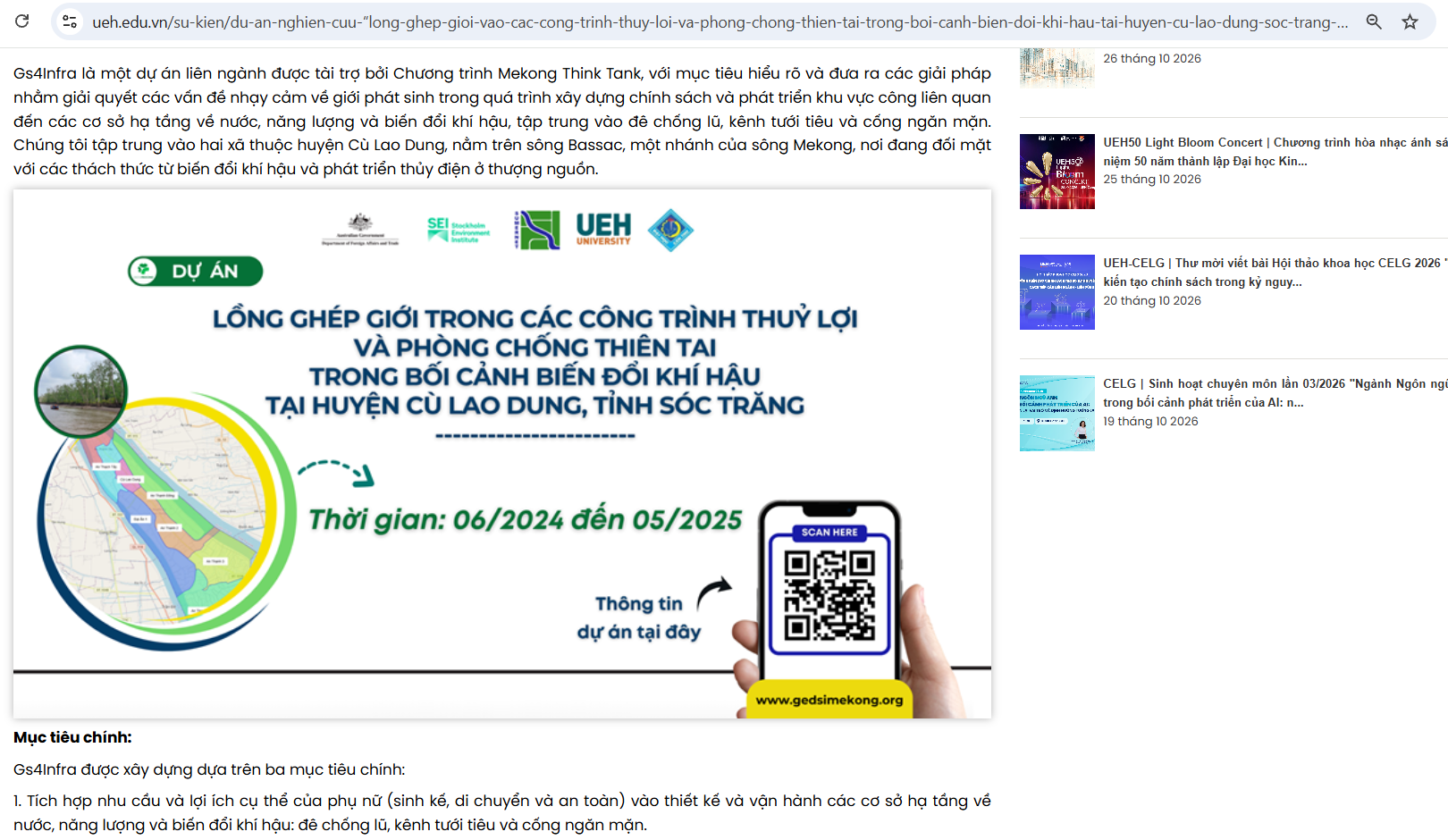
GS4Infra implementation schedule, June 2024–May 2025, including planned policy consultations and research recommendations in 2025.
Public evidence: GS4Infra Research Project: Gender Mainstreaming in Irrigation Infrastructure and Disaster Risk Reduction in Cu Lao Dung District, Soc Trang (UEH Portal).
The research focuses on flood protection dykes, irrigation canals and salinity-control sluice gates. Through fieldwork and consultation with local officials, it explores infrastructure management approaches suited to changing climatic conditions and community needs, contributing to water security in the Mekong Delta.
During 2024–2025, GS4Infra combined training for residents of An Thanh Dong and An Thanh Nam and local officials with consultations on irrigation infrastructure and disaster risk reduction. Collaboration among UEH, public agencies and communities helped incorporate water-use needs, access to irrigation infrastructure and gender-related differences into the assessment of local management and operational solutions.
- Expanding formal cooperation with local authorities in 2025
3.1. UEH–Ca Mau Provincial People’s Committee Cooperation Agreement, 2025–2030
Level of cooperation: Local government cooperation.
In September 2025, UEH and the Ca Mau Provincial People’s Committee signed a comprehensive cooperation agreement for 2025–2030, expanding collaboration on research, policy advice, education and innovation for local development.
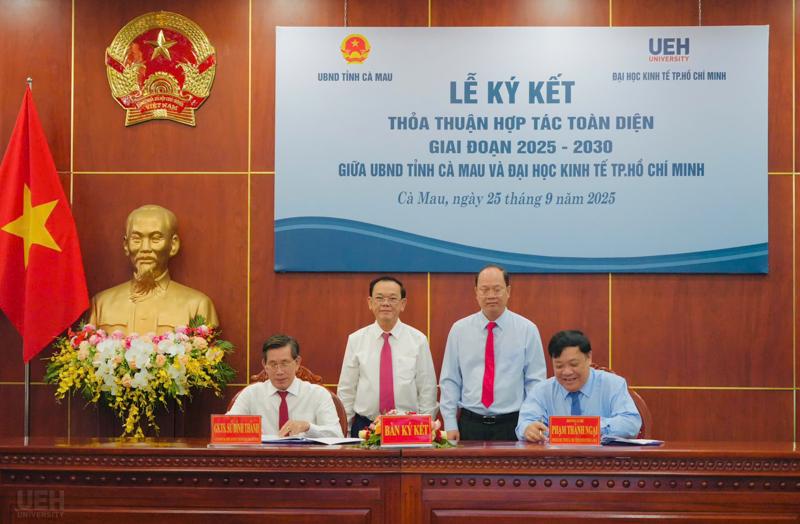
UEH signs a comprehensive cooperation agreement for 2025–2030 with the Ca Mau Provincial People’s Committee.
Public evidence: Signing Ceremony of the Comprehensive Cooperation Agreement for 2025–2030 between UEH and the Ca Mau Provincial People’s Committee (UEH Portal, 26 September 2025).
The agreement covers research and policy advice related to sustainable development, the marine economy, clean energy and climate adaptation. In Ca Mau, these priorities intersect with challenges involving salinity intrusion, water resources and coastal resilience. The agreement establishes a potential basis for future joint research and policy proposals on water governance, salinity adaptation and coastal ecosystem protection; it does not by itself demonstrate completion of a dedicated water-security intervention.
3.2. UEH–Can Tho City People’s Committee Cooperation Agreement, 2025–2030
Level of cooperation: Local government cooperation.
In November 2025, UEH and the Can Tho City People’s Committee signed a cooperation agreement for 2025–2030 to strengthen education, scientific research, policy advice and sustainable development in the Mekong Delta.
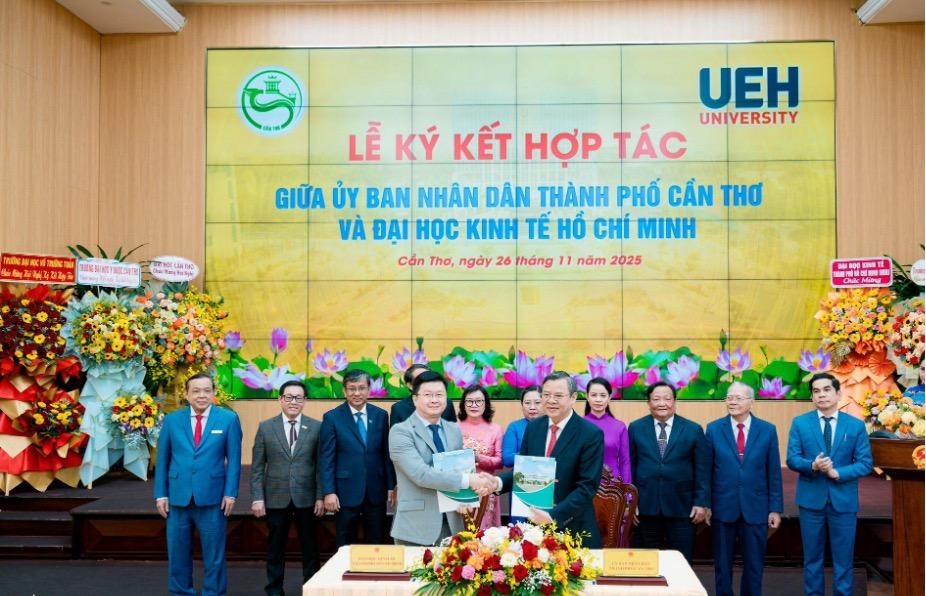
UEH signs a cooperation agreement for 2025–2030 with the Can Tho City People’s Committee.
Public evidence: UEH and Can Tho City People’s Committee Sign 2025–2030 Cooperation Agreement for Sustainable Development in the Mekong Delta (UEH Portal, 27 November 2025).
The agreement focuses on policy research and advice, planning, smart urban development, the green economy and climate adaptation. These areas are relevant to urban flooding, drainage management and climate-resilient infrastructure in Can Tho, a major Mekong Delta city. The 2025–2030 framework creates opportunities for future applied research on flood management, water infrastructure planning and regional water security, while the publicly documented agreement is broader than water security alone.
- Women4Mangrove – Field cooperation with local authorities and communities on coastal wetland ecosystems
Level of cooperation: Local government cooperation.
In 2025, UEH expanded sustainable development cooperation in the Mekong Delta through Women4Mangrove – Empowering Women for Nature-based Coastal Solutions, a UEH-led project supported under the SEA Grants programme through UNOPS.
The project promotes sustainable livelihoods linked to mangrove conservation and restoration, with particular emphasis on women’s participation and coastal communities.
The project team conducted field visits and consultations with local stakeholders. A stakeholder meeting brought together representatives of local authorities, communities, environmental experts and development partners to discuss progress and future activities.
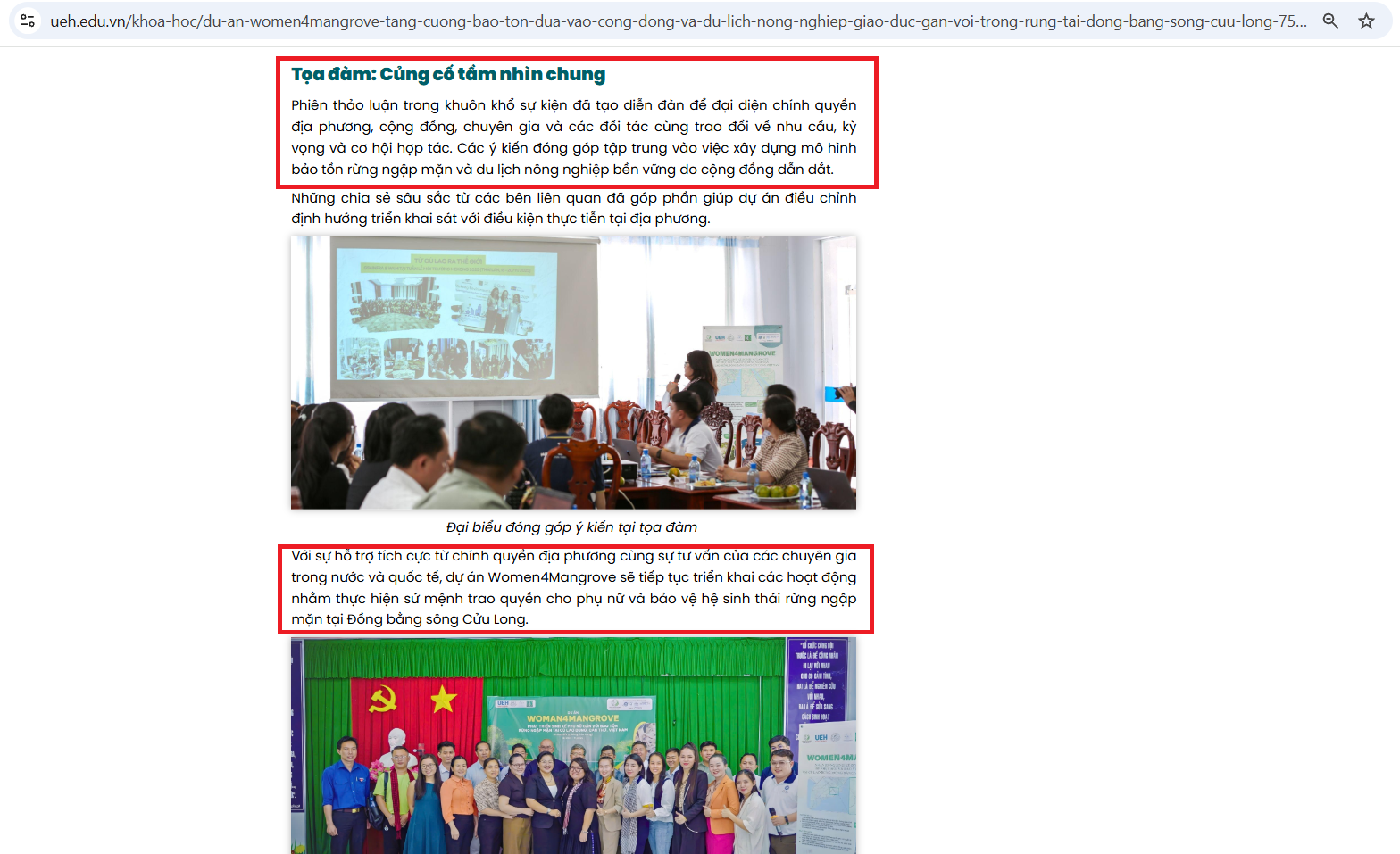
UEH and local stakeholders discuss mangrove conservation and sustainable livelihoods under the Women4Mangrove project.
Public evidence: Women4Mangrove: Strengthening Community-based Conservation and Educational Agro-tourism Linked to Reforestation in the Mekong Delta (UEH Portal, 20 December 2025).
Through fieldwork and engagement with local authorities, communities and partners, Women4Mangrove supports mangrove ecosystem conservation and restoration alongside sustainable livelihoods. Nature-based solutions can strengthen coastal resilience to climate change and complement water-environment protection and coastal resource management. This is evidence of ecosystem-focused cooperation rather than a direct water supply or irrigation management programme.
- Outcomes of cooperation relevant to water security
In 2025, UEH worked with public authorities and partners on sustainable development challenges in the Mekong Delta, including water governance, irrigation infrastructure, salinity intrusion, flooding and coastal ecosystems.
GS4Infra provides the most direct evidence of government collaboration on water security, involving irrigation authorities, local governments and communities in Cu Lao Dung in research and consultation on irrigation and disaster risk reduction. UEH also signed two formal cooperation agreements with the Ca Mau and Can Tho People’s Committees, establishing frameworks for sustainable development, climate adaptation and future resource-management research. Women4Mangrove added cooperation with local authorities and communities on coastal ecosystem conservation and environmental resilience.
These activities connect academic research, government collaboration and local development needs while creating opportunities for further water-security initiatives.
- Comparison with the previous reporting period
Compared with the previous evidence submission, UEH continued direct collaboration with public authorities through GS4Infra on irrigation infrastructure and disaster risk reduction in Cu Lao Dung. In 2025, UEH additionally signed two comprehensive cooperation agreements for 2025–2030 with the Ca Mau and Can Tho People’s Committees, broadening the institutional basis for research, policy advice, green economic development and climate adaptation. Women4Mangrove also involved engagement with local authorities and communities on coastal ecosystem protection.
These developments demonstrate continuity in water-related research cooperation and the expansion of broader sustainable development partnerships. Water security remains a relevant potential area for further collaborative work in the Mekong Delta.
- Conclusion
Through GS4Infra and its broader sustainable development partnerships with local governments, UEH contributes to research and dialogue on water governance, irrigation infrastructure, salinity intrusion, flooding and coastal ecosystems. In 2025, continued cooperation in Cu Lao Dung, two new agreements with local authorities, and Women4Mangrove strengthened connections among the university, public agencies and communities. Together, they support the institutional and research foundations for improved water security and SDG 6 – Clean Water and Sanitation.