

Water-conscious planting – Plant landscapes to minimise water usage
THE Sustainability Impact Ratings 2027 | SDG 6 – Clean Water and Sanitation | Data Year: 2025
The University of Economics Ho Chi Minh City (UEH) manages planting and landscape maintenance with consideration for water efficiency, matching species selection to climate conditions, planting locations, and irrigation requirements. Under its Green Campus Practice Regulations, UEH prioritizes considering plants that tolerate heat and dry conditions or require less supplemental irrigation once established, together with suitable irrigation scheduling and location-specific maintenance.
In 2025, UEH maintained landscaped areas at the Nguyen Van Linh Campus and supplemented its inventory with records from Campuses A, B, E, and H and student dormitories. The inventories identify plants relevant to reduced irrigation requirements, including bougainvillea, moss rose, Madagascar periwinkle, snake plant, and ZZ plant. The 2025 evidence primarily documents their presence and ongoing maintenance, rather than establishing that every campus plant is drought tolerant or was newly planted in 2025.
1. Policies and Approaches to Water-Conscious Landscaping at UEH
1.1. UEH Green Campus Practice Regulations
UEH applies its Green Campus Practice Regulations based on Decision No. 2059/QD-DHKT-CSVC (2022). The publicly available version was updated in 2024 and continued to apply during the 2025 data year. Under Article 19, Clause 6, UEH encourages the use of native plants that require less water and maintenance in campus planning, renovation, and construction. This is a species-selection policy, not evidence that every plant in the inventories is native or drought tolerant.
Article 22, Clause 3, of the Green Campus Practice Regulations also encourages native planting combined with drip irrigation or automated irrigation using soil-moisture sensors to reduce landscape water consumption. Appropriate plant selection and irrigation solutions are therefore considered together, rather than judging water efficiency solely by the total number of plants.
Policy source: https://gogreen.ueh.edu.vn/quy-dinh-thuc-hanh-dai-hoc-xanh
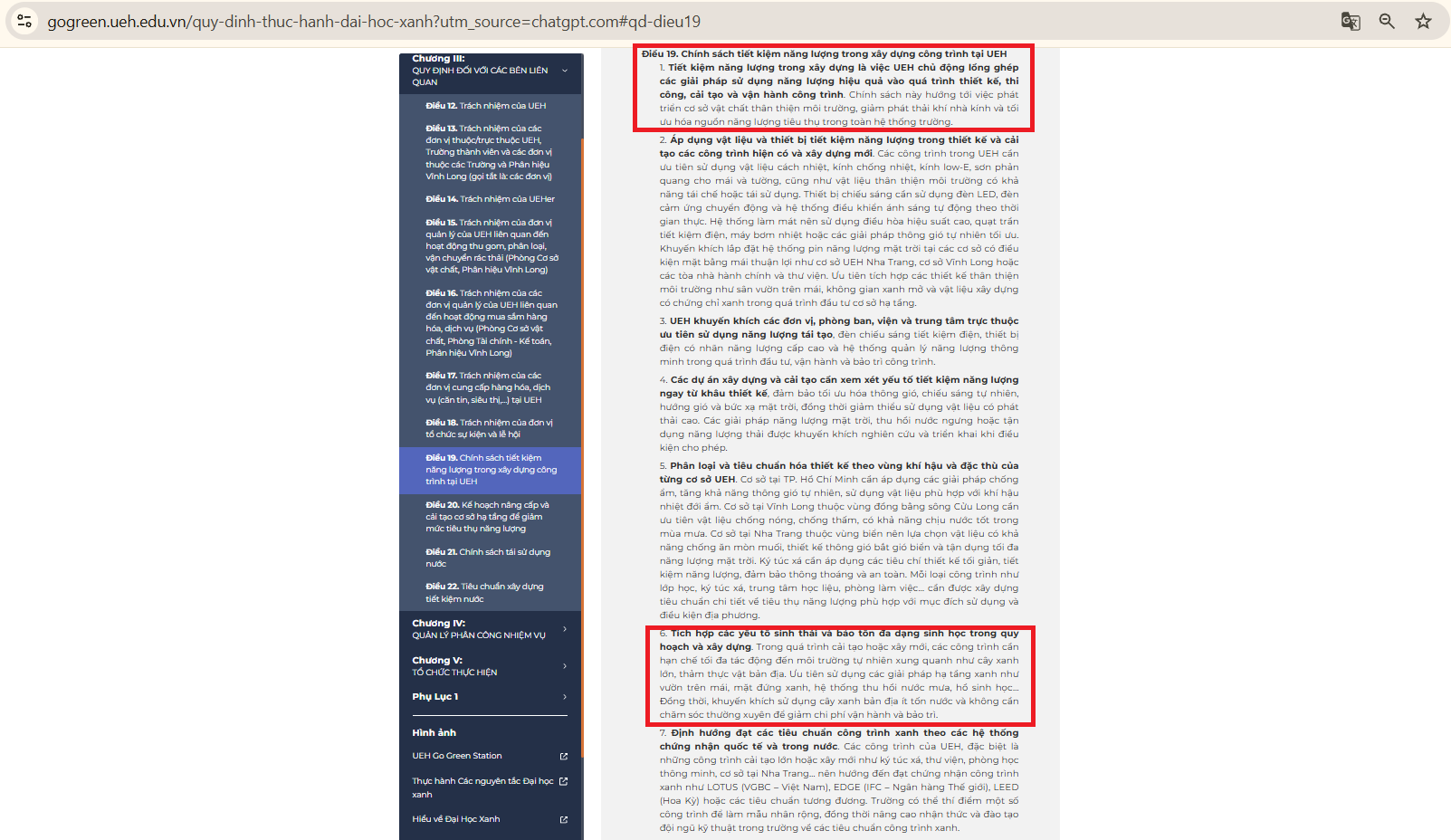
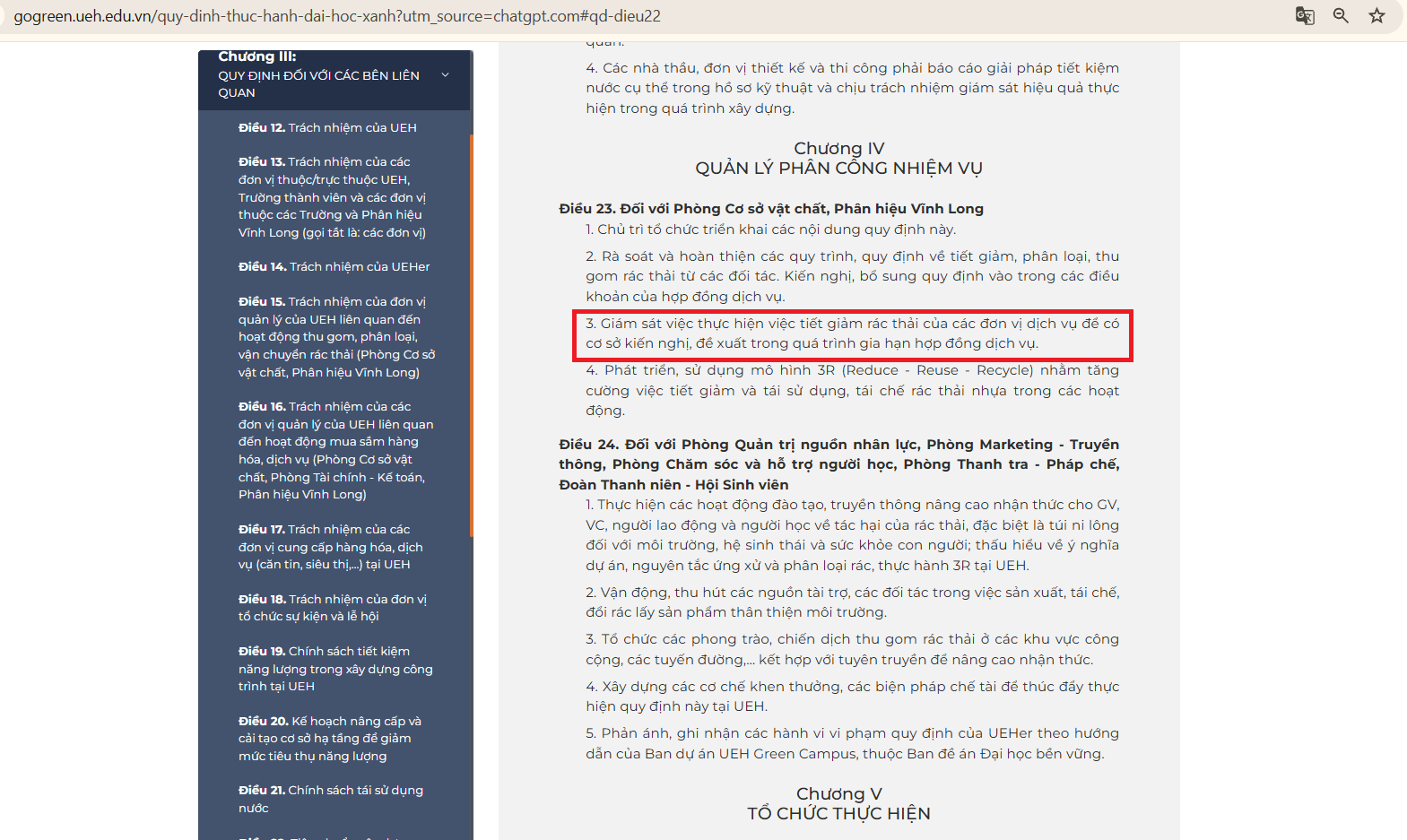
Articles 19(6) and 22(3) of UEH’s Green Campus Practice Regulations establish a preference for native plants with low water needs, together with water-efficient landscape irrigation.
Public source: UEH Green Campus – Green Campus Practice Regulations.
2. Implementation of Landscaping with Plants Adapted to Dry Conditions Across UEH Campuses
In landscape management, UEH considers plants’ ability to tolerate heat, retain water, and establish their root systems, as well as planting conditions at each campus. Plants in sunny locations, well-drained soil, or suitable potting media can be managed according to their specific irrigation needs. Newly planted specimens still require adequate irrigation during establishment.
The inventories identify several relevant species or groups: (1) bougainvillea, which tolerates heat and drought once established, at Campuses N, A, B, E, H and Dormitory N; (2) moss rose, a succulent-leaved plant adapted to heat and dry conditions, at Campus N; (3) Madagascar periwinkle, adapted to sunny and periodically dry conditions, at Campuses N, A, E and Dormitory N; (4) snake plant, requiring relatively little watering in well-drained growing media, at Campuses A, B and H; and (5) ZZ plant, whose rhizomes store water, at Campuses A, B and E.
Drought tolerance informs the selection of landscaping with potentially lower supplemental irrigation requirements but does not replace operational water-use data. Bougainvillea prefers well-drained conditions and tolerates drought once established; moss rose withstands heat and dry conditions; ZZ plants and snake plants can tolerate longer intervals between watering when their growing media have dried; and Madagascar periwinkle is adapted to sunny settings.
Inventory of Outdoor Landscaping Plants and Potted Plants
| Outdoor plants | ||||
| No. | Plant species / type | Unit | Quantity | Photographic evidence |
| 1 | Beach spider lily | Plant | 45,700 | 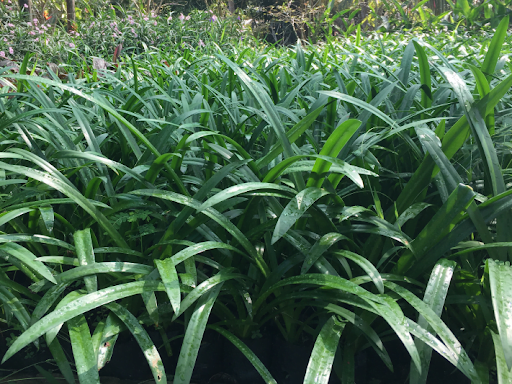 |
| 2 | Agave | Plant | 163 | 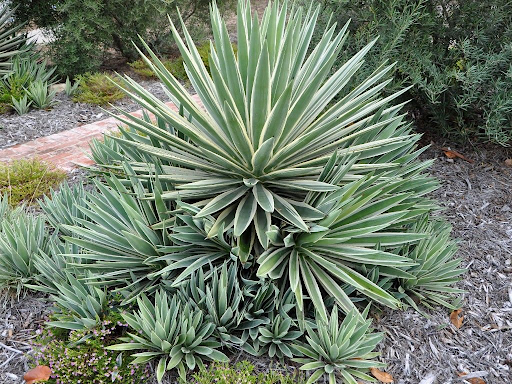 |
| 3 | Golden dewdrop | Plant | 1,620 | 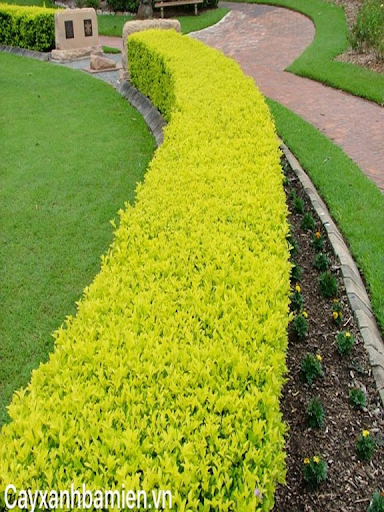 |
| 4 | Silver fan palm | Plant | 47 | 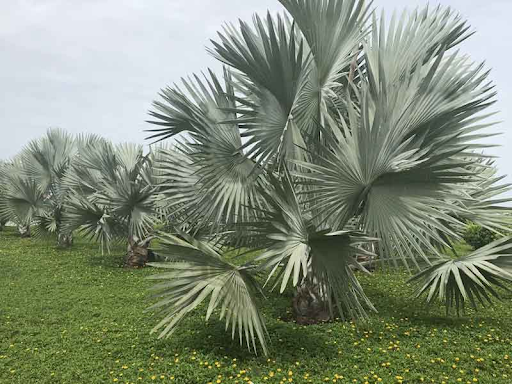 |
| 5 | Sago palm / cycad | Plant | 118 | 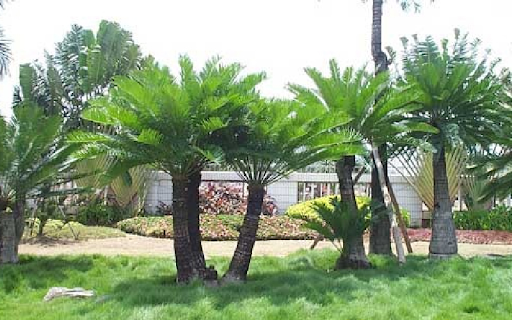 |
| 6 | Large orange jasmine | Plant | 65 | 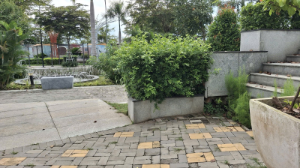 |
| 7 | Small orange jasmine | Plant | 1,811 | 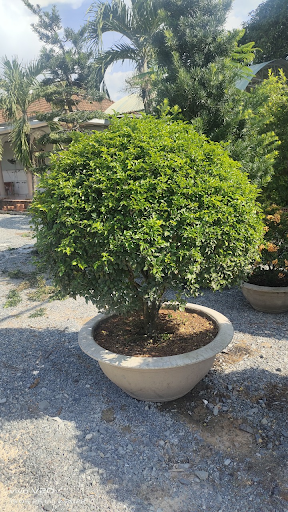 |
| 8 | Mountain dracaena | Plant | 108 | 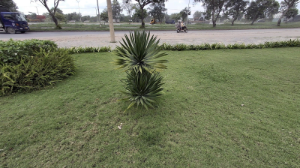 |
| 9 | Grafted bougainvillea | Plant | 105 | 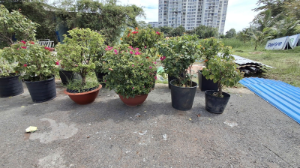 |
| 10 | Conifer / ornamental cypress | Plant | 4 | 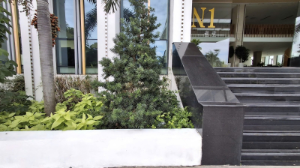 |
| 11 | Yellow cassia | Plant | 13 | 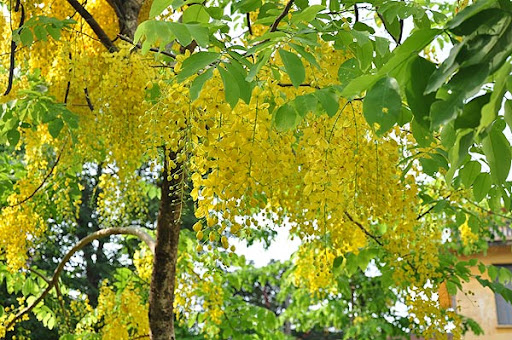 |
| 12 | Giang huong duoi cong (local name) | Plant | 27 | |
| 13 | Ornamental palm | Plant | 12 | |
| 14 | Royal palm | Plant | 77 | |
| 15 | Foxtail palm | Plant | 10 | |
| 16 | Mai hoa dang (local name) | Plant | 105 | |
| 17 | Yellow apricot blossom | Plant | 8 | |
| 18 | False heather | Plant | 1,905 | |
| 19 | White-leaf ornamental plant | Plant | 895 | |
| 20 | Jasmine | Plant | 2,893 | |
| 21 | Fern | Plant | 38,270 | |
| 22 | Fishing-pole bamboo | Plant | 4,420 | |
| 23 | Silver butterfly bush | Plant | 307 | |
| 24 | Moss rose (Portulaca) | Plant | 3,400 | |
| 25 | Texas sage | Plant | 1,015 | |
| 26 | Red-tipped ornamental tree | Plant | 216 | |
| 27 | Yellow-striped ornamental pineapple | Plant | 36,600 | |
| 28 | Palm | Plant | 162 | |
| 29 | Hibiscus | Plant | 1,876 | |
| 30 | Heliconia | Plant | 4,065 | |
| 31 | Ambarella tree | Plant | 4 | |
| 32 | Guava tree | Plant | 5 | |
| 33 | Mango tree | Plant | 25 | |
| 34 | Rose apple / plum tree | Plant | 4 | |
| 35 | Coconut palm | Plant | 25 | |
| 36 | Custard apple tree | Plant | 3 | |
| 37 | Taiwan almond tree | Plant | 2 | |
| 38 | Crape myrtle | Plant | 25 | |
| 39 | Heliconia | Plant | 970 | |
| 40 | Royal poinciana | Plant | 28 | |
| 41 | Spider plant | Plant | 50 | |
| 42 | Yellow bells | Plant | 90 | |
| 43 | Madagascar periwinkle | Plant | 600 | |
| 44 | Wild giang huong tree | Plant | 14 | |
| 45 | Bougainvillea | Plant | 1,425 | |
| 46 | Fence bougainvillea | Plant | 450 | |
| 47 | Lantana | Plant | 195 | |
| 48 | Yellow trumpetbush | Plant | 75 | |
| 49 | Pink trumpet tree | Plant | 6 | |
| 50 | Water jasmine | Plant | 2 | |
| 51 | Mai tieu thu (local name) | Plant | 747 | |
| 52 | Orchid tree | Plant | 26 | |
| 53 | Pink shower tree | Plant | 3 | |
| 54 | Red cassia | Plant | 31 | |
| 55 | Red elephant ear plant | Plant | 70 | |
| 56 | Red coleus | Plant | 195 | |
| 57 | Crape myrtle / tuong vi | Plant | 138 | |
| 58 | Grafted tuong vi | Plant | 2 | |
| 59 | Climbing ixora | Plant | 8 | |
| 60 | Dai phu gia ornamental plant | Plant | 7 | |
| 61 | Chinese evergreen | Plant | 150 | |
| 62 | ZZ plant | Plant | 75 | |
| 63 | Fittonia / nerve plant | Plant | 8 | |
| 64 | Clumping ornamental bamboo | Plant | 55 | |
| 65 | Climbing ixora | Plant | 22 | |
| 66 | Giang huong tree | Plant | 47 | |
| 67 | Climbing bougainvillea | Plant | 150 | |
| 68 | Diamond conifer (local name) | Plant | 8 | |
| 69 | Large freshwater mangrove | Plant | 2 | |
| 70 | Bougainvillea in square pot | Plant | 15 | |
| 71 | Climbing bougainvillea | Plant | 766 | |
| 72 | Shrub bougainvillea | Plant | 450 | |
| 73 | Crape jasmine | Plant | 150 | |
| 74 | Nipa palm | Plant | 55 | |
| 75 | Japanese fan palm | Plant | 29 | |
| 76 | Golden palm | Plant | 2 | |
| Total outdoor plants | 153,226 |
| Potted plants | ||||
| No. | Plant species / type | Unit | Quantity | Photographic evidence |
| 1 | Chinese evergreen | Plant | 198 | |
| 2 | Song of India dracaena | Plant | 107 | |
| 3 | Happiness tree (local name) | Plant | 36 | |
| 4 | ZZ plant | Plant | 83 | |
| 5 | Dai phu gia ornamental plant | Plant | 57 | |
| 6 | Bougainvillea | Plant | 74 | |
| Total potted plants | 555 |
Total inventory: 153,781
| Landscaping at 135 Tran Hung Dao Student Dormitory | ||||
| No. | Plant species / type | Unit | Quantity | Photographic evidence |
| 1 | Beach spider lily
Planting bed No. 1: 4.65×0.725m |
Plant | 123 | |
| 2 | Beach spider lily
Planting bed No. 2: 1.96×1.23m |
Plant | 73 | |
| 3 | Japanese golden palm, 1 m tall | Pot | 2 | |
| 4 | Mountain dracaena | Plant | 1 | |
| 5 | Purple heart plant | Plant | 80 |
| Landscaping at 43–45 Nguyen Chi Thanh Student Dormitory | ||||
| No. | Plant species / type | Unit | Quantity | Photographic evidence |
| 1 | Pothos on support pole, 2 m tall | Pot | 2 | |
| 2 | Japanese golden palm, 1 m tall | Pot | 2 | |
| 3 | Thaumatophyllum / split-leaf philodendron | Pot | 3 |
Total plants recorded at these dormitories: 286
2.3. Additional Plant Inventories at Other UEH Campuses in 2025
In 2025, UEH supplemented its landscape inventory with records for Campuses A, B, E, and H, in addition to Campus N and the dormitories. The tables retain the original inventory units (individual plants, pots, planting beds, and green walls), because a bed or wall cannot be counted as equivalent to an individual plant. Drought-tolerant groups are identified by species name and inventory location, without describing them as newly planted unless planting dates are documented.
Table 6. Plant Inventory at Campus A
| No. | Plant species / group | Unit | Quantity | Photographic evidence |
| 1 | Green wall | Green wall | 3 | |
| 2 | Planting bed with peace lily, cycad, Madagascar periwinkle, red-tipped shrubs, grass and ac o | Planting bed | 3 | |
| 3 | Bird-of-paradise planting bed | Planting bed | 5 | |
| 4 | Large palm bed with Madagascar periwinkle | Planting bed | 4 | |
| 5 | Poinsettia | Planting bed | 1 | |
| 6 | Snake plant | Planting bed | 3 | |
| 7 | Madagascar periwinkle | Pot | 33 | |
| 8 | Large ZZ plant | Pot | 9 | |
| 9 | Large bamboo | Planting bed | 1 | |
| 10 | Dracaena | Pot | 5 | |
| 11 | Happiness tree (local name) | Pot | 2 | |
| 12 | Fiddle-leaf fig | Pot | 1 | |
| 13 | Bougainvillea | Pot | 54 |
Source: DFM – worksheet ‘3.1. Plant Inventory (A)’, rows 5–17.
Table 7. Plant Inventory at Campus B
| No. | Plant species / group | Unit | Quantity | Photographic evidence |
| 1 | Green wall | Green wall | 2 | |
| 2 | Large planting bed | Planting bed | 2 | |
| 3 | Aglaonema (van loc cultivar) | Pot | 19 | |
| 4 | Freshwater mangrove | Plant | 11 | |
| 5 | Pothos | Pot | 36 | |
| 6 | Aglaonema (phu quy cultivar) | Pot | 4 | |
| 7 | ZZ plant | Pot | 57 | |
| 8 | Bougainvillea | Plant | 33 | |
| 9 | Dai phu gia ornamental plant | Pot | 32 | |
| 10 | Snake plant | Pot | 69 | |
| 11 | Chinese evergreen | Pot | 17 | |
| 12 | Song of India dracaena | Pot | 5 | |
| 13 | Hawaiian palm | Pot | 28 | |
| 14 | Dracaena | Pot | 5 | |
| 15 | Mountain dracaena | Plant | 1 | |
| 16 | Conifer / ornamental cypress | Plant | 29 | |
| 17 | Lady palm | Plant | 5 | |
| 18 | Umbrella tree | Plant | 1 | |
| 19 | Coconut palm | Plant | 1 | |
| 20 | Tropical almond | Plant | 2 | |
| 21 | Mango tree | Plant | 1 | |
| 22 | Weeping fig | Plant | 3 | |
| 23 | Peace lily | Pot | 50 | |
| 24 | Trailing dollar plant | Pot | 14 |
Source: DFM – worksheet ‘3.2. Plant Inventory (B)’, rows 5–28.
Table 8. Plant Inventory at Campus H
| No. | Plant species / type | Unit | Quantity | Photographic evidence |
| 1 | Pothos | Pot | 1 | |
| 2 | Dwarf umbrella tree | Pot | 1 | |
| 3 | Snake plant | Pot | 1 | |
| 4 | Bougainvillea | Pot | 8 | |
| 5 | Dracaena | Pot | 3 |
Source: DFM – worksheet ‘3.6. Plant Inventory (H)’, rows 5–9.
Table 9. Plant Inventory at Campus E
| No. | Plant species / type | Unit | Quantity | Photographic evidence |
| 1 | Spider lily | Planting bed | 1 | |
| 2 | Peace lily | Pot | 4 | |
| 3 | ZZ plant | Pot | 11 | |
| 4 | Bougainvillea | Pot | 18 | |
| 5 | Hawaiian bamboo | Pot | 1 | |
| 6 | Madagascar periwinkle | Pot | 28 | |
| 7 | Dwarf umbrella tree | Pot | 2 | |
| 8 | Desert rose / frangipani (species unverified) | Pot | 3 | |
| 9 | Dai phu gia ornamental plant | Pot | 4 | |
| 10 | Dracaena | Pot | 11 | |
| 11 | Aglaonema (van loc cultivar) | Pot | 2 |
Source: DFM – worksheet ‘3.7. Plant Inventory (E)’, rows 5–15.
Table 10. Plant Inventory at Campus N Student Dormitory, Based on DFM Records
| No. | Plant species / type | Unit | Quantity | Photographic evidence |
| 1 | Bougainvillea | Plant | 51 | |
| 2 | Peace lily | Plant | 36 | |
| 3 | Split-leaf philodendron | Plant | 148 | |
| 4 | Madagascar periwinkle | Plant | 188 | |
| 5 | Fern | Plant | 170 | |
| 6 | Mountain dracaena | Plant | 1 | |
| 7 | South American philodendron | Plant | 12 | |
| 8 | Small prayer plant | Plant | 24 | |
| 9 | Spider lily | Plant | 586 | |
| 10 | Bird of paradise | Plant | 300 | |
| 11 | Freshwater mangrove | Plant | 1 | |
| 12 | Spider plant | Plant | 200 | |
| 13 | Rose | Plant | 100 |
Source: DFM – worksheet ‘3.4. Plant Inventory (Campus N Dormitory)’, rows 5–17.
2.4. Continued Landscape Maintenance Under the 2025 Contract
In 2025, UEH continued landscape care and maintenance under Contract No. 1854/HD-CVCX, signed on July 28, 2025, for the period August 1, 2025–July 31, 2026. This documents continued landscape maintenance during the 2025 data year, but is not a separate certification of the proportion of drought-tolerant plants or the amount of irrigation water saved.
The contract covers Campuses A, B, E, and H, the Vo Thi Sau teaching and working facility, and the District 8 facility. Services include watering, plant care, pruning, cleaning planting beds, inspecting plant condition, and replacing dead plants in accordance with technical requirements.
The contract appendix lists plants by maintenance location, including bougainvillea, snake plants, and other species with varying water requirements. Read together with the inventory, the contract provides evidence that UEH continued maintaining and managing landscaping at multiple sites in 2025.
Plant care, maintenance, and landscape management across UEH campuses under Contract No. 1854/HD-CVCX in 2025.
Source: Contract No. 1854/HD-CVCX, dated July 28, 2025, Article 1 and the scope-of-work appendix, pages 2–9 and 17–21.
https://drive.google.com/file/d/1zvl6gdA3r6joItpyOLZtUWLkRtF9WjGg/view
5. Implementation Results in 2025 and Comparison with the Previous Evidence Submission
5.1. Plant Inventory Results and Expanded Evidence Coverage Across UEH
In 2025, UEH maintained landscaping at Campus N and supplemented inventory data from other locations. The documentation records 153,781 inventory units at Campus N (153,226 outdoor plants and 555 potted plants), 650 mixed inventory units at Campuses A, B, E, and H, and 2,103 plants or pots at the student dormitories. The combined total presented is 156,534 inventory units, not 156,534 individual plants or plants newly planted in 2025. More important than the aggregate count, these inventories confirm that UEH maintained bougainvillea, moss rose, Madagascar periwinkle, snake plants, and ZZ plants in identifiable locations, consistent with consideration of drought-tolerant plants requiring less supplemental irrigation.
Table 11. Summary of Plant Inventory Data Presented in the 2025 Evidence
| No. | Campus / location | Total inventory units |
| 1 | Nguyen Van Linh Campus (N) | 153,781 |
| 2 | 135 Tran Hung Dao Dormitory | 279 |
| 3 | 43–45 Nguyen Chi Thanh Dormitory | 7 |
| 4 | Campus A | 124 |
| 5 | Campus B | 427 |
| 6 | Campus H | 14 |
| 7 | Campus E | 85 |
| 8 | Campus N Dormitory (DFM inventory) | 1,817 |
| Total inventory units (plants/pots/beds/walls) | 156,534 |
The 2025 inventory expands the evidence from the Nguyen Van Linh Campus to additional teaching, working, and student residential locations. Because the datasets use different units (plants, pots, planting beds, and green walls), the total describes inventory coverage rather than demonstrating a proportional increase in the number of individual plants or water savings.
In particular, the inventories document continued maintenance of species suitable for landscaping with lower supplemental irrigation requirements: bougainvillea at N, A, B, E, H and Dormitory N; moss rose at N; Madagascar periwinkle at N, A, E and Dormitory N; snake plants at A, B, H; and ZZ plants at A, B, E.
5.2. Review of 2025 Results and Comparison with the Previous Submission
In 2025, UEH continued caring for landscaped areas and considering plant groups adapted to heat and relatively dry conditions after establishment. Campus N recorded 153,781 plants and potted plants, while Campuses A, B, E, and H recorded 650 mixed inventory units and dormitories recorded 2,103 plants or pots. Bougainvillea, Madagascar periwinkle, moss rose, snake plants, and ZZ plants illustrate species choices with lower supplemental irrigation requirements in suitable locations. The 1,817 recorded for Campus N Dormitory is the total inventory for that area, not a verified count of new plantings at the Green Living Hub.
Compared with the previous evidence submission, which focused on Campus N, the 2025 evidence extends inventory coverage to Campuses A, B, E, and H and the dormitories. Contract No. 1854/HD-CVCX also documents ongoing plant maintenance in 2025. Most directly relevant to water-conscious planting, UEH’s documented plant species have been considered in relation to their drought tolerance and irrigation needs. Changes in overall inventory counts are not treated as substitutes for measured irrigation water consumption.
6. Conclusion
In 2025, UEH continued maintaining landscaping that includes species known to tolerate relatively dry conditions or require less supplemental irrigation once established, notably bougainvillea, moss rose, Madagascar periwinkle, snake plants, and ZZ plants. Cross-referencing species names, inventory locations, and plant characteristics demonstrates how UEH considers water demand in landscape management, consistent with Article 19, Clause 6, and Article 22, Clause 3, of its Green Campus Practice Regulations. Together with the 2025 landscape maintenance contract, this evidence supports water-conscious planting to minimize water use and advance SDG 6 – Clean Water and Sanitation. Quantifying irrigation water savings would require separate operational water-use measurements.