

The University of Economics Ho Chi Minh City (UEH) regards wastewater management and treatment as an important element of its Green University operating strategy, aimed at responsible resource use, limiting water pollution and developing a sustainable academic campus. UEH implements solutions for collecting and treating wastewater on its campuses. Among them, the wastewater treatment system at the Nguyen Van Linh campus (Campus N) has its own technical dossier and uses anoxic–oxic (AO) biological technology combined with physicochemical treatment, sedimentation and disinfection stages. In 2025, UEH continued to prioritize water governance by reviewing the wastewater treatment system at Campus N, including its operating procedures and the water quality test results conducted by a third party.
Building on the development of the Green University in previous years, UEH has gradually linked wastewater treatment with infrastructure governance and the control of environmental impacts on campus. Whereas last year’s evidence post focused on describing the wastewater treatment system, the AO technology and the design specifications, in 2025 UEH additionally recorded a review of the treatment system at the Nguyen Van Linh campus, while continuing to update the Green University Regulations and prioritizing the standardization of water management. These elements reflect continuity between investment in treatment infrastructure and the governance and inspection of the system during operation.
-
Wastewater management policy and orientation within UEH’s Green University model
During 2011–2025, UEH gradually developed a new-generation academic campus model, shifting from a smart campus to a green and circular campus, linking facilities management with the goals of efficient resource use and reduced environmental impact.
This orientation is implemented through the UEH Green Campus Project, a component of UEH’s strategy for developing a Multidisciplinary and Sustainable University. The Project promotes systematizing regulations, standardizing management activities and using data to monitor the effectiveness of environmental solutions.
In 2025, UEH Green Campus continued to update the Green University Regulations, prioritizing the standardization of water management. This work is tied to the review of wastewater treatment infrastructure and water quality test results, serving as a basis for determining the next priorities on saving water, promoting reuse and controlling wastewater quality.
Accordingly, wastewater treatment at UEH is placed within the orientation of green campus governance, combining technical infrastructure with monitoring and review activities during operation.
Sources of evidence:
- UEH’s New-Generation Academic Campus Operating Strategy 2011–2025: From Smart Campus to Green and Circular Campus (UEH Portal, 01/06/2025), introductory section on the green and circular campus orientation.
- New Steps of the UEH Green Campus Project in 2025 (UEH Green Campus, 04/02/2026), section “Governance – Standardizing the sustainable governance system at UEH”, especially the paragraph on standardizing water management.
- The wastewater treatment system at the Nguyen Van Linh campus
UEH has a technical design dossier for the wastewater treatment system under the investment project to build the University of Economics Ho Chi Minh City at Area No. 15, Nam Thanh Pho Urban Area, Phong Phu Commune, Binh Chanh District, Ho Chi Minh City, associated with the Nguyen Van Linh campus (Campus N).
According to the technical dossier prepared by Hung Thien Mechanical-Electrical-Environmental Construction Joint Stock Company, the system is designed with a capacity of 550 m³/day, using anoxic–oxic (AO) biological treatment technology combined with collection, grease separation, equalization, physicochemical treatment, sedimentation and disinfection stages.
The system is designed for semi-automatic operation, aimed at treating domestic wastewater from the facility, controlling organic matter, suspended solids, nutrients and microorganisms before the treated water is discharged into the receiving drainage system.
The main parameters in the design dossier include:
| Parameter | Value per design dossier |
| Design capacity | 550 m³/day |
| Average hourly flow | 22.9 m³/hour |
| Maximum hourly flow | 27.5 m³/hour |
| Main treatment technology | AO – Anoxic/Oxic |
| Supporting stages | Physicochemical treatment, sedimentation, disinfection and sludge management |
| Standard used in design | QCVN 14:2008/BTNMT – Column B |
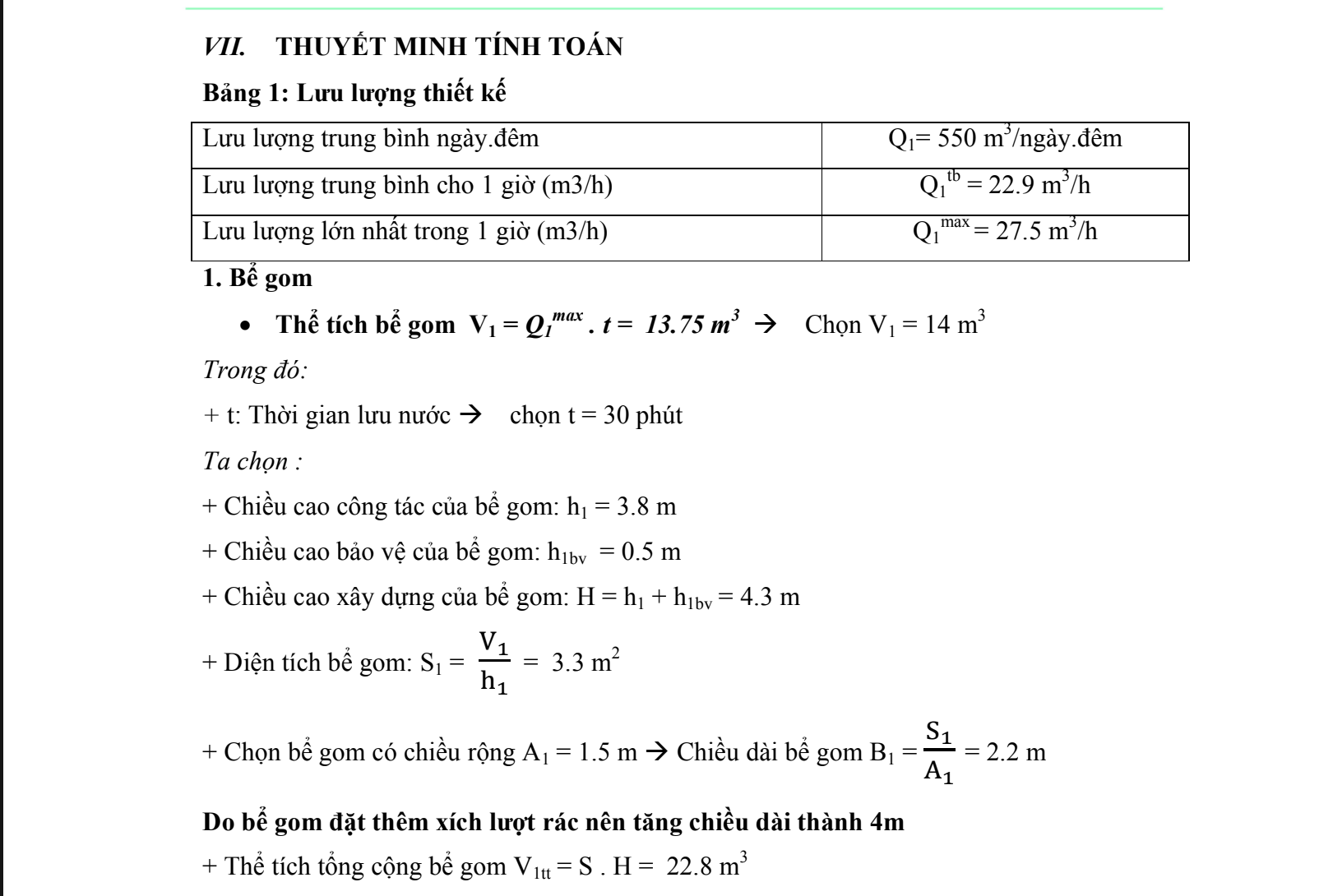
Design dossier and flow calculation table of the wastewater treatment system at the Nguyen Van Linh campus.
Sources of evidence:
- Design specification of the UEH N wastewater treatment system, PDF page 1: project name and location; PDF pages 3–4: objectives and technology options; PDF page 9: Section VII – Calculation notes, Table 1 – Design flow.
- UEH Rises in the UI GreenMetric 2025 Green University Ranking: Top 896 Worldwide and Top 5 in Vietnam (UEH Portal, 18/12/2025), section “Water use and reuse policy”, announcement on AO wastewater treatment technology.
- Wastewater treatment process and technology
The wastewater treatment system at the Nguyen Van Linh campus is designed as a series of consecutive stages, combining mechanical, physicochemical and biological treatment before the output water is disinfected.
According to the technology flow diagram in the design dossier, the main treatment line is arranged as follows:
Collection and grease separation → Equalization → Reaction tank → Coagulation–flocculation → Primary sedimentation → Anoxic → FBBR aerobic biological treatment → Biological sedimentation → Disinfection → Treated water.
In addition to the wastewater treatment line, the system is designed with a sludge holding tank and supporting equipment for transporting and collecting the sludge generated.
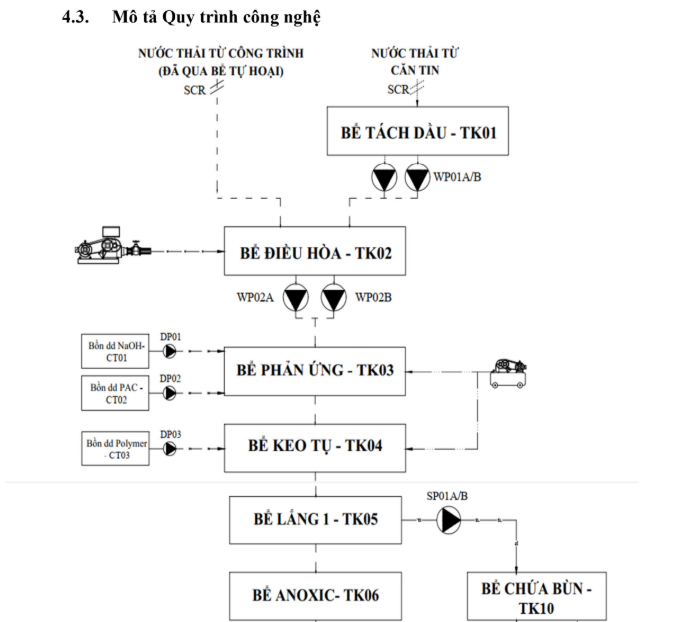
Technology flow diagram of the wastewater treatment system at the Nguyen Van Linh campus, showing stages TK01–TK10.
Sources of evidence: Design specification of the UEH N wastewater treatment system, PDF page 5, Section 4.3 – Description of the technological process.
Collection, grease separation and equalization of wastewater
Wastewater generated from the facility is fed into the collection system, passing through screening, sediment and grease removal stages before being transferred to the equalization tank.
The equalization tank stabilizes the flow and concentration of the wastewater, limiting the impact of fluctuating pollution loads on the downstream treatment stages.
According to the design dossier, the equalization tank is calculated with a hydraulic retention time of about 7 hours, combined with an air supply system and pumping equipment to support the equalization process.
Physicochemical treatment and primary sedimentation
After equalization, the wastewater passes through the reaction, coagulation–flocculation and primary sedimentation units. These stages are designed to help separate suspended solids and sediment components through physicochemical reactions, floc formation and settling.
According to the technical specification, the coagulation process uses supporting chemicals such as PAC and polymer, enabling the separation of sediment before the wastewater continues into the biological treatment tanks.
Anoxic–oxic (AO) biological treatment
AO (Anoxic–Oxic) technology is a key component of the selected wastewater treatment option.
In the Anoxic tank, the microbial community operates under oxygen-deficient conditions to support the conversion of nitrogen-containing compounds and the treatment of nutrients in the wastewater.
Next, the wastewater is passed through the FBBR aerobic biological treatment unit, which uses microbial activity combined with an air supply system to break down organic compounds and help reduce the pollution load.
The design dossier describes mixing equipment, air blowers, air diffusers and supporting systems that maintain operating conditions for the biological treatment tanks.
Biological sedimentation and sludge management
Wastewater after biological treatment is passed to a sedimentation tank to separate sludge and remaining solids.
According to the design option, part of the sludge is recirculated to the biological unit to maintain microbial biomass; the excess sludge is transferred to the sludge holding tank for collection, transport and treatment according to the technical plan.
Providing a separate sludge collection line allows the wastewater treatment process to be separated from the management of waste generated by the system.
Disinfection of wastewater before discharge into the receiving system
In the final stage, the settled wastewater is passed through a disinfection tank to reduce remaining pathogenic microorganisms. According to the design dossier, the system uses chlorine disinfection, with a designed contact time of about 1 hour, before the treated water is pumped to the city drainage manhole.
The process at Campus N is designed as a sequence of stages from collection, physicochemical treatment, anoxic–oxic (AO) biological treatment and sedimentation to disinfection and sludge management, aimed at controlling the various pollutants in domestic wastewater.
Sources of evidence: Design specification of the UEH N wastewater treatment system, PDF page 5 (process diagram), page 8 (drainage after disinfection) and pages 20–21 (disinfection tank design).
- Water quality parameters and technical standard basis
The wastewater treatment system at the Nguyen Van Linh campus is designed based on the characteristics of domestic wastewater and the requirement to control pollution indicators before discharge into the receiving system.
In the design dossier, QCVN 14:2008/BTNMT – the national technical regulation on domestic wastewater, Column B – is used as the basis for determining the target parameters.
The table below summarizes wastewater values before and after treatment according to the design dossier:
| Indicator | Before treatment | After treatment (per design) |
| pH | 6–8 | 6–8 |
| BOD₅ | 250 mg/L | 20 mg/L |
| Total suspended solids (TSS) | 150 mg/L | 40 mg/L |
| Ammonium (N–NH₄⁺) | 20 mg/L | 5 mg/L |
| Nitrate (N–NO₃⁻) | 35 mg/L | 30 mg/L |
| Phosphate | 20 mg/L | 6 mg/L |
| Total coliforms | 8,000 MPN/100 mL | 3,000 MPN/100 mL |
According to the technical calculation plan, the system is designed to achieve a BOD₅ reduction of about 92% and a TSS reduction of about 73.3%. The values before and after treatment are taken from the design dossier and reflect the system’s targets and calculation parameters; they are not actual monitoring results for 2025.
On the legal basis, the design dossier for the wastewater treatment system at the Nguyen Van Linh campus uses QCVN 14:2008/BTNMT – the national technical regulation on domestic wastewater, Column B – as the basis for determining the treatment parameters. From 01/09/2025, Circular 05/2025/TT-BTNMT promulgating QCVN 14:2025/BTNMT officially took effect.
Under Clause 1, Article 3 of Circular 05/2025/TT-BTNMT, facilities already in operation, or projects that met environmental dossier requirements before 01/09/2025, may continue to apply QCVN 14:2008/BTNMT and related provisions until the end of 31/12/2031. For the wastewater treatment system at the Nguyen Van Linh campus, determining the applicable standard during the transitional period must be based on the time of operation and the facility’s environmental legal documentation.
Sources of evidence:
- Design specification of the UEH N wastewater treatment system, PDF page 2: Table 1 – Parameters before and after treatment; PDF page 6: Section V – Level of wastewater treatment.
- QCVN 14:2008/BTNMT: Section 1.1 – Scope of regulation; Section 2.2 – C values of pollutant parameters; Section 2.3 – K coefficient.
- Circular 05/2025/TT-BTNMT – Promulgating QCVN 14:2025/BTNMT, Article 2 – Effect; Article 3 – Transitional provisions; Article 4 – Implementation roadmap.
- Review of operating procedures and wastewater quality testing in 2025
In addition to maintaining its water management orientation, in 2025 UEH recorded a review of the wastewater treatment system at the Nguyen Van Linh campus within the framework of the UEH Green Campus Project.
According to the 2025 activity summary published on the UEH Green Campus website on 04/02/2026, the Project reviewed the wastewater treatment system at the Nguyen Van Linh campus, including operating procedures and water quality test results conducted by a third party.
This activity was carried out within UEH’s orientation of standardizing its sustainable governance system, with a focus on improving the capacity to manage and monitor water on campus.
The summary also notes that UEH recorded more than 80% of water-saving devices in use; on that basis, the priorities for the next period were identified as limiting water use, promoting reuse and strengthening wastewater quality control. The indicator on water-saving devices reflects water resource management in general, not the performance of the wastewater treatment plant.
Reviewing the operating procedures and examining the third-party test results are directly relevant to the management of the wastewater treatment system in 2025. In parallel, in the announcement of its UI GreenMetric 2025 results, UEH again referred to the application of AO technology in wastewater treatment, showing that wastewater management was publicly disclosed in the school’s reporting and green campus assessment activities in 2025.
Sources of evidence:
- New Steps of the UEH Green Campus Project in 2025: The Journey of Operating and Spreading the UEH Green University Model to the Community (UEH Green Campus, 04/02/2026), section “Governance – Standardizing the sustainable governance system at UEH”, paragraph on the wastewater treatment system at the Nguyen Van Linh campus.
- UEH Rises in the UI GreenMetric 2025 Green University Ranking: Top 896 Worldwide and Top 5 in Vietnam (UEH Portal, 18/12/2025), content on water management and wastewater treatment technology.
- Monitoring results of treated wastewater at the Nguyen Van Linh campus in 2025
The 2025 environmental protection report of the Nguyen Van Linh campus records two samplings of wastewater after the treatment system, on 10/12/2025 and 17/12/2025. Sampling and analysis were carried out by Sao Viet Environment and Occupational Safety Co., Ltd. (Vimcerts 286). The two test result certificates clearly state the sampling location, sampling date, each analyzed parameter, the measured result and the comparison limit under QCVN 14:2008/BTNMT, Column B, K=1.
Results of the 10/12/2025 sample (Certificate No. 02159/2025/KQTN, issued 19/12/2025): pH 7.02; TSS 6 mg/L; BOD₅ 16 mg/L; nitrate 12.0 mg/L; phosphate 1.27 mg/L; total coliforms 1,100 MPN/100 mL. These parameters are within the limits stated on the test certificate (pH 5–9; TSS 100 mg/L; BOD₅ 50 mg/L; nitrate 50 mg/L; phosphate 10 mg/L; total coliforms 5,000 MPN/100 mL).
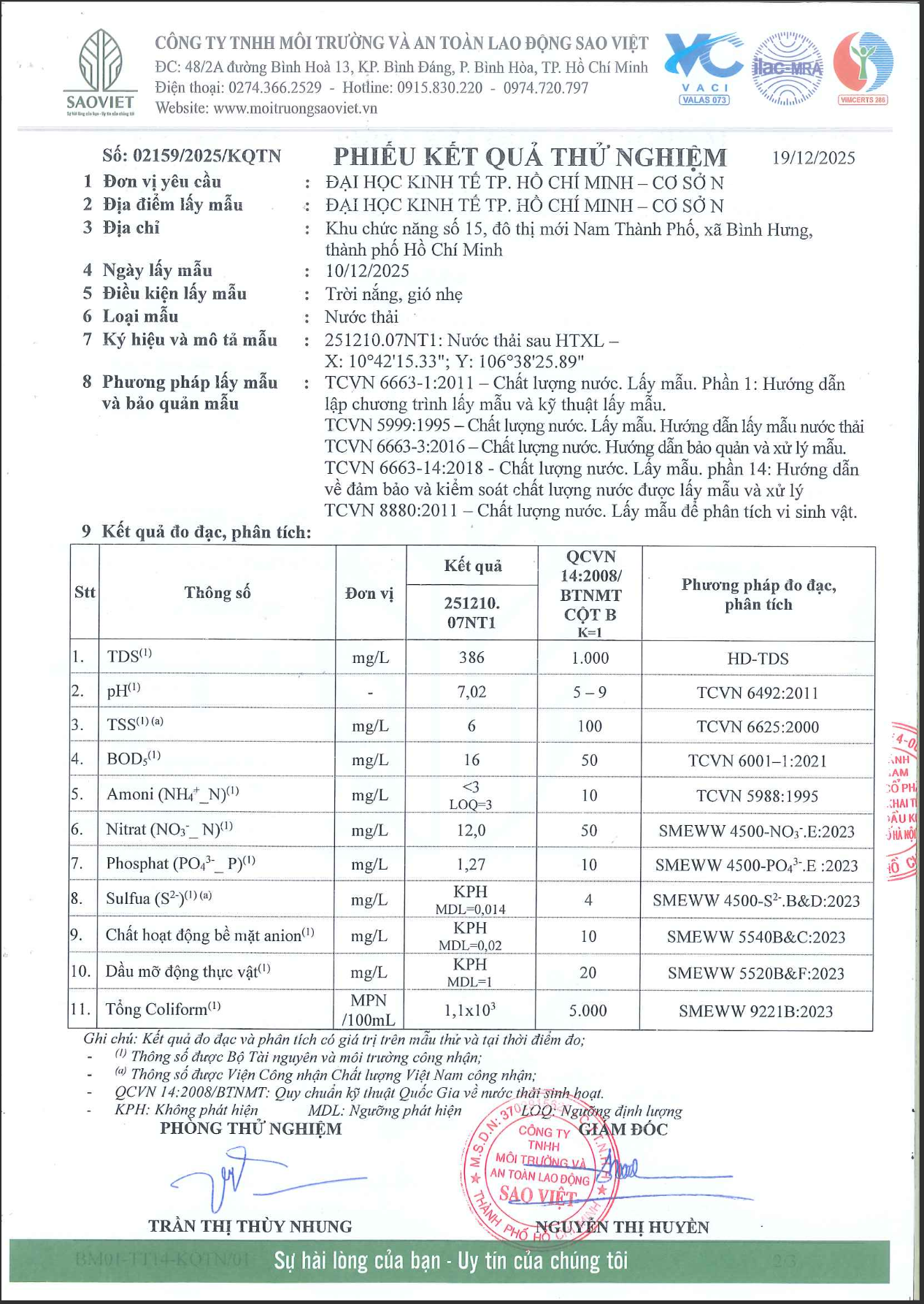
Analysis results of the treated wastewater sample of 10/12/2025 at the Nguyen Van Linh campus
Source: 2025 Environmental Protection Report – UEH Nguyen Van Linh campus,
Results of the 17/12/2025 sample (Certificate No. 02259/2025/KQTN, issued 26/12/2025): pH 7.52; TSS 7 mg/L; BOD₅ 54 mg/L; nitrate 12.4 mg/L; phosphate 1.18 mg/L; total coliforms 4,300 MPN/100 mL. Among these parameters, BOD₅ is higher than the 50 mg/L limit stated on the certificate; the other parameters just listed are within the comparison limits. Therefore, it cannot be concluded that both samples met all indicators.
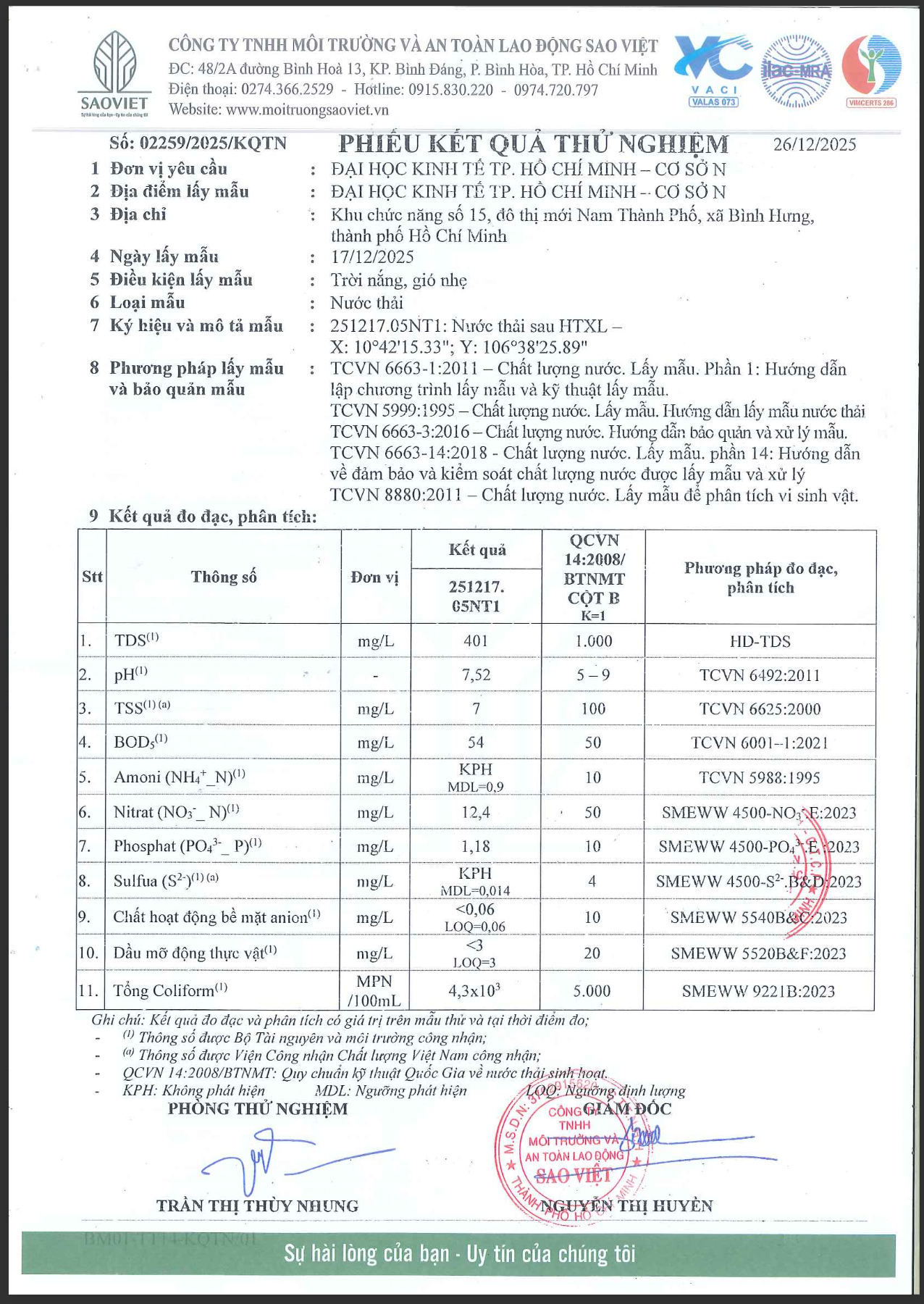
Analysis results of the treated wastewater sample of 17/12/2025 at the Nguyen Van Linh campus
Source: 2025 Environmental Protection Report – UEH Nguyen Van Linh campus,
Comparing the two test certificates with the comments on PDF page 12 of the report reveals an inconsistency: the general comments state that the indicators do not exceed QCVN 14:2008/BTNMT Column B, whereas the 17/12/2025 certificate records BOD₅ exceeding the limit. This result needs to be clarified by the unit managing the system, together with a review of inspection and operating records or additional sampling. The two certificates demonstrate that monitoring of treated wastewater took place in 2025, but they are not sufficient grounds to assert that all output wastewater always meets the standard.
Conclusion
In the period before 2025, UEH built the technical foundation for wastewater treatment at the Nguyen Van Linh campus, with a design dossier for a system of 550 m³/day capacity applying anoxic–oxic (AO) biological technology combined with physicochemical treatment, sedimentation, disinfection and sludge management. The technical dossier specifically describes the stages, equipment and quality targets for treated water, forming the basis for identifying and managing the facility’s wastewater treatment process.
In 2025, UEH continued to publish information on its AO wastewater treatment technology and recorded a review of the wastewater treatment system at the Nguyen Van Linh campus, covering two identified elements: operating procedures and water quality test results conducted by a third party. At the same time, the UEH Green Campus Project continued to update the Green University Regulations, emphasizing the standardization of water management to strengthen resource governance and environmental impact control.
Compared with last year’s evidence, which mainly introduced the technology, design capacity and expected treatment parameters, the 2025 dossier adds public information on a system review activity during the assessment year. The combination of the technical dossier, the technology disclosure and the operational review demonstrates UEH’s effort to bring the wastewater treatment process into green campus governance, aiming at pollution control and contributing to SDG 6 – Clean Water and Sanitation.