

6.2.1. Water Consumption Tracking at UEH
Water consumption tracking – Measure the total volume of water used in the university that is taken from mains supply, desalinated, or extracted from rivers, lakes, or aquifers
THE Sustainability Impact Ratings 2027 | SDG 6 – Clean Water and Sanitation | Data Year 2025
The University of Economics Ho Chi Minh City (UEH) measures and monitors water consumption at its teaching facilities, workplaces and student dormitories through water meters, periodic meter readings and site-specific consumption summary reports. These activities enable UEH to manage water demand, monitor changes between reporting periods and establish a data foundation for sustainable resource management.
In 2025, UEH recorded total water consumption of 136,646 m³, based on consolidated figures reconciled against water supply records from Saigon Water Corporation (SAWACO), representing a decrease of 17,002 m³, equivalent to 11.07% compared with the revised 2024 figure of 153,648 m³. The data were consolidated from water supply management records, metering systems and technical reports, strengthening transparency, verifiability and the effectiveness of water resource monitoring at UEH.
1. Water Consumption Measurement and Management System
UEH measures water consumption through water meters installed at teaching facilities, student dormitories and functional areas. Data are monitored monthly and consolidated by location, including meter information, opening and closing readings, and consumption volumes.
Water consumption is determined from metering data and water supply records for the reporting period. Where meters have been replaced or readings have fluctuated, the figures must be cross-checked against handover readings and data from before and after meter replacement to ensure accuracy.
According to the 2025 Environmental Protection Report, water used at the Nguyen Van Linh Campus is supplied by the municipal water network (mains supply). Other sites are monitored through water supply management records and meter data. The available documentation does not separately confirm volumes abstracted directly from rivers, lakes or aquifers, or produced through desalination.
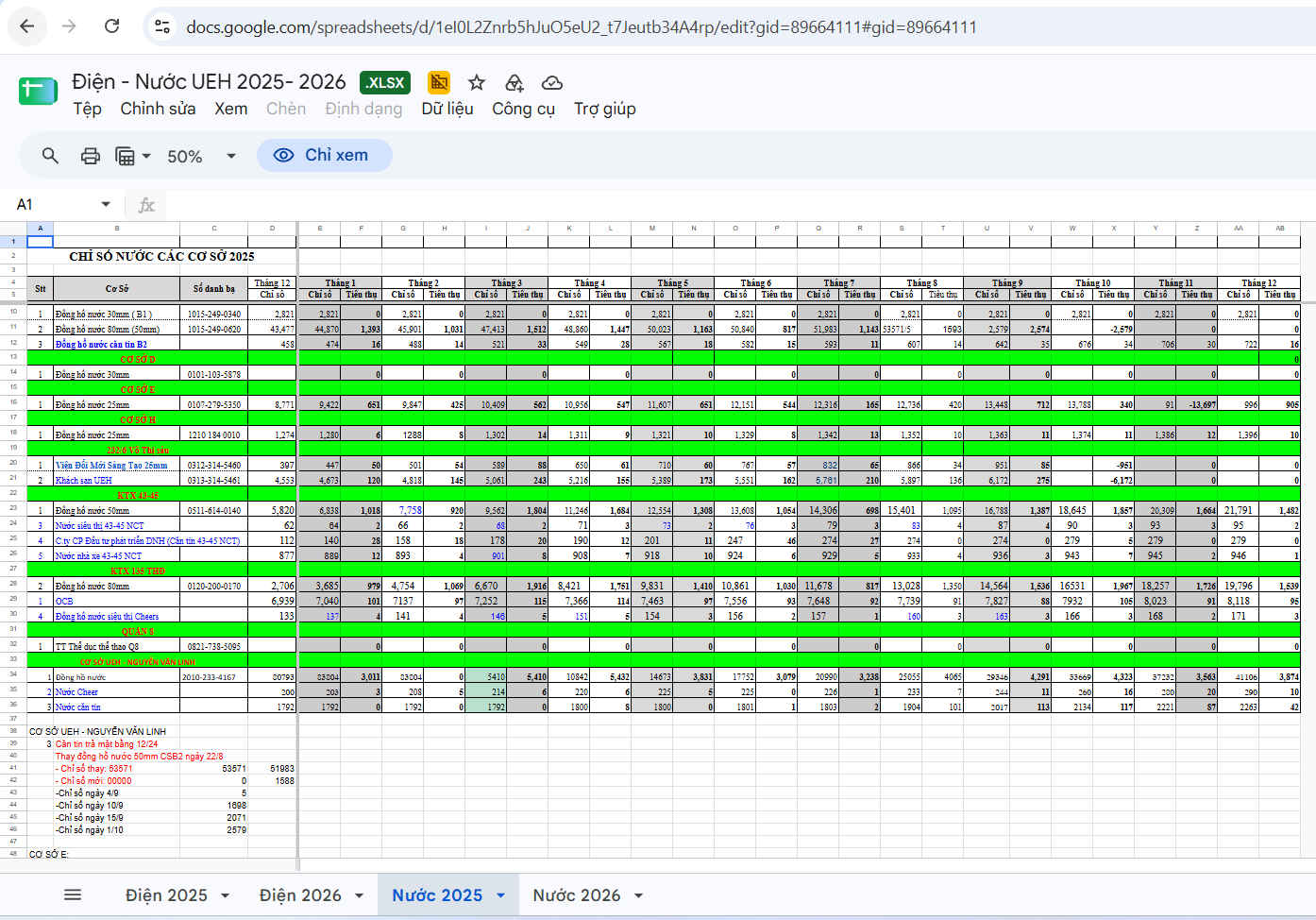
Monthly meter readings and water consumption data at UEH facilities.
Source: UEH Facilities Management Unit – UEH Electricity and Water 2025–2026, “Water 2025” worksheet.
https://docs.google.com/spreadsheets/d/1eI0L2Znrb5hJuO5eU2_t7Jeutb34A4rp/edit?gid=89664111
2. Water Consumption Measurement Results for 2025
According to consolidated figures reviewed by UEH against SAWACO water supply records, total water consumption across UEH facilities in 2025 was 136,646 m³.
The review also established that total water consumption in 2024 was 153,648 m³, replacing the figure of 213,907 m³ previously recorded in the summary table. The revised figure is used as the basis for comparison between the two reporting periods.
Table 1. Total Water Consumption at UEH, 2024–2025
| Year | Total Water Consumption (m³) | Change from Previous Year |
| 2024 | 153,648 | — |
| 2025 | 136,646 | −11.07% |
Source: Consolidated UEH water consumption data for 2024–2025, reviewed against water supply records from Saigon Water Corporation (SAWACO).
In 2025, UEH continued to monitor water consumption at locations used for teaching, research, administration and residential activities, including Campuses A, B, E, V, N and H, and student dormitories.
Site-specific data are managed through metering systems and water supply records, helping UEH monitor demand, assess consumption changes and identify areas where water resource management should be strengthened.
| Campus / Location | Water Consumption in 2025 (m³) |
| Campus A – Meter A1 | 24,567 |
| Campus A – Meter A2 | 753 |
| Campus E – 54 Nguyen Van Thu | 6,460 |
| Campus V – 232 Bis Vo Thi Sau | 2,144 |
| Student Dormitory – 135 Tran Hung Dao | 17,108 |
| Student Dormitory – 43–45 Nguyen Chi Thanh | 15,932 |
| Facility at 144 Street 44, Truong Dinh Hoi | 1,232 |
| Campus N – Nguyen Van Linh | 44,678 |
| Campus B – 279 Nguyen Tri Phuong | 15,516 |
| Campus H – 1A Hoang Dieu | 122 |
Table of water consumption at UEH facilities in 2025, used to cross-check meter data and compile site-specific totals.
Source: UEH 2025 water data summary provided by the responsible management unit.
https://docs.google.com/spreadsheets/d/1Q7lsw7Z1z1RDewS__zvMoEZlow2gtlq-/edit?gid=1572445542
3. Water Consumption Monitoring Results over Time
3.1. Changes in UEH-Wide Water Consumption, 2024–2025
According to the reviewed consolidated data, UEH recorded total water consumption of 153,648 m³ in 2024. In 2025, the recorded volume was 136,646 m³. Compared with 2024, water consumption in 2025 changed as follows:
- Absolute difference: 153,648 − 136,646 = 17,002 m³.
- Percentage decrease: (17,002 / 153,648) × 100 = 11.07%.
The results show that recorded total water consumption in 2025 was lower than in 2024 after reconciling the figures against water supply records.
Maintaining measurement data across years gives UEH a basis for monitoring changes in water demand, identifying consumption trends and supporting resource management at its facilities.
In addition, reviewing and correcting data across reporting periods improves the consistency and reliability of the reporting system and supports further refinement of UEH’s data aggregation methodology for sustainable management.
3.2. Comparison of Results at the Nguyen Van Linh Campus
In addition to UEH-wide consolidated data, the 2025 Environmental Protection Report for the Nguyen Van Linh Campus provides separate measurement data that can be used to cross-check water consumption at this location.
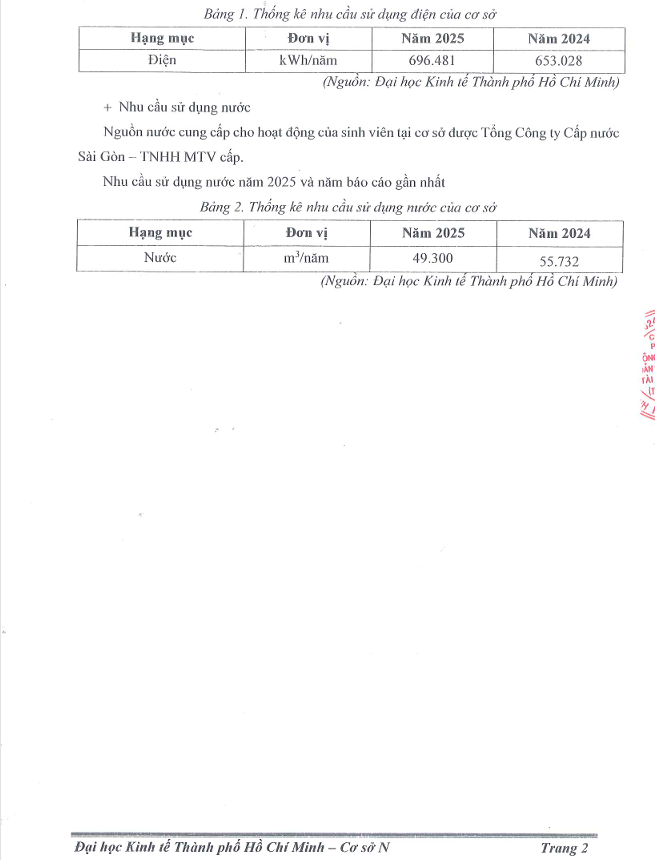
Water consumption table for the Nguyen Van Linh Campus, recording 55,732 m³ in 2024 and 49,300 m³ in 2025.
According to the technical report, the Nguyen Van Linh Campus recorded water consumption of 55,732 m³ in 2024 and 49,300 m³ in 2025.
Table 2. Comparison of Water Consumption at the Nguyen Van Linh Campus Based on the Environmental Report
| 2024 | 2025 | Difference | Percentage Change |
| 55,732 m³ | 49,300 m³ | −6,432 m³ | −11.54% |
Source: 2025 Environmental Protection Report for the Nguyen Van Linh Campus, Table 2 – Water Demand Statistics.
https://drive.google.com/file/d/110g21J2YT1VPq3rdyprcOW3l0zMSeodn/view?usp=drive_link
According to the campus environmental report, recorded water consumption in 2025 decreased by 6,432 m³ compared with 2024, equivalent to 11.54%.
These data provide additional evidence of water consumption monitoring and management at a specific campus. Campus-level figures are used to cross-check the corresponding management records and do not replace the consolidated UEH-wide total for the reporting period
4. Implementation Results for 2025 and Comparison with the Previous Period
In 2025, UEH continued measuring water consumption at teaching facilities, workplaces and student dormitories through water meters, periodic management data and technical reports.
According to figures reviewed against SAWACO water supply records, total water consumption in 2025 reached 136,646 m³, which was 17,002 m³, or 11.07%, lower than the 2024 level of 153,648 m³.
Compared with the figures reported in the previous period, the 2024 value was revised from 213,907 m³ to 153,648 m³ to align it with the reviewed water supply records. The adjustment was made to improve data accuracy and comparability and does not reflect a change in the methodology used to determine water consumption.
The 2025 records continued to use site-level meter data, university-wide consolidated figures and technical reports for the Nguyen Van Linh Campus as evidence of water consumption measurement and monitoring.
These data strengthen verifiability and change monitoring while supporting UEH in improving water resource management in its ongoing operations.
5. Conclusion
Through water meters, periodically recorded data and consolidated reports, UEH continued Water consumption tracking in 2025 at its teaching facilities, workplaces and student dormitories. According to consolidated figures reviewed against SAWACO water supply records, total water consumption at UEH in 2025 was 136,646 m³, a decrease of 11.07% compared with 153,648 m³ in 2024.
Maintaining the measurement system, reviewing data and cross-checking water supply records enhances the accuracy, transparency and verifiability of water consumption figures. It also enables UEH to monitor demand and further develop sustainable resource management solutions in support of SDG 6 – Clean Water and Sanitation.