

The University of Economics Ho Chi Minh City (UEH) is steadfast in implementing its “Multidisciplinary – Sustainable” strategy, in which international cooperation is a crucial foundation for contributing to the Sustainable Development Goals (SDGs). In 2024, UEH published more than 500 international articles in reputable journals indexed by the Web of Science, Scopus and ABDC; nearly 50 % of UEH’s international publications are related to the SDGs. The university has 42 scientific research projects aligned with the SDGs as defined by UEH, and 127 research projects and student‑led initiatives focusing on new ideas, technology applications, and solutions for sustainable development, circular economy, green living, zero waste, emission reduction, and sustainable local economic development.
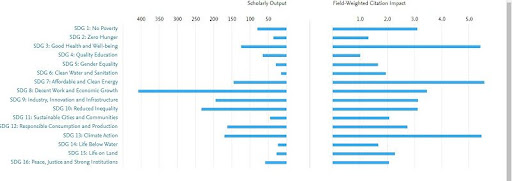
The number and impact of UEH’s international publications linked to the 16 United Nations Sustainable Development Goals from 2021 – 2024 (based on data extracted from the Scopus database in December 2024).
This year, UEH achieved many positive results in mobilising international resources and expanding the university’s network of relationships by actively participating in international projects. The university is currently involved in a total of 12 international projects, with six new projects approved in 2024, of which four have already started and two are scheduled to begin in 2025. These projects have had and continue to have positive effects on the university’s reputation, the expansion of its partnership network, and, most importantly, tangible benefits for communities and society as the initiatives are carried out under sustainable, environmentally‑protective, digital‑transformation and food‑security‑ensuring orientations.
As a nationally designated multidisciplinary university, UEH has organized 19 international conferences and actively participated in international meetings, workshops, and comparative research to develop and disseminate best‑practice approaches for implementing the SDGs. Over the past year, UEH has:
+ Co‑organised numerous annual international conferences (ICBF, ICOB, ELG, J‑ACBES, SRS, RTD, etc.) that bring together global scholars and experts to compare and discuss sustainable‑development approaches covering green finance, circular economy, climate change, digital transformation, food security, sustainable agriculture, and smart cities.
+ Collaborated with the World Bank, the University of Regensburg (Germany), international research institutes, and many ASEAN and European universities to carry out policy research and develop comparative solution frameworks and recommendations.
+ Built an international‑connectivity ecosystem through activity series such as ArtTech Fusion 2024, Vung Tau Future, and the World Urban Forum in Cairo, contributing to the global diffusion of knowledge and SDG practices within communities.
These activities demonstrate that UEH not only participates but also co‑creates international standards for the SDGs, contributing to the development of best‑practice solutions for Southeast Asia and the world.
| Activities | International partners | Form of cooperation | Implementation/Comparative review | Outcome – Best practice | SDG contribution |
| 12th World Urban Forum (WUF12) in Cairo, Egypt | International leaders, experts and stakeholders such as Turkey, Egypt, South Korea, Belgium, Mexico and Nepal, UN‑Habitat. | Participating in a series of activities, research exchanges, and thematic discussions (2 main discussion sessions). | Discussing local actions toward sustainable urban development and metropolitan planning in the digital‑technology era. UEH shared the community economic‑tourism‑art development strategy of Tam Thanh commune, Quảng Nam as a practical example. | Proposing initiatives and shared experiences applying real‑world technology to strengthen and promote smart‑city development in Vietnam. | SDG 11 (Sustainable Cities and Communities), SDG 17 (Partnerships for the Goals). |
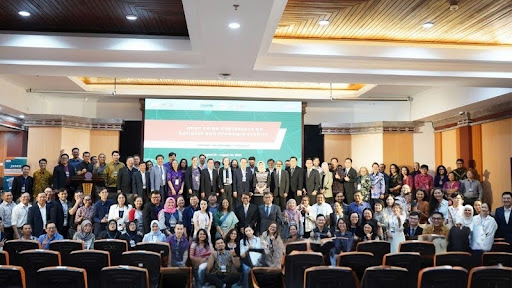
| RTD 2024 Conference – Resilience by Technology & Design | 12 prestigious training institutions and research institutes worldwide (Italy, Australia, South Korea, Macau, Taiwan, Singapore, Japan, etc.). More than 200 scientists and experts from 18 countries. | Co‑organizing a multidisciplinary international conference consisting of a series of paper presentations, discussion sessions, exhibitions and field surveys in the Mekong Delta.
Signing an MOU with Singapore University. |
The conference focused on the themes “Fostering Sustainability” and “Towards a More Sustainable Mekong Delta”.
Research groups from Europe, Japan, ASEAN and Vietnam presented and compared technological‑design solutions to increase climate‑change resilience, aiming at sustainable actions (e.g., comparative study of nature‑based solutions: “Nature‑Based Solutions for a Sustainable Coastal City”, “Smart City Strategy of Korea”, …). Included a field‑survey program in the Mekong Delta. 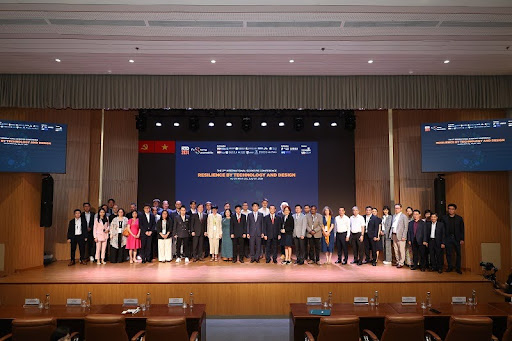
Delegates and experts from 18 countries attended the RTD 2024 conference. |
Disseminating knowledge and technology‑design solutions toward global sustainability.
Proposing a trans‑national solution framework for urgent issues, promoting sustainable development in the Mekong Delta region and Southeast Asia such as digital transformation, sustainable energy, and nature‑based development. |
SDG 11 (Sustainable Cities and Communities), SDG 13 (Climate Action), SDG 17 (Partnerships for the Goals). |
| Special Discussion Session “Sustainability” (RTD 2024 Conference) | Experts from the World Bank Group, Saint Joseph University (Macau), and KAIST (South Korea). The discussion references the role of universities in the United States, the United Kingdom, Indonesia, Macau, South Korea and Vietnam. | International conference, expert dialogue, knowledge sharing. | The discussion clarifies the role of universities and stakeholders (businesses, the UN) in addressing the climate crisis and food‑security challenges to achieve the SDGs. Universities share interdisciplinary research and education models. | It affirms that cooperation (SDG 17) is the key to achieving comprehensive impact and emphasizes the university’s role in promoting lifelong learning and research that tackles social and environmental issues. | SDG 17 (Partnerships for the Goals), SDG 4 (Quality Education). |
| Annual International Conference ELG 2024: Twin Transition – Digitalization & Climate Change | UEH organizes the event with keynote speakers from Germany, Australia and Sweden.
More than 120 papers from many countries. |
The international conference lasts two days, comprising three plenary sessions and 26 parallel discussion sessions. | Theme: “Dual‑Transformation Approaches: Digitalisation and Climate Change in Developing Countries.” Experts discuss and compare international strategies that combine digital technology and climate change (dual transformation).
The discussion examines the integration of digital transformation and green transformation to generate substantial benefits for sustainable development. Presentations address global challenges, for example the impact of climate change on welfare in rural Southeast Asia and the development of a legal framework for AI. Research proposes adaptive solutions involving digitalisation and the climate crisis. 
The opening session of the ELG 2024 conference takes place on the morning of 30 July 2024. |
Contributing knowledge, provides a practical framework for the Southeast Asian region and offers policy suggestions for the dual‑transformation process.
Creating opportunities for networking and building academic relationships. Providing practical initiatives and feasible solutions that promote sustainable development in developing countries. Enhancing understanding of the role of digitalisation and climate change in contemporary economic development. |
SDG 13 (Climate Action), SDG 9 (Industry, Innovation and Infrastructure), SDG 17 (Partnerships for the Goals). |
| International Conference on Business Theories and Practices (iCOB 2024) | Attracting more than 180 research papers from researchers and scholars from countries such as Australia, Japan, Taiwan, Indonesia, Malaysia, Switzerland, and Poland. Speakers from Australia (University of New South Wales), the UK (University of Birmingham), and the United States (Harvard University). | Annual international conference, comprising 3 plenary sessions, 38 parallel discussion sessions, and 3 Industry Talk sessions. | Presentation and comparison of theory and practice in business management across many countries.
The discussion sessions focus on CSR, environmental issues, ESG integration and sustainable development, green and sustainable consumption. Speaker Prof. Dr. Samuel Adomako emphasized transforming academic research into practical solutions (addressing the challenges and opportunities in bridging the gap between research and practice). 
Overview of the three Industry Talk sessions |
Contributing to global best‑practice governance: proposing a new model that links ethical commitments with business strategy.
Promoting collaboration between researchers and businesses to enhance the applicability of research. |
SDG contribution: SDG 12 (Responsible Consumption and Production), SDG 13 (Climate Action), SDG 17 (Partnerships for the Goals). |
| International Conference on Business and Finance 2024: Academic Forum for Exchanging Contemporary Issues in Economics and Finance | Co‑organized with the University of Lincoln (The UK) and Nanyang Technological University (NTU) (Singapore). Gathering more than 150 scientists, researchers and scholars. Papers come from many countries. | The high‑level annual international scientific conference features an academic forum, co‑organised collaboration and sharing of research results. | Conference theme: “Navigating Change, Innovation, Sustainability and Globalisation”. 200 research papers from global scholars, of which more than 80 high‑quality papers were selected for presentation. Topics focus on green economics, development of sustainable financial markets, climate‑change impacts on economic and financial development. The conference includes discussion sessions with chief editors/associate editors of renowned journals such as International Review of Financial Analysis, Resources Policy, Sustainable Cities and Society, etc. | Promoting interdisciplinary dialogue, cooperation and innovation, creating bridges for scholars domestically and abroad.
Improving the quality of research works and disseminating progress in scientific research. Contributing to policy‑making: providing practical benefits of initiatives focused on the SDGs, ensuring meaningful contributions to global development, especially in climate change, hunger and inequality. Promoting economic growth, sustainable development and improving quality of life through education and technology. |
Direct contribution to SDG 17 – Partnerships for the Goals; SDG 4 – Quality Education; SDG 13 – Climate Action; SDG 12 – Responsible Consumption and Production; SDG 10 – Reduced Inequalities; SDG 1. |
| Joint Asian Conference on Business and Economic Studies 2024 (J-ACBES 2024) | Co‑organized with two universities in Indonesia. More than 350 scientists from over 36 countries attended, with speakers from the United States, Germany, the UK and Australia. | The annual international partnership conference was held outside Vietnam for the first time. An Implementation Agreement (IA) was signed among the three universities to promote joint research. | The conference brings together three reputable symposiums. It includes comparative presentations on publishing ethics (“Publishing With Integrity”) and gender asymmetry in society. Day 3 focuses on disseminating reports and community‑service projects carried out in Bali, Indonesia.
|
Elevating UEH’s scientific reputation and expanding its international collaborations. Shares best practices from community activities such as mangrove‑area clean‑ups and the development of OCOP (One Village One Product) products. |
SDG contribution: SDG 17 (Strengthen International Cooperation), SDG 5 (Gender Equality), SDG 10, SDG 11, SDG 14, SDG 15 (Environmental and Community Protection). |
| Southern Region Circular Economy Training Workshop | Collaboration with the Institute for Strategy and Policy on Resources and Environment (Ministry of Natural Resources and Environment). International experts from the EU and Japan. | Co‑organized a knowledge‑and‑law training workshop. | International experts presented the legal framework and circular‑economy practices in Europe and Japan. UEH and local partners discussed these in the Vietnamese context, covering the global background, the role of local authorities in circular‑economy development, and the methods and indicators for provincial‑level circular‑economy assessment and monitoring.
The workshop aims to reach a common understanding of standardized measurement and evaluation of circular‑economy value. 
Overview of the workshop |
Helping regulatory agencies identify best practices and priority areas for action to meet circular‑economy goals. Contributing to decision‑making and policy formulation for a more sustainable future (aligned with the Southern Region). |
SDG contribution: SDG 12 (Responsible Consumption and Production), SDG 17 (Partnerships for the Goals), SDG 16 (Peace, Justice and Strong Institutions). |
| Workshop “Economic Growth and Technology in Southeast Asia” (UEH & University of Regensburg) | University of Regensburg (Germany). Professors and graduate students from Germany and Vietnam. | Co‑organized a research workshop. | Exchanging knowledge and comparative research results on economic growth and technology in Southeast Asia. Comparative research topics on Vietnam and ASEAN (e.g., ASEAN migration). | Proposing optimal, practical solutions based on the economic context and characteristics of Southeast‑Asian countries. Reinforced Vietnam‑Germany cooperation spirit toward sustainable growth goals. | SDG 8, SDG 9, SDG 17 |
| Workshops on “Green Growth & Climate Modelling” jointly organized by UEH and the World Bank, May 2024 | Collaboration with the World Bank. | Co‑organized a scientific conference and policy dialogue (both in‑person and online). | Sharing a report on green growth in Vietnam, compared with global climate‑research and modelling studies such as the MANAGE, MINDSET, CPAT and Triple‑Dividend Methodologies.
Comparing estimated environmental‑damage costs (about 10 % of GDP) and climate‑risk losses (13 % of GDP by 2050) for Vietnam. Discussing initiatives to promote green, sustainable and climate‑resilient economic growth in Vietnam. |
Promoting rich idea exchange and a shared commitment to sustainable economic development in Vietnam.
Providing climate‑policy and green‑finance model recommendations based on international experience. Paving the way for stakeholders to act together toward a greener future. |
SDG 8 (Economic Growth), SDG 13 (Climate Action), SDG 17 (Partnerships for the Goals). |
| SRS 2024 Workshop (EU strategies for Sustainable Growth) | Expert from the Keele Business School, Keele University, the UK. | Organising a scientific forum (Sustainable Research Seminar – SRS) to exchange advanced research and practical lessons. | Vietnamese researchers collaborated and listened to Assoc. Prof. Dr. Chen shares the key strategies that the European Union (EU) has implemented to promote sustainable growth. By presenting case studies from EU member states, effective response strategies were proposed for developing countries such as Vietnam.
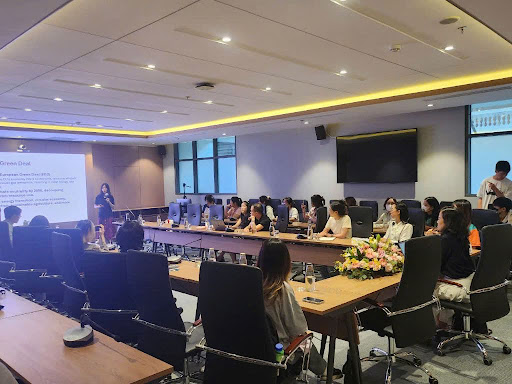
Assoc. Prof. Dr. Xihui Haviour Chen spoke at the programme |
Proposing effective response strategies for Vietnam, including the development of a clear policy framework and the promotion of green‑technology R&D. It raised new research questions and practical policy suggestions. | SDG 13 (Climate Governance), SDG 9 (Green Innovation and Infrastructure Development), SDG 17 (International Cooperation) |
| Conference on researching the development of digital economy in Ho Chi Minh city: Efforts towards a smart and sustainable urban future | Collaboration with the Ho Chi Minh City Department of Information and Communications and international experts from the Seoul Institute, South Korea. | Co‑implementing a research project on solutions
Inviting international experts to share their experiences. |
Sharing lessons learned in implementing and evaluating the digital economy in Vietnam and other countries, especially South Korea. Dr. Jaeuk Ju presented the implementation and evaluation process of the digital economy: lessons from Seoul, South Korea, and compared international measurement criteria (DESI, ADB, OECD).

Dr. Jaeuk Ju presented his experience at the conference. |
Proposing solutions on data‑collection methods, analysis, and evaluation of the digital economy that suit the current conditions in Ho Chi Minh City.
Affirming UEH’s “global thinking, local action” journey. |
SDG contribution: SDG 9 (Industry, Innovation, Infrastructure) and SDG 11 (Smart and Sustainable Cities). |
| Vung Tau Future Events Series 2024 – 3rd International Design Competition: Reimagining Cities towards Carbon Neutrality | Domestic and international experts.
More than 400 students from across continents participated in the competition. Judges/experts came from South Korea, Thailand, China and Belgium.
|
Organising a conference, exhibition and international design competition. | International‑local cooperation: experts shared research results across a wide range of fields, from architecture, design, urban planning, landscape, night‑economy economics, to visual‑media communication about the city at the conference. This allowed a comparison of sustainable urban‑tourism development solutions between Vietnam and the international community.
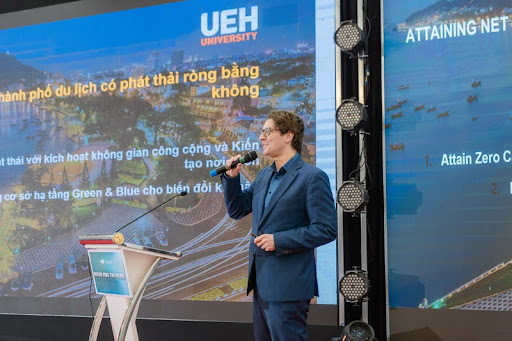
Prof. Sébastien Goethals spoke on the theme “Vung Tau – Towards a Zero‑Emission Tourist City.” The international competition was themed “Reimagining Cities Towards Carbon Neutrality.” Participants applied unique planning strategies and creative designs to experiment with new urban‑planning directions, promoting carbon‑neutral outcomes in the Bac Phuoc Thang area. |
Collecting innovative, breakthrough proposals for carbon‑neutral urban planning. Helping Vung Tau set a direction toward becoming a high‑quality, zero‑emission tourist city. |
SDG contribution: SDG 11 (Sustainable Cities and Communities) and SDG 13 (Climate Action). |
| The “Students Research International Conference for Young Researchers in Economics and Business 2024” (SR-ICYREB 2024) | Economic and business schools, both domestic and international | An academic forum for exchanging ideas and research findings. | Research focuses on sustainable development, the digital economy, and meeting Net‑Zero targets, strengthening both national and international cooperation. | UEH received a “Best Paper Award” for a study on ESG performance and emission levels, contributing to a solid academic foundation and encouraging student scientific research. | SDG 17, SDG 13, SDG 9 |
| The International Event Series ArtTech Fusion 2024 (ATF24): ArtTech – A New Fusion for the Future Generation for S ustainability | International partner universities from Asia, Europe and the United States, scholars and artists worldwide.
|
Co‑organized a series of more than 30 international academic, exhibition and artistic activities. Published an academic book with IGI Global (USA) |
The title is “New ArtTech For Future Generations,” focusing on sustainability. The volume includes a discussion session on collaboration to build an ArtTech community aimed at solving sustainability challenges. Discussions covered blockchain, post‑digital design, and AI applications. The exhibition brought together artworks created by students from institutions across the globe (Thailand, Macau, China, Taiwan and South Korea) for cultural exchange and learning. |
Promoting the intersection of technology and art to develop education and a sustainable society. Creating a foundation for new initiatives and solutions that address global challenges. |
SDG contribution: SDG 11 (Sustainable Cities and Communities) and SDG 17 (Partnerships for the Goals). |
| 12th World Urban Forum (WUF12) in Cairo, Egypt | International leaders, experts and stakeholders such as Turkey, Egypt, South Korea, Belgium, Mexico, Nepal and UN‑Habitat. | Participating in a series of activities, research exchanges and thematic discussions (two main discussion sessions). | Discussing local actions aimed at sustainable urban development and metropolitan planning in the digital‑technology era. UEH shared the community economic‑tourism‑art development strategy of Tam Thanh commune, Quảng Nam as a practical example. | Proposing initiatives and shared experiences applying real‑world technology to strengthen and promote smart‑city development in Vietnam. | SDG 11 (Sustainable Cities and Communities), SDG 17 (Partnerships for the Goals). |
| The International Event Series ArtTech Fusion 2024 (ATF24): ArtTech – A New Fusion for the Future Generation for S ustainability | International partner universities from Asia, Europe and the United States, scholars and artists worldwide. | Co‑organizing a series of more than 30 international academic, exhibition and artistic activities.
Publishing an academic book with IGI Global (USA) |
The title is “New ArtTech For Future Generations,” focusing on sustainability. The volume includes a discussion session on collaboration to build an ArtTech community aimed at solving sustainability challenges.
Discussions covered blockchain, post‑digital design, and AI applications. The exhibition brought together artworks created by students from institutions across the globe (Thailand, Macau, China, Taiwan and South Korea) for cultural exchange and learning. |
Promoting the intersection of technology and art to develop education and a sustainable society.
Creating a foundation for new initiatives and solutions that address global challenges. |
SDG contribution: SDG 11 (Sustainable Cities and Communities), SDG 17 (Partnerships for the Goals). |
| THE INTERNATIONAL SUMMER CAMP “URBAN BEYOND THE URBAN 2024” | Handong Global University (South Korea), Ngurah Rai University (Indonesia), KU Leuven (Belgium), and the University of Trieste (Italy). | International summer camp and co‑creation of solutions. | Theme: “Smart Approaches: A Co‑Creation Platform and Nature‑Based Solutions for Cam Lam, Khanh Hoa.” The program involved experts from Italy, Belgium, South Korea, Indonesia and Vietnam. Participants conducted field observations, interviewed residents, and consulted local authorities, then synthesized observations on the current situation in Cam Lam and proposed nature‑based measures that suit local needs and lifestyles. | Disseminating knowledge and leaving a mark on the knowledge‑sharing journey of students from many countries. Proposed design options to preserve existing green areas and increase green coverage over grey zones. | SDG contribution: SDG 11 (Sustainable Cities and Communities), SDG 17 (Partnerships for the Goals). |
| Summer School on Environmental Valuation using Discrete Choice Experiments (DCE): Strategies for Sustainable Development in Southeast Asia | Southeast Asian Environmental Economics Institute (EEPSEA), Environment for Development (EfD) Center in Vietnam. Experts from Spain, Germany, and Canada.
Funded by the Swedish International Development Cooperation Agency (Sida). Participants from Southeast Asian countries. |
International summer course (10 sessions) with collaborative teaching, knowledge transfer and research‑method training. | Exploring the theoretical basis of Discrete Choice Experiments (DCE), advanced econometric modelling, and their application to sustainable‑development strategies in Southeast Asia. | Equipping participants with valuable tools and knowledge, contributing to the promotion of research and sustainable development in the region.
Experts support the development of students’ research ideas into complete proposals, embodying the spirit of “knowledge dissemination to the community.” |
SDG contribution: SDG 17 (Partnerships for the Goals), SDG 4 (Quality Education). |
| The 2nd ASEAN Summer Camp 2024: Empowering Global Leaders through Entrepreneurship, Innovation and Sustainability | Eight ASEAN‑region universities, including UEH (host), Padjadjaran University (Indonesia), King Mongkut’s Thonburi University of Technology (Thailand), University of Malaya (Malaysia), and Northwestern University (Philippines). | International student‑exchange and multicultural‑learning programme. | Student‑exchange cooperation, sharing of experience and in‑depth lectures from international scholars and experts such as Prof. Desmond Doran (University of Kent, The United Kingdom), Prof. Christopher Gan (Lincoln University, New Zealand), and scholars from Thailand, the Philippines and Malaysia. Sessions focus on “Sustainable Entrepreneurship Towards the SDGs & Asian Challenges” and “AI and Sustainable Entrepreneurship: Examples from the U.K. and Vietnam.” | Creating a networking space for international students in Southeast Asia through academic activities, practical experiences and cultural exchange.
Equipping participants with knowledge and skills in global leadership, innovation, entrepreneurship and sustainable development. Promoting academic collaboration and expanding the partnership network between UEH and ASEAN universities. |
SDG 4 (Quality Education). The programme aims to develop global leadership through innovation and sustainability, indirectly supporting many other SDGs such as SDG 7, 8, 9, 10, 11, 12, 13, 14, 15, 16, 17. |
| SMU-XO Digital Business Program | Singapore Management University (SMU). | Student‑exchange programme for study and work. | Students take part in real‑world projects, applying digital‑business strategies to address local issues. | Helping students develop innovative capacity and promote sustainable development in the community. | (SDG 17, SDG 9, SDG 11). |
| Digital Security Hackathon | UNDP Vietnam, the Dutch Embassy, Youth Co:Lab. | Organising a multilateral‑cooperation event (hackathon). | Creating networking opportunities between UEH students, entrepreneurs and partner organisations with shared goals. | Nurturing creative ideas and sustainable‑technology solutions. | SDG 17, SDG 9 |
| EU4Sustainability Project (Jean Monnet Actions) | European Union (funded through the Erasmus programme). | Project, research and teaching collaboration. | Vietnam has fewer than ten higher‑education institutions funded by the Jean Monnet Actions, and UEH is one of them.
UEH compiled and taught seven courses on sustainable development. |
Enhancing understanding of global sustainable‑development topics, EU sustainable finance, European sustainable‑society research, and the EU Green Deal. | Contributed to knowledge dissemination (SDG 17, SDG 4). |
| “Vietnam Green Bond Readiness Program” | Collaboration with the Global Green Growth Institute (GGGI), the Vietnamese Ministry of Finance and the Luxembourg Government. | The partnership programme supports the long‑term development of the green‑bond market in Vietnam. | Organising a course/presentation on “Sustainable Finance through a Gender and Social‑Inclusion Lens”. The programme boosts investment in sustainable projects that reduce greenhouse‑gas emissions. | Supporting the development of the green‑bond market. | SDG contribution: SDG 13 (Green‑house‑gas Emission Reduction), SDG 5 (Gender Equality). |
| “Training for Trainer” (Vietnam Green Bond Readiness Program) | Global Green Growth Institute (GGGI), the Vietnamese Ministry of Finance, and the Luxembourg Government. | Cooperation programme for market development and training. | Supporting the long‑term development of Vietnam’s green‑bond market. The Sustainable Finance Institute (SFI) at UEH has completed teaching materials and courses on sustainable finance and provides training for source lecturers. | Boosting investment in sustainable projects that reduce greenhouse‑gas emissions, contributing to national targets.
Training high‑quality human resources in sustainable finance. |
SDG 4 and SDG 13 (Climate Action). |
| “Nature-based Solutions” Project (APN) | APN (funded); scientists from Vietnam, Thailand, and Cambodia. | A scientific research and capacity‑building project (value USD 135,000). | The research collaboration addresses water scarcity and climate‑change challenges in Southeast Asia. Through a collaborative approach, the project creates a knowledge‑sharing platform among stakeholders, providing deep insights into the impacts of climate change on water balance in the selected cities via climate scenarios, with data‑analysis reports, water‑supply assessments and recommendations for sustainable water management. | Enhancing research capacity for early‑career scientists.
Proposing practical nature‑based solutions in Vietnam, Thailand and Cambodia. |
SDG 6 (Clean Water) and SDG 13 (Climate Action). |
| Gender Equality Partnerships Project | University of York, British Council. | International project | A comparative project that evaluates tools for promoting an increase in the proportion of women holding leadership positions in Vietnamese higher‑education institutions by improving leadership skills and confidence, especially for mid‑career women and those approaching retirement.
Collaboration on training and the organization of workshops to encourage participation and expand mentoring opportunities for women. |
Strengthening women’s leadership roles in higher education in Vietnam.
Providing practical policy recommendations to reduce cultural barriers. The research results help enhance cooperation between Vietnamese and UK universities in the fields of gender equality and sustainable development. |
SDG4, SDG 5 and SDG 17. |
| GS4Infra Project (Gender Integration in Infrastructure Development) | Mekong Think Tank programme – funded. Collaborating with the Department of Agriculture and Rural Development, local authorities and civil‑society organisations in Cu Lao Dung district, Soc Trang province. |
Field research and community‑training activities | Providing solutions aimed at addressing gender‑sensitive issues that arise during policy formulation and infrastructure development for water, energy and climate‑change adaptation in the local area (Cu Lao Dung, Soc Trang).
Training and consulting to help the community contribute feedback for refining local infrastructure‑development plans. 
UEH, together with local authorities and civil‑society groups, delivered training for residents of Cu Lao Dung district, Soc Trang province. |
Raising community awareness of the importance of water‑management infrastructure and its challenges.
Helping the community contribute input to local infrastructure‑development planning. |
Addressing issues related to gender equality (SDG 5) and climate action (SDG 13). |
| Evaluation of Nature-based Solutions (NBS) Project | APN (Asia‑Pacific Network for Global Change Research) – scientists from Vietnam, Cambodia and Thailand. | International research project. | Collaborating on researching nature‑based solutions to strengthen urban water‑security, comparing solutions among three Southeast‑Asian cities: Chiang Rai, Can Tho and Phnom Penh. | Providing practical nature‑based solutions to improve water‑security.
Contributing to raising community awareness and motivating comprehensive local development policies. |
SDG contribution: SDG 6 (Clean Water and Sanitation), SDG 16 (Peace, Justice and Strong Institutions), SDG 17 (Partnerships for the Goals). |
| Digital Skills to Succeed (DS2S) Project | Collaborating with the German Federal Ministry for Economic Cooperation and Development (BMZ). Participating in an Asian university network. Implementing courses in India, Bangladesh and Vietnam. |
Engaging in the Asian university network to design and deliver a Digital Entrepreneurship course. | The course aims at equipping students – especially women – with essential digital skills. The project promotes digital‑transformation programmes in Vietnam, deploying and applying an international training programme across three countries. | Equipping students, particularly women, to lead in an inclusive and sustainable digital economy. | Contributing to SDG 4 (Quality Education), SDG 5 (Gender Equality), SDG 8 (Decent Work and Economic Growth) and SDG 9 (Industry, Innovation and Infrastructure). |
| Empowering change project | International scientists.
|
International project. | Collaborating to provide a climate‑change and sustainable‑development course for female scientists in Ho Chi Minh City.
|
Conducting training and enhancing knowledge on climate change and sustainable development. | Contributing to SDG 13 (Climate Action), SDG 17 (Partnerships for the Goals) and SDG 5 (Gender Equality). |
| Case Study Writing Project for World Resources Institute | International University Network
|
International project | Co‑authoring a case study for the World Resources Institute, providing teaching materials on sustainable finance and climate‑risk governance, and making a positive contribution to the development of international training programmes.
|
Making a positive contribution to the development of international learning programmes.
Enhancing capacity to respond to global challenges, transferring knowledge, promoting sustainable development and connecting the international community.
. |
Linked to SDG 4, SDG 13 and SDG 17. |
| “Food Loss in the Pangasius Catfish Value Chain of the Mekong River Basin” Project | ACIAR and IRDC (funded); researchers from Vietnam, Laos and Cambodia. | Field‑research and research‑capacity‑building project. | Researching major challenges (analyzing loss in the smooth‑fish supply chain in the Mekong River basin) at each stage of the value chain. Implementing training, developing and testing value‑chain research tools. Applying foresighting tools to develop sustainable solutions. 
Project “Food Loss in the Smooth‑Fish (catfish) Value Chain in the Mekong River Basin.”
|
Strengthening food‑loss research capacity for researchers from the three participating countries: Vietnam, Laos and Cambodia. Improving livelihoods for smooth‑fish‑sector workers, protecting natural resources and enhancing food security in the context of climate change. Increasing ability to analyse supply chains and develop sustainable solutions suited to local conditions. |
Contributing to SDG 2 (Zero Hunger/Food Security) and SDG 17 (Partnerships for the Goals). |
| BlueRforD (Blue Resources for Development) Project – coordinated by EEPSEA (Economy and Environment Partnership for Southeast Asia) | Scientists from many countries.
A prestigious international cooperation network: Asian Development Bank (ADB), World Bank, Sida, SUMERNET, AAERE. |
International research initiative with multidisciplinary collaboration | The research project focuses on the sustainable development of marine resources, fisheries management, sustainable aquaculture, and marine‑spatial planning. | Contributing to research and policy‑making for the sustainable management of marine and ocean resources. | SDG 14, SDG 17 |
| Research: | Vietnamese and international researchers. | Research published in the journal Ambio (includes field surveys). | Summarizing challenges related to water security and ecological management.
Analyzing adaptive water‑management approaches in the Mekong Delta (focusing on An Giang and Bến Tre). Comparing sustainable‑agriculture models and farmer livelihood protection to recommend inter‑province cooperation, water‑quality management, and climate‑adapted crop transitions. Proposing applying adaptive water‑management strategies: shifting from flood‑control policies to water‑retention and achieving water security; integrating freshwater and saline‑water use. Analyzing the complex interaction between climate/development drivers and local water‑management interventions. |
Providing insights into adaptive water governance and the challenges of reconciling government policies with local farming communities, promoting more sustainable water‑security solutions.
Maintaining stable production and meeting sustainable‑development goals such as food security, clean water, and ecosystem conservation. |
Direct contribution to SDG 2 – Food Security, SDG 6 – Clean Water and Sanitation, SDG 13 – Climate Action, SDG 15 – Life on Land |
| Research: | UEH researchers and the Australian National University (ANU) | The research article, a policy analysis, was published in Environmental Sociology. | It provides a comprehensive analysis of water management and livelihood sustainability in the Mekong Delta, Vietnam, focusing specifically on the Ba Lai canal system.
The comparative study clarifies the conflict between the goals of water‑infrastructure development and the practical livelihood needs of coastal farmers, emphasizing the role of “everyday politics” and farmer resistance. It proposes multi‑stakeholder water‑resource governance with community and stakeholder participation to ensure livelihoods and sustainable development. 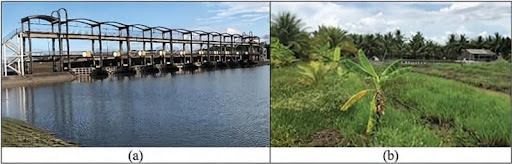
Ba Lai main canal (a) and hidden shrimp‑farming activities in the freshwater area of Thạnh Trị commune (b). |
The paper proposes inclusive governance structures to balance benefits among infrastructure development, environmental conservation and social equity, promoting the recognition and support of disadvantaged groups in decision making. | SDG 10 (Reduced Inequalities) and SDG 16 (Peace, Justice and Strong Institutions), SDG 6 (Clean Water and Sanitation), SDG 15 (Life on Land). |
| Article: “Drought and salinity intrusion in the Mekong Delta: What are the fundamental solutions?” | The analysis was written by a UEH expert, referencing international scholars (e.g., Dr. Huy Nguyen) and comparing solutions from the United States, Australia, the Netherlands and Singapore. | A policy analysis | The comparative study examines severe salinity intrusion events (2016, 2020) and evaluates global solutions (e.g., Singapore’s desalination technology, flood barriers in the US/Australia) for applicability in the Mekong Delta, proposing long‑term solutions for Vietnam. | Impacts include practical measures such as rain‑water harvesting to reduce groundwater extraction and land subsidence, and nature‑based solutions like expanding mangrove forests and restructuring salt‑tolerant crops. The paper stresses the need to strengthen forecasting capacity and coordinated investment in anti‑salinity infrastructure. | SDG contribution: SDG 6 (Clean Water and Sanitation), SDG 13 (Climate Action), SDG 9 (Industry, Innovation and Infrastructure). |
| Research:
“Critical hydrologic impacts from climate change: addressing an urgent global need” |
UEH researchers and researchers from Japan, Australia, the UK, Denmark, Italy, Germany, the US, Egypt. | International statement/academic publication published in the journal Sustain Sci. | Research collaboration on the melting glacier phenomenon in the Himalaya and the decline of freshwater resources severely affecting agricultural production and food security, especially in lowland areas dependent on large river systems. The statement emphasizes the need for global action to cope with changes in the hydrological cycle caused by the climate crisis. It then proposes water‑reuse solutions, improving irrigation efficiency, and applying nature‑based solutions such as soil and forest conservation to address urgent community issues. It proposes priority actions such as strengthening regional capacity to respond to climate risks, and building on international agreements to support vulnerable communities. |
It calls for investment in scientific research to transform agriculture to improve water‑use efficiency and food security. It proposes solutions to mitigate the impact of climate change on agricultural production and food security, directly contributing to SDG 2, 6, 13, 14, 15. |
Contributing SDG: SDG 13 (Climate Action), SDG 6 (Clean Water and Sanitation), SDG 2 (Food Security). |
| Research: | UEH and Australian researchers | The research article, based on expert interviews, was published in the journal Agriculture and Human Values. | It examines the ongoing agricultural transformation in the lower Mekong River basin countries – Laos, Cambodia and Vietnam – where internal and external factors are reshaping agricultural systems and rural livelihoods.
A comparative analysis of extension systems in lower‑Mekong (LMB) countries undergoing agrarian transitions is conducted, evaluating how extension services are attempting to adapt. The study argues that traditional extension models have failed to meet current needs. |
Impact: the research emphasizes the need for pluralistic extension approaches to enhance effectiveness. Provides valuable insights for policymakers to improve agricultural and rural development strategies in Southeast Asia. | SDG contribution: SDG 2 (Sustainable agriculture) and SDG 17 (Knowledge sharing/Regional partnerships). |
| Research: | UEH researchers and international co‑authors. The study focuses on north‑western Cambodia. | The scientific article was published in Critical Asian Studies and employs a political‑ecology approach. | It analyses the historical evolution of agriculture across major periods (from the Angkor era, French colonial period, Khmer Rouge, to the present).
It examines how power dynamics and land‑history influence extension programs in the region, including efforts to achieve the United Nations SDGs. The research stresses the need to design extension programs grounded in local contexts, to reduce inequality and empower farmers, thereby enhancing climate‑adaptation capacity and ensuring sustainable food security. |
Promoting farmer‑centered approaches, blurring the lines between extension and rural development.
Recommending addressing entrenched social and political structural issues rather than relying solely on technical interventions. |
SDG contribution: SDG 1 (No poverty) and SDG 2 (Zero hunger/Food security) through improving sustainable livelihoods, and SDG 10 (Reduced inequalities). |
| Research: “Smallholder farmers’ challenges and opportunities: Implications for agricultural production, environment and food security” | UEH researchers and international co‑authors. The study focuses on north‑western Cambodia but has global significance. |
The scientific article was published in the Journal of Environmental Management and uses a mixed‑method approach (surveys, crop monitoring and climate‑forecast modeling). | It analyses four distinct farmer typologies and compares the climate‑change adaptation strategies (rising temperatures and changing rainfall) that farmers apply, showing that these measures are often insufficient to reduce vulnerability. The research examines how power relations and land‑history affect extension programmes in the area. Current programmes, which focus on productivity and commercialisation, fail to meet the needs of small‑holder farmers because they ignore local contexts and maintain unequal power relations. The study stresses the need to design context‑based extension programmes that reduce inequality and empower farmers, thereby enhancing climate‑adaptation capacity and ensuring sustainable food security. |
It proposes tailored interventions to strengthen the adaptive capacity of small farmers and recommends balancing economic growth with environmental sustainability, promoting sustainable intensification and climate‑resilient agricultural practices. | SDG contribution: SDG 2 (Zero Hunger/Food Security), SDG 13 (Climate Action), SDG 1 (No Poverty). |
| Research:
“Foreign Direct Investment (FDI) and Forest Land: A Sectoral Investigation” |
UEH researchers and international co‑authors.
The study uses a global dataset, analysing data from 85 countries (1991–2020).
|
The scientific article was published in Environmental and Sustainability Indicators.
|
It tests the “FDI ecological halo” hypothesis across nine FDI sectors, comparing the impacts of FDI in traditional industries (agriculture, mining, manufacturing, construction) and service sectors (media, finance, transport) on land‑forest change and ecological footprints.
|
The findings call for stricter regulations to minimise environmental damage from FDI in traditional sectors and highlight the important role of multinational corporations in promoting corporate social responsibility and addressing global environmental challenges. | SDG contribution: SDG 15 (Life on Land – protecting and restoring forest resources) and SDG 17 (Partnerships for the Goals). |
| Electricity reliability and electric cooking: What can we learn from cross-national comparisons? | Collaborating with researchers from India, Nigeria, Ethiopia, Kenya, Central America and Mexico, together with Vietnam. Funded by Environment for Development (EfD). | Multinational research project. | The study uses cross‑national comparisons from household surveys in multiple African and Asian countries, supplemented by econometric analysis with country‑specific qualitative case studies. | It examines how electricity reliability, price, and gender motivations affect the adoption of electric cooking and the reduction of polluting solid‑fuel use, aiming to identify the factors influencing the uptake of electric cooking. | SDG 3 (Good Health and Well‑Being), SDG 5 (Gender Equality), SDG 7 (Affordable and Clean Energy), SDG 12 (Responsible Consumption and Production), SDG 13 (Climate Action), SDG 17 (Partnerships for the Goals). |
| Inducing behavioral change with pro-environmental messaging: improve the message or change the messenger? | Collaboration between authors in China and Vietnam. Funded by EfD. | Field experiment to promote environmentally‑friendly behaviour among tourists. | The comparative study examines the role of messengers with varying levels of expertise and credibility, and different message contents, by conducting a field experiment in hotels within a tourist area in Vietnam. By observing daily room‑level behaviour throughout the tourist season, the research tests the effectiveness of different messengers in generating environmentally‑friendly behavioural changes and the heterogeneous effects based on message content. | The goal is to clarify the most effective way to encourage tourists to act responsibly during their stay, identifying the most effective messenger and message content for inducing environmentally‑friendly behavioural change. | SDG 11 (Sustainable Cities and Communities), SDG 12 (Responsible Consumption and Production), SDG 13 (Climate Action), SDG 17 (Partnerships for the Goals). |
| Understanding non-compliance with rights-based fisheries management in Vietnam | International cooperation between Vietnamese authors and foreign authors. | Academic and policy research (EfD Discussion Paper). | The study shows that illegal fishing in Vietnam’s Tam Giang mangrove swamp, especially using small‑mesh nets, remains common despite TURF regulations. It analyzes the factors influencing non‑compliance with fishery‑management rules, using a binary logistic‑regression model and a randomized‑response technique to gain deeper insight into this sensitive behaviour. |
The research finds that awareness of the negative impacts of illegal fishing and the perceived legitimacy of the regulations significantly affect compliance. The study enriches the literature on regulatory compliance and provides valuable information for designing and implementing policies to improve compliance. | SDG 1 (No Poverty), SDG 12 (Responsible Consumption and Production), SDG 14 (Life Below Water). |
| Climate security and adaptation: government investment and farmer’s adaptation to climate change in coastal communities. | Cooperation with researchers in Ghana and Vietnam. The project is funded by EfD. | A two‑year research project (01/01/ 2023 – 31/12/2024). | The project investigates the impact of climate security on coastal communities, which are strongly affected by climate change, and examines climate‑adaptation strategies implemented by governments and farmers in the region. The study conducts lab‑in‑the‑field experiments and household surveys with rice‑farming households in two countries (Ghana, Vietnam) to explore the relationship between public adaptation investment and individual farmers’ adaptation decisions. |
The research uncovers the implications of climate security for coastal communities and helps understand how these adaptation choices reflect farmers’ climate‑security status. | SDG 1 (No Poverty), SDG 2 (Zero Hunger/Food Security), SDG 11 (Sustainable Cities and Communities), SDG 13 (Climate Action), SDG 17 (Partnerships for the Goals). |
| Climate-related Risks and Sustainable Cage Fish Farming in Vietnam and Uganda | Cooperation with researchers in Uganda and Vietnam.
The project is funded by EfD. |
A two‑year research project (01/01/ 2024 – 31/12/2025). | The study is a comparative analysis of risk perception and the factors influencing risk perception and adaptation decisions of cage‑fish farmers regarding climate‑related risks. The survey plans to include 900 cage‑fish farmers in the Mekong Delta, Vietnam, and Lake Victoria, Uganda. Factor analysis, choice experiments, multiple regression and multivariate probit models will be employed. |
The research provides scientific evidence on risk perception, risk preferences and the determinants of risk perception among cage‑fish farmers, as well as the factors driving their adaptation decisions to climate‑related risks. From this evidence, effective policies can be developed to secure farmers’ livelihoods and sustain the cage‑fish sector in both countries. | SDG 2 (Zero Hunger), SDG 8 (Decent Work and Economic Growth), SDG 13 (Climate Action), SDG 14 (Life Below Water), SDG 17 (Partnerships for the Goals). |
| Coping with Natural Hazards: Coastal Ecosystems’ Protective Services and Role in Shaping Informal Risk-Sharing and Shock Coping | Collaborating with researchers in India and Vietnam. The project is funded by EfD. | A multidisciplinary research project lasting two years (1/1/2024 – 31/12/2025). | This comparative study focuses on “green infrastructure,” marine and coastal ecosystems as solutions for disaster‑risk management at coastal sites in India and Vietnam.
It uses economic experiments and biophysical modelling to: (1) assess the protective services of coastal ecosystems; (2) examine how coastal inundated lands mediate informal community risk‑sharing mechanisms; and (3) explore how coastal ecosystems influence household shock‑response strategies, such as migration and remittances. |
Providing insight into the role of coastal ecosystems (green infrastructure) as a disaster‑risk‑management solution and a mechanism for rural households to stabilise income under risk. | SDG 1 (No Poverty), SDG 11 (Sustainable Cities and Communities), SDG 13 (Climate Action), SDG 14 (Life Below Water), SDG 15 (Life on Land), SDG 17 (Partnerships for the Goals). |
| Impacts of sharing research findings with study participants: Evidence from a field experiment | Collaborating with a researcher from Erasmus University Rotterdam (Netherlands). The field‑research context is Vietnam. | The research project employs a field experiment and is funded by NWO (Netherlands Organisation for Scientific Research). | Within a study of health‑related beliefs/knowledge between parents and children in Vietnam, the research analyses the impact of sharing research results with participants using a comparative experimental approach.
Quantitatively comparing the impact of three intervention/control groups: sharing general results (treatment 1), sharing personalised results (treatment 2), not sharing (control 1), and sharing results from broader documents (control 2) to identify the most effective research‑sharing method for improving health awareness. |
Identifying the best‑practice sharing method to enhance health‑related belief/knowledge, research quality/participation, and research awareness. | Good health (SDG 3). |
| Market and social sustainability of aquaculture: Communities’ and consumers’ perceptions of the farmed seafood industry | Multinational collaboration between researchers from Chile and Vietnam, focusing on the Chinese market. Part of the Blue Resources for Development (BlueRforD) programme. | The research project collects and analyses primary data. Funded by the Environment for Development Initiative (EfD).
|
Experimental analysis focuses on the interaction between the two leading aquaculture‑production countries (Chile and Vietnam) and the important consumption market (China). The comparative study examines the stringency of product evaluations for domestically produced versus imported goods. Collecting primary data in these countries not only allows understanding of the main drivers of consumer perceptions but also of consumers’ preferences for different attributes of aquaculture species and how these preferences respond to a set of bait.
|
The findings provide deep insights for designing information programmes and interventions to correct latent misconceptions, promoting market and societal sustainability. | SDG 2 (Zero Hunger), SDG 3 (Good Health and Well‑Being), SDG 10 (Reduced Inequalities), SDG 12 (Responsible Consumption and Production), SDG 14 (Life Below Water), SDG 17 (Partnerships for the Goals). |
| Thermal Imaging as Information Intervention for Saving Energy for Cooling: An Experiment in Vietnam | Multinational collaboration between authors from China and Vietnam, under the Sustainable Energy Transitions Initiative (SETI) of EfD. | The research project uses a Randomised Controlled Trial (RCT) with about 1,200 households in Vietnam. Funded by EfD. | A random‑controlled trial is conducted in Vietnam (about 1,200 households) to study the impact of providing thermal images (intervention) versus no intervention. The intervention effect is estimated using a Difference‑in‑Differences (DID) approach. The study seeks an improved way of delivering information interventions, as previous studies showed modest impacts, thereby identifying best practices for cooling‑energy savings. |
It provides important insights into new information‑intervention measures for cooling‑energy savings, helping reduce energy consumption in a warming climate. | SDG 7 (Affordable and Clean Energy), SDG 9 (Industry, Innovation and Infrastructure), SDG 12 (Responsible Consumption and Production), SDG 13 (Climate Action), SDG 17 (Partnerships for the Goals). |
| Thailand Vietnam Socio Economic Panel (TVSEP) Poverty Dynamics and Sustainable Development: A Long-Term Panel Project in Thailand and Vietnam, 2015–2024) | Long‑term project with research partners in Thailand and Vietnam, building on the work of the DFG Research Unit (FOR 756). | A long‑term panel study collecting primary survey data. | The long-term project conducts baseline surveys in collaboration with research partners in Thailand and Vietnam.
Socio‑economic data are gathered from 4,400 households in 440 villages across three Vietnamese provinces (Hà Tĩnh, Thừa Thiên Huế, Đắk Lắk) and three Thai provinces. Data has been collected over many years (from 2007 to 2024). By providing comparable panel data representing the rural areas of both countries, the study investigates poverty dynamics and vulnerability to shocks, thereby supplying evidence for the design of effective policies (best practices). |
It creates a long‑term dataset (TVSEP dataset) and in‑depth studies on poverty dynamics and sustainable development, helping to identify the most effective strategies for poverty reduction and shock response. | SDG 1 (No Poverty), SDG 2 (Zero Hunger), SDG 17 (Partnerships for the Goals). |
| Rural Structural Transformation in Developing Countries (RUSTDEC) | Co‑ordinated by the Fundació Privada Barcelona Graduate School of Economics (Spain) and funded by the European Research Council (ERC). Scope: focus on Sub‑Saharan Africa and Southeast Asia. | The research project is funded by the ERC (Grant agreement ID: 101078719). | The RUSTDEC project, funded by the ERC, aims to clarify agricultural‑productivity gaps in Sub‑Saharan Africa and Southeast Asia. To achieve this goal, the project uses theoretical modelling, micro‑panel data and geospatial data to illuminate productivity gaps in developing countries. It employs quasi‑experimental estimation techniques and quantitative structural modelling. | It identifies the determinants of agricultural productivity, the drivers of labour reallocation, and the historical/future impacts of climate change on agricultural production. These results have the potential to generate a ground‑breaking impact on anti‑poverty policy. | SDG 1 (No Poverty), SDG 13 (Climate Action), SDG 17 (Partnerships for the Goals). |
| Green Finance Certificate Training Program | The World Bank/IFC, Frankfurt School of Finance & Management gGmbH (FS). | Internationally funded project and joint implementation. | Rolling out an intensive Sustainable Finance training programme for Vietnam’s banking system. | Building capacity for senior bank officials (branch‑level managers and above) in Vietnam, developing best‑practice approaches to risk management and green financing. | SDG 17 (Global Partnerships), supporting SDGs related to sustainable finance and climate change. |
| Research on Green Economy and Climate Change | International partners (via journals, international conferences). | International research collaboration; participation in international conferences (e.g., “Enhancing Corporate Governance through ESG”). | Conducting review/comparative analyses of public‑investment impacts on emissions/energy consumption in ASEAN, and tax studies in 88 countries. | Publishing international papers/books on topics such as ESG, Green Economy, Life‑Cycle Assessment (LCA). | Contributing to SDGs on Green Economy and Climate Action (SDG 13), Sustainable Economic Growth (SDG 8), and Corporate Governance (related to SDG 17). |
Open related links:
1. 12th World Urban Forum (WUF12) in Cairo, Egypt: https://ueh.edu.vn/en/news/towards-carbon-neutral-and-sustainable-development-ueh-iscm-actively-connecting-with-local-authorities-domestic-and-international-partners-73331
2. RTD 2024 Conference – Resilience by Technology & Design: https://ueh.edu.vn/en/news/rtd-2024-outstanding-contributions-in-technology-and-design-to-global-sustainability-72146
3. Special Discussion Session “Sustainability” (RTD 2024 Conference): https://future.ueh.edu.vn/en/chi-tiet-knowlege/podcast-special-discussion-session-sustainability-the-role-of-universities-and-stakeholders-in-sustainable-development/
4. Annual International Conference ELG 2024: Twin Transition – Digitalization & Climate Change: https://ueh.edu.vn/en/news/annual-international-conference-on-economy-law-and-government-2024-elg2024-%E2%80%9Capproaches-to-the-twin-transition-%E2%80%93-digitalization-and-climate-change-in-developing-countries%E2%80%9D-72200
5. International Conference on Business Theories and Practices (iCOB 2024): https://ueh.edu.vn/en/news/international-conference-on-business-theories-and-practices-icob-2024-73056
6. International Conference on Business and Finance 2024: https://icbf2024.sciencesconf.org
7. Joint Asian Conference on Business and Economic Studies 2024 (J-ACBES 2024): https://ueh.edu.vn/en/news/the-joint-asian-conference-on-business-and-economic-studies-in-2024-j-acbes-2024-remarkable-figures-and-highlights-72496
8. Circular Economy Training Workshop (Southern Region): https://ueh.edu.vn/en/news/training-workshop-on-the-circular-economy-for-the-southern-region-75213
9. Workshop “Economic Growth and Technology in Southeast Asia” (UEH & University of Regensburg): https://ueh.edu.vn/en/news/university-of-economics-ho-chi-minh-city-and-university-of-regensburg-germany-jointly-organizing-the-workshop-economic-growth-and-technology-in-southeast-asia-72546
10. Workshops on “Green Growth & Climate Modelling” (UEH and World Bank): https://ueh.edu.vn/en/news/workshops-on-green-growth-climate-modelling-jointly-organized-by-ueh-and-the-world-bank-may-2024-71816
11. SRS 2024 – EU Strategies for Sustainable Growth: https://ueh.edu.vn/en/news/srs-2024-ueh-school-of-banking-advancing-sustainable-development-and-green-innovationseptember-04-2024-75215
12. Conference on Digital Economy Development in Ho Chi Minh City: https://ueh.edu.vn/en/news/conference-on-researching-the-development-of-digital-economy-in-ho-chi-minh-city-efforts-towards-a-smart-and-sustainable-urban-future-71760
13. Vung Tau Future Events Series 2024 – 3rd International Design Competition: https://ueh.edu.vn/en/news/looking-back-at-the-series-of-vung-tau-future-events-in-vung-tau-city-in-2024-71314
14. SR-ICYREB 2024 – Students Research International Conference for Young Researchers: https://ueh.edu.vn/en/news/ueh-attending-the-students-research-international-conference-for-young-researchers-in-economics-and-business-2024-sr-icyreb-2024-72757
15. ArtTech Fusion 2024 (ATF24): https://ueh.edu.vn/en/news/the-return-of-the-international-event-series-arttech-fusion-2024-atf24-arttech-a-new-fusion-for-the-future-generation-for-s-ustainability-72642
16. Urban Beyond the Urban 2024 Summer Camp: https://iscm.ueh.edu.vn/en/news/ubu2024
17. Summer School on Environmental Valuation using Discrete Choice Experiments (DCE): https://ueh.edu.vn/en/news/a-memorial-summer-school-on-discrete-choice-experiments-organized-at-ueh-71994
18. 2nd ASEAN Summer Camp 2024: https://www.ueh.edu.vn/en/news/[the-2nd-asean-summer-camp-2024]-the-space-brings-together-future-global-leaders-through-innovation-and-sustainability-72253
19. SMU-XO Digital Business Program: https://ueh.edu.vn/en/news/ueh-is-to-promote-an-innovation-startup-ecosystem-towards-sustainable-community-values-73370
20. EU4Sustainability Project (Jean Monnet Actions): https://www.eu4sustainability.com/
21. Vietnam Green Bond Readiness Program: https://ueh.edu.vn/en/news/academic-efforts-research-and-policy-proposals-supporting-local-communities-73356
22. Training for Trainer (Vietnam Green Bond Readiness Program): https://ueh.edu.vn/en/news/ueh-sustainable-finance-institute-imprints-in-2024-and-the -journey-to-accompany-the-sdgs-73298
23. Nature-based Solutions Project (APN): https://ueh.edu.vn/en/news/ueh-sustainable-finance-institute-imprints-in-2024-and-the-journey-to-accompany-the-sdgs-73298
24. GS4Infra Project (Gender-Sensitive Infrastructure): https://ueh.edu.vn/en/news/academic-efforts-research-and-policy-proposals-supporting-local-communities-73356
25. Evaluation of Nature-based Solutions (NBS) Project: https://ueh.edu.vn/en/news/academic-efforts-research-and-policy-proposals-supporting-local-communities-73356
26. Digital Skills to Succeed (DS2S) Project: https://ueh.edu.vn/en/news/ueh-is-to-promote-an-innovation-startup-ecosystem-towards-sustainable-community-values-73370
27. Case Study Writing Project for World Resources Institute: https://ueh.edu.vn/en/news/ueh-sustainable-finance-institute-imprints-in-2024-and-the-journey-to-accompany-the-sdgs-73298
28. Food Loss in Pangasius Catfish Value Chain (ACIAR/IDRC): https://www.hapri.org/post/international-conference-on-the-research-project-food-loss-in-the-pangasius-catfish-value-chain
29. BlueRforD (Blue Resources for Development – EEPSEA): https://ueh.edu.vn/en/news/the-economy-and-environment-partnership-for-southeast-asia-accompanying-university-of-economics-ho-chi-minh-city-on-the-journey-of-sowing-green-seeds-73297
30. Water Security in Mekong Delta – Adaptive Management Perspective: https://www.hapri.org/post/evolving-pathways-towards-water-security-in-the-vietnamese-mekong-delta-an-adaptive-management-pers?lang=vi
31. Water Management Policies & Farmer Livelihoods (Mekong Delta): https://www.hapri.org/post/when-water-management-policies-derail-livelihood-aspirations-farmers-agency-in-everyday-politics?lang=vi
32. Drought and Salinity Intrusion Solutions (Mekong Delta): https://www.hapri.org/post/drought-and-salinity-intrusion-in-the-mekong-delta-what-are-the-fundamental-solutions?lang=vi
33. Critical Hydrologic Impacts from Climate Change: https://www.hapri.org/post/tác-độc-thủy-văn-nghiêm-trọng-từ-biến-đổi-khí-hậu-giải-quyết-nhu-cầu-cấp-bách-toàn-cầu?lang=vi
34. Agricultural Extension in Southeast Asia: https://www.hapri.org/post/chuyển-đổi-nông-nghiệp-và-khuyến-nông-ở-đông-nam-á-thách-thức-và-đổi-mới?lang=vi
35. Historical Agrarian Change in Cambodia: https://www.hapri.org/post/historical-agrarian-change-and-its-connections-to-contemporary-agricultural-extension-in-northwest-c?lang=vi
36. Smallholder Farmers’ Challenges & Opportunities: https://www.hapri.org/post/smallholder-farmers-challenges-and-opportunities-implications-for-agricultural-production-environ?lang=vi
37. Foreign Direct Investment (FDI) and Forest Land: https://www.hapri.org/post/foreign-direct-investment-fdi-and-forest-land-a-sectoral-investigation?lang=vi
38. Electricity Reliability and Electric Cooking: https://www.efdinitiative.org/research/projects/electricity-reliability-and-electric-cooking-what-can-we-learn-cross-national
39. Pro-environmental Messaging Behavioral Change: https://www.efdinitiative.org/research/projects/inducing-behavioral-change-pro-environmental-messaging-improve-message-or-change
40. Rights-based Fisheries Management Compliance (Vietnam): https://www.efdinitiative.org/publications/understanding-non-compliance-rights-based-fisheries-management-vietnam
41. Climate Security and Farmer Adaptation: https://www.efdinitiative.org/research/projects/climate-security-and-adaptation-government-investment-and-farmers-adaptation
42. Climate-related Risks and Sustainable Cage Fish Farming: https://www.efdinitiative.org/research/projects/climate-related-risks-and-sustainable-cage-fish-farming-vietnam-and-uganda
43. Coastal Ecosystems’ Protective Services: https://www.efdinitiative.org/research/projects/coping-natural-hazards-coastal-ecosystems-protective-services-and-role-shaping
44. Thermal Imaging for Energy Saving (Vietnam): https://www.efdinitiative.org/research/projects/thermal-imaging-information-intervention-saving-energy-cooling-experiment-vietnam
45. Market Sustainability of Aquaculture: https://www.efdinitiative.org/research/projects/market-and-social-sustainability-aquaculture-communities-and-consumers
46. TVSEP – Thailand Vietnam Socio Economic Panel (2015-2024): https://www.tvsep.de/en/project
47. RUSTDEC – Rural Structural Transformation in Developing Countries: https://cordis.europa.eu/project/id/101078719
![[Research Contribution] How Did Social Distancing Policies Affect Vietnam’s Economy During COVID-19?](https://future.ueh.edu.vn/wp-content/uploads/2026/03/ueh-thumbnail-639093349337291519.png)