


In 2022, the University of Economics Ho Chi Minh City (UEH) issued a regulation on hazardous waste treatment, initially forming a management foundation for specific types of waste, such as used batteries and broken electronic equipment. However, the policy at that time was limited to basic guidance and pilot implementation, often involving spontaneous cooperation with municipal waste collection units or scrap buyers, without clear monitoring and treatment procedures. By 2024, UEH officially completed and enforced this policy, establishing a closed-loop and safe process for collection, handover, and treatment through cooperation with A Chau Environmental Company, a unit licensed to operate hazardous waste treatment. This progress has deepened the policy, enhanced management efficiency, and demonstrated UEH’s commitment to building a Green University and achieving sustainable development.
1. Regarding the Policy
According to Article 3. Practice of Waste Classification at UEH of Chapter II: Regulations on Green University Practice at UEH in the UEH Green University Regulation (https://gogreen.ueh.edu.vn/en/green-campus-regulations#cat03), the hazardous waste treatment policy was stated as: “Hazardous waste must be collected and stored at designated technical areas within each campus to be sent to licensed partners for proper handling and disposal.”
Although UEH’s regulation on hazardous waste treatment in 2022 was limited to a basic framework, without specifically detailing the classification procedure or monitoring mechanism, the University proactively implemented hazardous waste collection and treatment activities at its campuses. At that time, used batteries, broken electronic equipment, and certain potentially harmful materials were manually sorted at the source of generation, then transferred to the Technical Office of each area for temporary storage, before being handed over to the Ho Chi Minh City Urban Environment Company or spontaneous scrap collectors for further processing. The collection system primarily relied on the existing transport network between UEH’s campuses in Ho Chi Minh City, ensuring a fast and convenient consolidation process.


Image of Used Battery Collection
This solution offered the advantage of a relatively low operating cost, approximately 415 million VND per year, while utilizing the existing collection and transportation infrastructure, which helped maintain stable hazardous waste treatment. However, since the majority of the collected waste was transferred to landfills, this method did not ensure sustainable treatment standards and posed potential environmental pollution risks. Furthermore, UEH lacked a periodic reporting system on the volume of hazardous waste processed, could not determine the revenue generated from recycled waste, and did not yet have a mechanism for returning recycled products to the Community Shop.
Although UEH began to form a hazardous waste management model, the procedure and mechanism remained simplistic, failing to meet the requirements for transparency and circularity. These limitations subsequently became the foundation for UEH to further refine the model in 2024, with a more professional new procedure, a licensed treatment partner, and detailed updated regulations to align with the actual operational system.
Entering 2024, UEH officially refined and completed its hazardous waste treatment procedure, transitioning from a basic collection model to a synchronized management system with monitoring and a circularity orientation. The internal collection procedure is maintained similarly to the previous year but is supplemented with more detailed guidelines on classification, recording, storage, and handover.
Specifically, in the 2024 UEH Green University Regulation, the Hazardous Waste Treatment Policy is adjusted in Chapter II as follows:
“Article 7: Hazardous waste treatment policy
+ Hazardous waste management is the collection, storage and transfer by UEH of waste that poses a risk to human health and the environment, including used batteries, electronic components, defective electronic devices, fluorescent lamps and materials containing heavy metals. The objective of this policy is to ensure that all hazardous waste generated during UEH’s learning, research and operational activities is safely managed, properly collected and treated by licensed units, contributing to the development of a sustainable waste recycling system on campus.
+ For battery and electronic waste: must be collected separately in specialized containers, labeled with the warning “Hazardous waste – Batteries and electronic equipment”, located in designated areas. When full, the waste is transferred to the Technical Department of each facility for temporary collection, before being handed over to a licensed treatment unit.
+ For other types of hazardous waste (such as fluorescent bulbs, electrical components, chemical-containing materials, etc.): generating units must classify, safely package, label, and transfer to the Technical Department for treatment according to prescribed procedures.
+ Internal units are responsible for ensuring classification, storage, recording of volume and periodic handover, and reporting implementation results to the UEH Green Campus Coordination Board for synthesis, monitoring and evaluation of implementation effectiveness.
+ The collection, transportation and treatment of hazardous waste is only carried out through partners with legal hazardous waste treatment licenses, ensuring full compliance with environmental and occupational safety laws.
+ Units that do not comply with classification regulations or handle procedures incorrectly will be reminded, inspected and handled according to internal regulations, and will have points deducted in the assessment of Green Campus criteria implementation.”
2. Implementation
Thanks to the supplementation of the Hazardous Waste Treatment Policy in 2024, management efforts became standardized across all campuses and more transparent in the monitoring phase. The crucial difference this year is UEH’s cooperation with A Chau Environmental Company, a unit legally licensed to operate hazardous waste treatment as regulated by the Ministry of Natural Resources and Environment. After collection and consolidation at UEH’s campuses, all used batteries, broken electronic equipment, and heavy metal-containing materials are handed over to A Chau Environmental Company to perform the advanced treatment stage.

UEH met with A Chau Environmental Company at UEH Mekong campus to finalize the hazardous waste collection and treatment plan

The hazardous waste has been collected and transported by the partner to the treatment facility
At the treatment plant, A Chau Environmental Company re-sorts the waste by material group to select the most appropriate treatment method. Used batteries are manually dismantled to separate the casing, anode, cathode, and electrolyte solution. Broken electronic components are disassembled to recover valuable metals such as copper, nickel, and zinc, while non-recyclable materials are treated using chemical neutralization technology to eliminate toxicity. The remaining parts are safely disposed of in a specialized treatment area that meets national environmental standards. The entire process is monitored by an ISO-certified environmental management system, ensuring no release of toxic fumes, heavy metals, or solvents into the soil, water, or air environments.

Model of the collection – transportation – treatment process for used batteries by A Chau Environmental Company
Additionally, A Chau Environmental Company implements a strict input-output control mechanism, fully recording the volume of waste received, the proportion of recycled materials, and the final disposal method. This data is compiled and periodically reported to UEH, enabling the University to monitor and track statistics, and integrate the results into the annual Green Campus report.
The new solution offers several clear advantages. Firstly, all of UEH’s hazardous waste (batteries) is now treated in compliance with relevant standards, complete with legal documentation and periodic reports, ensuring transparency and environmental accountability. Cooperation with a specialized unit shifts the treatment method from landfilling to recycling and resource recovery, contributing to emission reduction and the formation of a circular economy model on campus. Concurrently, feedback from the partner helps UEH accurately grasp the volume of waste generated and the recycling rate, allowing for the development of more effective environmental management and education strategies.
| Noted: In 2024, UEH enrolled 7,900 students, an increase of 100 compared to the previous year, mainly due to the introduction of two new training programs. On average, each student generates approximately 36.5 kilograms of waste per year. Although the total amount of waste increased, the volume of waste sent to landfill decreased compared to 2023. This demonstrates that UEH’s waste management policies and initiatives have produced positive and effective results. | ||||||||
| No | Year | 2023 | 2024 | |||||
| Type of waste (kg) | Description | Produced | Treated | % Treated | Produced | Treated | % Treated | |
| 1 | Organic waste | Biodegradable waste generated from food, plants, and other natural materials that can decompose naturally. | 74.262 | 27.649 | 37,23% | 76.921 | 66.552 | 86,52% |
| Food Waste | Cooked food, rice, vegetables, meat scraps | 25.404 | 8.790 | 34,60% | 26.138 | 22.825 | 87,32% | |
| Green Waste | Grass clippings, fallen leaves, branches. | 48.858 | 18.859 | 38,60% | 50.783 | 43.727 | 86,11% | |
| 2 | Recyclable/Inorganic waste | Non-biodegradable materials that can be recycled into new products. | 54.139 | 9.535 | 17,61% | 56.710 | 51.771 | 91,29% |
| Plastic | Plastic bottles, cups, straws, plastic bags. | 19.751 | 2.669 | 13,51% | 10.509 | 10.303 | 98,04% | |
| Metal | Aluminum cans, iron scraps, paper clips. | 10.647 | 303,86 | 2,85% | 12.969 | 11.587 | 89,35% | |
| Paper | Printing paper, cardboard boxes, notebooks. | 22.764 | 6353,80 | 27,91% | 31.986 | 28.875 | 90,27% | |
| Milk carton | Milk and juice boxes. | 597,86 | 102,62 | 17,16% | 748,98 | 648,46 | 86,58% | |
| Glass | Glass bottles, jars, broken glassware. | 378,96 | 105,82 | 27,92% | 496,56 | 356,75 | 71,84% | |
| 3 | Toxic waste | Batteries, fluorescent lamps, electronic waste, lab chemicals. | 76.500 | 34.898 | 45,62% | 77.000 | 68.402 | 88,83% |
| 4 | Landfill waste | Residual waste that cannot be reused, recycled, or composted. | 132.819 | 23.906 | ||||
| Organic landfill waste | Food waste mixed with plastic or Styrofoam boxes, Used tissues and paper towels contaminated with oil, Spoiled food mixed with inorganic waste | 46.613 | 10.369 | |||||
| Inorganic landfill waste | Plastic packaging with food residues, Styrofoam containers, Dirty paper cups and straws,Composite materials (multi-layer packaging) | 44.604 | 4.939 | |||||
| Toxic landfill waste | Contaminated lab gloves or masks, Broken fluorescent tubes after neutralization, Solid residues from hazardous waste treatment | 41.602 | 8.598 | |||||
| 5 | Total
(Organic waste + Inorganic waste + Toxic waste) |
204.901 | 72.082 | 35,18% | 210.631 | 186.725 | 88,65% | |
However, the new model also comes with some challenges during the initial implementation phase. Collection and treatment costs have slightly increased to approximately 482.5 million VND per year, due to the expanded collection scope and the requirement for periodic control system operation. Furthermore, the program is currently only being piloted at major campuses in Ho Chi Minh City, requiring more time for full-system expansion. Nevertheless, this is a necessary investment to achieve a sustainable hazardous waste management model that is controlled and adheres to national environmental standards.
With this new procedure, UEH has transitioned from traditional disposal methods to a modern hazardous waste management model, involving coordination between the University and professional enterprises. This serves as powerful evidence of UEH’s strong commitment to building a green, safe learning environment and moving towards comprehensive sustainable development.
3. Regarding the Waste Collection System Currently Deployed at UEH
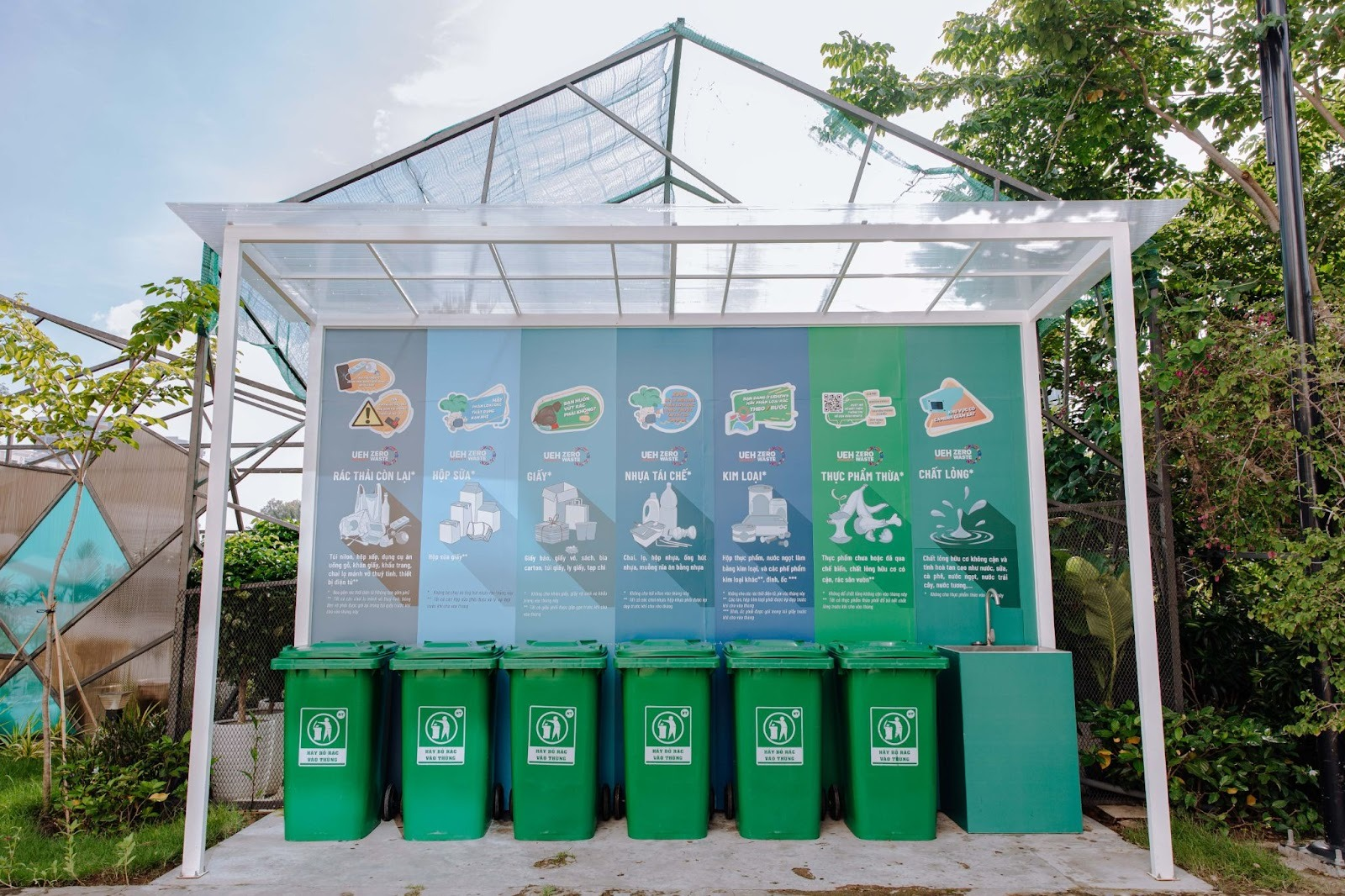
UEH is currently implementing a recyclable waste circular system across its campus, ensuring that recyclable waste is effectively sorted at the source; after sorting, the waste is collected by partners and transported to recycling facilities; some recycled products are returned to the University for exhibition and communication purposes as part of the Green Campus initiatives.
UEH IS CURRENTLY EXECUTING UP TO STEP 4
Principles of waste classification and waste treatment methods at UEH facilities in the city. Ho Chi Minh and UEH – Vinh Long Branch
| No | Type of waste | Describe | Classification method | Processing method |
|
Model 7 |
||||
| 1 | Liquid | Non-residue organic liquids such as coffee, soft drinks, juice, soy sauce, etc. | The liquid needs to be filtered of residue and residue before being put into the tank. | Waste water treatment |
| 2 | Leftover food | Unprocessed or processed foods, organic liquids with residue, yard waste. | Pour out all the water and liquid in leftover food before putting it in the bin. | Landfill |
| 3 | Metal | Food cans, metal beverage cans, screws and other metal scraps. | Pour out all the steps, remaining liquid and press the can/box before putting it in the bin;
Nails and screws are wrapped in paper bags before being put into boxes. |
Send to collection partner for recycling |
| 4 | Recycled plastic | Bottles, jars, plastic containers, plastic straws, plastic spoons, other plastic waste products. | Pour out all remaining water and liquid and flatten the empty plastic bottle/cup before placing it in the bin. | Send to collection partner for recycling |
| 5 | Paper | Notebook paper, printing paper, newspapers, books, cardboard, paper bags, paper cups, and other paper waste. | Keep it dry and fold it neatly before putting it in the box. | Send to collection partner for recycling |
| 6 | Milk carton | Paper milk carton (no straw included). | Empty the remaining milk from the carton and flatten it before putting it in the carton. | Send to collection partner for recycling |
| 7 | Remaining waste | Waste that does not belong to the above groups (except waste that is electronic equipment and batteries brought to the Technical Department at each facility). | Keep dry; Pour off water and liquid before putting it in the bin. | Landfill |
| Model 3 | ||||
| 1 | Organic waste group | Unprocessed or unprocessed foods, organic liquids with residue, yard waste. | Landfill | |
| 2 | Recyclable waste group | Waste such as metal, paper, plastic, milk cartons. | Keep dry; Empty remaining water and liquids from jars, cups, bottles, and boxes; Flatten if possible before placing in the bin. | Send to collection partner for recycling |
| 3 | The remaining group of waste | Waste that does not belong to the above groups (except waste that is electronic equipment and batteries brought to the Technical Department at each facility). | Keep dry; Pour off water and liquid before putting it in the bin. | Landfill |

Additional Information:
HCMC Urban Environment Company Limited (CITENCO); Waste Collection, Transportation, and Treatment Services: https://www.citenco.com.vn/dich-vu
Used Battery Treatment Process by A Chau Environmental Company: https://moitruongachau.com/en/recovery-of-used-batteries.html
Open related links:
1. 2023, Article 3. Practice of Waste Classification at UEH of Chapter II: Regulations on Green University Practice at UEH in the UEH Green University Regulation, https://gogreen.ueh.edu.vn/en/green-campus-regulations#cat03
2. 2024, Image of Used Battery Collection, https://drive.google.com/drive/folders/1lQ-QK9EVzMNpOPDNoVz4sqFLAuchI6nc
3. (n.d.), Image of the trash bins, https://drive.google.com/drive/folders/1o2m9HC6IxJ9TWgcf0GzTN_35v8hWLoZq?usp=drive_link
4. (n.d.), HCMC Urban Environment Company Limited (CITENCO); Waste Collection, Transportation, and Treatment Services, https://www.citenco.com.vn/dich-vu
5. (n.d.), Used Battery Treatment Process by A Chau Environmental Company, https://moitruongachau.com/en/recovery-of-used-batteries.html
![[UEH 50] UEH Organizes the UEH Visiting Lecturer Conference 2026: Connecting Knowledge, Co-creating a Sustainable Academic Ecosystem](https://future.ueh.edu.vn/wp-content/uploads/2026/08/ueh-thumbnail-639231613726052180-1.png)
![[UEH 50] UEH Visiting Lecturers Conference 2026: Connecting Knowledge, Co-Creating Values for the UEH Academic Ecosystem](https://future.ueh.edu.vn/wp-content/uploads/2026/08/ueh-thumbnail-639225793752780476.png)