


The University of Economics Ho Chi Minh City (UEH) has established a Carbon and Emissions Reduction Process as a central component of its “Regulations Regarding Green Campus Practice” (2024 update). Accordingly, UEH has transitioned from a strategic orientation to concrete action by implementing a comprehensive system for carbon inventory, monitoring, and reduction across all campuses. The university has carried out practical initiatives to realize the goal of “From Green Campus to Net Zero Emissions,” including: operating the Living Lab Net Zero Emissions, researching carbon credit tracking models for individuals/ units, developing the AI Scan to Classify system integrating emissions indicators by waste type; implementing efficient building management and energy use, Calories Stair – Power-Up Steps program, No Single-use Plastic Day; and the installation of solar power systems at the main campuses.
In 2024, UEH generated 470,224.2 kWh of solar electricity, reducing CO₂ emissions by 1,265,560.2 tons – equivalent to approximately 12,000 trees – while also saving 134,755 liters of water and 11,177.28 kWh of electricity through its recycling system. These outcomes have been recorded and published in the UEH Green Campus Sustainability Report 2024.
1. Regarding the Policy
In 2023, UEH’s Green University Practice regulations were limited to general principles on energy saving, waste reduction, and the use of environmentally friendly vehicles, without specific provisions for carbon inventory, monitoring, and reduction across the entire campus system. The absence of a clearly established emissions management process hindered the coordinated implementation of environmental impact assessments and carbon offset planning.
By 2024, to enhance its sustainable development policy framework, UEH refined and expanded the Carbon and Emissions Reduction Process as a central component of the Regulations Regarding Green Campus Practice. This process aims to tightly control emissions, promote the use of renewable energy, expand green spaces, and progressively move toward carbon neutrality across all academic, research, and operational activities of the university. Specifically:
In 2023, according to Article 5. Practice Green Campus Principles at UEH under Chapter II: Green Campus Practice Regulations at UEH in the Regulations Regarding Green Campus Practice: only referred to general principles for carbon reduction:
“Article 5. Practice Green Campus Principles at UEH
UEH requires UEHers and visitors to UEH to practice the principles of Green Campus as follows:
1. Requiring dissection and garbage classification upon discharging waste;
2. Keeping the academic space and environment clean;
3. Protecting and preserving facilities and equipment at UEH spaces and campuses;
4. Practicing saving resources: electric lights, air conditioners, electrical equipment, washing water, drinking water directly from the tank;
5. Practicing saving office printing paper, encouraging digital document forms;
6. Protecting and taking care of trees at all UEH campuses;
UEH encourages UEHer and visitors to UEH to practice the following Green University principles:
7. Increasing plants at desks, offices, and rooms (for student dormitories);
8. Maximizing physical activity and encouraging the use of stairs within campuses in terms of the appropriate distances;
9. Encouraging the choice and the use of public transportation, UEH Shuttle Bus to UEH Campuses.
10 .Practicing the reduction of single-use plastic waste within the campus”
Therefore, in 2024, to enhance the effectiveness of measuring carbon reduction and to promote emissions reduction actions, UEH added new provisions to Article 5. Practice Green Campus Principles at UEH, under Chapter II: Green Campus Practice Regulations at UEH in the Regulations Regarding Green Campus Practice.
“Article 5. Practice Green Campus Principles at UEH
11. Conduct carbon inventory and monitor greenhouse gas emissions across all UEH campuses. The university collects and consolidates data on energy, water, and fuel consumption, as well as other emissions-generating activities, forming the basis for developing low-carbon roadmaps and reporting in the annual sustainable development.
12. Implement intelligent energy and emissions management models through the use of sensors, software, and automated monitoring systems to manage electricity, air conditioning, lighting, and water in order to identify high-emission areas and propose timely mitigation measures.
13. Implement a carbon offset program through activities such as tree planting, expanding green spaces, recycling materials, and collaborating with environmental organizations to offset carbon and greenhouse gas emissions generated from academic activities, transportation, and event organization.
14. Give priority to selecting suppliers, partners, and collaborating units with low-emission standards in procurement, purchasing, transportation, and service provision activities, while promoting green production models and sustainable logistics.
15. Develop a “Carbon-Neutral Events” program applicable to conferences, meetings, and organized activities at UEH; units are required to reduce greenhouse gas emissions, utilize renewable energy, employ recycled materials and digital communication tools instead of printing, and report emissions and offset measures after each event.
16. Promote research and innovation on carbon emission reduction, encouraging faculties, institutes, and research groups to develop projects, models, and technological solutions related to carbon management, clean energy, and the circular economy for practical application in UEH operations.
17. Strengthen awareness-raising and training on carbon emissions through educational programs, workshops, and community activities, enabling UEH members to understand the impact of greenhouse gas emissions and cultivate habits for reducing emissions in daily learning, work, and life.”
The supplementation and refinement of the Carbon and Emission Reduction Procedure enables UEH to establish a clearer mechanism for measuring, managing, and controlling carbon and greenhouse gas emissions, while enhancing the accountability of its units, partners, and UEHers in reducing the carbon footprint. This policy not only improves transparency and efficiency in the University’s environmental governance but also reinforces UEH’s pioneering role within the network of Green Universities in Vietnam and the region.
Regarding Carbon Management Process and Strategy
UEH has taken a pioneering role in implementing its strategy to become a Multidisciplinary and Sustainable University, with the Operations pillar focusing on the key objective of transitioning “From a green campus to carbon neutrality”.
1. Net Zero Emissions Goal:
+ UEH has initiated Solution Group 2 – Starting implementing Living Lab Net Zero Emissions at UEH campuses.
+ Efforts to reduce carbon emissions mark the foundational step toward a Neutral Carbon University model, representing the next phase of UEH’s Green University development.
+ All new buildings and infrastructure at UEH are designed and constructed according to international sustainable standards, including energy efficiency optimization and carbon emissions reduction.
2. Research and Development of Carbon Process:
+ UEH is conducting Research on models and implementation approaches for achieving Net Zero Emissions across the campus (Activity 9).
+ Activity 10 focuses on the research and development of a carbon credit framework and a tracking model for carbon credits at the level of individual UEH members, departments, buildings, and campuses.
+ The AI Scan to Classify technology is currently under R&D to integrate greenhouse gas emission metrics for each type of waste, aiming to educate students on responsible consumption.
Source: UEH Green Campus Project Report 2024: https://gogreen.ueh.edu.vn/en/sustainability-report/annual-report
+ Among the 71 research studies conducted within Living Lab UEHGC, five focus specifically on the role of carbon credits in achieving the Net Zero Emissions goal.
3. Energy Operation and Management:
+ The Operations Team implements Building Management and Energy Efficiency activities (Activity 11).
+ The Operations pillar encompasses sustainable practice models, including the use of Renewable Energy and efficient Waste Management systems.
Source: UEH Green Campus Project Report 2024: https://gogreen.ueh.edu.vn/en/sustainability-report/annual-report
Regarding Practical Implementation and Emission Reduction
1. Renewable Energy Development:
+ UEH has installed multiple solar power stations with a total capacity exceeding 509.000 kWp across its three largest campuses: A, B, and N.
+ The implementation of advanced solar energy systems represents a concerted effort to reduce carbon emissions and protect the environment.
2. Energy and Emissions Reduction (Source: UEH Green Campus Project Report 2024: https://gogreen.ueh.edu.vn/en/sustainability-report/annual-report)
+ UEH has completed construction and officially launched the “UEH GREEN CAMPUS CALORIES STAIR – Power-Up Steps” at buildings B1, B2, and N1. This initiative encourages UEHers to use staircases instead of elevators, thereby reducing greenhouse gas emissions and promoting a healthy, active lifestyle.
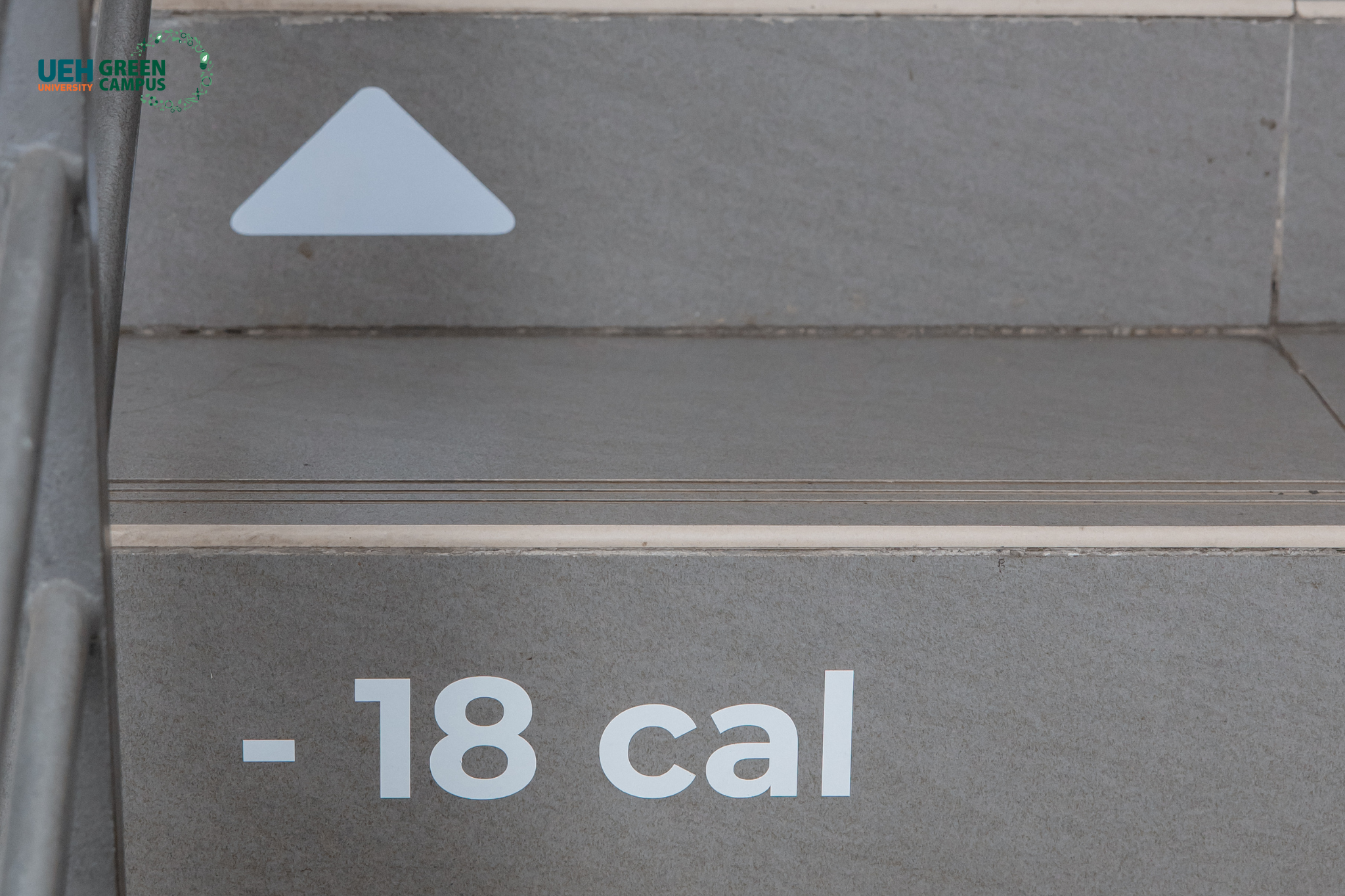

UEH Green Campus Calories Stair accompanied by motivational messages for UEHers using the staircases
+ The “Towards No Single-Use Plastics Future” campaign was officially launched on 19 October 2024 at Campus V, focusing on reducing and ultimately eliminating single-use plastics.
+ The University continues to implement “No Single-use Plastic Day” on the last Wednesday of each month, starting from October at Campus V, to strongly promote a lifestyle free from single-use plastics.
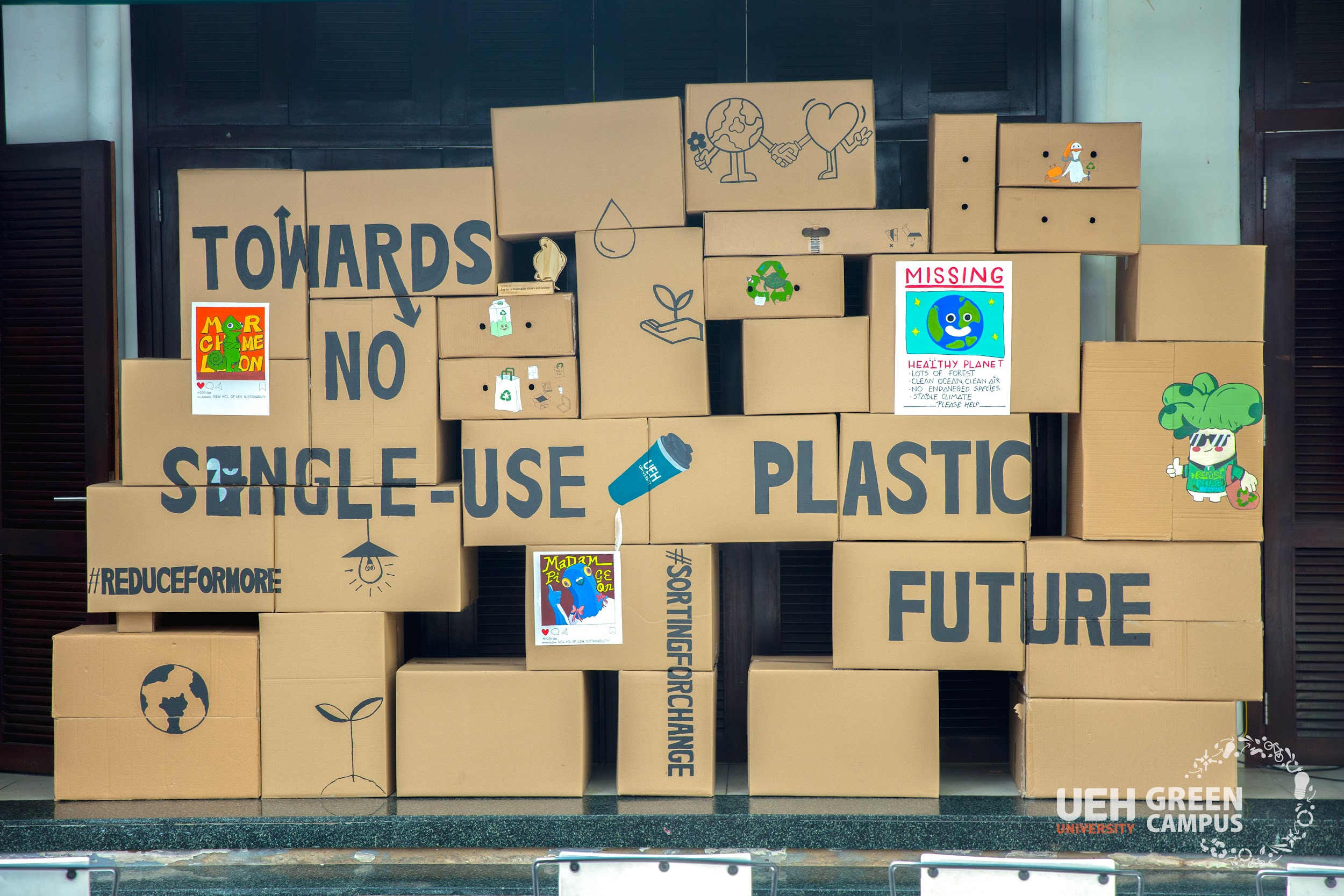

Students participated in the No Single-Use Plastic Quiz during the launch event of the campaign
+ The UEH recycling model is implemented with a 3-tier classification process.
Emission Reduction Data
UEH Green Campus project has recorded impressive figures on emission reduction in 2024:
1. Solar Energy:
+ In 2024, UEH generated 470.000 kWh of solar electricity.
+ Specifically, the solar power systems at four buildings (A, B, N1, N2) produced 470.224,2 kWh.
+ This solar energy generation contributed to reducing nearly 1,270,000 tons of CO₂ emissions.
+ Detailed data show that 1.265.560,2 tons CO2 emissions were avoided, equivalent to planting 12.000 trees.
2. From the Recycling System (i Ve Chai Machine):
The i Ve Chai automatic recycling machines were installed at UEH’s A, B, and N campuses in August 2024.
+ As of November 2024, the system had collected nearly 25.000 plastic bottles and 9.800 aluminum cans.
+ This initiative directly contributed to a reduction of 1,746.45 kg of CO₂ emissions. while also saving 134.755 liters of water and 11.177,28 kWh of electricity.
* Sources: UEH Green Campus Annual Report – https://gogreen.ueh.edu.vn/en/sustainability-report/annual-report and UEH 2024 Annual Activity Summary Article: https://ueh.edu.vn/cuoc-song-ueh/tin-tuc/ueh-va-no-luc-xay-dung-dai-hoc-xanh-thong-minh-tu-nhung-cong-trinh-den-khuon-vien-xanh-than-thien-voi-moi-truong-73313
Through its policies, technologies, and behavioral initiatives, UEH directly contributes to SDG 13 – Climate Action and SDG 7 – Affordable and Clean Energy, thereby realizing its vision of “From Green Campus to Carbon Neutrality” – a clear testament to UEH’s pioneering role in sustainable development practices in Vietnam.
Open related links:
1. 2023 – Article 5, Practice Green Campus Principles at UEH – https://gogreen.ueh.edu.vn/en/green-campus-regulations#qd-dieu5
2. 2024 – UEH Green Campus Annual Report – https://gogreen.ueh.edu.vn/en/sustainability-report/annual-report
3. December 11, 2024 – UEH and Solar Energy: Affirming the Pioneering Role in Green Energy Application with the Reduction of 1,265.5602 tons of CO2 – https://gogreen.ueh.edu.vn/en/breaking-news/ueh-and-solar-energy-affirming-the-pioneering-role-in-green-energy-application-with-the-reduction-of-12655602-tons-of-co2
4. January 23, 2024 – Striving to build a green and smart university, UEH happily welcomes the Spring of At Ty 2025 – https://ueh.edu.vn/cuoc-song-ueh/tin-tuc/ueh-va-no-luc-xay-dung-dai-hoc-xanh-thong-minh-tu-nhung-cong-trinh-den-khuon-vien-xanh-than-thien-voi-moi-truong-73313
5. December 31, 2024 – New steps of UEH Green Campus in 2024 – Creating and spreading the Green University Model – https://gogreen.ueh.edu.vn/gogreen.ueh.edu.vn/public/en/breaking-news/new-steps-of-ueh-green-campus-in-2024-creating-and-spreading-the-green-university-model
![[UEH Uni Talk] Sustainable Career Orientation 5.0 Live Talk Series “Empowering Tomorrow” 2026](https://future.ueh.edu.vn/wp-content/uploads/2026/04/ueh-thumbnail-639125573568872337-5.png)
![[Research Contribution] Factors affecting the green consumption decisions of students in Ho Chi Minh City](https://future.ueh.edu.vn/wp-content/uploads/2026/04/ueh-thumbnail-639126160551781453-1.png)