

7.2.3 – Carbon reduction and emission reduction process
The University of Economics Ho Chi Minh City (UEH) identified greenhouse gas emissions management and efficient energy use as central priorities in its Green, Smart and Sustainable University development strategy. Through its Green Campus Regulations, UEH publicly outlined a carbon management process covering data collection, classification of emissions into Scopes 1, 2 and 3, calculation of carbon dioxide equivalent (CO₂e), assessment, and the development and implementation of emission reduction measures. In 2025, UEH continued to put this process into practice through carbon footprint estimates, energy management in smart buildings, solar electricity generation, sustainable transport initiatives, circular waste management and trials of resource monitoring technologies. These efforts gradually strengthened the data foundations and management capabilities supporting its Net Zero 2050 ambition.
1. Strategic Direction
UEH structured its carbon management approach around three areas of action:
Strengthening greenhouse gas emissions measurement and monitoring. By collecting data on energy consumption and operational activities, UEH progressively identified direct and indirect emission sources to support carbon footprint assessments and the development of improvement measures.
Implementing operational emission reduction measures. The University prioritised energy efficiency, renewable energy, smart building management, sustainable transport, responsible procurement and circular-economy waste management.
Promoting ongoing assessment and improvement. Measurement results and operational information provided a basis for identifying priorities, developing initiatives and progressively strengthening UEH’s emissions management system.
2. Objectives and Stakeholders
Objective: To establish and implement a carbon management process to control sources of greenhouse gas emissions, improve energy efficiency, reduce reliance on high-emission energy sources and strengthen the capacity to monitor and report emission reduction outcomes.
Stakeholders: Facilities and operations management units, the UEH Green Campus Project, schools and institutes, specialist departments, Youth Union and Student Association organisations, student clubs and relevant partners.
3. Internal Commitments and Supporting Policies
To manage carbon emissions and establish greenhouse gas reduction procedures across the University, UEH continued to implement the Green Campus Practice Regulations issued under Decision No. 2059/QD-DHKT-CSVC in 2022. Clauses 11–17 of Article 5 addressed carbon emissions inventories and monitoring; the use of smart energy and emissions management systems; carbon offsetting measures; preference for suppliers with low-emission standards; low-emission events; and research into emission reduction technologies. Article 9, ‘Emission Reduction and Carbon Management Policy’, was particularly relevant.
In 2025, UEH maintained its carbon management framework while preparing a proposed update to the Green Campus Practice Regulations, restructuring Article 9 under the title ‘Greenhouse Gas Emission Reduction and Towards a Carbon-Neutral University’. Compared with the earlier provisions, the proposed update emphasised a systematic emissions management process encompassing inventories, data analysis, identification of major emission sources, development of reduction measures and monitoring of implementation outcomes. It aimed to integrate emissions management with energy management, smart monitoring technologies and a carbon-neutrality pathway, rather than focusing solely on individual electricity-saving or emission reduction measures. Specifically:
Article 9. Emission Reduction and Carbon Management
This article stipulated the measurement, management and reduction of greenhouse gas emissions at UEH, with a view to carbon neutrality and sustainable development across the University’s teaching, research and operational activities.
- Carbon emissions measurement and monitoring process: UEH developed an emissions measurement process comprising the collection of energy consumption and operational data; classification into three scopes (Scopes 1, 2 and 3); and calculation of CO₂e using internationally standardised tools or software. The data collected served as a basis for assessments, reporting and proposals for annual emission reduction plans.
| Scope | Implementation Measures |
| Scope 1
(Direct emission reduction measures) |
– Convert University-operated vehicles and student shuttle buses to electricity or renewable energy.
– Reduce fossil fuel use in operations and prioritise clean or renewable fuels. – Regularly inspect and maintain mechanical and refrigeration systems to prevent leaks of greenhouse gases. |
| Scope 2
(Reducing indirect emissions from purchased energy) |
– Optimise lighting, air-conditioning and other major electricity-consuming systems.
– Install renewable energy systems, such as rooftop solar panels, on UEH buildings. – Regularly monitor and report energy consumption to manage electricity efficiency across the University. |
| Scope 3
(Reducing value-chain emissions) |
– Prioritise suppliers and partners with sustainability certifications or commitments.
– Implement green procurement policies and reduce waste and plastic packaging. – Encourage online meetings and limit unnecessary business travel. |
- Encouraging and facilitating programmes related to emission reduction. UEH encouraged and supported departments, member schools, Youth Union and Student Association organisations, and student clubs in implementing or jointly organising training, workshops, forums and communication campaigns on energy saving, emission reduction and climate change adaptation. These activities sought to raise awareness, encourage green action and promote a culture of sustainability throughout UEH.
- Investment in and partnerships for green technology development: UEH proactively sought partnerships with organisations, enterprises and non-governmental organisations (NGOs) on clean energy, carbon capture and storage, carbon-offsetting tree planting and other sustainability programmes. Such investments and collaborations were expected to achieve genuine and measurable emission reductions.
Continuing its carbon management approach, on 14 May 2026 UEH developed an implementation plan for the 2026 Greenhouse Gas Inventory Project, supporting the UEH Neutral Carbon Campus 2026–2030 initiative. The plan called for the collection and standardisation of emissions data for 2024–2025 across Scopes 1, 2 and 3; screening of significant emission sources under ISO 14069:2013; calculations, uncertainty assessment and preparation of a greenhouse gas inventory report in accordance with ISO 14064-1:2018. Implementation stages included preparation, data collection, establishment of an inventory team, completion of missing datasets, quality review, emission calculations, internal assessment, final reporting and data storage in the Smart Rankings Management System. The Sustainable Finance Institute (SFI) was assigned technical responsibility for the inventory in collaboration with UEH’s data and operations management units.
4. Evidence of Programmes and Activities Implemented in 2025
| No. | Programme/Project | Type/Classification | Activities and Outcomes | Public Source |
| 1 | UEH’s follow-up greenhouse gas inventory plan: standardising 2024–2025 data towards a Neutral Carbon Campus 2026–2030 | University-wide greenhouse gas inventory plan; Scope 1, 2 and 3 emissions management; data quality control | On 14 May 2026, UEH developed its implementation plan for the 2026 Greenhouse Gas Inventory Project. The plan covered the review of emission sources under ISO 14069:2013; collection and completion of Scope 1, 2 and 3 data for 2024 and 2025; CO₂e calculations under ISO 14064-1:2018; uncertainty assessments; internal checks; and preparation of the inventory report. According to the schedule, the report was expected to be completed in August–September 2026, with data stored in the Smart Rankings Management System by the end of September 2026. The plan represented a subsequent step towards improving the completeness, reliability and traceability of emissions data in support of the reduction pathway. | 2026 Greenhouse Gas Inventory Plan
https://drive.google.com/file/d/1VaRJWEfD2MKUObLDVT9kS9MLs6UuNug4/view |
| 2 | Estimating UEH’s carbon footprint and identifying emission sources | Measurement, monitoring and assessment of greenhouse gas emissions | UEH publicly reported estimated carbon emissions of 3,561.96 tonnes of CO₂e over the most recent 12 months, primarily associated with electricity consumption and transportation. This was direct evidence of emissions quantification and identification of major sources, providing a basis for prioritising energy and sustainable mobility measures. | UEH Green Campus, ‘New Advances of the UEH Green Campus Project in 2025’, published on 4 February 2026, reporting 2025 outcomes.
UEH Green Campus – New Advances of the UEH Green Campus Project in 2025 |
| 3 | Managing energy consumption across smart buildings | Energy monitoring; management of indirect Scope 2 emissions | In 2025, UEH reported 79,665.85 m² of smart-building floor area, equivalent to 76.3% of the University’s total floor area. Buildings were equipped with centralised management and monitoring systems, real-time energy consumption tracking, and automated lighting and air-conditioning controls. These measures supported the management of electricity consumption, which UEH identified as a significant emissions source. | UEH Green Campus, ‘New Advances of the UEH Green Campus Project in 2025’, published on 4 February 2026, reporting 2025 outcomes.
UEH Green Campus – New Advances of the UEH Green Campus Project in 2025 |
| 4 | Operating solar electricity systems at Campuses A, B and N | Renewable energy; an emission reduction measure relating to Scope 2 | During the 2025, UEH’s solar electricity systems generated more than 508,000 kWh/year, supplying Campuses A, B and N directly. The use of renewable electricity displaced part of the University’s purchased electricity and contributed to measures for managing energy-related emissions.
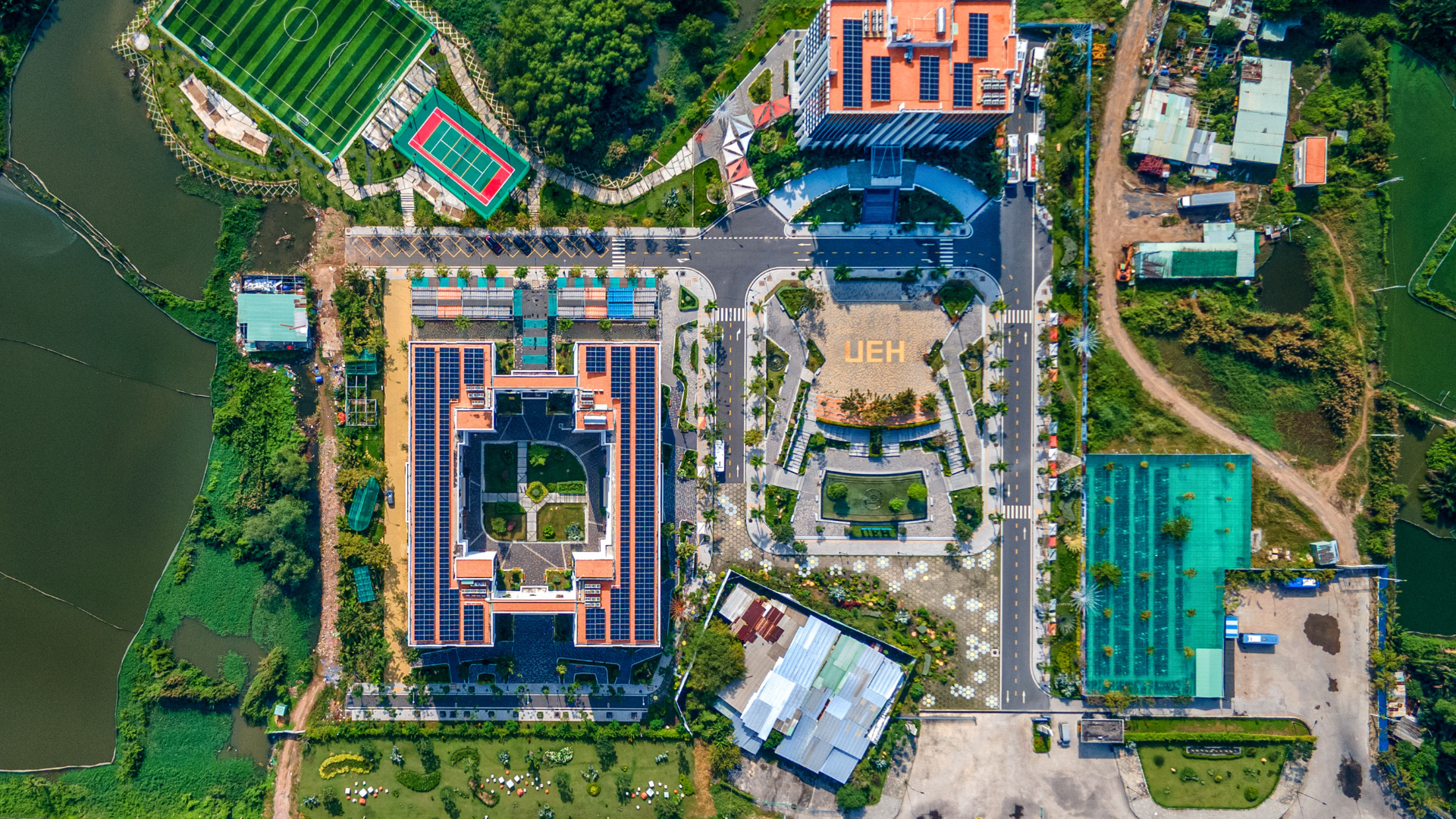
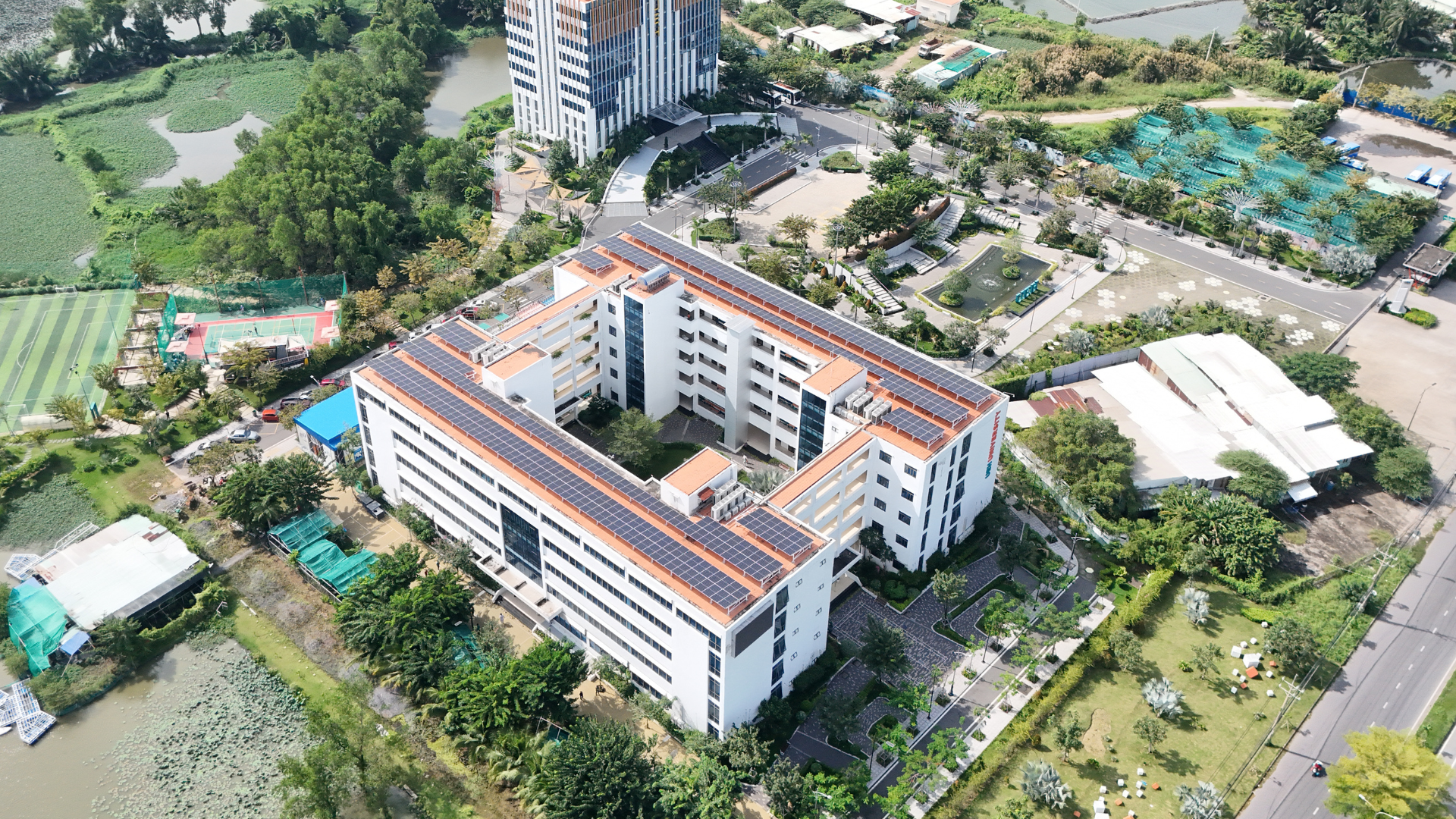
UEH installed solar power systems at its campuses |
UEH Green Campus, ‘New Advances of the UEH Green Campus Project in 2025’, published on 4 February 2026, reporting 2025 outcomes.
UEH Green Campus – New Advances of the UEH Green Campus Project in 2025 |
| 5 | Maintaining UEH Shuttle Bus services and encouraging sustainable transport | Managing transport-related emissions; reducing reliance on private vehicles | UEH maintained its Shuttle Bus service with nearly 10 trips per day to facilitate travel between campuses and encourage reduced use of private vehicles. The initiative addressed transportation, one of the two major categories of emission sources identified by the University.
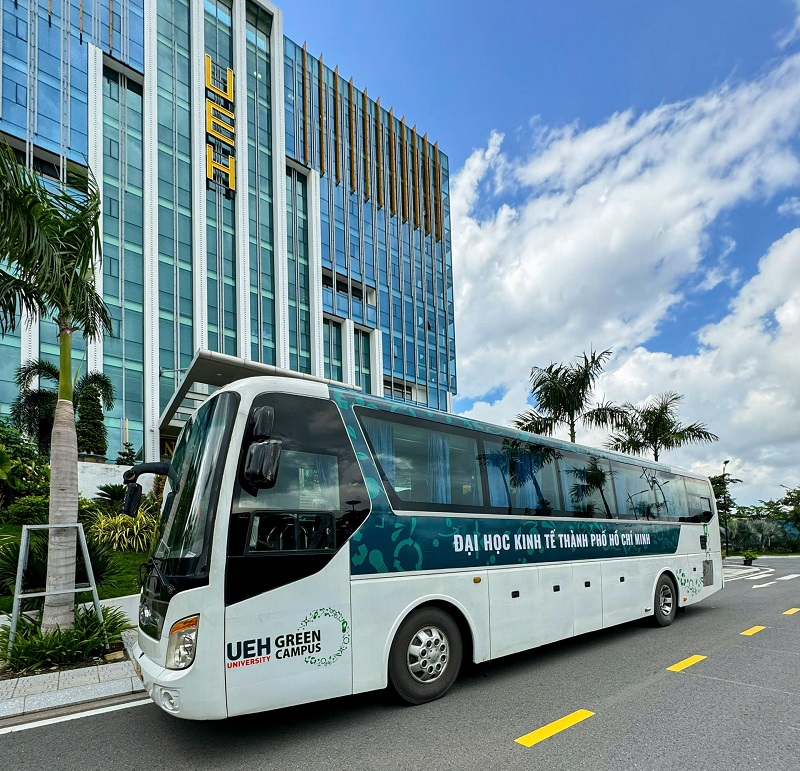
Modern, comfortable UEH Shuttle Bus |
UEH Green Campus, ‘New Advances of the UEH Green Campus Project in 2025’, published on 4 February 2026, reporting 2025 outcomes.
UEH Green Campus – New Advances of the UEH Green Campus Project in 2025 |
| 6 | UEH Green Campus – Digital Twin pilot at Vo Thi Sau Campus | Infrastructure management technology; visualisation of operational data | In 2025, UEH piloted a Digital Twin at Vo Thi Sau Campus, using visualised data to support resource management, building operations and energy conservation. The system supported the monitoring of energy consumption and laid the groundwork for improving building efficiency and emissions management. | UEH Green Campus, ‘New Advances of the UEH Green Campus Project in 2025’, published on 4 February 2026, reporting 2025 outcomes.
UEH Green Campus – New Advances of the UEH Green Campus Project in 2025 |
| 7 | Waste management based on the 3R model and source separation | Waste management and circular economy; measures supporting indirect emission reductions | In 2025, UEH continued to manage waste under the 3R (Reduce – Reuse – Recycle), combining waste segregation stations for three and seven material categories, practices under the Green Campus Regulations and waste reduction communications. These activities helped manage waste streams and promote reuse and recycling of resources.


Green practice station – UEH Go Green Station |
UEH Green Campus, ‘New Advances of the UEH Green Campus Project in 2025’, published on 4 February 2026, reporting 2025 outcomes.
UEH Green Campus – New Advances of the UEH Green Campus Project in 2025 |
| 8 | UEH Green Campus 2025 – Green Influence: Education on emission reduction across the three scopes | Awareness-raising programme supporting implementation of carbon reduction policy | UEH Green Campus delivered the Green Influence programme, jointly organised by the Human Resources and Entrepreneurship Club and the Faculty of Management’s Youth Union and Student Association. The programme included GREEN ACT online communication activities, GREEN SPACE – Workshop LOW CARBON and GREEN MISSION a practical challenge on TikTok, helping students identify sources of Scope 1, 2 and 3 emissions and adopt behaviours that reduce emissions.
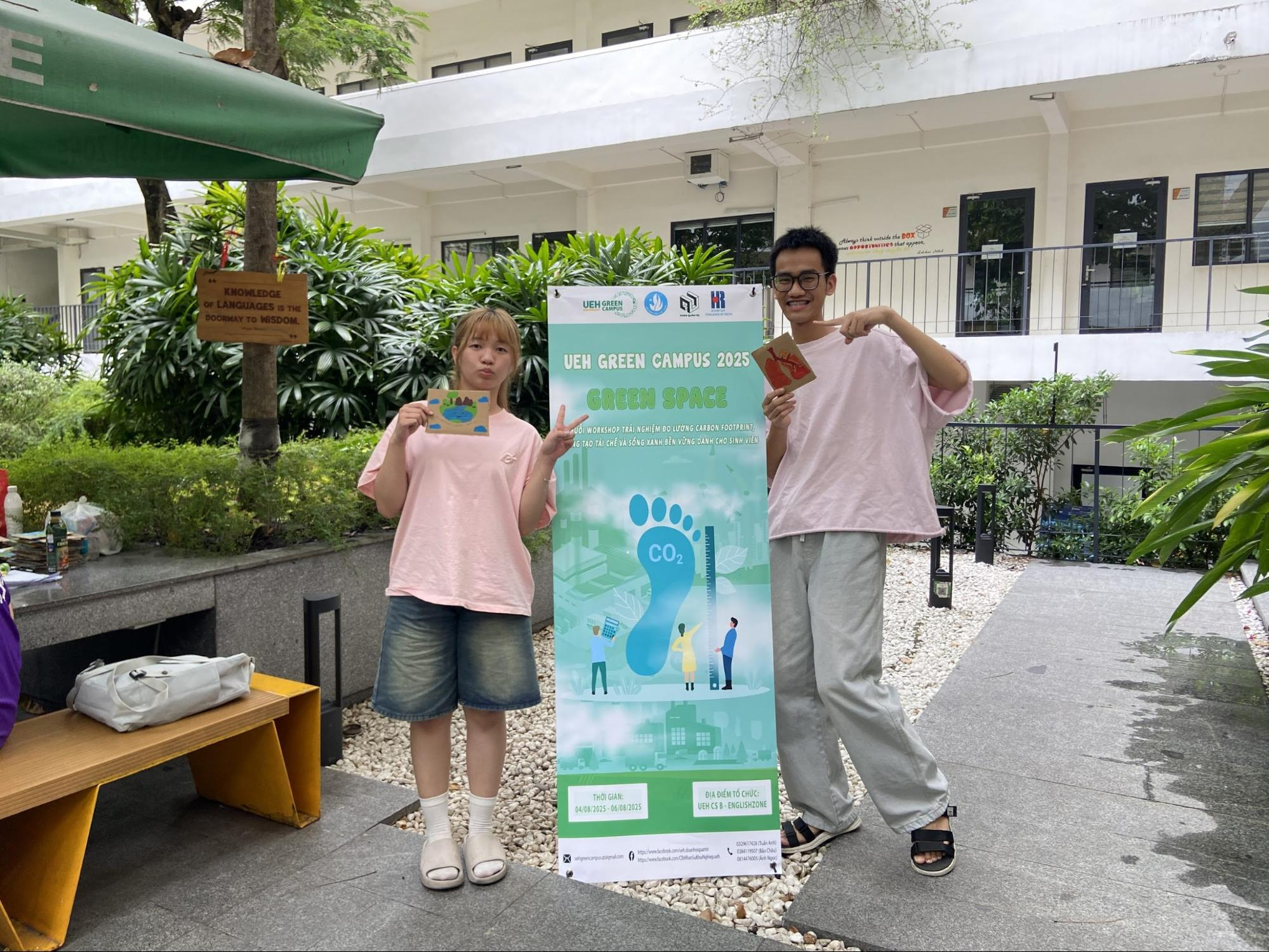
Students checking in at the activity booth |
UEH Green Campus, ‘Looking Back at UEH Green Campus 2025: Green Influence’, published on 19 August 2025.
UEH Green Campus – A Look Back at the Green Influence Programme, |
| 9 | ‘Cham Xanh’ (A Touch of Green) Programme – Encouraging greenhouse gas emission reduction | Community communication and emission reduction practices at UEH | The ‘Cham Xanh’ programme included ECO IN YOU, GREEN SOWER and GO GREENNIE, which guided students in reducing their environmental impact through electricity and water conservation, avoiding single-use plastics, green transportation and waste segregation, thereby raising awareness.
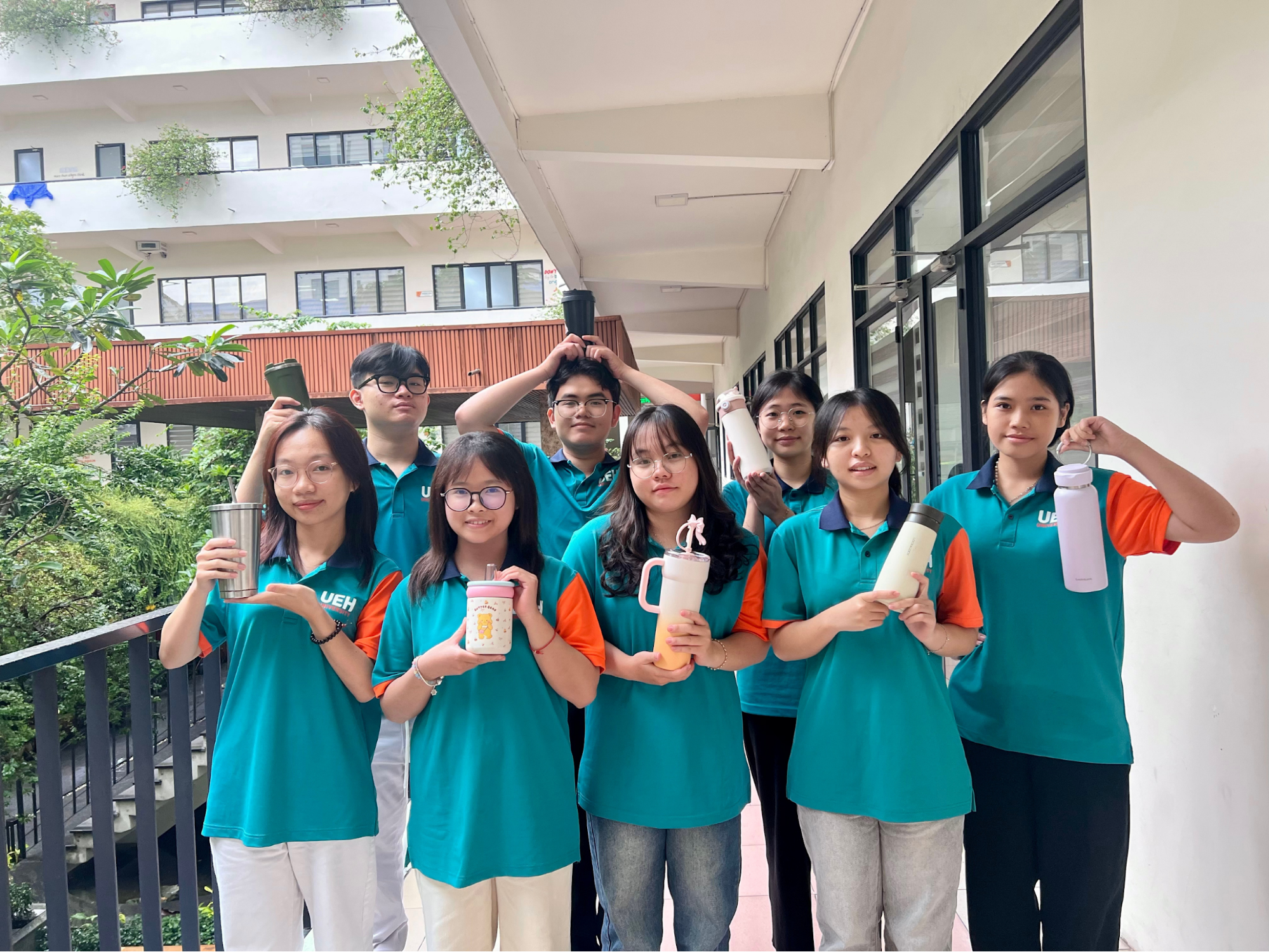
Students actively sharing green-living messages |
UEH Green Campus, ‘Cham Xanh Activity Series – Encouraging Greenhouse Gas Emission Reductions’, published on 17 November 2025. |
| 10 | Green Pulse – The Rhythm of Green Living: Encouraging changes in travel modes | Communication and practices promoting low-emission transport | From 6 to 17 November 2025, the Faculty of Accounting’s Student Association organised the Green Pulse programme to encourage environmentally friendly travel modes. The programme recorded more than 700 student registrations and nearly 600 student commitments, supporting shifts towards more sustainable travel behaviour.

Images from the programme |
UEH Green Campus, ‘Awareness-Raising Programme Promoting Green Transport: GREEN PULSE – The Rhythm of Green Living’, published on 18 November 2025. |
| 11 | UEH Green Campus – Digital Twin: Pilot environmental monitoring and smart energy management system at Vo Thi Sau Campus | Digital Twin: real-time environmental monitoring; support for carbon management and operational optimisation | UEH undertook research and pilot development of the smART Hub Living Labs – Towards Net Zero model at Campus V, 232/6 Vo Thi Sau Street. According to ISCM’s description, its Digital Twin combined environmental sensor networks, automation and real-time data dashboards. Environmental indicators were collected to monitor indoor conditions, inform natural ventilation strategies, improve comfort and enhance operational efficiency. The system generated experimental data to support energy management, evaluation of emissions reduction options and progress towards Net Zero.

Digital Twin project towards Net Zero at Vo Thi Sau Campus |
ISCM – smART Hub Living Labs, Package 3: Towards Net Zero.
https://iscm.ueh.edu.vn/smart-hub-living-labs/pages/package-3/index.html |
5. Conclusion
In 2025, UEH continued to implement its carbon management approach through the process set out publicly in the Green Campus Practice Regulations, focusing on data collection, emission source classification, CO₂e calculation, emission reduction measures and outcome monitoring. Compared with 2024 evidence, which primarily concerned solar energy, waste management and green practice initiatives, published 2025 reporting added important information on estimated carbon footprint, identification of major emission sources, real-time energy management and pilots of digital tools for operational monitoring.
Key reported outcomes included an estimated 3,561.96 tonnes of CO₂e over the most recent 12 months, 79,665.85 m² of smart-building floor area, 580,000 kWh/year of solar electricity, alongside sustainable transport measures and circular waste management. These outcomes illustrated the links between UEH’s carbon management policy and its practical initiatives.
By maintaining and gradually strengthening its measurement, monitoring and emission reduction tools, UEH continued to contribute to SDG 7 – Affordable and Clean Energy, particularly indicator 7.2.3 of THE Sustainability Impact Ratings.