

15.4.1 – Water discharge guidelines and standards
In 2025, the University of Economics Ho Chi Minh City (UEH) continued to manage wastewater quality in accordance with Vietnam’s environmental technical standards, integrating wastewater collection, treatment, monitoring, and incident prevention into campus operations. In particular, UEH maintained its wastewater treatment and water-quality monitoring procedures at the Nguyen Van Linh Campus, where a centralized wastewater treatment system has a design capacity of 550 m³/day. These activities were documented in the 2025 Environmental Protection Report and UEH’s publicly available materials on wastewater collection, treatment, and quality control.
1. Description of water discharge standards and guidelines
a) Application of national technical regulations on wastewater quality
UEH draws on environmental protection legislation and national technical regulations on domestic wastewater to establish requirements for controlling water quality before discharge, specifically:
QCVN 14:2008/BTNMT – National Technical Regulation on Domestic Wastewater, promulgated under Decision No. 16/2008/QD-BTNMT dated 31 December 2008 of the Ministry of Natural Resources and Environment, which specifies limits for pollutants in domestic wastewater. At the Nguyen Van Linh Campus, technical documentation and the 2025 Environmental Protection Report identify QCVN 14:2008/BTNMT, Column B, as the benchmark for assessing effluent quality. Monitored parameters include pH, biochemical oxygen demand (BOD₅), total suspended solids (TSS), nitrogen compounds, phosphate, and Coliform. Monitoring these parameters helps assess risks of dissolved oxygen depletion, nutrient enrichment, and microbial contamination in receiving waters.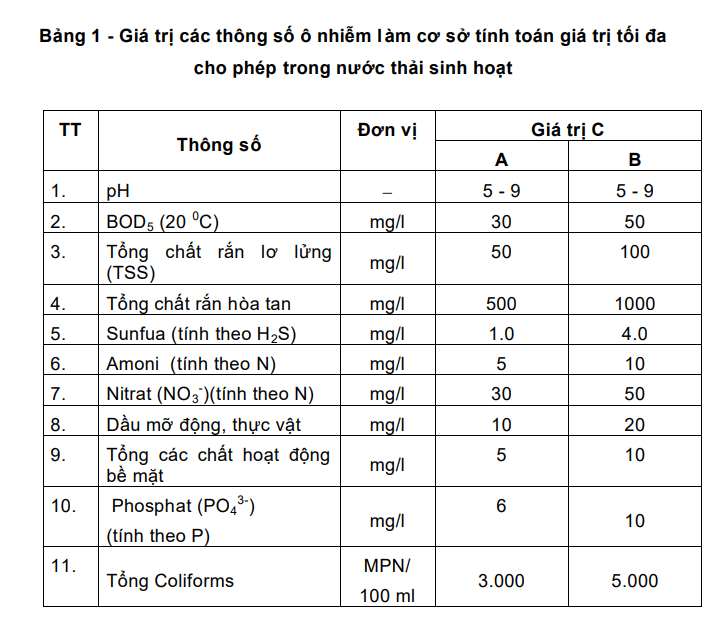
Water sample analysis results indicated that UEH’s treatment system operated effectively and performed better than the prescribed regulatory limits:
- TSS (total suspended solids) decreased from 150 mg/L to 40 mg/L, 60% below the permissible threshold of 100 mg/L. BOD₅ (biochemical oxygen demand) decreased from 250 mg/L to 20 mg/L, corresponding to a treatment efficiency of 92%.
- Ammonium (N-NH₄⁺) decreased from 20 mg/L to 5 mg/L, below the 10 mg/L limit.
- Total Coliform decreased from 8,000 MPN/100 mL to 3,000 MPN/100 mL, below the QCVN limit of 5,000 MPN/100 mL.
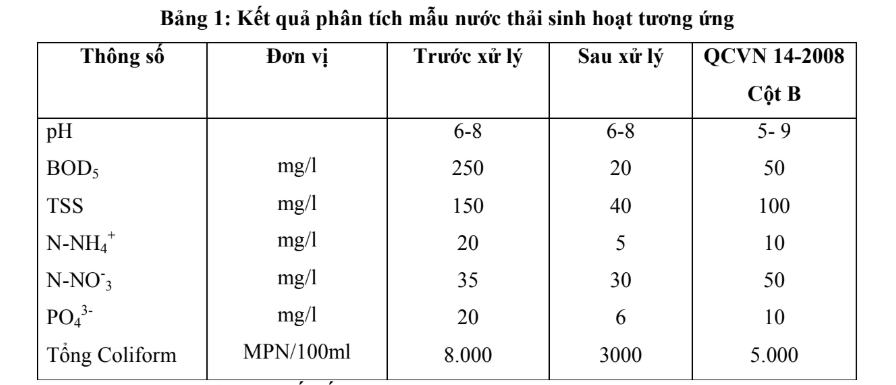
These results demonstrate UEH’s efforts to control effluent quality, protect ecological conditions, and reduce impacts on the urban environment. In addition, UEH conducts quarterly sampling of treated wastewater and sends samples to an independent testing organization for analysis, supporting transparency and consistent compliance with government requirements.
In 2025, Vietnam issued Circular No. 05/2025/TT-BTNMT dated 28 February 2025, together with QCVN 14:2025/BTNMT – National Technical Regulation on Domestic Wastewater and Wastewater from Urban Areas and Concentrated Residential Areas, effective from 1 September 2025. Pursuant to Article 3(1) and Article 4, facilities eligible for transitional arrangements may continue applying the previous regulation until 31 December 2031, while projects falling under the new scope must comply with the 2025 regulation according to the prescribed schedule. Accordingly, UEH determines the applicable standard by considering each campus’s legal status, environmental documentation, and wastewater treatment system characteristics.
b) Guidelines for wastewater collection, classification, and control at source
UEH implements guidelines for managing wastewater generated by learning, teaching, research, and daily activities on campus, focusing on preventing untreated wastewater from entering the environment directly. According to UEH’s published wastewater management procedures, water sources to be identified and classified include domestic wastewater, wastewater potentially containing chemicals, and stormwater runoff. Classification according to the characteristics of each source helps prevent cross-contamination and supports the selection of appropriate collection and treatment methods.
At the Nguyen Van Linh Campus, the 2025 Environmental Protection Report confirms that domestic wastewater generated by campus activities is collected and conveyed to the wastewater treatment system. The system includes mechanical, biological, and disinfection stages before treated effluent is discharged into the shared drainage system. For stormwater runoff, the campus uses its existing stormwater drainage network and cleans surfaces to limit the transport of waste, sediment, litter, and other pollutants by runoff.
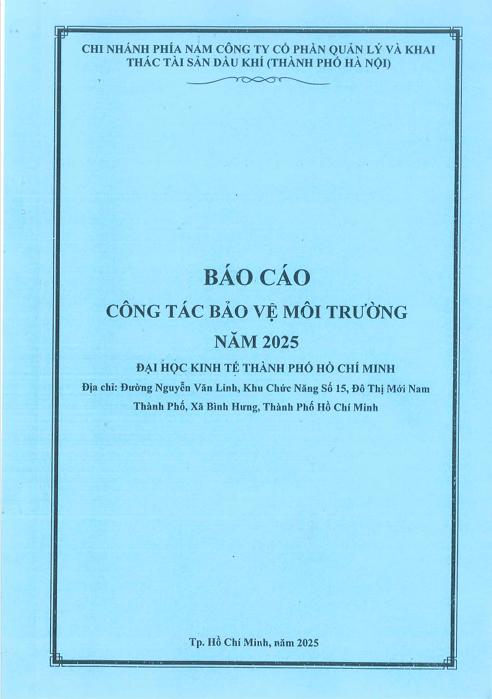
2025 Environmental Protection Report for the Nguyen Van Linh Campus
UEH’s published procedures for identifying domestic wastewater, water potentially containing chemicals, and stormwater runoff
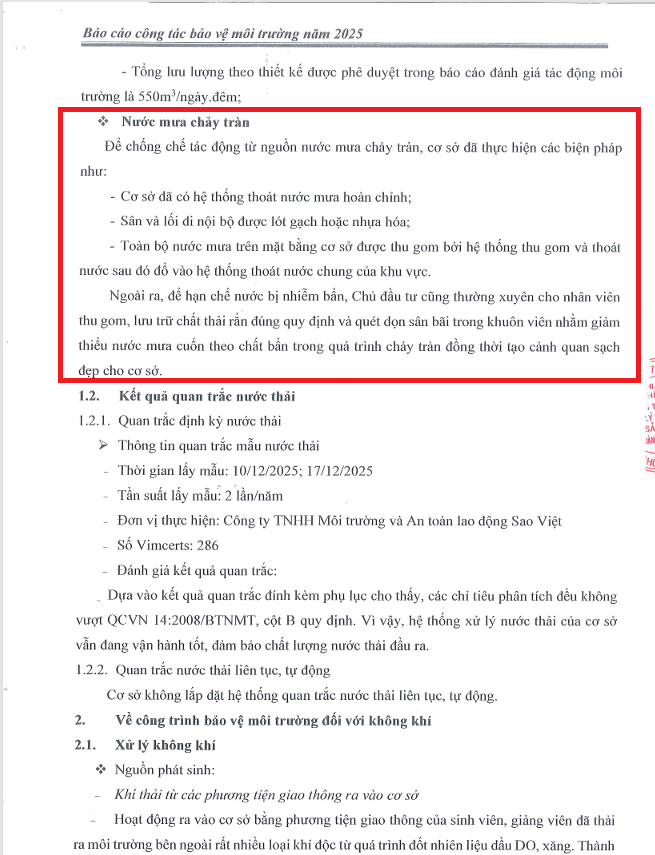
The 2025 Environmental Protection Report describes stormwater collection through a separate drainage system at the Nguyen Van Linh Campus
2. Guidelines for wastewater treatment operation, monitoring, and quality protection
a) Wastewater treatment process at the Nguyen Van Linh Campus
In 2025, the Nguyen Van Linh Campus continued to operate and maintain a wastewater treatment system with a design capacity of 550 m³/day to treat domestic wastewater generated by campus operations.
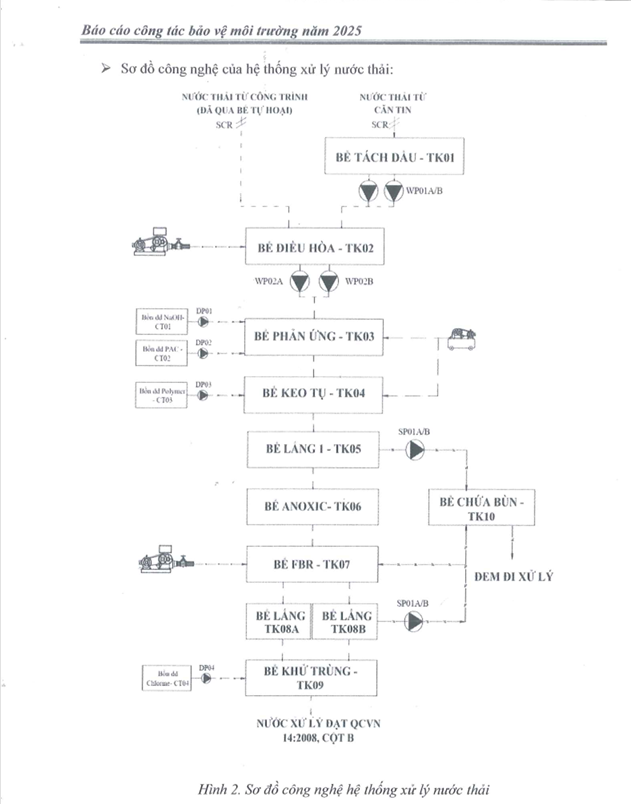
According to the process-flow diagram in the 2025 Environmental Protection Report, wastewater passes through the following main stages: Wastewater collection → Oil separation tank → Equalization tank → Reaction tank → Coagulation tank → Sedimentation tank → Anoxic tank → FBR tank → Sedimentation tanks → Disinfection tank → Treated effluent.
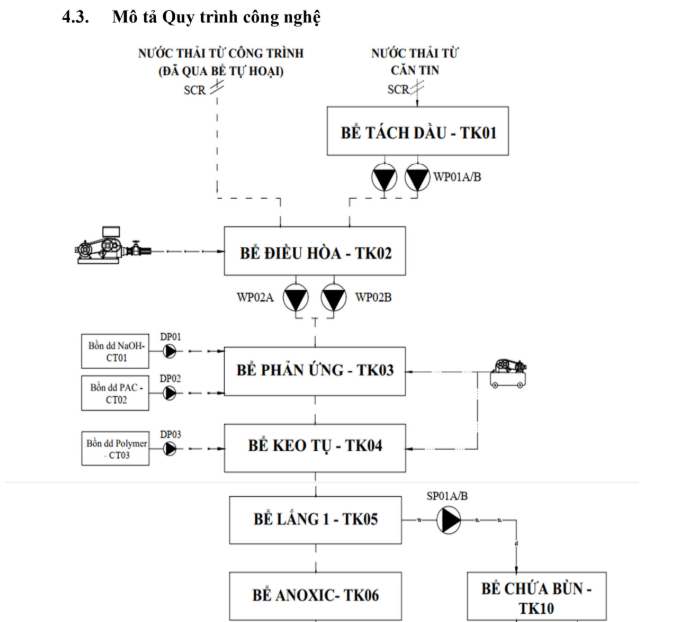
Wastewater treatment process at the Nguyen Van Linh Campus
The system combines pollutant separation, biological treatment, and disinfection. The equalization tank stabilizes flow rates and pollutant concentrations. Reaction, coagulation, and sedimentation stages help remove solids and some organic matter, while biological treatment reduces organic pollutants and nutrients. Disinfection lowers the risk of microbial contamination before the treated water enters the receiving drainage system. Together, these stages aim to control pollutants that may affect water quality, aquatic habitats, and human health.
b) Periodic inspections and wastewater quality monitoring
UEH monitors wastewater quality to assess treatment performance and identify parameters requiring operational adjustment.
According to the 2025 Environmental Protection Report for the Nguyen Van Linh Campus, monitoring was conducted with the participation of Sao Viet Environment and Occupational Safety Co., Ltd. The records document two wastewater sampling rounds, on 10 December 2025 and 17 December 2025, with measured water-quality parameters compared against the relevant technical limits.
Monitoring results enable assessment of effluent quality and help identify changes requiring inspection, maintenance, or adjustment of treatment operations. In the two December 2025 laboratory reports, TSS, pH, phosphate, and Coliform values were within the laboratory’s referenced limits. However, BOD₅ in the sample collected on 17 December 2025 was reported at 54 mg/L, exceeding the 50 mg/L limit stated on the report. This finding requires review against the applicable legal documentation and technical assessment by the responsible unit to determine appropriate management measures.
The 2025 monitoring activities demonstrate that UEH has a mechanism for testing treated wastewater quality and using analytical data to support operational oversight and improvement, rather than relying solely on the treatment facility’s design capacity.
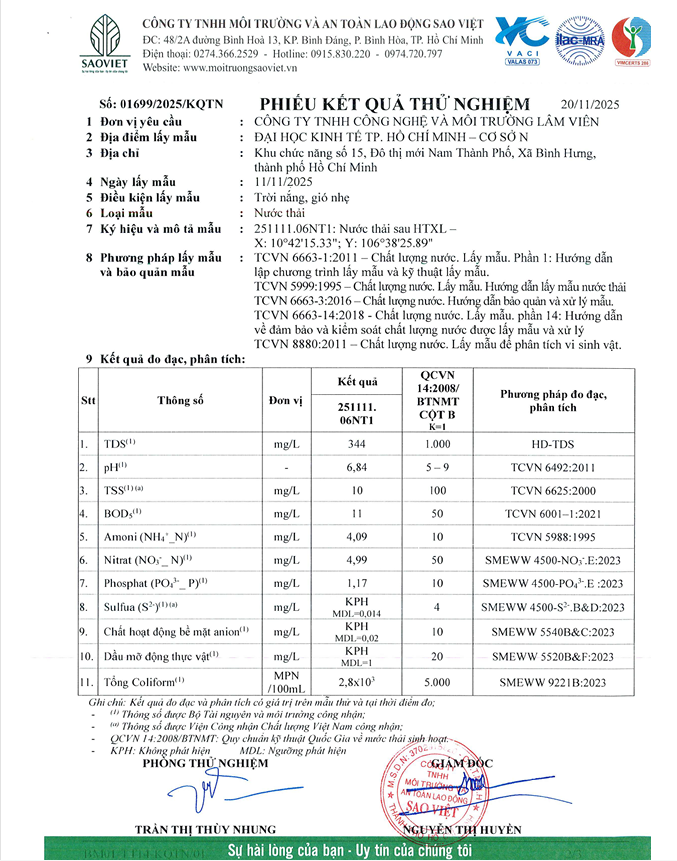
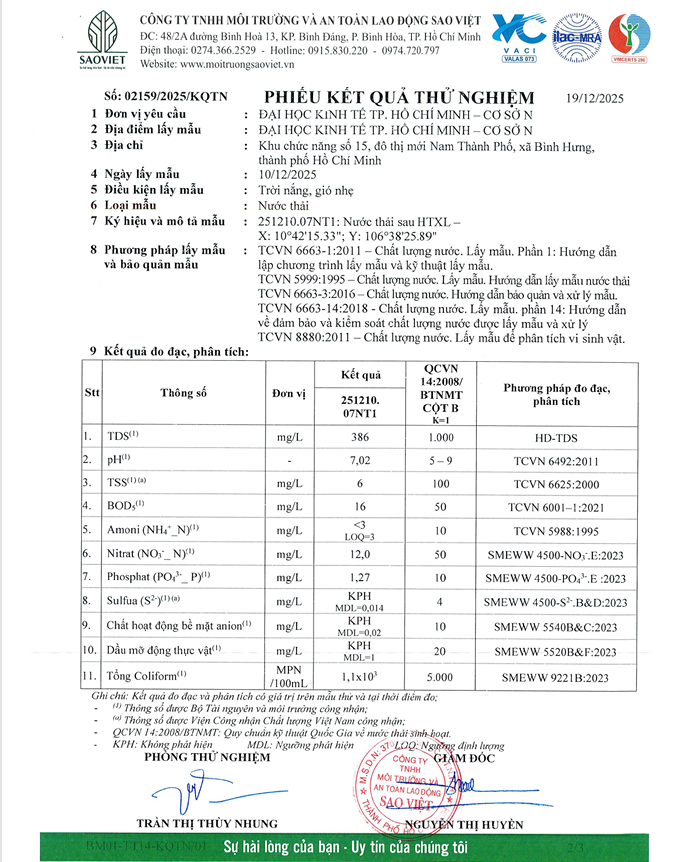
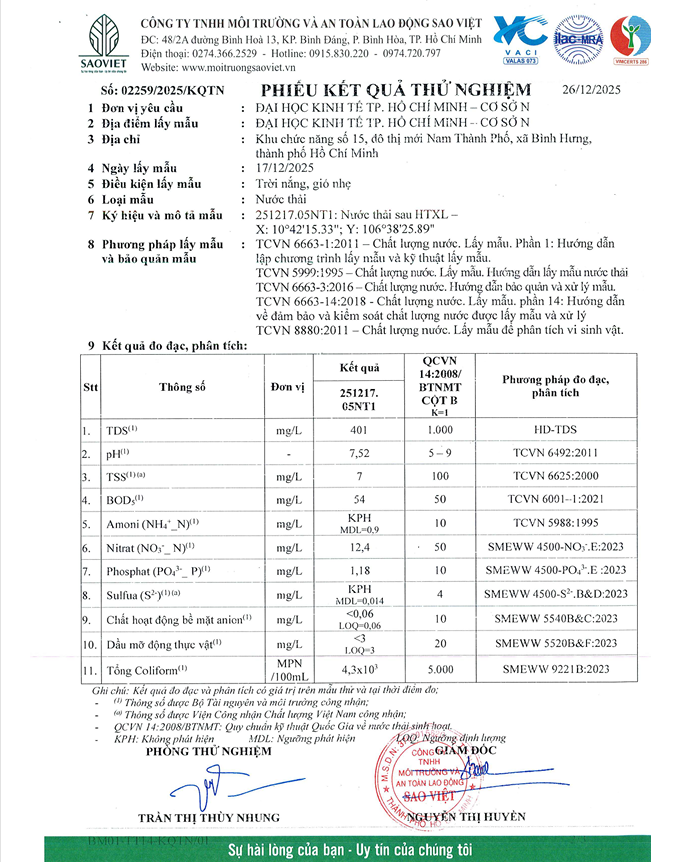
Wastewater monitoring reports at the Nguyen Van Linh Campus are retained for each sampling round, providing additional evidence of wastewater quality inspections in 2025
c) Prevention of and response to wastewater-related environmental incidents
Alongside wastewater treatment and quality monitoring, UEH implements incident-prevention measures for its wastewater collection and drainage systems.
The 2025 Environmental Report for Campus N identifies measures including inspection and maintenance of collection and drainage systems, detection and repair of blocked or leaking pipes, and corrective action to limit wastewater releases into the environment during system failures. Incident prevention helps reduce the risk of pollutants entering soil and receiving waters, thereby limiting adverse effects on ecosystems and on the health of students, staff, and nearby communities.
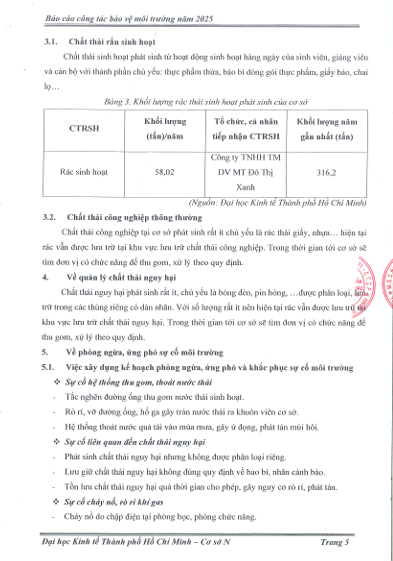
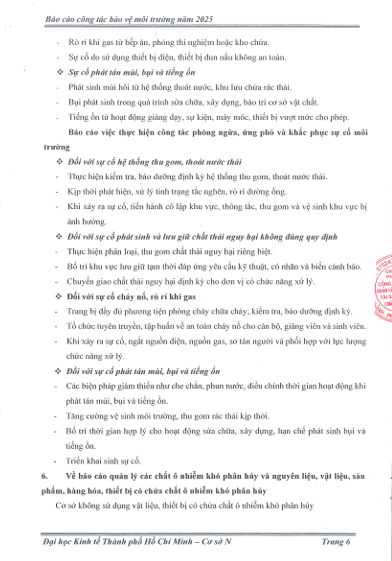
Prevention of and response to wastewater-related environmental incidents at UEH
3. Conclusion
In 2025, UEH continued applying wastewater quality management standards and guidelines to prevent pollution and protect the environment across its campuses. At the Nguyen Van Linh Campus, operation of a centralized wastewater treatment system with a design capacity of 550 m³/day, together with wastewater collection, biological treatment, sedimentation, disinfection, and effluent quality monitoring, demonstrated the practical integration of technical water discharge requirements into campus operations.
Through the monitoring rounds conducted in December 2025, UEH obtained data to track key pollution parameters, identify variations in water quality, and support assessment and operational adjustments where necessary. Publicly communicating the wastewater treatment process and updating references to national technical regulations also strengthen transparency in environmental management.
The water discharge standards and guidelines are applied to limit the impacts of pollutants on receiving waters, soil, ecosystems, living organisms, and human health. In this way, UEH continued working toward Indicator 15.4.1 – Water Discharge Guidelines and Standards by integrating legal requirements, campus facilities management, and environmental quality monitoring.