

17.4.1. UEH Commits to Integrating Education on the Sustainable Development Goals (SDGs) for All Students
Education for SDGs Commitment to Meaningful Education
THE Sustainability Impact Ratings 2027 | SDG 17 – Partnerships for the Goals | Data year 2025
The University of Economics Ho Chi Minh City (UEH) identifies education for sustainable development as a cross-cutting orientation in its strategy to become a Multidisciplinary and Sustainable University, aiming to equip all learners with the knowledge, competencies and sense of responsibility to act on economic, social and environmental challenges.
Through the Glo-cal Education: Empower & Act on Sustainability model, UEH promotes global citizenship education grounded in local practice, integrating sustainability knowledge into formal curricula, compulsory foundation courses, major-specific courses, elective courses and experiential learning activities. This orientation is implemented through a multidisciplinary and interdisciplinary approach that combines knowledge of economics, management, technology, the environment and social responsibility.
In 2025, UEH continued to put its SDG education commitment into practice through a system of academic programs that integrate sustainable development content; maintained the Sustainable Development course within the group of compulsory foundation courses of undergraduate programs as announced by the University; developed specialized programs and courses; and expanded project-based learning, problem-solving practice and international cooperation.
The course matrix linked to the 17 SDGs, publicly released by UEH, lists 74 programs, showing the connection between each academic program, its compulsory courses, elective courses and the corresponding SDGs. This serves as the basis for UEH to monitor and promote the integration of sustainability education at the program level.
-
Strategic commitment and mechanisms for integrating SDG education at UEH
1.1. Glo-cal Education: Empower & Act on Sustainability – A global citizenship education model for action on sustainability
UEH has developed the Glo-cal Education model, which combines global citizenship competencies (Global Citizenship) with the ability to solve local problems (Local Action). Education does not stop at transferring knowledge but aims at the ability to apply knowledge and technology to create solutions that contribute to sustainable development.
The model is guided by nine educational components:
-
Sustainable Curriculum Design: Integrating sustainable development into curriculum design.
-
Interdisciplinary Learning and Problem-Solving: Interdisciplinary learning and solving real-world problems.
-
Lifelong Learning Approaches: Developing lifelong learning competencies.
-
Diverse Teaching Methods: Diversifying teaching methods, experiential learning and hands-on practice.
-
Campus Practices as Living Lab: Using the university campus as a living laboratory.
-
Cultural Diversity and Global Perspectives: Promoting cultural diversity and global perspectives.
-
Global and Local Partnerships: Connecting international and local partners in education.
-
Global Citizenship and Local Action: Linking global citizenship responsibility with local action.
-
Student Support: Supporting learners in accessing educational opportunities and developing their competencies.
These components form the foundation for UEH to deliver SDG education through academic programs, teaching methods, hands-on experiences and community engagement activities.
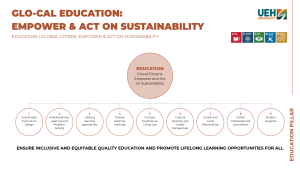
Figure 1. The Glo-cal Education: Empower & Act on Sustainability model with the nine components of UEH’s Education pillar.
Source: Education pillar strategy document – Glo-cal Education, UEH.
1.2. Integrating SDGs into the curriculum – Full Curriculum Integration
UEH has publicly committed to bringing sustainable development knowledge into its entire system of academic programs, aligned with the content, learning outcomes and professional specifics of each major.
Integration is carried out through three groups of courses:
-
Foundation Courses: Foundation courses that equip students with general knowledge and competencies.
-
Specific Sustainability Courses: Specialized courses on sustainable development, the environment, the circular economy, sustainable finance and responsible governance.
-
Integrated Sustainability Courses: Major-specific courses that integrate SDG content in economics, finance, management, technology, agriculture, communications and related fields.
In 2025, UEH used the course matrix linked to the 17 SDGs to show the relationship between academic programs and the sustainable development goals. The matrix publicly lists 74 programs, distinguishing between mandatory courses (BB) and elective courses (TC).
Some examples of integration across different fields of study:
Academic program |
SDG-linked courses |
Type |
Economics |
Sustainable Development; Environmental Economics |
Mandatory; elective |
Agribusiness |
Sustainable Development; Business and Sustainability; Sustainable Food Supply Chains |
Mandatory |
Robotics and Artificial Intelligence |
Sustainable Development |
Mandatory |
Marketing – ASEAN Co-op |
Green Marketing; Sustainable Entrepreneurship |
Mandatory |
Human Resource Management |
Diversity, Equity and Inclusion in the Workplace |
Elective |
This approach allows learners to engage with the SDGs not only through a standalone course but also through issues tied to their field of study and career orientation.
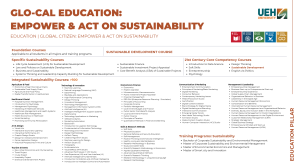
Figure 2. Integrating sustainability knowledge into UEH’s system of Foundation Courses, Specific Sustainability Courses and Integrated Sustainability Courses.
Source: Education Pillar strategy document; SDG-related course matrix – UEH Office of Quality Assurance and Internal Control.
Public sources:
-
UEH Future – Commitment to SDG education: https://future.ueh.edu.vn/1741-giao-duc-vi-muc-tieu-phat-trien-ben-vung/
-
Office of Quality Assurance and Internal Control: https://docs.google.com/spreadsheets/d/13KvAtP7bfZfqNto72xCGApmbOzrUVVnj/edit?gid=1958847996#gid=1958847996
1.3. Mandatory sustainable development education – Mandatory Education
UEH designates the Sustainable Development course as one of six compulsory foundation courses in undergraduate programs, according to the University’s official announcement.
The course provides knowledge of the 17 SDGs and of issues related to economic and social development, the environment, natural resources, responsible consumption and sustainable governance. Learners are introduced to ways of understanding the relationships among development goals and of applying that knowledge to analyze real-world issues.
This commitment is reflected in actual teaching activities in 2025:
-
Undergraduate level: The Sustainable Development course is part of the compulsory foundation course group as announced by UEH; the SDG matrix shows its application across many academic programs.
-
Part-time (in-service) programs: Official timetable No. 368/ĐHKT-ĐT dated 21/07/2025 records the Sustainable Development course (2 credits), with classes 25C3ECO50122002 and 25C3ECO50122004.
-
Master’s level: The Corporate and Environmental Sustainability Management program includes compulsory courses such as Circular Economy and Sustainable Development and Business and Environment, as shown in the 2025 program catalog and teaching timetable.
Thus, SDG education is built into regular, for-credit teaching and delivered through specific courses, rather than depending solely on students’ voluntary participation in extracurricular programs.
Public sources:
-
UEH Admissions Portal – Six compulsory foundation courses: https://tuyensinh.ueh.edu.vn/bai-viet/tuyen-sinh-dai-hoc-2024-6-mon-hoc-bat-buoc-o-tat-ca-cac-nganh-hoc-lam-nen-su-dac-biet-cua-sinh-vien-dai-hoc-kinh-te-tp-ho-chi-minh/
-
UEH Green Campus – Introduction to the Sustainable Development course: https://future.ueh.edu.vn/ueh-green-campus/uehgc-subject-mon-phat-trien-ben-vung
1.4. Elective and in-depth courses – Optional Education
In addition to foundation courses, UEH expands opportunities for in-depth SDG learning through elective courses and academic programs suited to each field of study.
Courses publicly listed in program structures include Environmental Economics; Sustainable Production and Consumption; Diversity, Equity and Inclusion in the Workplace; and specialized courses related to ESG, sustainable finance, ecological planning and urban governance.
Notably, the Jean Monnet EU4Sustainability project delivered seven courses/topics between January and July 2025, with more than 500 learner participations according to UEH’s summary announcement. Content covered European Union sustainable development policy, green finance, sustainable law and governance, sustainable society and the EU Green Deal.
These programs add interdisciplinary learning opportunities, helping learners access international approaches and build the competencies to address SDG challenges in line with their own fields of expertise.
Public sources:
UEH – 2025 summary of Jean Monnet EU4Sustainability:
https://ueh.edu.vn/cuoc-song-ueh/tin-tuc/ueh-hoan-thanh-thanh-cong-nam-thu-hai-du-an-jean-monnet-module-ve-phat-trien-ben-vung-chau-au-eu4sustainability-74586
-
Evidence of implementing the SDG education commitment in 2025
Evidence / Program |
Scope and form of implementation |
2025 results and contributions |
01. Glo-cal Education commitment and SDG integration in academic programs |
University-wide; Full Curriculum Integration orientation through foundation, major-specific and elective courses |
UEH announced its SDG education commitment and a matrix of 74 program lines with courses mapped to the SDGs |
02. Foundation course Sustainable Development |
Compulsory foundation course for undergraduate programs as announced; specific teaching schedule in the 2025 part-time programs |
Brings SDG education into regular for-credit learning; timetable No. 368/ĐHKT-ĐT shows Sustainable Development classes, 2 credits |
03. Major-specific courses integrating SDGs |
Economics, Agribusiness, Robotics and Artificial Intelligence, Marketing ASEAN Co-op and other programs |
The SDG matrix shows mandatory and elective courses tied to specific fields and sustainable development goals |
04. Corporate and Environmental Sustainability Management program |
Bachelor’s and master’s training in management, the environment, the circular economy and sustainable development |
Bachelor’s program opened for admission in 2025; records show 42 students enrolled in cohort K51. The master’s level has a 2025 timetable for specialized courses |
05. Jean Monnet EU4Sustainability |
International, interdisciplinary courses on SDGs, finance, law and sustainability policy |
Delivered 7 courses/topics from January to July 2025, with more than 500 learner participations |
06. Green Skills to 17 SDGs Impact – ACIYLS 2025 |
International cooperation workshop, problem-based learning, discussion and solution proposals for SDG 11 and SDG 13 |
On 22/05/2025, UEH Green Campus co-organized a workshop where students practiced analyzing sustainable urban and climate action issues |
07. Global Hackathon – Greenovation 2025 |
Project-based learning, design thinking, development of environmental and sustainable business solutions |
On 10–13/09/2025, 15 UEH students and 20 Singaporean students developed and presented ideas for tackling sustainability problems |
08. SEED 2025 – Field learning and co-creation |
UEH worked with FHNW (Switzerland) and Asian universities to survey businesses and livelihoods in Khánh Hòa |
Students conducted surveys, analyzed business models and proposed green marketing and sustainable livelihood development solutions |
09. UEH Training Quality Improvement Conference 2025–2030 |
The Training Office, the QAIC Office and academic units took part in reviewing programs, learning outcomes and teaching methods |
On 06/06/2025, UEH held a discussion on improving training quality, laying a governance foundation for continued integration of sustainable development content |
Key evidence sources:
-
SDG education commitment: https://future.ueh.edu.vn/1741-giao-duc-vi-muc-tieu-phat-trien-ben-vung/
-
SDG course matrix: https://qaic.ueh.edu.vn/
-
Foundation course Sustainable Development: https://future.ueh.edu.vn/ueh-green-campus/uehgc-subject-mon-phat-trien-ben-vung
-
Jean Monnet EU4Sustainability: https://ueh.edu.vn/cuoc-song-ueh/tin-tuc/ueh-hoan-thanh-thanh-cong-nam-thu-hai-du-an-jean-monnet-module-ve-phat-trien-ben-vung-chau-au-eu4sustainability-74586
-
Green Skills to 17 SDGs Impact: https://gogreen.ueh.edu.vn/en/breaking-news/ueh-green-campus-collaborates-with-aciyls-2025-equipping-the-young-generation-with-green-skills-through-the-workshop-green-skills-to-17-sdgs-impact
-
Global Hackathon 2025: https://ueh.edu.vn/cuoc-song-ueh/tin-tuc/global-hackathon-2025-giai-phap-sang-tao-cho-su-phat-trien-ben-vung-74830
-
SEED 2025: https://www.ueh.edu.vn/cuoc-song-ueh/tin-tuc/hanh-trinh-thuc-dia-seed-2025-dong-kien-tao-giai-phap-phat-trien-ben-vung-tai-dia-phuong-cua-sinh-vien-ueh-va-quoc-te-74569
-
Training Quality Improvement Conference: https://ueh.edu.vn/cuoc-song-ueh/tin-tuc/hoi-nghi-cai-tien-chat-luong-dao-tao-ueh-giai-doan-2025-2030-dinh-huong-chien-luoc-cho-su-phat-trien-ben-vung-74306
-
Results of implementing the SDG education commitment in 2025
In 2025, UEH continued to put its commitment to education for sustainable development into practice through three key results:
First, integrating SDG education into the system of academic programs. The public matrix of 74 program lines shows the link between training content and the 17 SDGs, covering both mandatory and elective courses. This approach allows sustainability education to be delivered by field of expertise rather than being limited to programs specialized in the environment.
Second, maintaining access to sustainability knowledge through regular for-credit courses. The Sustainable Development course is identified as one of six compulsory foundation courses at the undergraduate level, as announced by UEH. The 2025 records also document teaching in part-time programs and compulsory courses on the circular economy and the environment in specialized master’s programs.
Third, expanding ways of learning and applying the SDGs. Beyond in-class courses, the Jean Monnet EU4Sustainability, Green Skills to 17 SDGs Impact, Global Hackathon and SEED 2025 programs enable students to practice research, solve problems, co-design solutions and draw on international experience in sustainable development.
The UEH Green Campus 2025 summary, published in February 2026, records approximately 442 courses with sustainable development content, equivalent to 27.07% of all courses at the time of reporting. This indicator reflects the scale of sustainability content integration across the course system; it should be distinguished from the share of academic programs that integrate SDGs and the share of students who actually take these contents.
-
Continuity and progress compared with 2024
In 2024, UEH announced the Sustainable Development course as part of the group of six compulsory foundation courses at the undergraduate level, while maintaining its academic programs and green practice activities.
In 2025, UEH continued to demonstrate its commitment to SDG integration at the university level, made concrete through the program matrix, course timetables, the development of new academic programs, and the expansion of interdisciplinary learning activities and international cooperation.
Notably, the bachelor’s program in Corporate and Environmental Sustainability Management opened for admission in 2025; the Jean Monnet EU4Sustainability courses were delivered during the year; and the Global Hackathon and SEED activities expanded opportunities to apply knowledge to real economic, social and environmental issues.
These results show that SDG education is delivered through multiple components of UEH’s training ecosystem, from regular programs to experiential learning and international cooperation. Determining the extent of university-wide coverage requires further cross-checking against the full list of programs operating in 2025.
-
Conclusion